Works › Prior Analytics, Books I–II
Volume 1 · pp. 502–505
Chapter X. On the properties of the third figure.
A marker with ≈ is an approximate page boundary, placed by measure of the text; the page photographs remain the authority. In the paired views, clicking a page marker brings that page into view.
CAPUT X. De proprietatibus tertiae figurae.
Si autem eidem quidem subjecto quod medium est, hoc quidem extremum majus inest omni, ita quod universaliter extremum praedicatur de medio: illud vero quod est minus extremum, nulli inest medio, ita quod universaliter extremum minus removetur a medio: vel si forte ambo extrema insint omni medio, ita quod utrumque extremum de medio praedicatur universaliter: vel etiam si ambo extrema nulli insint medio, ita quod utrumque universaliter removeatur vel negetur de medio: figuram terminorum hujusmodi dispositionis et ordinis voco tertiam, in qua medium bis subjicitur, et utraque extremitas de medio praedicatur.
Determinamus hic figuram prout una et communis est ad conjugationes utiles, et ad conjugationes inutiles. Medium autem in hac figura dico metaphorice, de quo sicut de subjecto ambo extrema praedicantur: extremitates vero voco in hac figura ipsa praedicata quae praedicantur de medio in duabus praemissis propositionibus. Majorem vero voco extremitatem, quae longius distat a medio. Minorem vero extremitatem voco, quae proposita est juxta medium. Ponitur autem in hac figura medium foras quidem extremitatum, ita quod ultimum est in positione terminorum et ordine. Et hoc quidem observabimus in positione litterarum quae extrema designant et medium, sicut et modum proprium propositionis medii in praehabitis figuris observavimus. In prima enim litteram designantem medium posuimus in medio extremorum, et in secunda figura litteram quae denotabat medium posuimus ante extrema: hic autem eam litteram quae designat medium, ponemus post ambo extrema, ita quod in ordine litterarum et terminorum est ultima, et minor extremitas media, et major extremitas prima.
Cujus haec ratio est: quia secundum ordinem praedicabilium in linea praedicamentali, in prima figura medium stat sub majori extremitate, et minor extremitas stat sub medio, et sic medium ordine praedicabilium et situ est medium. Cum autem in secunda figura medium tantum praedicetur, et in ordine praedicabilium praedicatum sit prius subjecto, erit in secunda medium ordine et positione. Eadem autem ratione cum in tertia sit medium tantum subjicibile et non praedicabile, erit secundum positionem et ordinem naturalem terminorum ultimum. Et major extremitas longius distat a situ et proprietate medii: quia ipsa nunquam subjicitur, nec in praemissis, nec in conclusione, sed semper praedicatur. Minor autem extremitas propinquior est medio et situ et convenientia proprietatis medii: quia minor extremitas aliquando subjicitur ad minus in conclusione: propter quod medium ponitur foras extremitatum, quia accipitur ut pars utriusque: quia in ordine praedicabilium id quod substat et subjicitur, pars est ejus cui substat et cui subjicitur, sicut homo pars est animalis, et animal pars animati corporis, et sic de aliis ascendendo in linea praedicamentali. Sic etiam in secunda figura medium ponitur foras extremitatum: sed quia praedicatum est, habet se ut totum ad utramque extremitatem.
Ex his autem habetur, quod medium in hac tertia figura non est positione medium, sed extremum: et ideo non est medium nisi uniens et conjungens extrema, sicut et in secunda figura. Ex quo sequitur, quod perfectus non fit syllogismus in hac figura quantum ad evidentiam conclusionis, possibilis ad perfectionem syllogismus erit in hac figura: potest enim reduci ad primam figuram, et tunc est perfectus.
CHAPTER X. On the properties of the third figure.
But if to the same subject, which is the middle, this greater extreme belongs to every one, so that the extreme is universally predicated of the middle, while that which is the lesser extreme belongs to no middle, so that the lesser extreme is universally removed from the middle; or if perhaps both extremes belong to every middle, so that each extreme is predicated universally of the middle; or also if both extremes belong to no middle, so that each is universally removed or denied from the middle, I call the figure of terms of this kind of disposition and order the third, in which the middle is subjected twice and each extremity is predicated of the middle.
Here we determine the figure insofar as it is one and common to useful conjugations and to useless conjugations. But in this figure I call the middle metaphorically that of which both extremes are predicated as of a subject; but in this figure I call extremes the very predicates which are predicated of the middle in the two premised propositions. And I call the greater extreme the one which is farther from the middle. But I call the lesser extreme the one which is set next to the middle. In this figure, however, the middle is placed outside the extremes, so that it is last in the position and order of terms. And we shall observe this in the position of the letters which designate the extremes and the middle, just as we also observed the proper mode of the proposition of the middle in the preceding figures. For in the first figure we placed the letter designating the middle in the middle of the extremes, and in the second figure we placed the letter which denoted the middle before the extremes; but here we shall place that letter which designates the middle after both extremes, so that in the order of letters and terms it is last, the lesser extreme is middle, and the greater extreme first.
The reason for this is that according to the order of predicables in the categorial line, in the first figure the middle stands under the greater extreme and the lesser extreme stands under the middle, and thus the middle is middle in the order and situation of predicables. But since in the second figure the middle is only predicated, and in the order of predicables the predicate is prior to the subject, the middle will be middle in order and position in the second. By the same reason, since in the third the middle is only subjectible and not predicable, it will be last according to the position and natural order of the terms. And the greater extreme is farther from the situation and property of the middle, because it is never subjected, neither in the premises nor in the conclusion, but is always predicated. But the lesser extreme is nearer to the middle both in situation and in agreement with the property of the middle, because the lesser extreme is sometimes subjected, at least in the conclusion. On account of this the middle is placed outside the extremes, because it is accepted as a part of each; because in the order of predicables that which underlies and is subjected is a part of that under which it stands and to which it is subjected, as man is a part of animal, and animal a part of animated body, and so with other things ascending in the categorial line. Thus also in the second figure the middle is placed outside the extremes; but because it is predicate, it has itself as a whole toward each extreme.
But from these things it is had that the middle in this third figure is not middle in position, but an extreme; and therefore it is not a middle except as uniting and joining the extremes, as also in the second figure. From this it follows that no syllogism is made perfect in this figure with respect to the evidence of the conclusion, although a syllogism possible for perfection will be in this figure; for it can be reduced to the first figure, and then it is perfect.
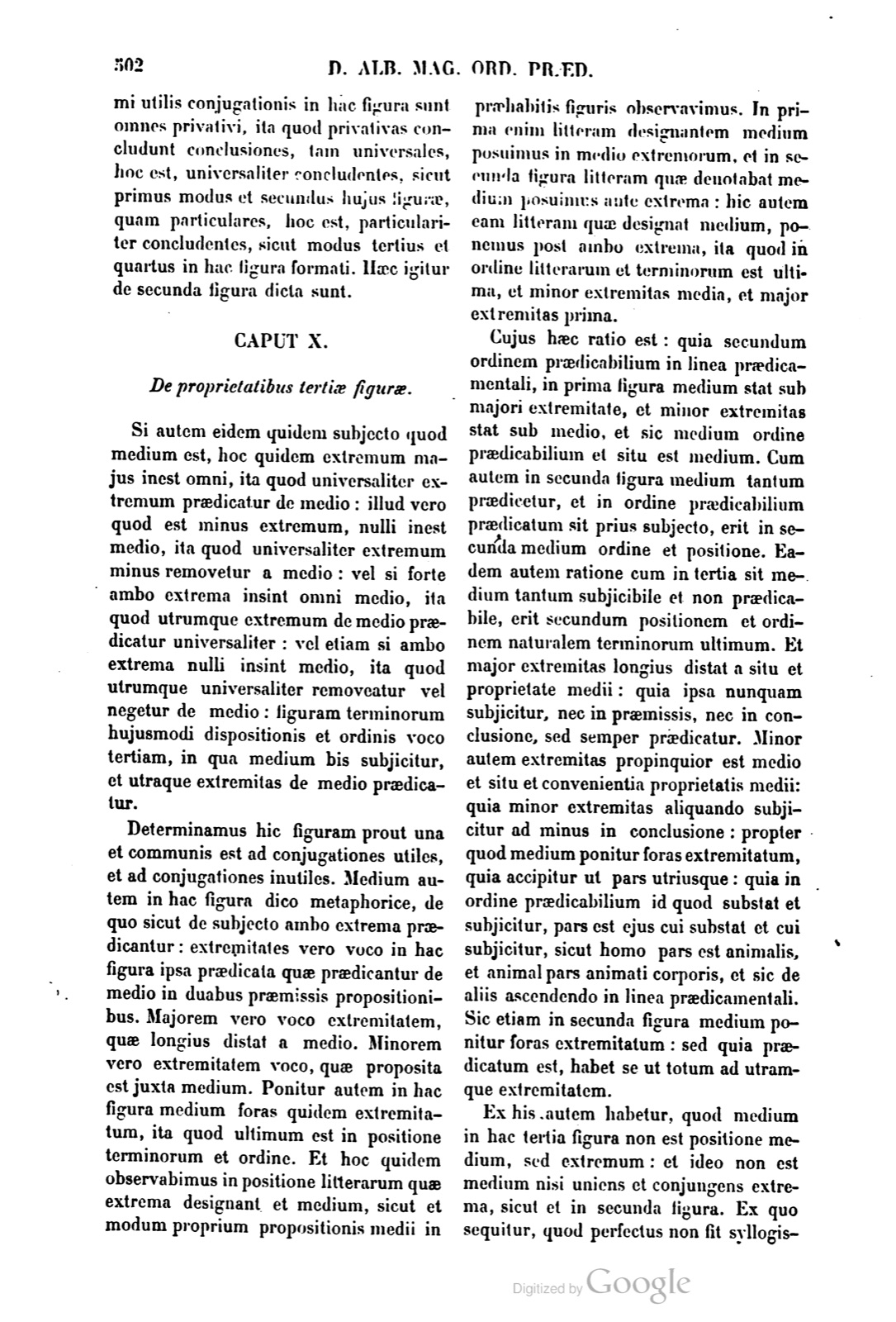
Potest autem in hac figura syllogismus et ambobus terminis ut praedicatis universaliter se habentibus ad medium, ita quod uterque de medio praedicetur universaliter: et potest iterum esse syllogismus, non ambobus terminis se universaliter habentibus ad medium, ita quod unus de medio praedicetur universaliter, et alter particulariter. Sint igitur notae terminorum et signa istae litterae P, R, S; et S quae est ultima sit medium, R vero minor extremitas, P autem sit major. Haec igitur est dispositio tertiae figurae.
Cujus proprietates sunt duae: una quidem, quod minorem non potest habere negativam. Et alia, quod non potest habere conclusionem universalem, sed semper particularem. Ratio autem primi, quod scilicet minorem oportet habere affirmativam, haec est: quia medium est pars extremitatum vel in ratione partis acceptum: et ideo si minor esset negativa, nec affirmative nec negative posset aliquando concludi: posset enim contingere, quod extrema essent disparata: et tunc non posset concludi affirmative unum extremum de alio. Posset etiam contingere quod se haberent ad invicem ut subalterna, et tunc unum extremum de altero concludi non posset negative. Exemplum autem primi est, ut si dicamus tres terminos, animal, lapis, homo, ita quod medium sit homo, sic, omnis homo animal: nullus homo lapis, vel aliquis homo non lapis: et patet quod nullus lapis animal. Exemplum secundi est, si dicamus terminos esse, animal, asinus, homo, sic, omnis homo animal: nullus homo asinus: non potest inferri negative, ergo nullus asinus animal, quia omnis asinus animal: patet igitur quod nihil sequeretur in hac figura minori existente negativa.
Est autem hujus quod dictum est et alia causa satis convenienter assignata, et haec est, quod modi tertiae figurae descendunt a modis primae figurae per conversionem minoris: et quia minor in primo primae figurae, et in tertio (qui descendit a primo) semper est affirmativa: ideo in tertia figura minorem oportet esse affirmativam.
Sed tunc objectio est: quia in modis primae figurae, a quibus descendunt syllogismi tertiae figurae, minor est particularis, eo quod affirmativa universalis non convertitur nisi particulariter, descendunt syllogismi primae figurae particulares ab universalibus, sicut dicetur in sequentibus. Si ergo minor in syllogismis primae figurae est tantum particularis in tertio modo et quarto, quaeritur quae sit causa quod minor in tertia figura potest esse et universalis et particularis? Et ad hoc dicendum secundum aliquos, quod quando propositio una convertitur in aliam, utraque potest dici conversa alterius, scilicet et illa quae convertitur, et illa in quam convertitur: et hoc modo loquendo et universalis est conversa particularis, et particularis est conversa universalis: et quia prima a qua fit descensus est universalis, et ideo etiam quod ab illo descendit, quamvis per particulare descendat, potest esse universale, sicut patet in aliis. Hujus autem causa est: quia quando convertitur universalis in particularem, virtus universalis remanet in particulari: et sic etiam ipsum particulare in virtute universalis acceptum potest reduci ad universale.
But in this figure there can be a syllogism with both terms as predicates having themselves universally to the middle, so that each is predicated universally of the middle; and again there can be a syllogism without both terms having themselves universally to the middle, so that one is predicated universally of the middle and the other particularly. Therefore let the notes and signs of terms be these letters P, R, S; and let S, which is last, be the middle, R the lesser extreme, but P the greater. This, therefore, is the disposition of the third figure.
Its properties are two: one, indeed, that it cannot have the minor negative. And the other, that it cannot have a universal conclusion, but always a particular one. The reason for the first, namely that the minor must be affirmative, is this: because the middle is a part of the extremes, or is accepted under the account of a part; and therefore if the minor were negative, neither affirmatively nor negatively could anything ever be concluded. For it could happen that the extremes were disparate, and then one extreme could not be concluded affirmatively of the other. It could also happen that they had themselves to one another as subalternates, and then one extreme could not be concluded negatively of the other. An example of the first is if we state three terms, animal, stone, man, so that the middle is man, thus: every man is animal; no man is stone, or some man is not stone; and it is clear that no stone is animal. An example of the second is if we say the terms are being, animal, ass, man, thus: every man is animal; no man is ass; it cannot be inferred negatively, therefore no ass is animal, because every ass is animal. Therefore it is clear that nothing would follow in this figure if the minor were negative.
But of what has been said another cause is also assigned quite fittingly, and it is this: that the modes of the third figure descend from the modes of the first figure through conversion of the minor; and because the minor in the first mode of the first figure, and in the third, which descends from the first, is always affirmative, therefore in the third figure the minor must be affirmative.
But then there is an objection: because in the modes of the first figure from which the syllogisms of the third figure descend, the minor is particular, since the universal affirmative is converted only particularly; particular syllogisms of the first figure descend from universal ones, as will be said in what follows. Therefore, if in syllogisms of the first figure the minor is only particular in the third and fourth mode, it is asked what is the cause that the minor in the third figure can be both universal and particular. And to this one must say, according to some, that when one proposition is converted into another, each can be called the converse of the other, namely both the one which is converted and the one into which it is converted; and speaking in this way, both the universal is the converse of the particular, and the particular is the converse of the universal. And because the first from which the descent is made is universal, therefore also what descends from it, although it descends through the particular, can be universal, as is clear in other cases. The cause of this is that when the universal is converted into a particular, the power of the universal remains in the particular; and thus also the particular itself, accepted in the power of the universal, can be reduced to the universal.
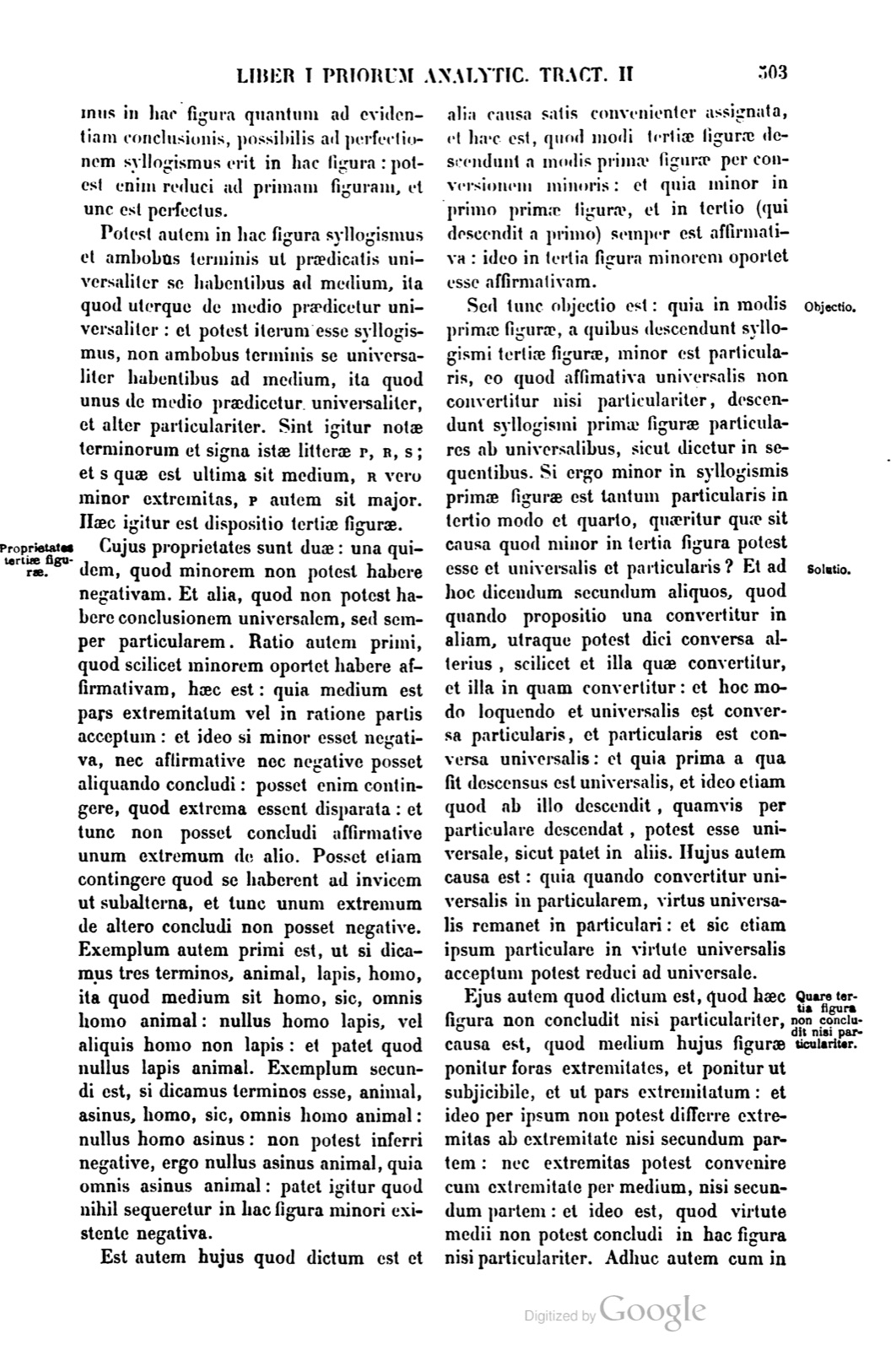
Ejus autem quod dictum est, quod haec figura non concludit nisi particulariter, causa est, quod medium hujus figurae ponitur foras extremitates, et ponitur ut subjicibile, et ut pars extremitatum: et ideo per ipsum non potest differre extremitas ab extremitate nisi secundum partem: nec extremitas potest convenire cum extremitate per medium, nisi secundum partem: et ideo est, quod virtute medii non potest concludi in hac figura nisi particulariter. Adhuc autem cum in hac figura medium se habeat ad extrema sicut inferius, et sicut pars, posset contingere quod extrema se haberent ad invicem ut subalterna; et tunc posset minor extremitas in plus quam major: propter quod major non praedicaretur de ipsa nisi particulariter: et tunc instantiam haberet talis syllogismi modus. Exemplum autem est in his terminis, animal, corpus, homo, sic, omnis homo animal: omnis homo corpus: patet quod non sequitur universalis, sed particularis, quoddam corpus animal.
Objiciunt tamen aliqui contra ea quae dicta sunt, sic dicentes, quod in qualibet figura plus possunt duae universales conjunctae quam universalis et particularis: sed universalis conjuncta particulari potest inferre conclusionem particularem: cum ergo plus possint duae universales, et non sit ostendere in quo plus possunt, nisi in hoc quod inferunt universalem, videtur quod in hac tertia figura ex universalibus possit inferri conclusio universalis.
Adhuc autem particularis cum universali particularem infert conclusionem sufficienter: cum autem ponitur universalis cum universali, plus est in universali quam in particulari: illud ergo plus ad conclusionem particularem videtur esse non causa ut causa: in hac ergo figura nunquam conjungenda est universalis cum universali: et sic primus modus et secundus hujus figurae non essent syllogismi.
Sed ad haec et similia non est difficile solvere. Dicendum enim quod dispositio medii causa est, quare in hac figura non est universalis conclusio. Et quod dicitur, quod plus potest universalis cum universali quam universalis cum particulari, dicendum quod hoc verum est in decursu syllogistico, sed non ad faciendum quantitatem conclusionis quando medium stat sub extremitatibus: nec in plus potest universalis cum universali, quam universalis cum particulari ad faciendam figuram, sed ad faciendum modum in figura plus potest universalis cum universali, quam universalis cum particulari: quia evidentius inferunt, et immediatius reducuntur universales syllogismi in primam figuram, quam particulares syllogismi, qui habent alteram particularem.
Ad hoc autem quod dicitur, quia id quod plus est in universali quam in particulari ad inferendam conclusionem particularem, est non causa ut causa, dico quod non est verum: quia facit ad evidentiam necessitatis: evidentior enim est necessitas conclusionis syllogisticae ex duabus universalibus, quam ex altera universali et altera particulari.
Sed non refert in hac figura, utrum major sit universalis, sive particularis: semper enim infertur conclusio particularis: quod non est in aliis figuris, in quibus majorem semper oportet esse universalem: et hoc est ideo, sicut dictum est, quod medium non concludit extremum de extremo sive affirmative sive negative, nisi secundum partem: et ad hoc quod hoc facere possit, non refert sive major sit universalis, sive particularis: quia medium vel est pars, vel sicut pars utriusque extremitatis. Adhuc de proprietatibus istius figurae, sicut jam diximus, est quod concludit tantum particulariter.
But the cause of what was said, that this figure concludes only particularly, is that the middle of this figure is placed outside the extremes and is posited as subjectible and as a part of the extremes; and therefore through it an extreme cannot differ from an extreme except according to part; nor can an extreme agree with an extreme through the middle except according to part; and therefore it is that by the power of the middle nothing can be concluded in this figure except particularly. Again, since in this figure the middle has itself toward the extremes as an inferior and as a part, it could happen that the extremes would have themselves to one another as subalternates; and then the lesser extreme could be more extensive than the greater, on account of which the greater would not be predicated of it except particularly; and then such a mode of syllogism would have an instance against it. The example is in these terms: animal, body, man, thus: every man is animal; every man is body; it is clear that a universal does not follow, but a particular, namely some body is animal.
Yet some object against what has been said, saying in this way that in any figure two universals joined have more power than a universal and a particular; but a universal joined with a particular can infer a particular conclusion. Therefore, since two universals have more power, and it cannot be shown in what they have more power except in this, that they infer a universal, it seems that in this third figure a universal conclusion can be inferred from universals.
Again, a particular with a universal sufficiently infers a particular conclusion; but when a universal is posited with a universal, there is more in the universal than in the particular. Therefore that excess with respect to a particular conclusion seems to be a non-cause as a cause. Therefore in this figure a universal should never be joined with a universal; and thus the first mode and second of this figure would not be syllogisms.
But it is not difficult to solve these and similar things. For one must say that the disposition of the middle is the cause why in this figure there is no universal conclusion. And as to what is said, that a universal with a universal has more power than a universal with a particular, one must say that this is true in the syllogistic running-through, but not for making the quantity of the conclusion when the middle stands under the extremes. Nor does a universal with a universal have more power than a universal with a particular for making the figure, but it has more power for making the mode in the figure, because universal syllogisms infer more evidently and are reduced more immediately into the first figure than particular syllogisms which have one premise particular.
But as to what is said, that what is more in the universal than in the particular for inferring a particular conclusion is a non-cause as a cause, I say that it is not true, because it contributes to the evidence of necessity. For the necessity of the syllogistic conclusion is more evident from two universals than from one universal and the other particular.
But in this figure it does not matter whether the major is universal or particular, for a particular conclusion is always inferred; this is not so in the other figures, in which the major must always be universal. And this is so, as has been said, because the middle does not conclude an extreme of an extreme, either affirmatively or negatively, except according to part; and for its being able to do this, it does not matter whether the major is universal or particular, because the middle either is a part, or is as a part, of each extreme. Again, among the properties of this figure, as we have already said, is that it concludes only particularly.
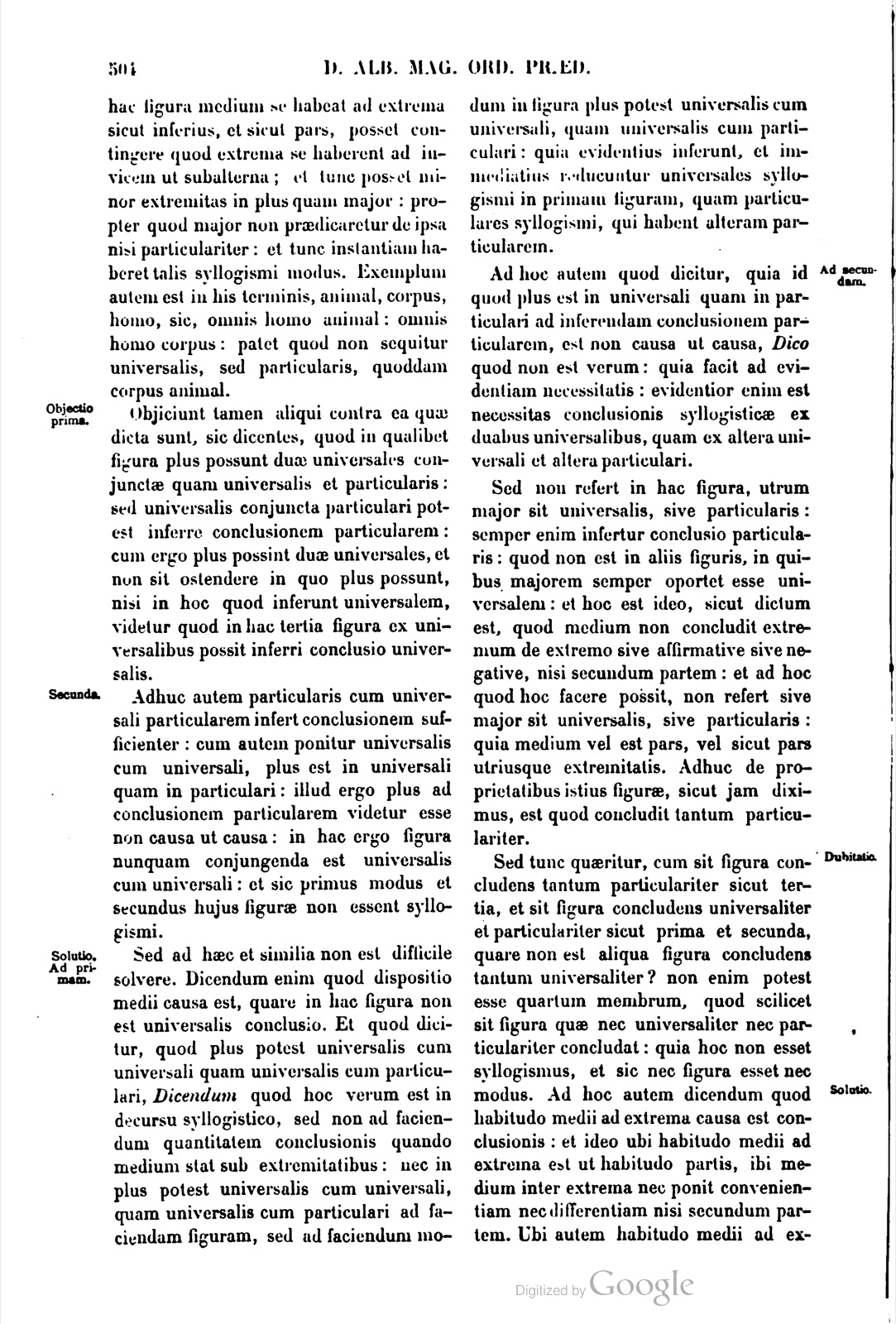
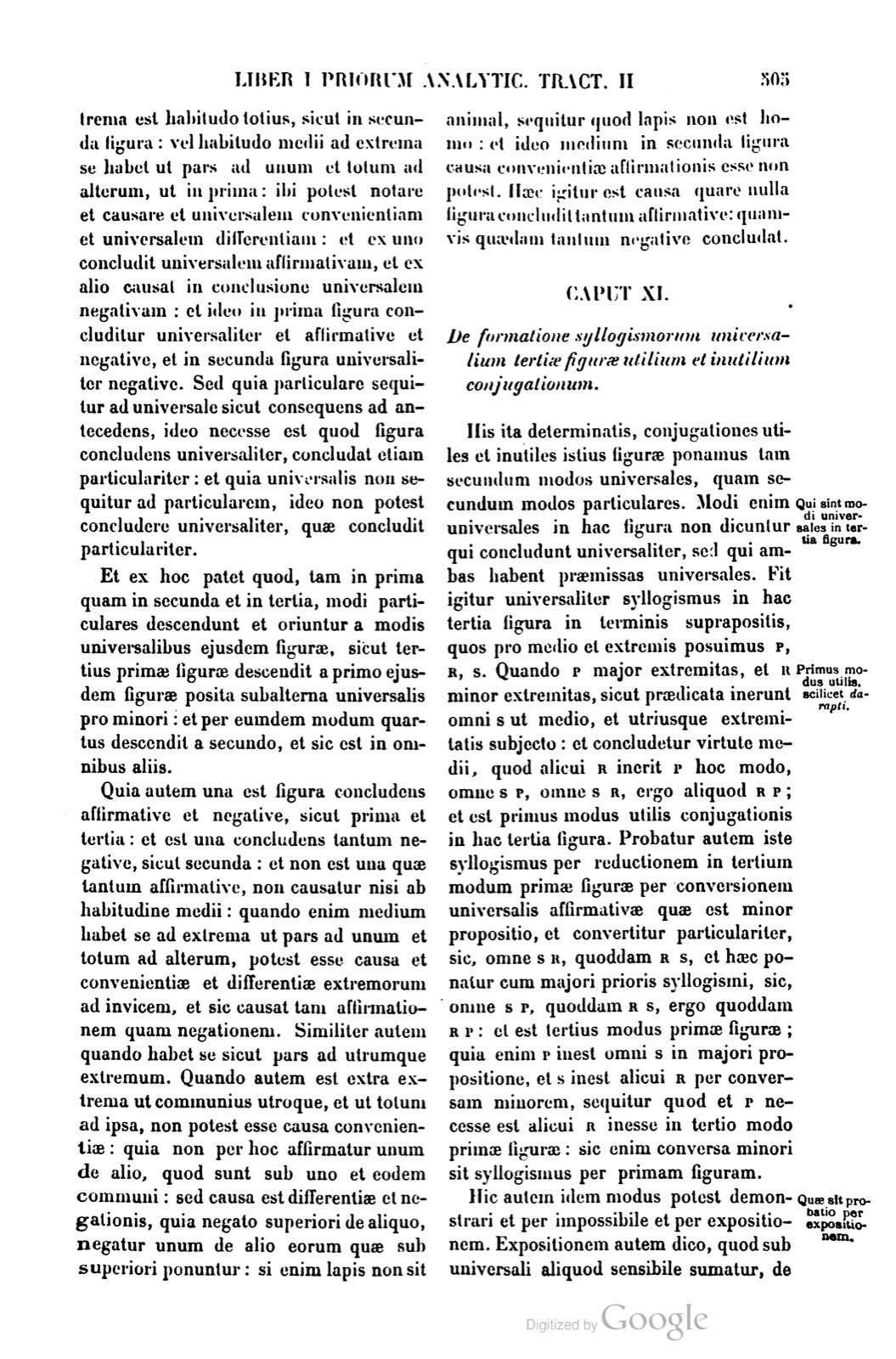
Sed tunc quaeritur, cum sit figura concludens tantum particulariter sicut tertia, et sit figura concludens universaliter et particulariter sicut prima et secunda, quare non est aliqua figura concludens tantum universaliter? non enim potest esse quartum membrum, quod scilicet sit figura quae nec universaliter nec particulariter concludat: quia hoc non esset syllogismus, et sic nec figura esset nec modus. Ad hoc autem dicendum quod habitudo medii ad extrema causa est conclusionis: et ideo ubi habitudo medii ad extrema est ut habitudo partis, ibi medium inter extrema nec ponit convenientiam nec differentiam nisi secundum partem. Ubi autem habitudo medii ad extrema est habitudo totius, sicut in secunda figura: vel habitudo medii ad extrema se habet ut pars ad unum et totum ad alterum, ut in prima: ibi potest notare et causare et universalem convenientiam et universalem differentiam: et ex uno concludit universalem affirmativam, et ex alio causat in conclusione universalem negativam: et ideo in prima figura concluditur universaliter et affirmative et negative, et in secunda figura universaliter negative. Sed quia particulare sequitur ad universale sicut consequens ad antecedens, ideo necesse est quod figura concludens universaliter, concludat etiam particulariter: et quia universalis non sequitur ad particularem, ideo non potest concludere universaliter, quae concludit particulariter.
Et ex hoc patet quod, tam in prima quam in secunda et in tertia, modi particulares descendunt et oriuntur a modis universalibus ejusdem figurae, sicut tertius primae figurae descendit a primo ejusdem figurae posita subalterna universalis pro minori: et per eumdem modum quartus descendit a secundo, et sic est in omnibus aliis.
Quia autem una est figura concludens affirmative et negative, sicut prima et tertia: et est una concludens tantum negative, sicut secunda: et non est una quae tantum affirmative, non causatur nisi ab habitudine medii: quando enim medium habet se ad extrema ut pars ad unum et totum ad alterum, potest esse causa et convenientiae et differentiae extremorum ad invicem, et sic causat tam affirmationem quam negationem. Similiter autem quando habet se sicut pars ad utrumque extremum. Quando autem est extra extrema ut communius utroque, et ut totum ad ipsa, non potest esse causa convenientiae: quia non per hoc affirmatur unum de alio, quod sunt sub uno et eodem communi: sed causa est differentiae et negationis, quia negato superiori de aliquo, negatur unum de alio eorum quae sub superiori ponuntur: si enim lapis non sit animal, sequitur quod lapis non est homo: et ideo medium in secunda figura causa convenientiae affirmationis esse non potest. Haec igitur est causa quare nulla figura concludit tantum affirmative: quamvis quaedam tantum negative concludat.
But then it is asked: since there is a figure that concludes only particularly, as the third does, and there is a figure that concludes universally and particularly, as the first and second do, why is there not some figure that concludes only universally? For there cannot be a fourth member, namely a figure which concludes neither universally nor particularly, because this would not be a syllogism, and thus would be neither figure nor mode. To this one must say that the relation of the middle to the extremes is the cause of the conclusion. And therefore where the relation of the middle to the extremes is as the relation of a part, there the middle among the extremes posits neither agreement nor difference except according to part. But where the relation of the middle to the extremes is the relation of a whole, as in the second figure, or the relation of the middle to the extremes has itself as part to one and whole to the other, as in the first, there it can mark and cause both universal agreement and universal difference; and from the one it concludes a universal affirmative, and from the other causes a universal negative in the conclusion. And therefore in the first figure one concludes universally and affirmatively and negatively, and in the second figure universally negatively. But because the particular follows upon the universal as consequent upon antecedent, therefore a figure concluding universally must also conclude particularly; and because the universal does not follow upon the particular, therefore a figure which concludes particularly cannot conclude universally.
And from this it is clear that, both in the first and in the second and in the third, particular modes descend and arise from universal modes of the same figure, just as the third of the first figure descends from the first of the same figure when the subalternate of a universal is posited for the minor; and in the same way the fourth descends from the second, and so it is in all the others.
But because one figure concludes affirmatively and negatively, as the first and third do, and one concludes only negatively, as the second does, and there is not one which concludes only affirmatively, this is caused only by the relation of the middle. For when the middle has itself to the extremes as part to one and whole to the other, it can be a cause both of the agreement and of the difference of the extremes toward one another, and thus it causes both affirmation and negation. Similarly also when it has itself as part to each extreme. But when it is outside the extremes as more common than each and as a whole toward them, it cannot be a cause of agreement, because one thing is not affirmed of another by reason of the fact that they are under one and the same common thing; but it is a cause of difference and negation, because when a superior is denied of something, one of those things that are posited under the superior is denied of another. For if a stone is not animal, it follows that stone is not man; and therefore the middle in the second figure cannot be the cause of the agreement of affirmation. This, therefore, is the cause why no figure concludes only affirmatively, although a certain figure concludes only negatively.
If a page does not appear, its photograph has not been uploaded yet.