Works › Prior Analytics, Books I–II
Volume 1 · pp. 501–502
Chapter IX. On the corollaries which are had from the things previously introduced.
A marker with ≈ is an approximate page boundary, placed by measure of the text; the page photographs remain the authority. In the paired views, clicking a page marker brings that page into view.
CAPUT IX. De corollariis quae habentur ex praeinductis.
Palam autem ex praeinductis est, quoniam omnes imperfecti sunt qui sunt in secunda figura syllogismi: omnes enim perficiuntur assumptis quibusdam quae vel insunt terminis ex necessitate, sicut est conversio, et per conversionem terminorum transpositio: vel ponuntur sive conceduntur velut hypothesis, sicut in deductione ad impossibile, in qua praemissae syllogismi ex hypothesi conceduntur, et negatur sequi conclusio: et ideo sumpto opposito conclusionis syllogizatur oppositum alterius praemissarum ante per hypothesim concessarum, sicut fit quando per impossibile syllogismum ostendimus.
Quamvis quidam dubitent dicentes et quaerentes causam quae sit consequentia ista: oppositum enim non potest stare cum praemisso: ergo conclusio sequitur. Sed ad hoc solvendum, est sciendum quod quidquid repugnat alicui non repugnat ei, nisi propter oppositum illius quod inest alicui, cui aliud repugnat: nigrum enim non repugnat albo, nisi propter album quod jam inest: et asinus non repugnat homini, nisi propter humanitatem quae jam inest: et generaliter affirmatio quae inest, facit repugnare negationem, et contraria contrariam: et sic est in omnibus. Si ergo unum oppositorum repugnat, oportet quod alterum insit: et ideo stat consequentia: unum oppositorum repugnat: ergo reliquum stabit, et inest.
CHAPTER IX. On the corollaries which are had from the things previously introduced.
But from the things introduced before it is clear that all syllogisms which are in the second figure are imperfect; for all are perfected by assuming certain things which either belong to the terms of necessity, as conversion does, and through conversion the transposition of terms; or which are posited or conceded as a hypothesis, as in reduction to impossibility, in which the premises of the syllogism are conceded from a hypothesis and the conclusion is denied to follow. And therefore, when the opposite of the conclusion has been taken, the opposite of one of the premises previously conceded by hypothesis is syllogized, as happens when we show a syllogism through impossibility.
Although some have doubts, saying and asking what the cause of this consequence is: for the opposite cannot stand with the premise; therefore the conclusion follows. But to solve this one must know that whatever is repugnant to something is not repugnant to it except on account of the opposite of that which belongs to something to which the other is repugnant. For black is not repugnant to white except because of the white that already belongs; and an ass is not repugnant to man except because of the humanity that already belongs. And in general, an affirmation which belongs makes a negation repugnant, and one contrary makes the contrary repugnant; and so it is in all cases. Therefore, if one of the opposites is repugnant, the other must belong; and therefore the consequence stands: one of the opposites is repugnant; therefore the remaining one will stand and belongs.
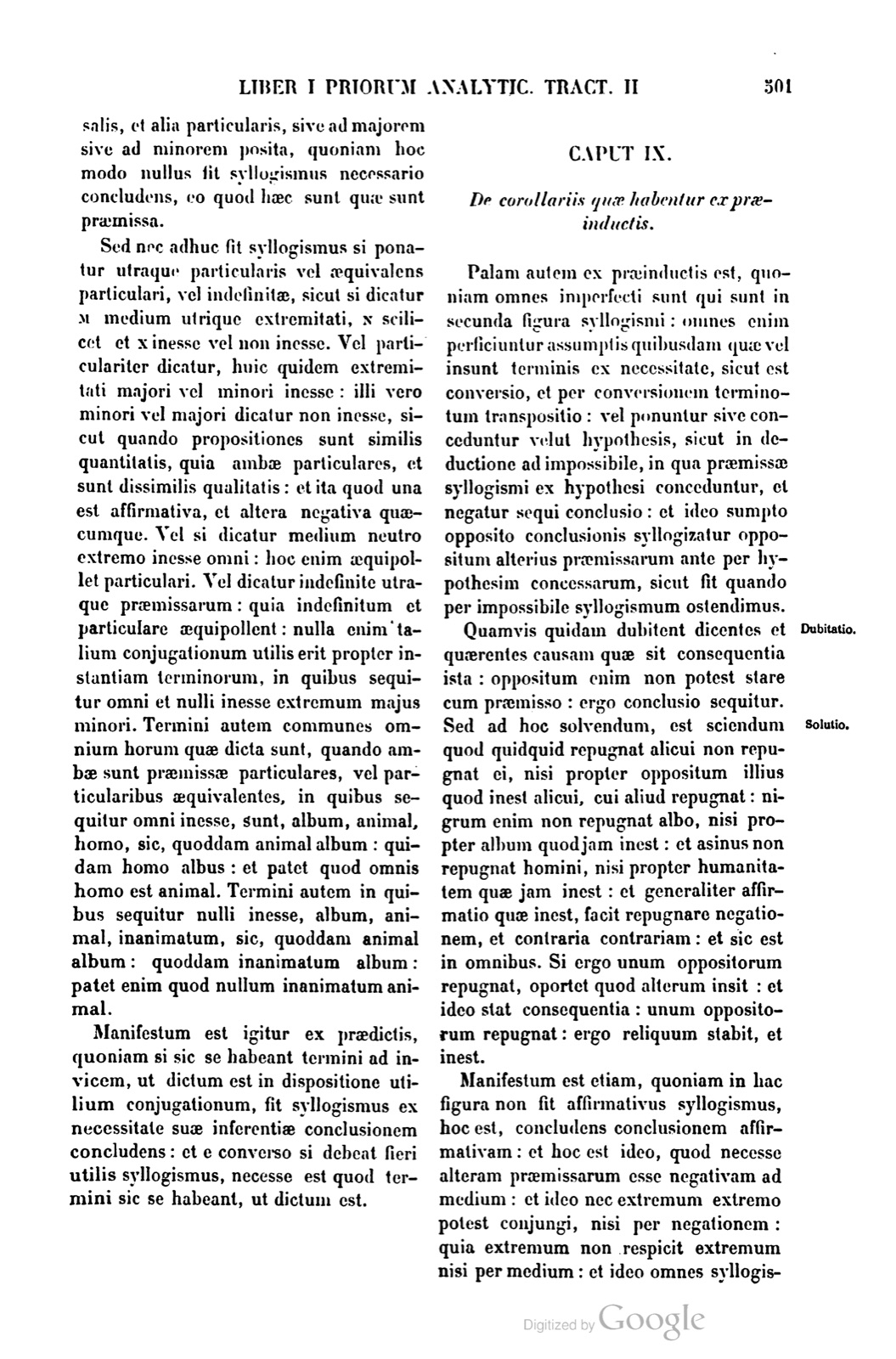
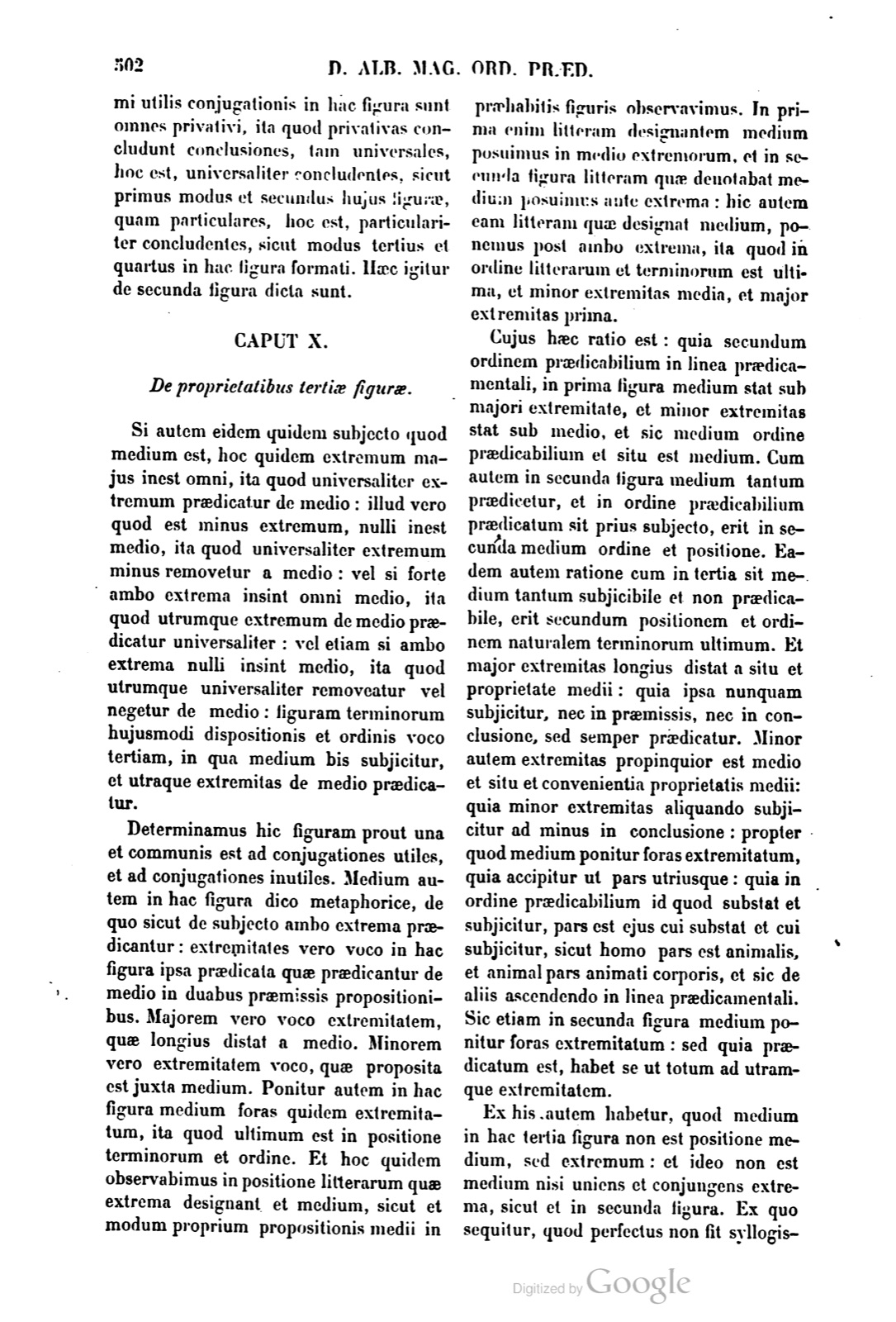
Manifestum est etiam, quoniam in hac figura non fit affirmativus syllogismus, hoc est, concludens conclusionem affirmativam: et hoc est ideo, quod necesse alteram praemissarum esse negativam ad medium: et ideo nec extremum extremo potest conjungi, nisi per negationem: quia extremum non respicit extremum nisi per medium: et ideo omnes syllogismi utilis conjugationis in hac figura sunt omnes privativi, ita quod privativas concludunt conclusiones, tam universales, hoc est, universaliter concludentes, sicut primus modus et secundus hujus figurae, quam particulares, hoc est, particulariter concludentes, sicut modus tertius et quartus in hac figura formati. Haec igitur de secunda figura dicta sunt.
It is also manifest that in this figure no affirmative syllogism is made, that is, none concluding an affirmative conclusion. This is because it is necessary that one of the premises be negative toward the middle; and therefore an extreme cannot be joined to an extreme except through negation, because an extreme regards an extreme only through the middle. And therefore all syllogisms of useful conjugation in this figure are all privative, so that they conclude privative conclusions, both universal, that is, concluding universally, as the first and second mode of this figure, and particular, that is, concluding particularly, as the third and fourth mode formed in this figure. These things, therefore, have been said about the second figure.
If a page does not appear, its photograph has not been uploaded yet.