Works › Prior Analytics, Books I–II
Volume 1 · pp. 498–501
Chapter VIII. On the formation of particular syllogisms of the second figure according to useful and useless conjugations.
A marker with ≈ is an approximate page boundary, placed by measure of the text; the page photographs remain the authority. In the paired views, clicking a page marker brings that page into view.
CAPUT VIII. De formatione syllogismorum particularium secundae figurae secundum utiles et inutiles conjugationes.
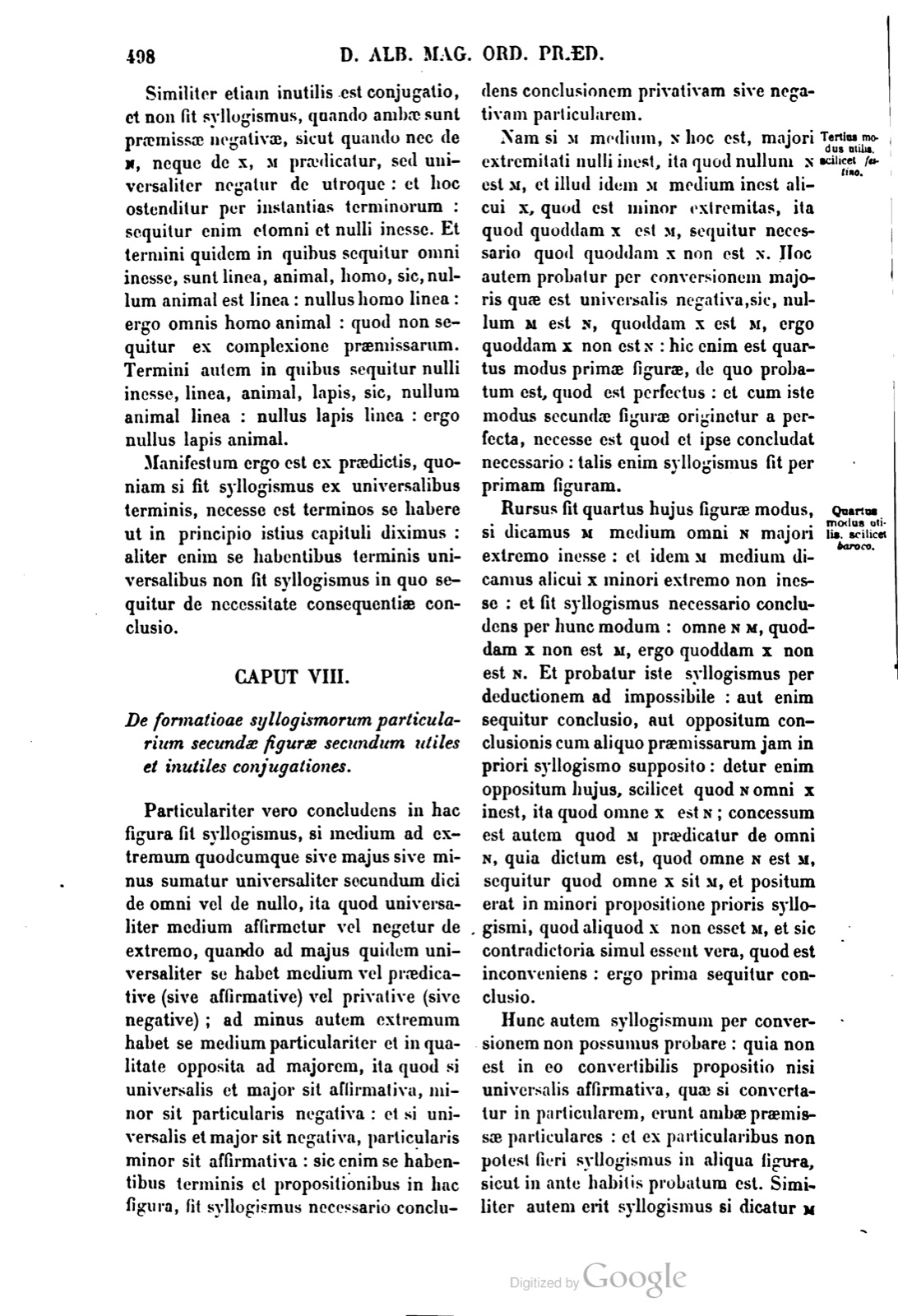
Particulariter vero concludens in hac figura fit syllogismus, si medium ad extremum quodcumque sive majus sive minus sumatur universaliter secundum dici de omni vel de nullo, ita quod universaliter medium affirmetur vel negetur de extremo, quando ad majus quidem universaliter se habet medium vel praedicative (sive affirmative) vel privative (sive negative); ad minus autem extremum habet se medium particulariter et in qualitate opposita ad majorem, ita quod si universalis et major sit affirmativa, minor sit particularis negativa: et si universalis et major sit negativa, particularis minor sit affirmativa: sic enim se habentibus terminis et propositionibus in hac figura, fit syllogismus necessario concludens conclusionem privativam sive negativam particularem.
Nam si M medium, N hoc est, majori extremitati nulli inest, ita quod nullum N est M, et illud idem M medium inest alicui X, quod est minor extremitas, ita quod quoddam X est M, sequitur necessario quod quoddam X non est N. Hoc autem probatur per conversionem majoris quae est universalis negativa, sic, nullum M est N, quoddam X est M, ergo quoddam X non est N: hic enim est quartus modus primae figurae, de quo probatum est, quod est perfectus: et cum iste modus secundae figurae originetur a perfecta, necesse est quod et ipse concludat necessario: talis enim syllogismus fit per primam figuram.
Rursus fit quartus hujus figurae modus, si dicamus M medium omni N majori extremo inesse: et idem M medium dicamus alicui X minori extremo non inesse: et fit syllogismus necessario concludens per hunc modum: omne N M, quoddam X non est M, ergo quoddam X non est N. Et probatur iste syllogismus per deductionem ad impossibile: aut enim sequitur conclusio, aut oppositum conclusionis cum aliquo praemissarum jam in priori syllogismo supposito: detur enim oppositum hujus, scilicet quod omni X inest N, ita quod omne X est N; concessum est autem quod M praedicatur de omni N, quia dictum est, quod omne N est M, sequitur quod omne X sit M, et positum erat in minori propositione prioris syllogismi, quod aliquod X non esset M, et sic contradictoria simul essent vera, quod est inconveniens: ergo prima sequitur conclusio.
Hunc autem syllogismum per conversionem non possumus probare: quia non est in eo convertibilis propositio nisi universalis affirmativa, quae si convertatur in particularem, erunt ambae praemissae particulares: et ex particularibus non potest fieri syllogismus in aliqua figura, sicut in ante habitis probatum est. Similiter autem erit syllogismus si dicatur M medium omni quidem inesse X, ita quod omne X est M, et illud idem medium quod est M non inest omni X, ita quod non omne X est M; erit syllogismus concludens, quod non omni X inest N, qui tamen idem est qui ex universali affirmativa, et particulari negativa. Quia non omnis et aliquis non aequipollent: unde eadem est demonstratio hujus syllogismi quae fuit in antecedentis per deductionem ad impossibile.
CHAPTER VIII. On the formation of particular syllogisms of the second figure according to useful and useless conjugations.
But a syllogism concluding particularly is made in this figure if the middle is taken universally in relation to either extreme, whether the greater or the lesser, according to being-said-of-every-one or being-said-of-none, so that the middle is universally affirmed or denied of the extreme, when in relation to the greater the middle has itself universally either predicatively (or affirmatively) or privatively (or negatively), but in relation to the lesser extreme the middle has itself particularly and in a quality opposite to the major, so that if the universal and major is affirmative, the minor is particular negative; and if the universal and major is negative, the particular minor is affirmative. For when terms and propositions have themselves thus in this figure, a syllogism is made necessarily concluding a privative or negative particular conclusion.
For if M, the middle, belongs to no N, that is, to the greater extreme, so that no N is M, and that same M, the middle, belongs to some X, which is the lesser extreme, so that some X is M, it follows necessarily that some X is not N. But this is proved by conversion of the major, which is universal negative, thus: no M is N; some X is M; therefore some X is not N. For this is the fourth mode of the first figure, concerning which it has been proved that it is perfect; and since this mode of the second figure originates from a perfect one, it is necessary that it too conclude necessarily, for such a syllogism is made through the first figure.
Again, the fourth mode of this figure is made if we say that M, the middle, belongs to every N, the greater extreme, and we say that the same M, the middle, does not belong to some X, the lesser extreme; and a necessarily concluding syllogism is made through this mode: every N is M; some X is not M; therefore some X is not N. And this syllogism is proved by reduction to impossibility: for either the conclusion follows, or the opposite of the conclusion follows with one of the premises already supposed in the prior syllogism. For let the opposite of this be given, namely that N belongs to every X, so that every X is N. But it was conceded that M is predicated of every N, because it was said that every N is M; therefore it follows that every X is M. And it had been posited in the minor proposition of the prior syllogism that some X was not M, and thus contradictories would be true at once, which is unfitting; therefore the first conclusion follows.
But we cannot prove this syllogism through conversion, because in it no proposition is convertible except the universal affirmative, and if that is converted into a particular, both premises will be particular; and from particulars a syllogism cannot be made in any figure, as has been proved in what went before. Similarly there will be a syllogism if it is said that M, the middle, indeed belongs to every X, so that every X is M, and that same middle which is M does not belong to every X, so that not every X is M; there will be a syllogism concluding that N does not belong to every X, which nevertheless is the same as the one from a universal affirmative and a particular negative. Because "not every" and "some not" are equivalent, the demonstration of this syllogism is the same as that of the preceding one through reduction to impossibility.
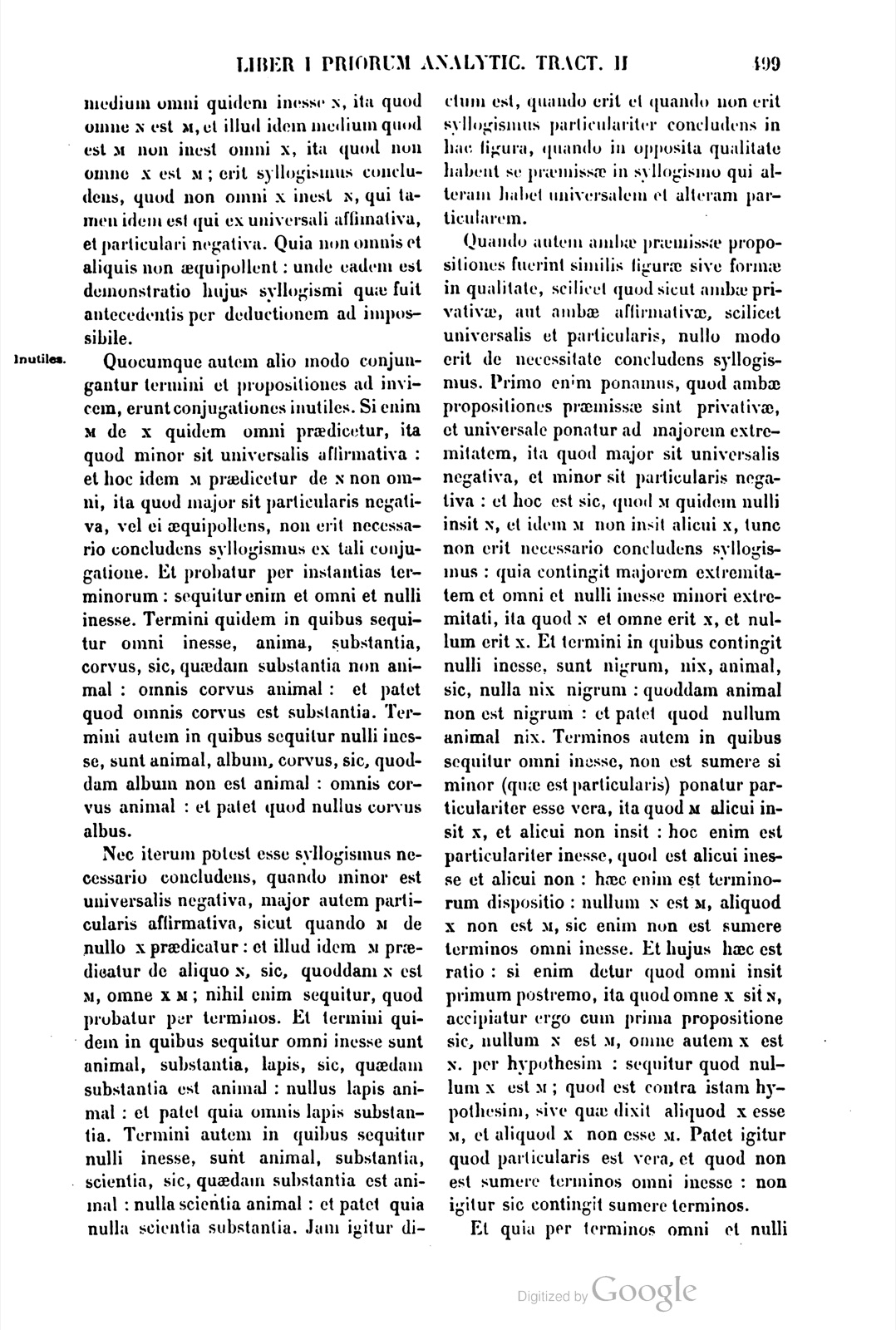
Quocumque autem alio modo conjungantur termini et propositiones ad invicem, erunt conjugationes inutiles. Si enim M de X quidem omni praedicetur, ita quod minor sit universalis affirmativa: et hoc idem praedicetur de N non omni, ita quod major sit particularis negativa, vel ei aequipollens, non erit necessario concludens syllogismus ex tali conjugatione. Et probatur per instantias terminorum: sequitur enim et omni et nulli inesse. Termini quidem in quibus sequitur omni inesse, anima, substantia, corvus, sic, quaedam substantia non animal: omnis corvus animal: et patet quod omnis corvus est substantia. Termini autem in quibus sequitur nulli inesse, sunt animal, album, corvus, sic, quoddam album non est animal: omnis corvus animal: et patet quod nullus corvus albus.
Nec iterum potest esse syllogismus necessario concludens, quando minor est universalis negativa, major autem particularis affirmativa, sicut quando M de nullo X praedicatur: et illud idem M praedicatur de aliquo N, sic, quoddam N est M, omne X M; nihil enim sequitur, quod probatur per terminos. Et termini quidem in quibus sequitur omni inesse sunt animal, substantia, lapis, sic, quaedam substantia est animal: nullus lapis animal: et patet quia omnis lapis substantia. Termini autem in quibus sequitur nulli inesse, sunt animal, substantia, scientia, sic, quaedam substantia est animal: nulla scientia animal: et patet quia nulla scientia substantia. Jam igitur dictum est, quando erit et quando non erit syllogismus particulariter concludens in hac figura, quando in opposita qualitate habent se praemissae in syllogismo qui alteram habet universalem et alteram particularem.
Quando autem ambae praemissae propositiones fuerint similis figurae sive formae in qualitate, scilicet quod sint ambae privativae, aut ambae affirmativae, scilicet universalis et particularis, nullo modo erit de necessitate concludens syllogismus. Primo enim ponamus, quod ambae propositiones praemissae sint privativae, et universale ponatur ad majorem extremitatem, ita quod major sit universalis negativa, et minor sit particularis negativa: et hoc est sic, quod M quidem nulli insit N, et idem M non insit alicui X, tunc non erit necessario concludens syllogismus: quia contingit majorem extremitatem et omni et nulli inesse minori extremitati, ita quod N et omne erit X, et nullum erit X. Et termini in quibus contingit nulli inesse, sunt nigrum, nix, animal, sic, nulla nix nigrum: quoddam animal non est nigrum: et patet quod nullum animal nix. Terminos autem in quibus sequitur omni inesse, non est sumere si minor (quae est particularis) ponatur particulariter esse vera, ita quod M alicui insit X, et alicui non insit: hoc enim est particulariter inesse, quod est alicui inesse et alicui non: haec enim est terminorum dispositio: nullum X est M, aliquod X non est M, sic enim non est sumere terminos omni inesse. Et hujus haec est ratio: si enim detur quod omni insit primum postremo, ita quod omne X sit N, accipiatur ergo cum prima propositione sic, nullum X est M, omne autem X est N per hypothesim: sequitur quod nullum N est M; quod est contra istam hypothesim, sive quae dixit aliquod X esse M, et aliquod X non esse M. Patet igitur quod particularis est vera, et quod non est sumere terminos omni inesse: non igitur sic contingit sumere terminos.
But in whatever other way terms and propositions are joined to one another, the conjugations will be useless. For if M is predicated of every X, so that the minor is universal affirmative, and this same thing is not predicated of every N, so that the major is particular negative, or equivalent to it, there will not be from such a conjugation a syllogism concluding necessarily. And this is proved through instances of terms, for both belonging to every one and belonging to no one follow. The terms in which belonging to every one follows are soul, substance, raven, thus: some substance is not animal; every raven is animal; and it is clear that every raven is substance. But the terms in which belonging to no one follows are animal, white, raven, thus: some white thing is not animal; every raven is animal; and it is clear that no raven is white.
Nor again can there be a syllogism concluding necessarily when the minor is universal negative and the major particular affirmative, as when M is predicated of no X, and the same M is predicated of some N, thus: some N is M; every X is M; for nothing follows, which is proved through terms. And the terms in which belonging to every one follows are animal, substance, stone, thus: some substance is animal; no stone is animal; and it is clear that every stone is substance. But the terms in which belonging to no one follows are animal, substance, science, thus: some substance is animal; no science is animal; and it is clear that no science is substance. Thus it has now been said when there will be and when there will not be a syllogism concluding particularly in this figure, when the premises in a syllogism that has one universal and the other particular have themselves in opposite quality.
But when both premised propositions are of like figure or form in quality, namely because both are privative or both affirmative, namely universal and particular, there will in no way be a syllogism concluding by necessity. First let us posit that both premised propositions are privative, and the universal is posited at the greater extreme, so that the major is universal negative and the minor particular negative. This is so if M belongs to no N and the same M does not belong to some X; then there will not be a syllogism concluding necessarily, because the greater extreme can belong both to every one and to no one of the lesser extreme, so that N will be both every X and no X. And the terms in which it can belong to no one are black, snow, animal, thus: no snow is black; some animal is not black; and it is clear that no animal is snow. But terms in which belonging to every one follows cannot be taken if the minor, which is particular, is posited as particularly true, so that M belongs to some X and does not belong to some; for this is to belong particularly, namely to belong to some and not to belong to some. For this is the disposition of terms: no X is M; some X is not M; in this way terms for belonging to every one cannot be taken. And the reason is this: for if it is granted that the first belongs to every last, so that every X is N, then let it be taken with the first proposition thus: no X is M; but every X is N by hypothesis; it follows that no N is M, which is against that hypothesis, namely the one which said that some X is M and some X is not M. Therefore it is clear that the particular is true, and that terms for belonging to every one cannot be taken; therefore in this way terms cannot be taken.
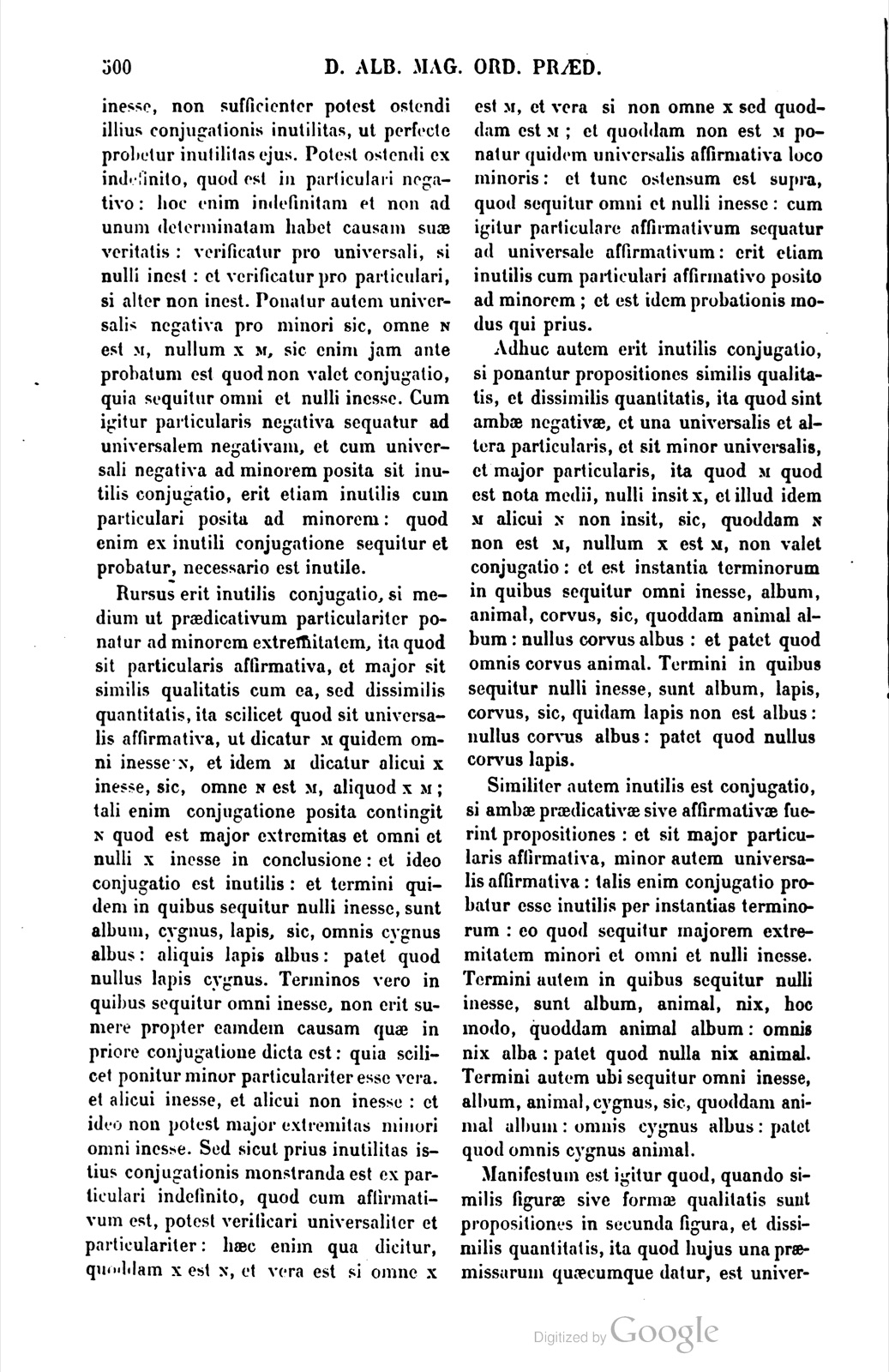
Et quia per terminos omni et nulli inesse, non sufficienter potest ostendi illius conjugationis inutilitas, ut perfecte probetur inutilitas ejus. Potest ostendi ex indefinito, quod est in particulari negativo: hoc enim indefinitam et non ad unum determinatam habet causam suae veritatis: verificatur pro universali, si nulli inest: et verificatur pro particulari, si alter non inest. Ponatur autem universalis negativa pro minori sic, omne N est M, nullum X M, sic enim jam ante probatum est quod non valet conjugatio, quia sequitur omni et nulli inesse. Cum igitur particularis negativa sequatur ad universalem negativam, et cum universali negativa ad minorem posita sit inutilis conjugatio, erit etiam inutilis cum particulari posita ad minorem: quod enim ex inutili conjugatione sequitur et probatur, necessario est inutile.
Rursus erit inutilis conjugatio, si medium ut praedicativum particulariter ponatur ad minorem extremitatem, ita quod sit particularis affirmativa, et major sit similis qualitatis cum ea, sed dissimilis quantitatis, ita scilicet quod sit universalis affirmativa, ut dicatur M quidem omni inesse N, et idem M dicatur alicui X inesse, sic, omne N est M, aliquod X M; tali enim conjugatione posita contingit N quod est major extremitas et omni et nulli X inesse in conclusione: et ideo conjugatio est inutilis: et termini quidem in quibus sequitur nulli inesse, sunt album, cygnus, lapis, sic, omnis cygnus albus: aliquis lapis albus: patet quod nullus lapis cygnus. Terminos vero in quibus sequitur omni inesse, non erit sumere propter eamdem causam quae in priore conjugatione dicta est: quia scilicet ponitur minor particulariter esse vera, et alicui inesse, et alicui non inesse: et ideo non potest major extremitas minori omni inesse. Sed sicut prius inutilitas istius conjugationis monstranda est ex particulari indefinito, quod cum affirmativum est, potest verificari universaliter et particulariter: haec enim qua dicitur, quoddam X est M, et vera est si omne X est M, et vera si non omne X sed quoddam est M; et quoddam non est M ponatur quidem universalis affirmativa loco minoris: et tunc ostensum est supra, quod sequitur omni et nulli inesse: cum igitur particulare affirmativum sequatur ad universale affirmativum: erit etiam inutilis cum particulari affirmativo posito ad minorem; et est idem probationis modus qui prius.
Adhuc autem erit inutilis conjugatio, si ponantur propositiones similis qualitatis, et dissimilis quantitatis, ita quod sint ambae negativae, et una universalis et altera particularis, et sit minor universalis, et major particularis, ita quod M quod est nota medii, nulli insit X, et illud idem M alicui N non insit, sic, quoddam N non est M, nullum X est M, non valet conjugatio: et est instantia terminorum in quibus sequitur omni inesse, album, animal, corvus, sic, quoddam animal album: nullus corvus albus: et patet quod omnis corvus animal. Termini in quibus sequitur nulli inesse, sunt album, lapis, corvus, sic, quidam lapis non est albus: nullus corvus albus: patet quod nullus corvus lapis.
And because the uselessness of that conjugation cannot sufficiently be shown through terms for belonging to every one and to no one, so that its uselessness may be perfectly proved, it can be shown from the indefinite which is in the particular negative; for this has an indefinite and not one-determined cause of its truth. It is verified as universal if it belongs to none, and it is verified as particular if one does not belong. But let a universal negative be posited for the minor thus: every N is M; no X is M. For in this way it was already proved before that the conjugation is not valid, because belonging to every one and to no one follow. Therefore, since the particular negative follows upon the universal negative, and since, with a universal negative posited at the minor, the conjugation is useless, it will also be useless with a particular posited at the minor; for what follows from a useless conjugation and is proved from it is necessarily useless.
Again, the conjugation will be useless if the middle as predicative is posited particularly at the lesser extreme, so that it is particular affirmative, and the major is of similar quality with it but dissimilar quantity, namely so that it is universal affirmative, as if M is said to belong to every N, and the same M is said to belong to some X, thus: every N is M; some X is M. With such a conjugation posited, N, which is the greater extreme, can belong both to every and to no X in the conclusion; and therefore the conjugation is useless. And the terms in which belonging to no one follows are white, swan, stone, thus: every swan is white; some stone is white; it is clear that no stone is a swan. But terms in which belonging to every one follows cannot be taken because of the same cause stated in the prior conjugation, namely because the minor is posited as particularly true, both belonging to some and not belonging to some; and therefore the greater extreme cannot belong to every lesser. But, as before, the uselessness of this conjugation must be shown from the particular indefinite, which, when it is affirmative, can be verified universally and particularly. For this proposition by which it is said "some X is M" is true if every X is M, and true if not every X but some is M; and "some is not M"; therefore let the universal affirmative be posited in place of the minor, and then it has been shown above that belonging to every one and to no one follow. Therefore, since the particular affirmative follows upon the universal affirmative, it will also be useless with a particular affirmative posited at the minor; and the mode of proof is the same as before.
Again, the conjugation will be useless if propositions of similar quality and dissimilar quantity are posited, so that both are negative, and one universal and the other particular, and the minor is universal and the major particular, so that M, which is the sign of the middle, belongs to no X, and that same M does not belong to some N, thus: some N is not M; no X is M. The conjugation is not valid; and there is an instance of terms in which belonging to every one follows: white, animal, raven, thus: some animal is white; no raven is white; and it is clear that every raven is animal. The terms in which belonging to no one follows are white, stone, raven, thus: some stone is not white; no raven is white; it is clear that no raven is a stone.
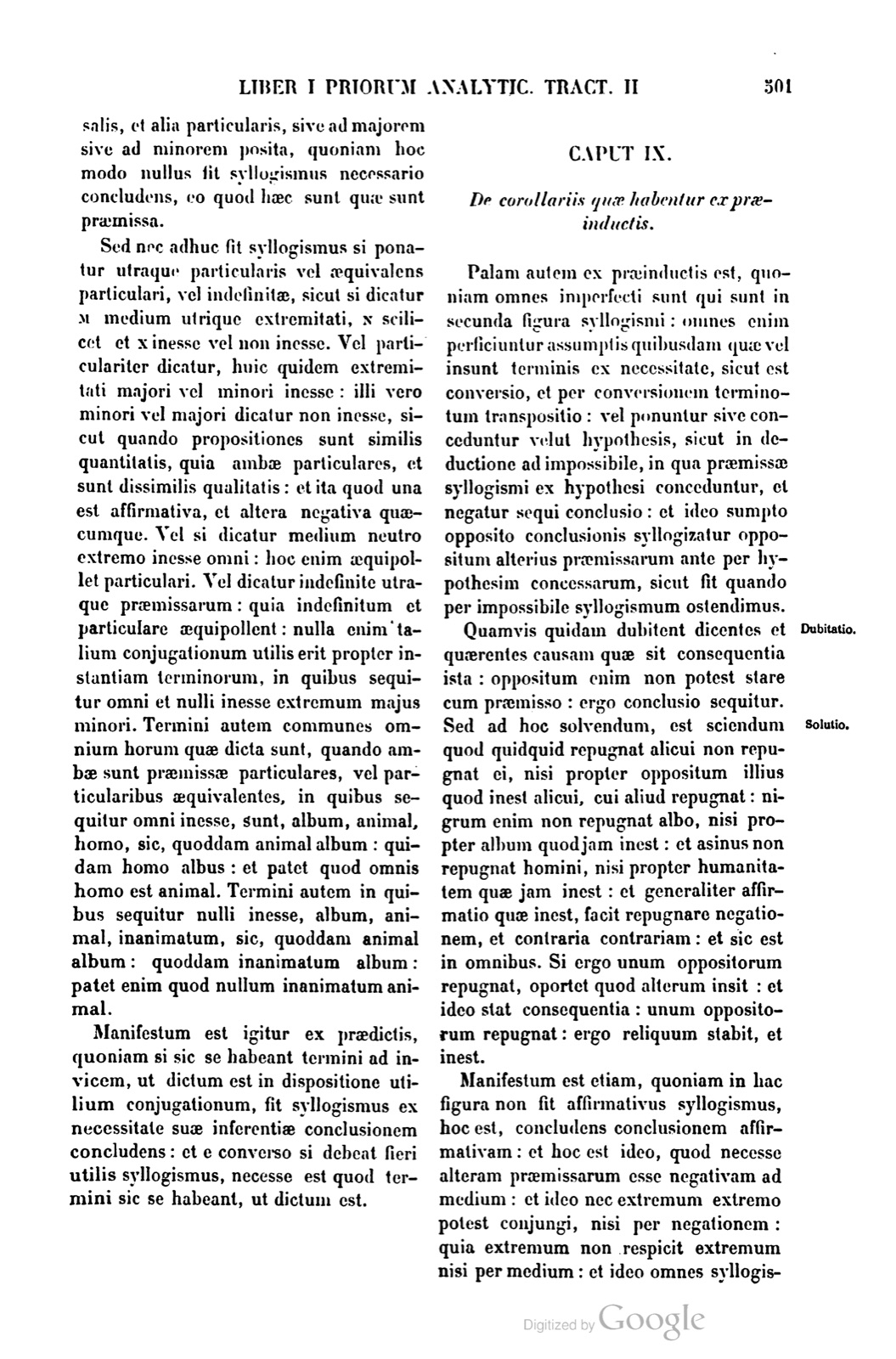
Similiter autem inutilis est conjugatio, si ambae praedicativae sive affirmativae fuerint propositiones: et sit major particularis affirmativa, minor autem universalis affirmativa: talis enim conjugatio probatur esse inutilis per instantias terminorum: eo quod sequitur majorem extremitatem minori et omni et nulli inesse. Termini autem in quibus sequitur nulli inesse, sunt album, animal, nix, hoc modo, quoddam animal album: omnis nix alba: patet quod nulla nix animal. Termini autem ubi sequitur omni inesse, album, animal, cygnus, sic, quoddam animal album: omnis cygnus albus: patet quod omnis cygnus animal.
Manifestum est igitur quod, quando similis figurae sive formae qualitatis sunt propositiones in secunda figura, et dissimilis quantitatis, ita quod hujus una praemissarum quaecumque datur, est universalis, et alia particularis, sive ad majorem sive ad minorem posita, quoniam hoc modo nullus fit syllogismus necessario concludens, eo quod haec sunt quae sunt praemissa.
Sed nec adhuc fit syllogismus si ponatur utraque particularis vel aequivalens particulari, vel indefinita, sicut si dicatur M medium utrique extremitati, N scilicet et X inesse vel non inesse. Vel particulariter dicatur, huic quidem extremitati majori vel minori inesse: illi vero minori vel majori dicatur non inesse, sicut quando propositiones sunt similis quantitatis, quia ambae particulares, et sunt dissimilis qualitatis: et ita quod una est affirmativa, et altera negativa quaecumque. Vel si dicatur medium neutro extremo inesse omni: hoc enim aequipollet particulari. Vel dicatur indefinite utraque praemissarum: quia indefinitum et particulare aequipollent: nulla enim talium conjugationum utilis erit propter instantiam terminorum, in quibus sequitur omni et nulli inesse extremum majus minori. Termini autem communes omnium horum quae dicta sunt, quando ambae sunt praemissae particulares, vel particularibus aequivalentes, in quibus sequitur omni inesse, sunt, album, animal, homo, sic, quoddam animal album: quidam homo albus: et patet quod omnis homo est animal. Termini autem in quibus sequitur nulli inesse, album, animal, inanimatum, sic, quoddam animal album: quoddam inanimatum album: patet enim quod nullum inanimatum animal.
Manifestum est igitur ex praedictis, quoniam si sic se habeant termini ad invicem, ut dictum est in dispositione utilium conjugationum, fit syllogismus ex necessitate suae inferentiae conclusionem concludens: et e converso si debeat fieri utilis syllogismus, necesse est quod termini sic se habeant, ut dictum est.
Similarly the conjugation is useless if both propositions were predicative or affirmative, and the major is particular affirmative but the minor universal affirmative. For such a conjugation is proved to be useless through instances of terms, because the greater extreme follows as belonging to the lesser both to every one and to no one. But the terms in which belonging to no one follows are white, animal, snow, in this way: some animal is white; all snow is white; it is clear that no snow is animal. But the terms where belonging to every one follows are white, animal, swan, thus: some animal is white; every swan is white; it is clear that every swan is animal.
Therefore it is manifest that when the propositions in the second figure are of similar figure or form of quality and dissimilar quantity, so that whichever one of the premises is given is universal and the other particular, whether posited at the greater or the lesser, in this way no syllogism concluding necessarily is made from the fact that these are the things premised.
Nor again is a syllogism made if each is posited as particular or equivalent to a particular, or indefinite, as if M, the middle, is said either to belong or not to belong to each extreme, namely N and X. Or let it be said particularly to belong to this extreme, whether greater or lesser, but not to belong to that other, whether lesser or greater, as when the propositions are of similar quantity because both are particular, and are of dissimilar quality, and so one is affirmative and the other negative, whichever it may be. Or if the middle is said to belong to neither extreme universally; for this is equivalent to a particular. Or let each premise be said indefinitely, because the indefinite and the particular are equivalent. For none of such conjugations will be useful because of the instance of terms in which the greater extreme is shown to belong to the lesser both to every one and to no one. The common terms of all these things that have been said, when both premises are particular or equivalent to particulars, in which belonging to every one follows, are white, animal, man, thus: some animal is white; some man is white; and it is clear that every man is animal. But the terms in which belonging to no one follows are white, animal, inanimate, thus: some animal is white; some inanimate thing is white; for it is clear that no inanimate thing is animal.
Therefore it is manifest from the foregoing that if the terms have themselves to one another as has been said in the disposition of useful conjugations, a syllogism is made, concluding its conclusion from the necessity of its inference; and conversely, if a useful syllogism ought to be made, the terms must have themselves as has been said.
If a page does not appear, its photograph has not been uploaded yet.