Works › Prior Analytics, Books I–II
Volume 1 · pp. 497–498
Chapter VII. On the formation of universal syllogisms of the second figure, both of useful and useless conjugations.
A marker with ≈ is an approximate page boundary, placed by measure of the text; the page photographs remain the authority. In the paired views, clicking a page marker brings that page into view.
CAPUT VII. De formatione syllogismorum universalium secundae figurae, sive utilium sive inutilium conjugationum.
Dicamus autem deinceps de formatione syllogismorum universalium in hac figura. Universalibus igitur existentibus terminis ad medium, ita quod medium de utraque extremitate universaliter praedicetur, secundum dici de omni et dici de nullo fit syllogismus secundum hujus figurae modum primum, si medium huic quidem quod est majus extremum, omni inest: illi vero quod est minus extremum, nulli inest, utrumlibet sic privativum, hoc est, sive major sive minor affirmativa, dummodo altera sit universalis negativa. Aliter autem in hac figura universalis non fit syllogismus. Et hoc probatur hoc modo: et accipiamus loco terminorum litteras M, N, X, ita quod M sit medium, N autem major extremitas, et X sit minor extremitas: et formetur modus primus tali complexione: praedicetur enim M de N quidem nullo, de X vero praedicetur omni esse: erit syllogismus ex majori universali negativa et minori universali affirmativa, sic, nullum N est M, omne X M, ergo nullum X N. Et ostenditur evidentia istius syllogismi per conversionem universalis negativae, quae simpliciter et in terminis convertitur: et si nullum N est M, nullum M est N, et tunc ex hac conversa fiat major propositio, et assumatur minor jam dicti syllogismi, sic, nullum M N, omne X M, ergo nullum X N, et iste est secundus modus primae figurae, qui jam in prima figura ostensus est perfectus.
Sic iterum formatur secundus hujus secundae figurae modus, qui constat ex majori affirmativa, minori autem negativa, sic: si enim M omni N inest: et idem M nulli X inest: tunc fit talis syllogismus: omne N est M, nullum X M, ergo nullum X N, convertitur enim minor quae universalis negativa. Unde et idem si M nulli inest X, sequitur quod e converso nullum X inest M; et tunc erit talis syllogismus transposita propositione: nullum M est X, omne N M, ergo nullum N X, et est iterum secundus primae figurae syllogismus.
Hoc autem idem est ostendere per deductionem ad impossibile: quia si dicatur non sequitur conclusio, tunc oppositum conclusionis stabit cum praemissis: et hoc non contingit, sicut facile patet cuilibet volenti sumere conclusionis oppositum, et contingenti cum altero praemissorum: et sequitur id quod stare non potest cum primo concesso. Quoniam ergo in hac figura fit syllogismus praedicto modo se habentibus terminis secundum figuram et complexionem, ex his quae dicta sunt manifestum est. Sed fit syllogismus non perfectus: quia perfectum est cui nihil deest, ut dicit Aristoteles: hic autem ad perfectionem evidentiae aliquid addere oportet praeter ea quae sunt in syllogismi constitutione: additur enim conversio, et etiam aliquando transpositio: et quando hoc additum est, primo apparet necessarium quod est in consequentia.
CHAPTER VII. On the formation of universal syllogisms of the second figure, both of useful and useless conjugations.
Next let us speak about the formation of universal syllogisms in this figure. Therefore, when the terms are universal in relation to the middle, so that the middle is predicated universally of each extreme, a syllogism is made according to being-said-of-every-one and being-said-of-none according to the first mode of this figure, if the middle belongs to every one of this which is the greater extreme, but belongs to none of that which is the lesser extreme, either being thus privative, that is, whether the major or the minor is affirmative, provided the other is a universal negative. But otherwise in this figure no universal syllogism is made. And this is proved in this way. Let us take, in place of terms, the letters M, N, X, so that M is the middle, N the greater extreme, and X the lesser extreme. And let the first mode be formed with such a complexion: for let M be predicated of no N, but let it be predicated as being of every X. There will be a syllogism from a universal negative major and a universal affirmative minor, thus: no N is M; every X is M; therefore no X is N. And the evidence of this syllogism is shown through conversion of the universal negative, which is converted simply and in terms. And if no N is M, no M is N; and then from this converse let the major proposition be made, and let the minor of the already mentioned syllogism be assumed, thus: no M is N; every X is M; therefore no X is N. And this is the second mode of the first figure, which has already been shown to be perfect in the first figure.
Thus again the second mode of this second figure is formed, which consists of an affirmative major and a negative minor, thus: for if M belongs to every N, and the same M belongs to no X, then such a syllogism is made: every N is M; no X is M; therefore no X is N, for the minor, which is a universal negative, is converted. Hence also, if the same M belongs to no X, it follows conversely that no X belongs to M; and then, with the proposition transposed, there will be such a syllogism: no M is X; every N is M; therefore no N is X, and again it is the second syllogism of the first figure.
But this same thing can be shown through reduction to impossibility, because if it is said that the conclusion does not follow, then the opposite of the conclusion will stand with the premises; and this does not happen, as is easily clear to anyone willing to take the opposite of the conclusion and what is contingent with one of the premises, and there follows what cannot stand with the first thing conceded. Therefore, since a syllogism is made in this figure when the terms have themselves in the aforesaid way according to figure and complexion, this is manifest from the things that have been said. But an imperfect syllogism is made, because that is perfect to which nothing is lacking, as Aristotle says; but here, for the perfection of evidence, one must add something beyond those things which are in the constitution of the syllogism. For conversion is added, and sometimes also transposition; and when this has been added, then first the necessity which is in the consequence appears.
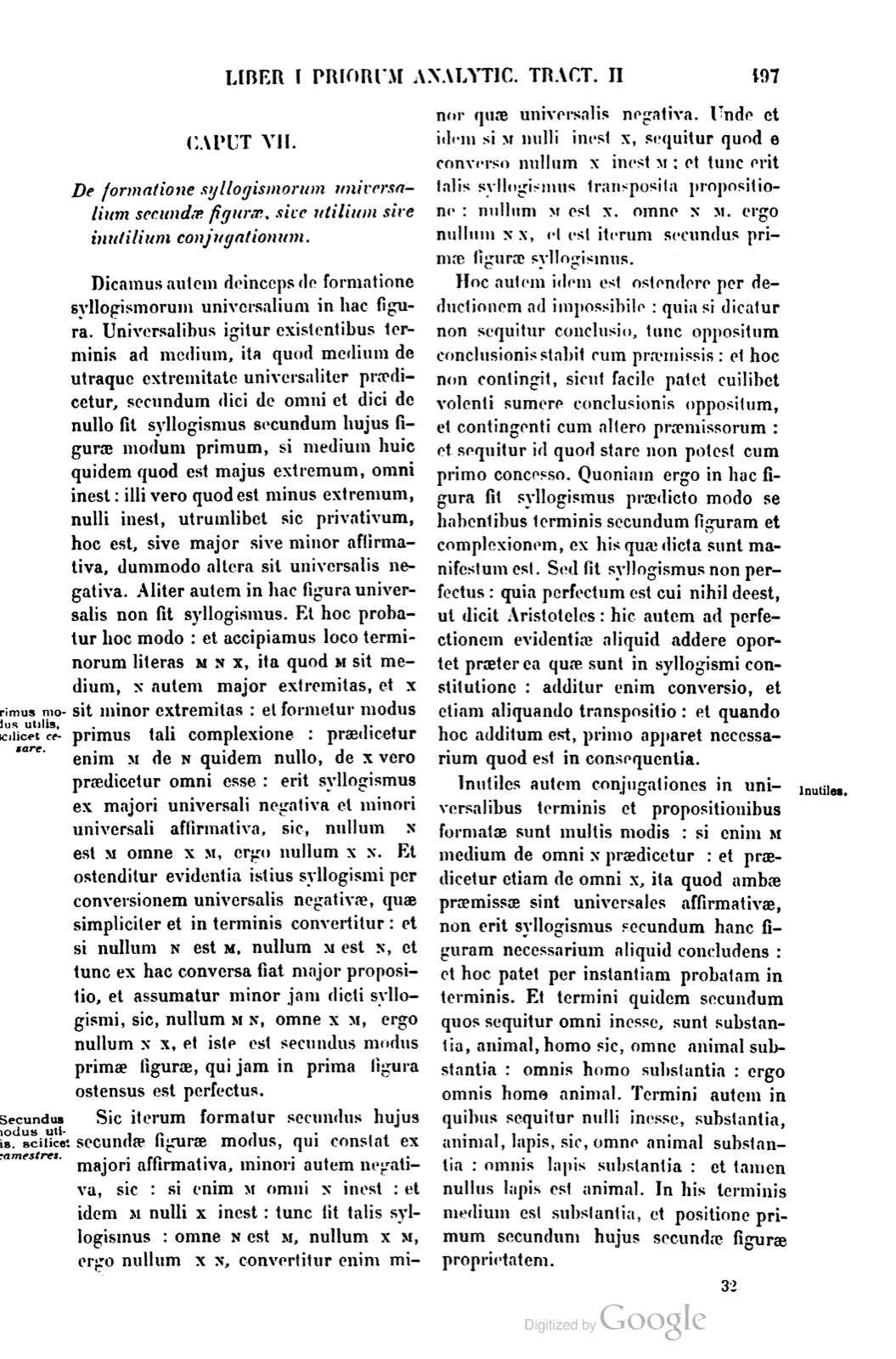
Inutiles autem conjugationes in universalibus terminis et propositionibus formatae sunt multis modis: si enim M medium de omni N praedicetur: et praedicetur etiam de omni X, ita quod ambae praemissae sint universales affirmativae, non erit syllogismus secundum hanc figuram necessarium aliquid concludens: et hoc patet per instantiam probatam in terminis. Et termini quidem secundum quos sequitur omni inesse, sunt substantia, animal, homo sic, omne animal substantia: omnis homo substantia: ergo omnis homo animal. Termini autem in quibus sequitur nulli inesse, substantia, animal, lapis, sic, omne animal substantia: omnis lapis substantia: et tamen nullus lapis est animal. In his terminis medium est substantia, et positione primum secundum hujus secundae figurae proprietatem.
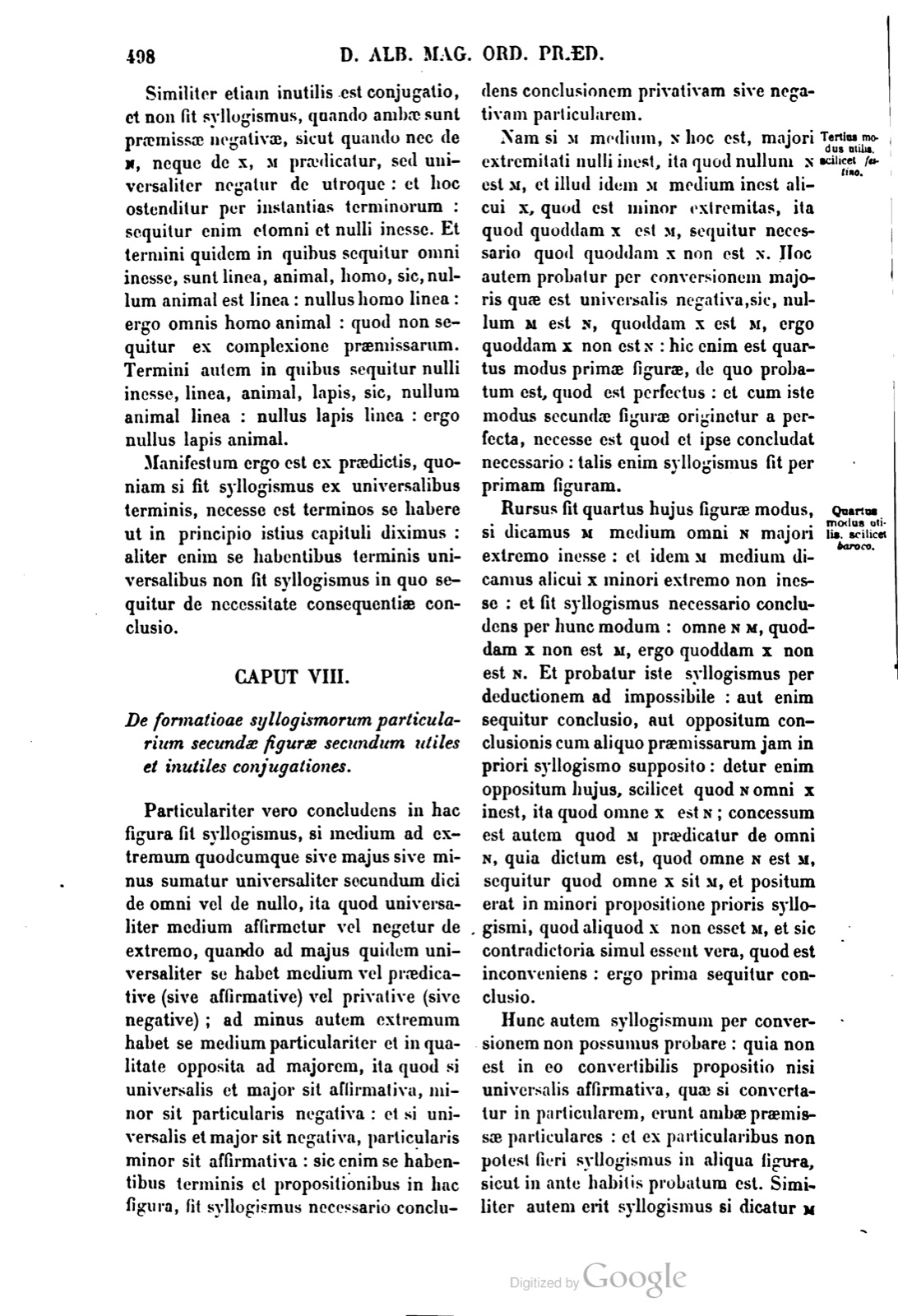
Similiter etiam inutilis est conjugatio, et non fit syllogismus, quando ambae sunt praemissae negativae, sicut quando nec de N, neque de X, M praedicatur, sed universaliter negatur de utroque: et hoc ostenditur per instantias terminorum: sequitur enim et omni et nulli inesse. Et termini quidem in quibus sequitur omni inesse, sunt linea, animal, homo, sic, nullum animal est linea: nullus homo linea: ergo omnis homo animal: quod non sequitur ex complexione praemissarum. Termini autem in quibus sequitur nulli inesse, linea, animal, lapis, sic, nullum animal linea: nullus lapis linea: ergo nullus lapis animal.
Manifestum ergo est ex praedictis, quoniam si fit syllogismus ex universalibus terminis, necesse est terminos se habere ut in principio istius capituli diximus: si aliter enim se habentibus terminis universalibus non fit syllogismus in quo sequitur de necessitate consequentiae conclusio.
But useless conjugations formed in universal terms and propositions are of many kinds. For if M, the middle, is predicated of every N, and is also predicated of every X, so that both premises are universal affirmatives, there will not be a syllogism according to this figure concluding something necessary; and this is clear through an instance proved in terms. The terms according to which belonging to every one follows are substance, animal, man, thus: every animal is substance; every man is substance; therefore every man is animal. But the terms in which belonging to no one follows are substance, animal, stone, thus: every animal is substance; every stone is substance; and nevertheless no stone is animal. In these terms the middle is substance, and is first in position according to the proper character of this second figure.
Similarly, the conjugation is also useless, and no syllogism is made, when both premises are negative, as when M is predicated neither of N nor of X, but is universally denied of each; and this is shown through instances of terms, for both belonging to every one and belonging to no one follow. And the terms in which belonging to every one follows are line, animal, man, thus: no animal is a line; no man is a line; therefore every man is animal, which does not follow from the complexion of the premises. But the terms in which belonging to no one follows are line, animal, stone, thus: no animal is a line; no stone is a line; therefore no stone is animal.
Therefore it is manifest from the foregoing that if a syllogism is made from universal terms, the terms must have themselves as we said at the beginning of this chapter; for if the universal terms have themselves otherwise, no syllogism is made in which the conclusion follows by necessity of consequence.
If a page does not appear, its photograph has not been uploaded yet.