Works › Prior Analytics, Books I–II
Volume 1 · pp. 495–496
Chapter VI. On the properties of the second figure, continuation.
A marker with ≈ is an approximate page boundary, placed by measure of the text; the page photographs remain the authority. In the paired views, clicking a page marker brings that page into view.
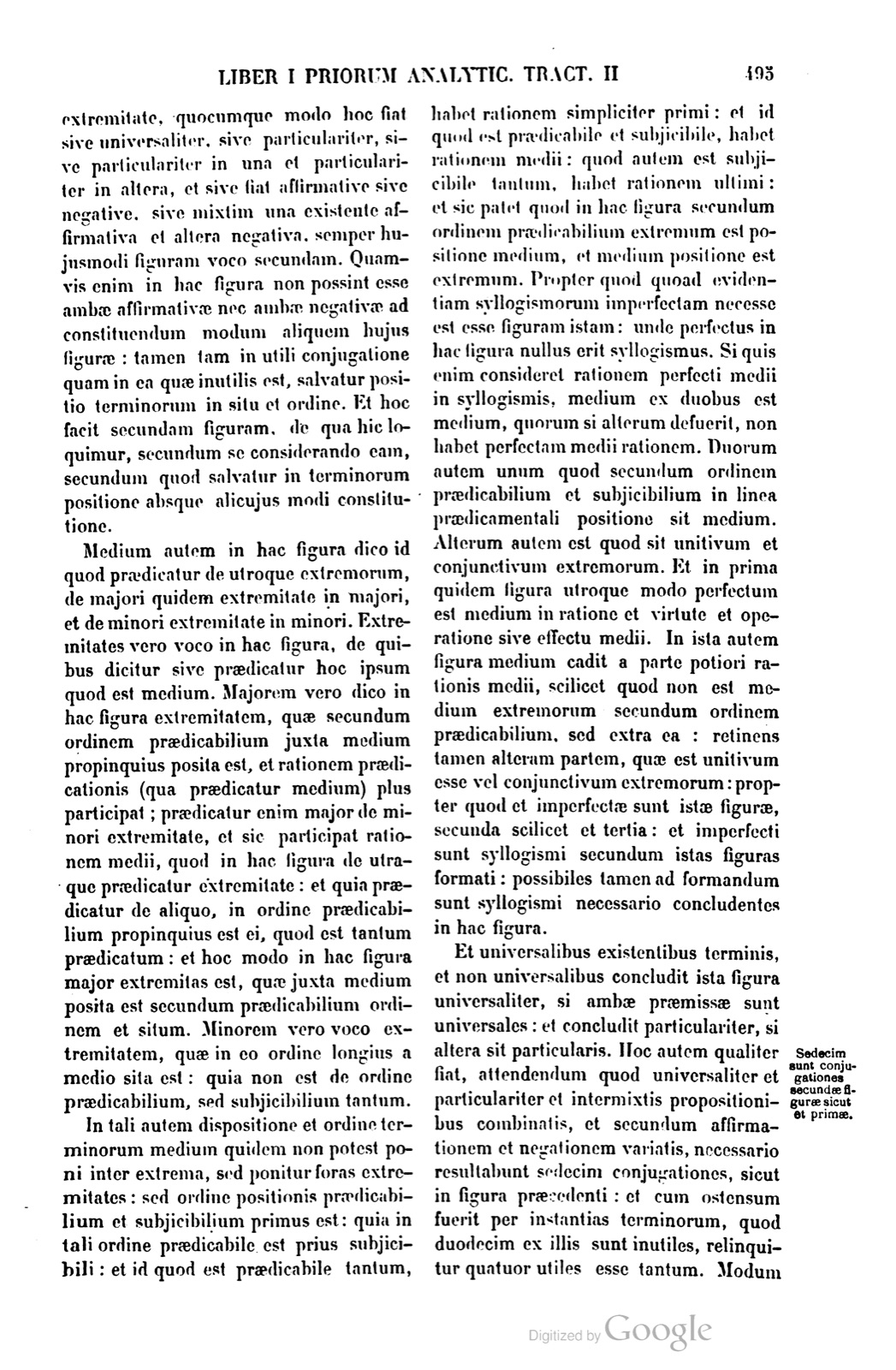
extremitate, quocumque modo hoc fiat sive universaliter, sive particulariter, sive particulariter in una et particulariter in altera, et sive fiat affirmative sive negative, sive mixtim una existente affirmativa et altera negativa, semper hujusmodi figuram voco secundam. Quamvis enim in hac figura non possint esse ambae affirmativae nec ambae negativae ad constituendum modum aliquem hujus figurae: tamen tam in utili conjugatione quam in ea quae inutilis est, salvatur positio terminorum in situ et ordine. Et hoc facit secundam figuram, de qua hic loquimur, secundum se considerando eam, secundum quod salvatur in terminorum positione absque alicujus modi constitutione.
Medium autem in hac figura dico id quod praedicatur de utroque extremorum, de majori quidem extremitate in majori, et de minori extremitate in minori. Extremitates vero voco in hac figura, de quibus dicitur sive praedicatur hoc ipsum quod est medium. Majorem vero dico in hac figura extremitatem, quae secundum ordinem praedicabilium juxta medium propinquius posita est, et rationem praedicationis (qua praedicatur medium) plus participat; praedicatur enim major de minori extremitate, et sic participat rationem medii, quod in hac figura de utraque praedicatur extremitate: et quia praedicatur de aliquo, in ordine praedicabilium propinquius est ei, quod est tantum praedicatum: et hoc modo in hac figura major extremitas est, quae juxta medium posita est secundum praedicabilium ordinem et situm. Minorem vero voco extremitatem, quae in eo ordine longius a medio sita est: quia non est de ordine praedicabilium, sed subjicibilium tantum.
In tali autem dispositione et ordine terminorum medium quidem non potest poni inter extrema, sed ponitur foras extremitates: sed ordine positionis praedicabilium et subjicibilium primus est: quia in tali ordine praedicabile est prius subjicibili: et id quod est praedicabile tantum, habet rationem simpliciter primi: et id quod est praedicabile et subjicibile, habet rationem medii: quod autem est subjicibile tantum, habet rationem ultimi: et sic patet quod in hac figura secundum ordinem praedicabilium extremum est positione medium, et medium positione est extremum. Propter quod quoad evidentiam syllogismorum imperfectam necesse est esse figuram istam: unde perfectus in hac figura nullus erit syllogismus. Si quis enim consideret rationem perfecti medii in syllogismis, medium ex duobus est medium, quorum si alterum defuerit, non habet perfectam medii rationem. Duorum autem unum quod secundum ordinem praedicabilium et subjicibilium in linea praedicamentali positione sit medium. Alterum autem est quod sit unitivum et conjunctivum extremorum. Et in prima quidem figura utroque modo perfectum est medium in ratione et virtute et operatione sive effectu medii. In ista autem figura medium cadit a parte potiori rationis medii, scilicet quod non est medium extremorum secundum ordinem praedicabilium, sed extra ea: retinens tamen alteram partem, quae est unitivum esse vel conjunctivum extremorum: propter quod et imperfectae sunt istae figurae, secunda scilicet et tertia: et imperfecti sunt syllogismi secundum istas figuras formati: possibiles tamen ad formandum sunt syllogismi necessario concludentes in hac figura.
Et universalibus existentibus terminis, et non universalibus concludit ista figura universaliter, si ambae praemissae sunt universales: et concludit particulariter, si altera sit particularis. Hoc autem qualiter fiat, attendendum quod universaliter et particulariter et intermixtis propositionibus combinatis, et secundum affirmationem et negationem variatis, necessario resultabunt sedecim conjugationes, sicut in figura praecedenti: et cum ostensum fuerit per instantias terminorum, quod duodecim ex illis sunt inutiles, relinquitur quatuor utiles esse tantum. Modum autem hujusmodi combinationis non est necesse repetere: quia idem qui fuit in figura prima quantum ad varietatem quantitatis et qualitatis in propositionibus: et nihil mutatur in eo nisi dispositio terminorum, quod mutat tantum figuram.
extreme, in whatever way this occurs, whether universally or particularly, or particularly in one and particularly in the other, and whether it occurs affirmatively or negatively, or mixedly, with one being affirmative and the other negative, I always call a figure of this kind the second. For although in this figure both propositions cannot be affirmative nor both negative for constituting some mode of this figure, nevertheless both in a useful conjugation and in one that is useless the position of terms in situation and order is preserved. And this makes the second figure, of which we are speaking here, considering it according to itself, according as it is preserved in the position of the terms without the constitution of any mode.
But in this figure I call the middle that which is predicated of each of the extremes, of the greater extreme indeed in the major, and of the lesser extreme in the minor. But in this figure I call extremes those of which this very thing which is the middle is said or predicated. And in this figure I call the greater extreme the extreme which, according to the order of predicables, is placed nearer the middle, and participates more in the account of predication by which the middle is predicated; for the greater is predicated of the lesser extreme, and thus participates in the account of the middle, which in this figure is predicated of each extreme. And because it is predicated of something, in the order of predicables it is nearer to that which is predicate only; and in this way in this figure the greater extreme is that which is placed next to the middle according to the order and situation of predicables. But I call the lesser extreme that which is situated farther from the middle in that order, because it is not of the order of predicables, but only of subjectibles.
But in such a disposition and order of terms the middle indeed cannot be placed between the extremes, but is placed outside the extremes; yet by the order of position of predicables and subjectibles it is first, because in such an order the predicable is prior to the subjectible; and that which is only predicable has the account of the first simply, while that which is predicable and subjectible has the account of the middle, and that which is only subjectible has the account of the last. And thus it is clear that in this figure, according to the order of predicables, the extreme is middle in position, and the middle is an extreme in position. On account of this, with respect to the evidence of syllogisms, this figure must be imperfect; hence no syllogism in this figure will be perfect. For if anyone considers the account of a perfect middle in syllogisms, the middle is middle from two things; if one of these is lacking, it does not have the perfect account of a middle. Of the two, one is that according to the order of predicables and subjectibles in the categorial line it be middle in position. The other is that it be unitive and conjunctive of the extremes. And in the first figure the middle is perfect in both ways in the account and power and operation or effect of the middle. But in this figure the middle falls short in the more important part of the account of the middle, namely because it is not the middle of the extremes according to the order of predicables, but outside them, nevertheless retaining the other part, which is being unitive or conjunctive of the extremes; on account of this, these figures too are imperfect, namely the second and third, and the syllogisms formed according to these figures are imperfect; nevertheless syllogisms concluding necessarily can be formed in this figure.
And when the terms are universal and not universal, this figure concludes universally if both premises are universal, and it concludes particularly if the other is particular. But as to how this happens, it must be attended to that, with propositions combined universally and particularly and intermingled, and varied according to affirmation and negation, sixteen conjugations will necessarily result, as in the preceding figure; and when it has been shown through instances of terms that twelve of them are useless, it remains that only four are useful. It is not necessary to repeat the manner of this kind of combination, because it is the same as what was in the first figure with respect to the variety of quantity and quality in the propositions, and nothing is changed in it except the disposition of the terms, which changes only the figure.
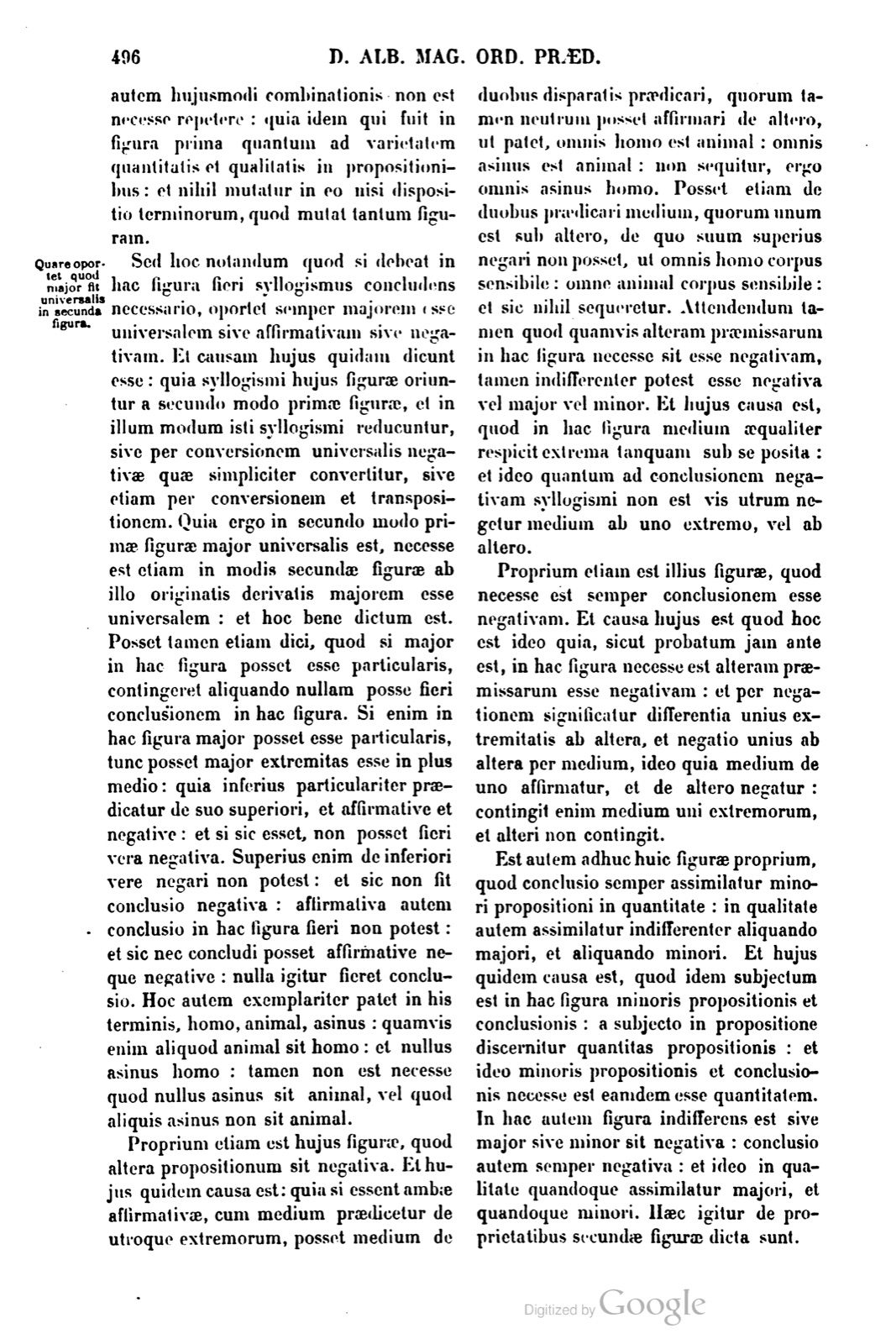
Sed hoc notandum quod si debeat in hac figura fieri syllogismus concludens necessario, oportet semper majorem esse universalem, sive affirmativam sive negativam. Et causam hujus quidam dicunt esse: quia syllogismi hujus figurae oriuntur a secundo modo primae figurae, et in illum modum isti syllogismi reducuntur, sive per conversionem universalis negativae quae simpliciter convertitur, sive etiam per conversionem et transpositionem. Quia ergo in secundo modo primae figurae major universalis est, necesse est etiam in modis secundae figurae ab illo originatis derivatis majorem esse universalem: et hoc bene dictum est. Posset tamen etiam dici, quod si major in hac figura posset esse particularis, contingeret aliquando nullam posse fieri conclusionem in hac figura. Si enim in hac figura major posset esse particularis, tunc posset major extremitas esse in plus medio: quia inferius particulariter praedicatur de suo superiori, et affirmative et negative: et si sic esset, non posset fieri vera negativa. Superius enim de inferiori vere negari non potest: et sic non fit conclusio negativa: affirmativa autem conclusio in hac figura fieri non potest: et sic nec concludi posset affirmative neque negative: nulla igitur fieret conclusio. Hoc autem exemplariter patet in his terminis, homo, animal, asinus: quamvis enim aliquod animal sit homo: et nullus asinus homo: tamen non est necesse quod nullus asinus sit animal, vel quod aliquis asinus non sit animal.
Proprium etiam est hujus figurae, quod altera propositionum sit negativa. Et hujus quidem causa est: quia si essent ambae affirmativae, cum medium praedicetur de utroque extremorum, posset medium de duobus disparatis praedicari, quorum tamen neutrum posset affirmari de altero, ut patet, omnis homo est animal: omnis asinus est animal: non sequitur, ergo omnis asinus homo. Posset etiam de duobus praedicari medium, quorum unum est sub altero, de quo suum superius negari non posset, ut omnis homo corpus sensibile: omne animal corpus sensibile: et sic nihil sequeretur. Attendendum tamen quod quamvis alteram praemissarum in hac figura necesse sit esse negativam, tamen indifferenter potest esse negativa vel major vel minor. Et hujus causa est, quod in hac figura medium aequaliter respicit extrema tanquam sub se posita: et ideo quantum ad conclusionem negativam syllogismi non est vis utrum negetur medium ab uno extremo, vel ab altero.
Proprium etiam est illius figurae, quod necesse est semper conclusionem esse negativam. Et causa hujus est quod hoc est ideo quia, sicut probatum jam ante est, in hac figura necesse est alteram praemissarum esse negativam: et per negationem significatur differentia unius extremitatis ab altera, et negatio unius ab altera per medium, ideo quia medium de uno affirmatur, et de altero negatur: contingit enim medium uni extremorum, et alteri non contingit.
Est autem adhuc huic figurae proprium, quod conclusio semper assimilatur minori propositioni in quantitate: in qualitate autem assimilatur indifferenter aliquando majori, et aliquando minori. Et hujus quidem causa est, quod idem subjectum est in hac figura minoris propositionis et conclusionis: a subjecto in propositione discernitur quantitas propositionis: et ideo minoris propositionis et conclusionis necesse est eamdem esse quantitatem. In hac autem figura indifferens est sive major sive minor sit negativa: conclusio autem semper negativa: et ideo in qualitate quandoque assimilatur majori, et quandoque minori. Haec igitur de proprietatibus secundae figurae dicta sunt.
But this must be noted: if in this figure a syllogism concluding necessarily ought to be made, the major must always be universal, whether affirmative or negative. And some say that the cause of this is that the syllogisms of this figure arise from the second mode of the first figure, and these syllogisms are reduced into that mode, either through the conversion of the universal negative, which is converted simply, or also through conversion and transposition. Therefore, because in the second mode of the first figure the major is universal, it is also necessary in the modes of the second figure derived and originated from it that the major be universal; and this is well said. Yet it could also be said that, if in this figure the major could be particular, it would sometimes happen that no conclusion could be made in this figure. For if in this figure the major could be particular, then the greater extreme could be more extensive than the middle, because the inferior is predicated particularly of its superior, both affirmatively and negatively; and if it were so, a true negative could not be made. For the superior cannot be truly denied of the inferior, and thus no negative conclusion is made; but an affirmative conclusion cannot be made in this figure, and thus it could be concluded neither affirmatively nor negatively; therefore no conclusion would be made. This is clear by example in these terms: man, animal, ass. For although some animal is man and no ass is man, still it is not necessary that no ass be animal, or that some ass not be animal.
It is also proper to this figure that one of the propositions be negative. The cause of this is that if both were affirmative, since the middle is predicated of each extreme, the middle could be predicated of two disparate things, of which nevertheless neither could be affirmed of the other, as is clear: every man is animal; every ass is animal; therefore it does not follow that every ass is man. The middle could also be predicated of two things of which one is under the other and of which its superior could not be denied, as: every man is a sensible body; every animal is a sensible body; and thus nothing would follow. Yet it must be attended to that, although one of the premises in this figure must be negative, nevertheless either the major or the minor can indifferently be negative. And the cause of this is that in this figure the middle regards the extremes equally as placed under it; and therefore with respect to the negative conclusion of the syllogism it makes no difference whether the middle is denied of one extreme or of the other.
It is also proper to this figure that the conclusion must always be negative. The cause of this is that this is so because, as has already been proved, in this figure one of the premises must be negative; and through negation the difference of one extreme from the other is signified, and the negation of one from the other through the middle, precisely because the middle is affirmed of one and denied of the other: for the middle happens to one of the extremes and does not happen to the other.
It is still proper to this figure that the conclusion is always assimilated to the minor proposition in quantity; but in quality it is assimilated indifferently sometimes to the major and sometimes to the minor. The cause of this is that the same thing is the subject in this figure of the minor proposition and of the conclusion. From the subject in a proposition the quantity of the proposition is discerned, and therefore the minor proposition and the conclusion must have the same quantity. But in this figure it is indifferent whether the major or the minor is negative; the conclusion, however, is always negative; and therefore in quality it is sometimes assimilated to the major and sometimes to the minor. These things, therefore, have been said about the properties of the second figure.
If a page does not appear, its photograph has not been uploaded yet.