Works › Prior Analytics, Books I–II
Volume 1 · pp. 477–480
Chapter XIII. On the Conversion of Affirmative Propositions Concerning the Contingent.
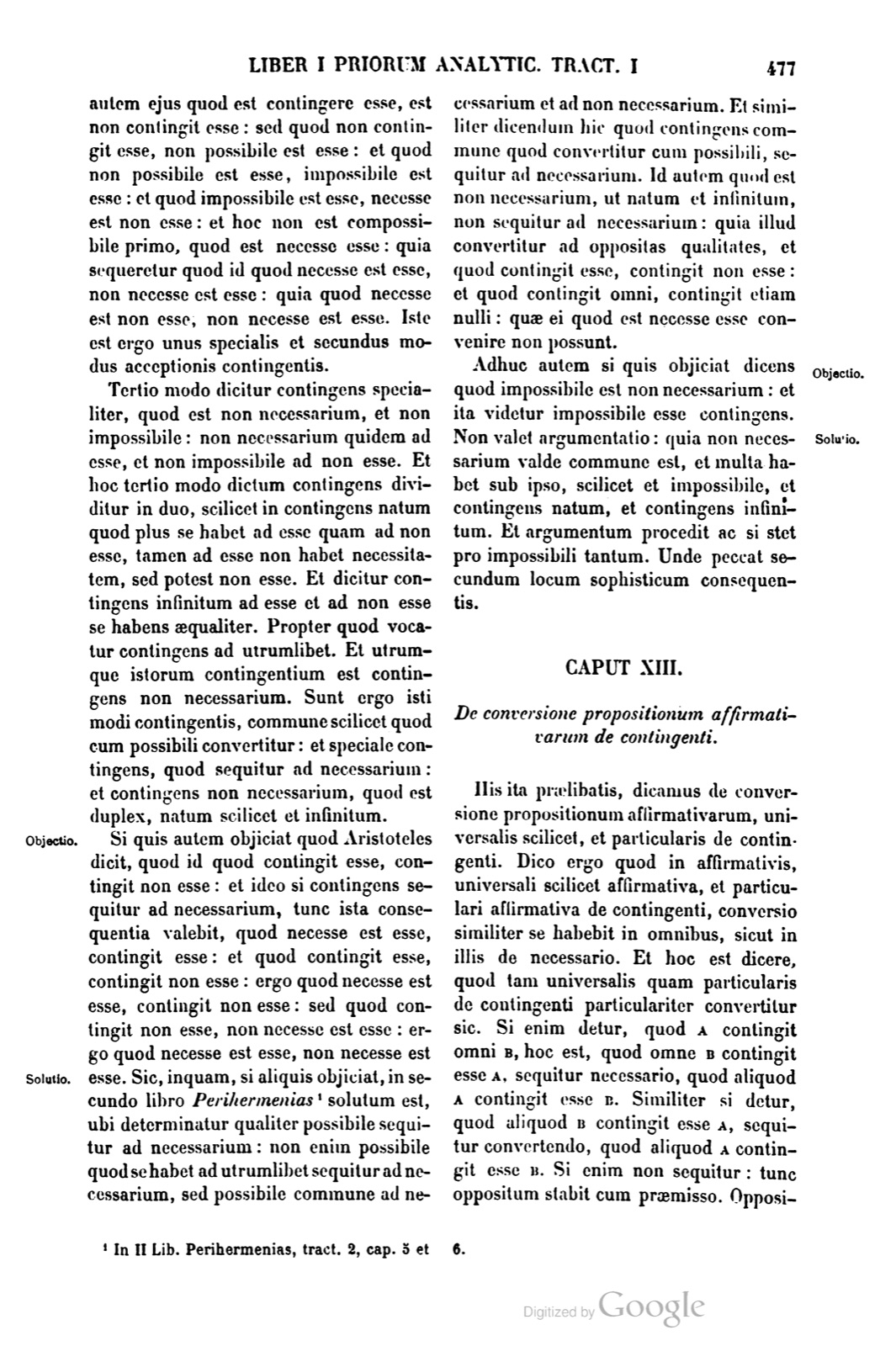
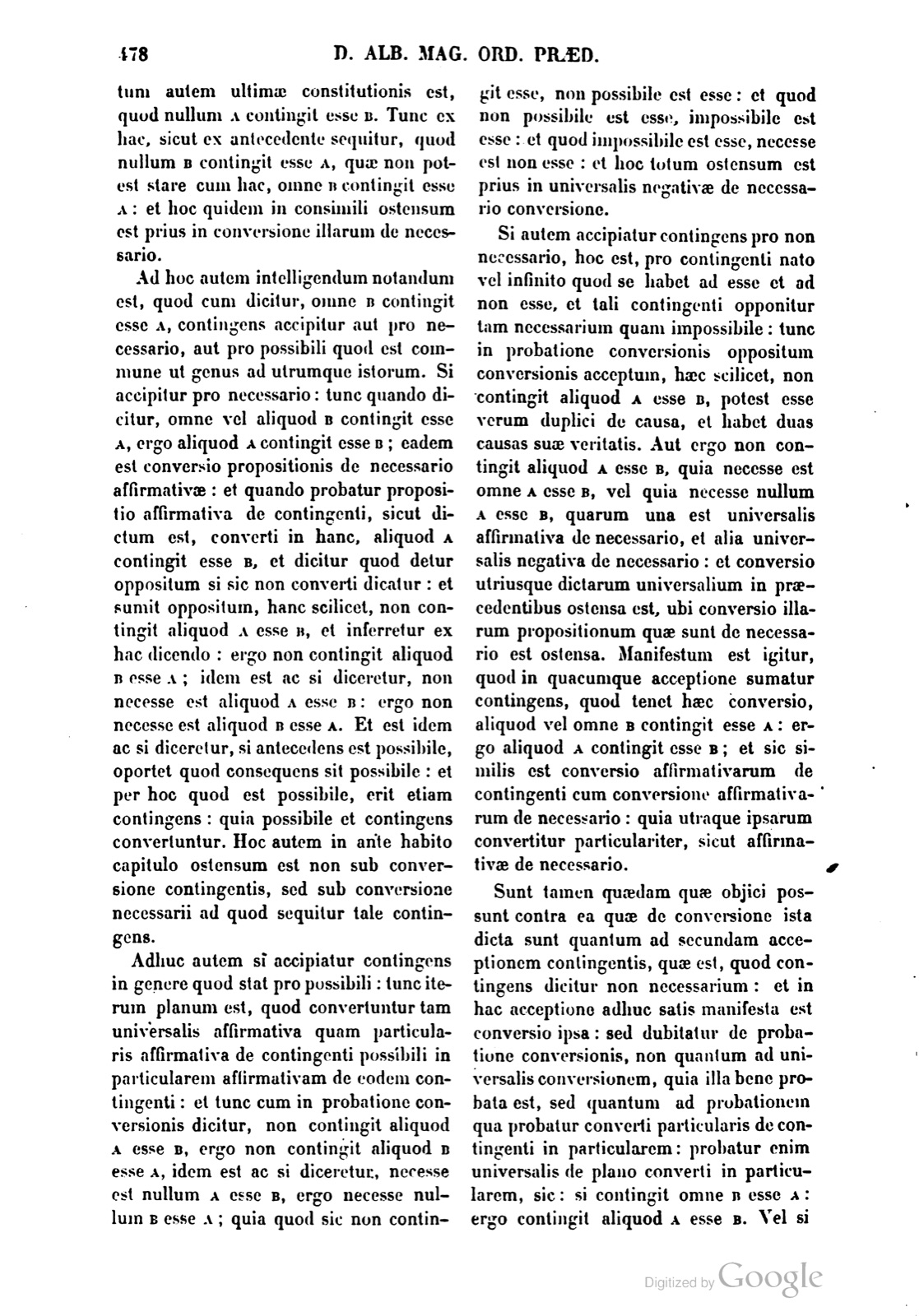
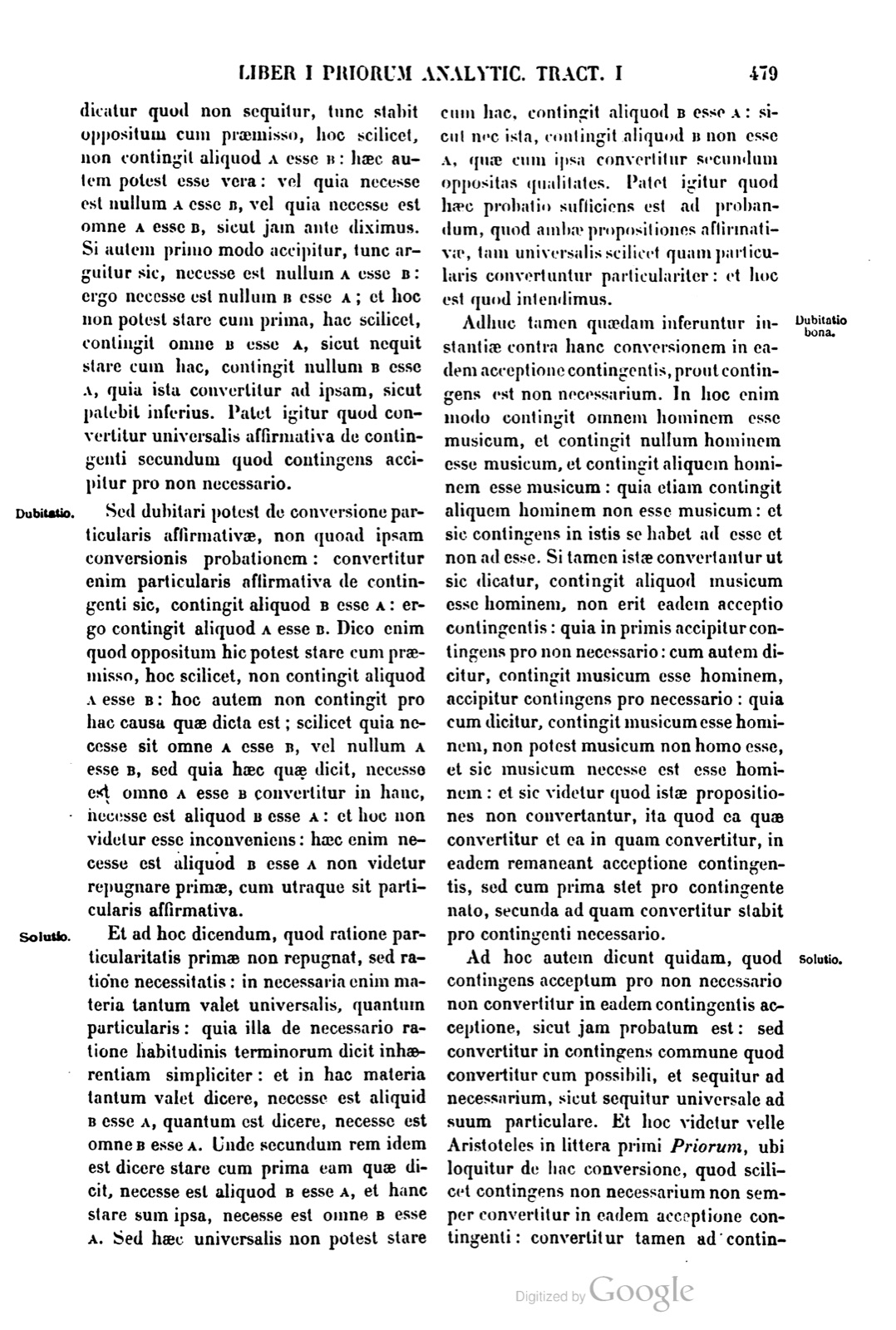
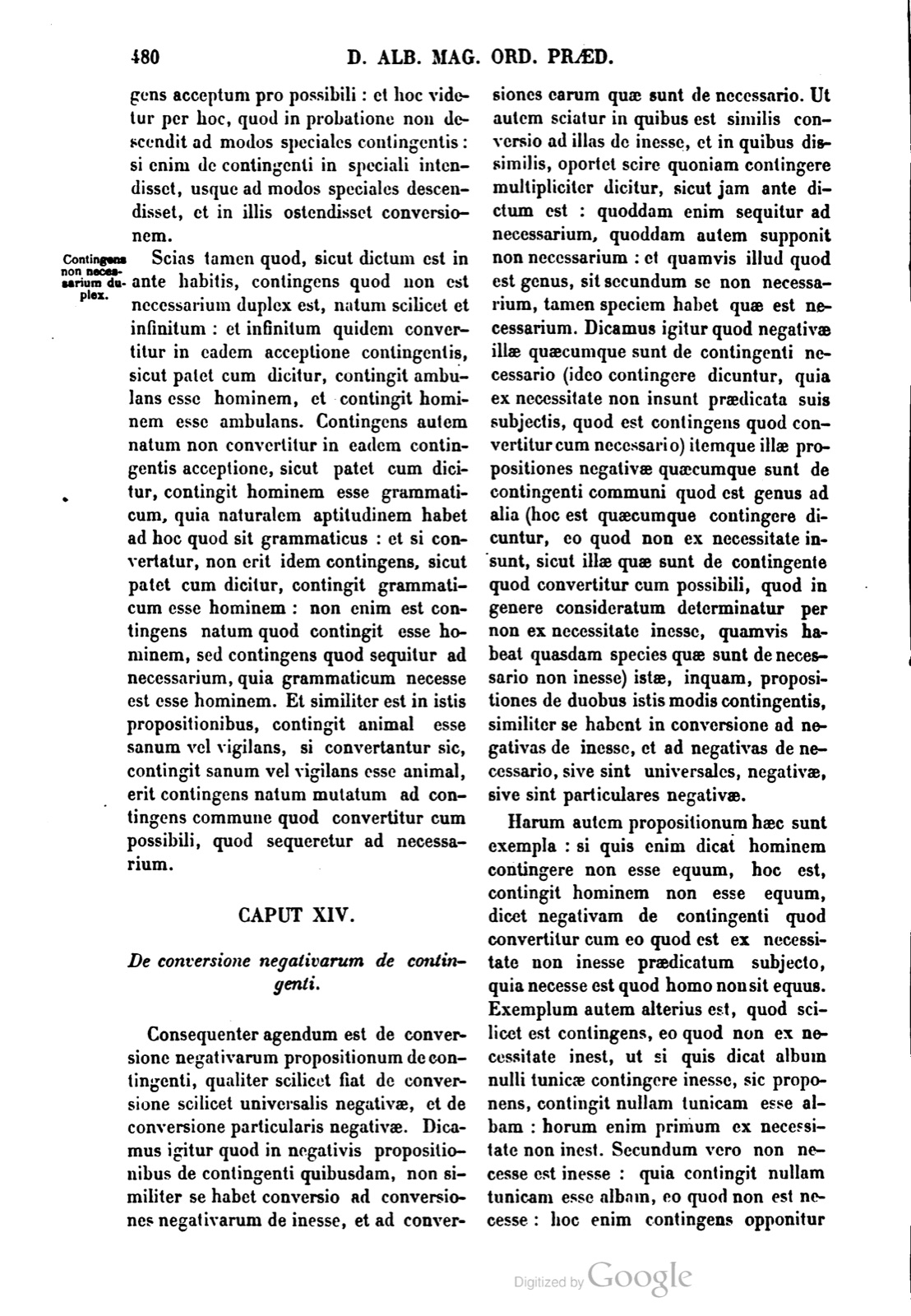
CAPUT XIII. De conversione propositionum affirmativarum de contingenti. His ita praelibatis, dicamus de conversione propositionum affirmativarum, universalis scilicet, et particularis de contingenti. Dico ergo quod in affirmativis, universali scilicet affirmativa, et particulari affirmativa de contingenti, conversio similiter se habebit in omnibus, sicut in illis de necessario. Et hoc est dicere, quod tam universalis quam particularis de contingenti particulariter convertitur sic. Si enim detur, quod A contingit omni B, hoc est, quod omne B contingit esse A, sequitur necessario, quod aliquod A contingit esse B. Similiter si detur, quod aliquod B contingit esse A, sequitur convertendo, quod aliquod A contingit esse B. Si enim non sequitur: tunc oppositum stabit cum praemisso. Oppositum autem ultimae constitutionis est, quod nullum A contingit esse B. Tunc ex hac, sicut ex antecedente sequitur, quod nullum B contingit esse A, quae non potest stare cum hac, omne B contingit esse A: et hoc quidem in consimili ostensum est prius in conversione illarum de necessario. Ad hoc autem intelligendum notandum est, quod cum dicitur, omne B contingit esse A, contingens accipitur aut pro necessario, aut pro possibili quod est commune ut genus ad utrumque istorum. Si accipitur pro necessario: tunc quando dicitur, omne vel aliquod B contingit esse A, ergo aliquod A contingit esse B; eadem est conversio propositionis de necessario affirmativae: et quando probatur propositio affirmativa de contingenti, sicut dictum est, converti in hanc, aliquod A contingit esse B, et dicitur quod detur oppositum si sic non converti dicatur: et sumit oppositum, hanc scilicet, non contingit aliquod A esse B, et inferretur ex hac dicendo: ergo non contingit aliquod B esse A; idem est ac si diceretur, non necesse est aliquod A esse B: ergo non necesse est aliquod B esse A. Et est idem ac si diceretur, si antecedens est possibile, oportet quod consequens sit possibile: et per hoc quod est possibile, erit etiam contingens: quia possibile et contingens convertuntur. Hoc autem in ante habito capitulo ostensum est non sub conversione contingentis, sed sub conversione necessarii ad quod sequitur tale contingens. Adhuc autem si accipiatur contingens in genere quod stat pro possibili: tunc iterum planum est, quod convertuntur tam universalis affirmativa quam particularis affirmativa de contingenti possibili in particularem affirmativam de eodem contingenti: et tunc cum in probatione conversionis dicitur, non contingit aliquod A esse B, ergo non contingit aliquod B esse A, idem est ac si diceretur, necesse est nullum A esse B, ergo necesse nullum B esse A; quia quod sic non contingit esse, non possibile est esse: et quod non possibile est esse, impossibile est esse: et quod impossibile est esse, necesse est non esse: et hoc totum ostensum est prius in universalis negativae de necessario conversione. Si autem accipiatur contingens pro non necessario, hoc est, pro contingenti nato vel infinito quod se habet ad esse et ad non esse, et tali contingenti opponitur tam necessarium quam impossibile: tunc in probatione conversionis oppositum conversionis acceptum, haec scilicet, non contingit aliquod A esse B, potest esse verum duplici de causa, et habet duas causas suae veritatis. Aut ergo non contingit aliquod A esse B, quia necesse est omne A esse B, vel quia necesse nullum A esse B, quarum una est universalis affirmativa de necessario, et alia universalis negativa de necessario: et conversio utriusque dictarum universalium in praecedentibus ostensa est, ubi conversio illarum propositionum quae sunt de necessario est ostensa. Manifestum est igitur, quod in quacumque acceptione sumatur contingens, quod tenet haec conversio, aliquod vel omne B contingit esse A: ergo aliquod A contingit esse B; et sic similis est conversio affirmativarum de contingenti cum conversione affirmativarum de necessario: quia utraque ipsarum convertitur particulariter, sicut affirmativae de necessario. Sunt tamen quaedam quae objici possunt contra ea quae de conversione ista dicta sunt quantum ad secundam acceptionem contingentis, quae est, quod contingens dicitur non necessarium: et in hac acceptione adhuc satis manifesta est conversio ipsa: sed dubitatur de probatione conversionis, non quantum ad universalis conversionem, quia illa bene probata est, sed quantum ad probationem qua probatur converti particularis de contingenti in particularem: probatur enim universalis de plano converti in particularem, sic: si contingit omne B esse A: ergo contingit aliquod A esse B. Vel si dicatur quod non sequitur, tunc stabit oppositum cum praemisso, hoc scilicet, non contingit aliquod A esse B: haec autem potest esse vera: vel quia necesse est nullum A esse B, vel quia necesse est omne A esse B, sicut jam ante diximus. Si autem primo modo accipitur, tunc arguitur sic, necesse est nullum A esse B: ergo necesse est nullum B esse A; et hoc non potest stare cum prima, hac scilicet, contingit omne B esse A, sicut nequit stare cum hac, contingit nullum B esse A, quia ista convertitur ad ipsam, sicut patebit inferius. Patet igitur quod convertitur universalis affirmativa de contingenti secundum quod contingens accipitur pro non necessario. Sed dubitari potest de conversione particularis affirmativae, non quoad ipsam conversionis probationem: convertitur enim particularis affirmativa de contingenti sic, contingit aliquod B esse A: ergo contingit aliquod A esse B. Dico enim quod oppositum hic potest stare cum praemisso, hoc scilicet, non contingit aliquod A esse B: hoc autem non contingit pro hac causa quae dicta est; scilicet quia necesse sit omne A esse B, vel nullum A esse B, sed quia haec quae dicit, necesse est omne A esse A convertitur in hanc, necesse est aliquod B esse A: et hoc non videtur esse inconveniens: haec enim necesse est aliquod B esse A non videtur repugnare primae, cum utraque sit particularis affirmativa. Et ad hoc dicendum, quod ratione particularitatis primae non repugnat, sed ratione necessitatis: in necessaria enim materia tantum valet universalis, quantum particularis: quia illa de necessario ratione habitudinis terminorum dicit inhaerentiam simpliciter: et in hac materia tantum valet dicere, necesse est aliquid B esse A, quantum est dicere, necesse est omne B esse A. Unde secundum rem idem est dicere stare cum prima eam quae dicit, necesse est aliquod B esse A, et hanc stare cum ipsa, necesse est omne B esse A. Sed haec universalis non potest stare cum hac, contingit aliquod B esse A: sicut nec ista, contingit aliquod B non esse A, quae cum ipsa convertitur secundum oppositas qualitates. Patet igitur quod haec probatio sufficiens est ad probandum, quod ambae propositiones affirmativae, tam universalis scilicet quam particularis convertuntur particulariter: et hoc est quod intendimus. Adhuc tamen quaedam inferuntur instantiae contra hanc conversionem in eadem acceptione contingentis, prout contingens est non necessarium. In hoc enim modo contingit omnem hominem esse musicum, et contingit nullum hominem esse musicum, et contingit aliquem hominem esse musicum: quia etiam contingit aliquem hominem non esse musicum: et sic contingens in istis se habet ad esse et non ad esse. Si tamen istae convertantur ut sic dicatur, contingit aliquod musicum esse hominem, non erit eadem acceptio contingentis: quia in primis accipitur contingens pro non necessario: cum autem dicitur, contingit musicum esse hominem, accipitur contingens pro necessario: quia cum dicitur, contingit musicum esse hominem, non potest musicum non homo esse, et sic musicum necesse est esse hominem: et sic videtur quod istae propositiones non convertantur, ita quod ea quae convertitur et ea in quam convertitur, in eadem remaneant acceptione contingentis, sed cum prima stet pro contingente nato, secunda ad quam convertitur stabit pro contingenti necessario. Ad hoc autem dicunt quidam, quod contingens acceptum pro non necessario non convertitur in eadem contingentis acceptione, sicut jam probatum est: sed convertitur in contingens commune quod convertitur cum possibili, et sequitur ad necessarium, sicut sequitur universale ad suum particulare. Et hoc videtur velle Aristoteles in littera primi Priorum, ubi loquitur de hac conversione, quod scilicet contingens non necessarium non semper convertitur in eadem acceptione contingenti: convertitur tamen ad contingens acceptum pro possibili: et hoc videtur per hoc, quod in probatione non descendit ad modos speciales contingentis: si enim de contingenti in speciali intendisset, usque ad modos speciales descendisset, et in illis ostendisset conversionem. Scias tamen quod, sicut dictum est in ante habitis, contingens quod non est necessarium duplex est, natum scilicet et infinitum: et infinitum quidem convertitur in eadem acceptione contingentis, sicut patet cum dicitur, contingit ambulans esse hominem, et contingit hominem esse ambulans. Contingens autem natum non convertitur in eadem contingentis acceptione, sicut patet cum dicitur, contingit hominem esse grammaticum, quia naturalem aptitudinem habet ad hoc quod sit grammaticus: et si convertatur, non erit idem contingens, sicut patet cum dicitur, contingit grammaticum esse hominem: non enim est contingens natum quod contingit esse hominem, sed contingens quod sequitur ad necessarium, quia grammaticum necesse est esse hominem. Et similiter est in istis propositionibus, contingit animal esse sanum vel vigilans, si convertantur sic, contingit sanum vel vigilans esse animal, erit contingens natum mutatum ad contingens commune quod convertitur cum possibili, quod sequeretur ad necessarium.
CHAPTER XIII. On the conversion of affirmative propositions concerning the contingent. With these things thus tasted beforehand, let us speak about the conversion of affirmative propositions, namely the universal and the particular about the contingent. Therefore I say that in affirmatives, namely in the universal affirmative and the particular affirmative about the contingent, conversion will hold itself in all respects in the same way as in those about the necessary. And this is to say that both the universal and the particular about the contingent are converted particularly in this way. For if it is granted that A contingently belongs to every B, that is, that every B contingently is A, it follows necessarily that some A contingently is B. Similarly, if it is granted that some B contingently is A, it follows by converting that some A contingently is B. For if it does not follow, then the opposite will stand with the premise. But the opposite of the final constitution is that no A contingently is B. Then from this, as from an antecedent, it follows that no B contingently is A, which cannot stand with this, every B contingently is A; and this indeed was shown before in a similar case in the conversion of those propositions about the necessary. But for understanding this, one must note that when it is said, every B contingently is A, the contingent is taken either for the necessary, or for the possible which is common as a genus to both of those. If it is taken for the necessary, then when it is said, every or some B contingently is A, therefore some A contingently is B, it is the same conversion of an affirmative proposition about the necessary. And when an affirmative proposition about the contingent is proved, as has been said, to be converted into this, some A contingently is B, and it is said that the opposite should be granted if it is said not to be converted in this way, and the opposite is taken, namely this, it does not contingently happen that some A is B, and from this it would be inferred by saying, therefore it does not contingently happen that some B is A, it is the same as if it were said: it is not necessary that some A be B; therefore it is not necessary that some B be A. And it is the same as if it were said: if the antecedent is possible, the consequent must be possible; and through the fact that it is possible, it will also be contingent, because possible and contingent are converted. But this was shown in the chapter had before, not under the conversion of the contingent, but under the conversion of the necessary, upon which such a contingent follows. Further, if the contingent is taken in the genus which stands for the possible, then again it is plain that both the universal affirmative and the particular affirmative about the possible contingent are converted into a particular affirmative about the same contingent; and then, when in the proof of conversion it is said, it does not contingently happen that some A is B, therefore it does not contingently happen that some B is A, it is the same as if it were said: it is necessary that no A be B; therefore it is necessary that no B be A. For what in this way does not contingently be is not possible to be; and what is not possible to be is impossible to be; and what is impossible to be is necessary not to be; and this whole thing was shown before in the conversion of the universal negative about the necessary. But if the contingent is taken for the non-necessary, that is, for the native or infinite contingent which holds itself to being and to non-being, and both the necessary and the impossible are opposed to such a contingent, then, in the proof of conversion, the opposite of the conversion that has been taken, namely this, it does not contingently happen that some A is B, can be true from a twofold cause and has two causes of its truth. Therefore either it does not contingently happen that some A is B because it is necessary that every A be B, or because it is necessary that no A be B; of these, one is a universal affirmative about the necessary, and the other a universal negative about the necessary. And the conversion of each of the stated universals was shown in the preceding matters, where the conversion of those propositions which are about the necessary was shown. Therefore it is manifest that in whatever acceptance the contingent is taken, this conversion holds: some or every B contingently is A; therefore some A contingently is B. And thus the conversion of affirmatives about the contingent is similar to the conversion of affirmatives about the necessary, because each of them is converted particularly, just as affirmatives about the necessary are. Nevertheless certain things can be objected against the things that have been said about this conversion with respect to the second acceptance of the contingent, which is that the contingent is called non-necessary. And in this acceptance the conversion itself is still sufficiently manifest; but there is doubt about the proof of the conversion, not with respect to the conversion of the universal, because that has been well proved, but with respect to the proof by which the particular about the contingent is proved to be converted into a particular. For the universal is plainly proved to be converted into a particular in this way: if every B contingently is A, therefore some A contingently is B. Or if it is said that it does not follow, then the opposite will stand with the premise, namely this, it does not contingently happen that some A is B. But this can be true either because it is necessary that no A be B, or because it is necessary that every A be B, as we said before. But if it is taken in the first way, then it is argued thus: it is necessary that no A be B; therefore it is necessary that no B be A. And this cannot stand with the first, namely this, every B contingently is A, just as it cannot stand with this, no B contingently is A, because that proposition is converted to it, as will be clear below. Therefore it is clear that the universal affirmative about the contingent is converted insofar as the contingent is taken for the non-necessary. But there can be doubt about the conversion of the particular affirmative, not with respect to the proof of the conversion itself, for a particular affirmative about the contingent is converted thus: some B contingently is A; therefore some A contingently is B. For I say that the opposite here can stand with the premise, namely this, it does not contingently happen that some A is B. But this does not happen for the cause which has been stated, namely because it is necessary that every A be B or that no A be B, but because this which says, it is necessary that every A be A, is converted into this, it is necessary that some B be A; and this does not seem to be unfitting. For this, it is necessary that some B be A, does not seem to be repugnant to the first, since each is a particular affirmative. And to this one must say that it is not repugnant by reason of the particularity of the first, but by reason of necessity. For in necessary matter the universal is worth as much as the particular, because that proposition about the necessary, by reason of the disposition of terms, says inherence simply; and in this matter it is worth as much to say, it is necessary that some B be A, as to say, it is necessary that every B be A. Hence according to the thing it is the same to say that with the first stands that proposition which says, it is necessary that some B be A, and that this proposition stands with it: it is necessary that every B be A. But this universal cannot stand with this, some B contingently is A, just as neither can this, some B contingently is not A, which is converted with it according to opposite qualities. Therefore it is clear that this proof is sufficient for proving that both affirmative propositions, namely the universal and the particular, are converted particularly; and this is what we intend. Yet certain instances are still inferred against this conversion in the same acceptance of the contingent, insofar as the contingent is non-necessary. For in this way it contingently happens that every human being is musical, and it contingently happens that no human being is musical, and it contingently happens that some human being is musical, because it also contingently happens that some human being is not musical; and thus the contingent in these cases holds itself to being and to non-being. Yet if these are converted so that it is said in this way, it contingently happens that some musical thing is a human being, it will not be the same acceptance of the contingent, because in the first propositions the contingent is taken for the non-necessary, but when it is said, it contingently happens that the musical is a human being, the contingent is taken for the necessary. For when it is said, it contingently happens that the musical is a human being, the musical cannot be a non-human being, and thus the musical is necessarily a human being. And so it seems that these propositions are not converted in such a way that the proposition which is converted and that into which it is converted remain in the same acceptance of the contingent; rather, while the first stands for the native contingent, the second to which it is converted will stand for the necessary contingent. To this, however, some say that the contingent taken for the non-necessary is not converted in the same acceptance of the contingent, as has already been proved, but is converted into the common contingent which is converted with the possible and follows upon the necessary, just as the universal follows upon its particular. And this Aristotle seems to intend in the text of the first book of the Prior Analytics, where he speaks about this conversion: namely, that the non-necessary contingent is not always converted in the same contingent acceptance; nevertheless it is converted to the contingent taken for the possible. And this seems from the fact that in the proof he does not descend to the special modes of the contingent; for if he had intended the contingent in special, he would have descended all the way to the special modes and would have shown conversion in them. Yet you should know that, as was said in the preceding matters, the contingent which is not necessary is twofold, namely native and infinite. And the infinite is indeed converted in the same acceptance of the contingent, as is clear when it is said, it contingently happens that what is walking is a human being, and it contingently happens that a human being is walking. But the native contingent is not converted in the same acceptance of the contingent, as is clear when it is said, it contingently happens that a human being is grammatical, because he has a natural aptitude for this, that he be grammatical; and if it is converted, it will not be the same contingent, as is clear when it is said, it contingently happens that the grammatical is a human being. For it is not a native contingent that it contingently happens to be a human being, but a contingent which follows upon the necessary, because the grammatical is necessarily a human being. And it is similar in these propositions: it contingently happens that an animal is healthy or awake; if they are converted in this way, it contingently happens that the healthy or awake thing is an animal, the native contingent will have been changed to the common contingent which is converted with the possible, which would follow upon the necessary.
If a page does not appear, its photograph has not been uploaded yet.