Works › Prior Analytics, Books I–II
Volume 1 · pp. 476–477
Chapter XII. On the Distinction of the Modes in Which the Contingent Is Taken.
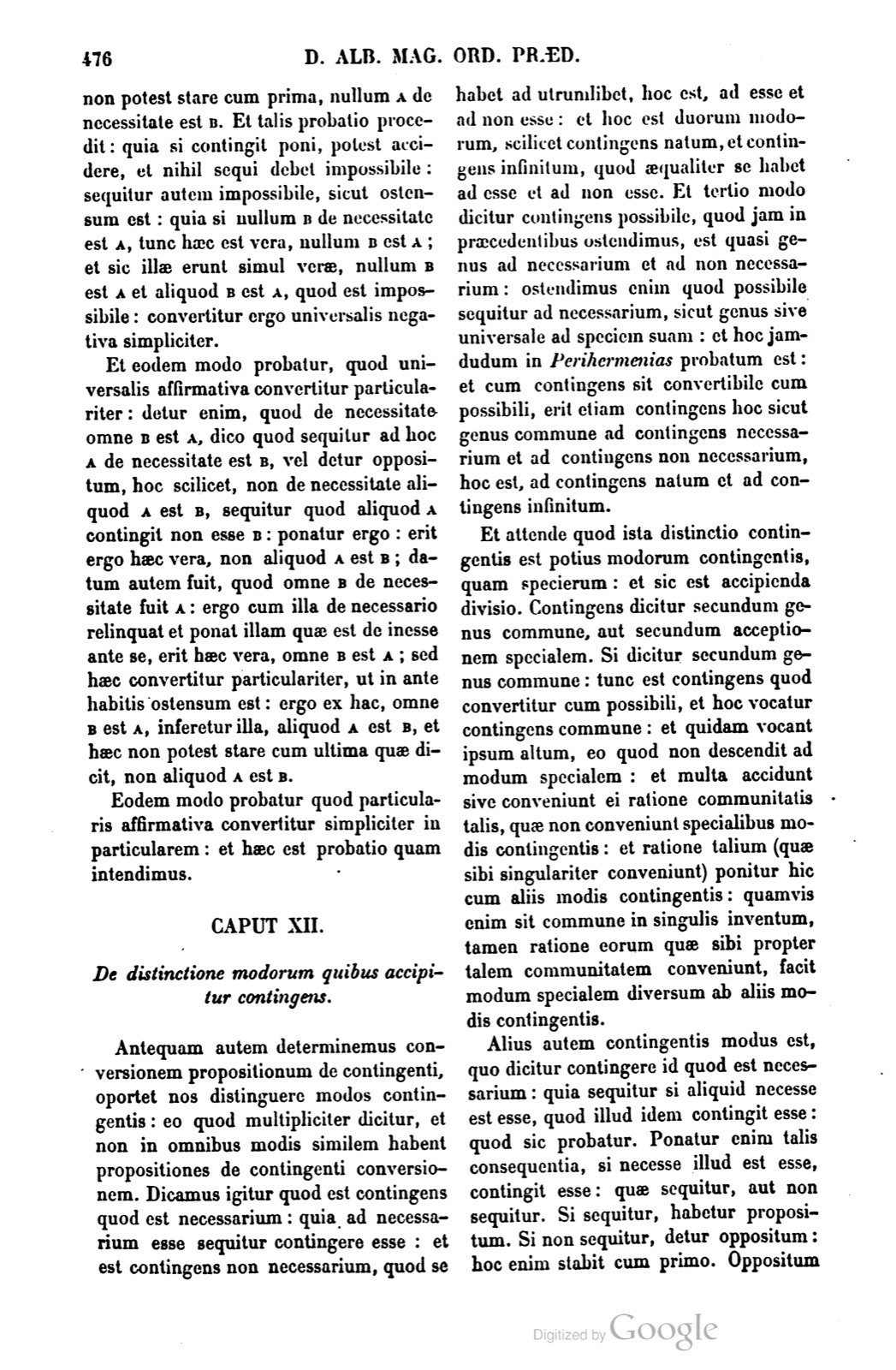
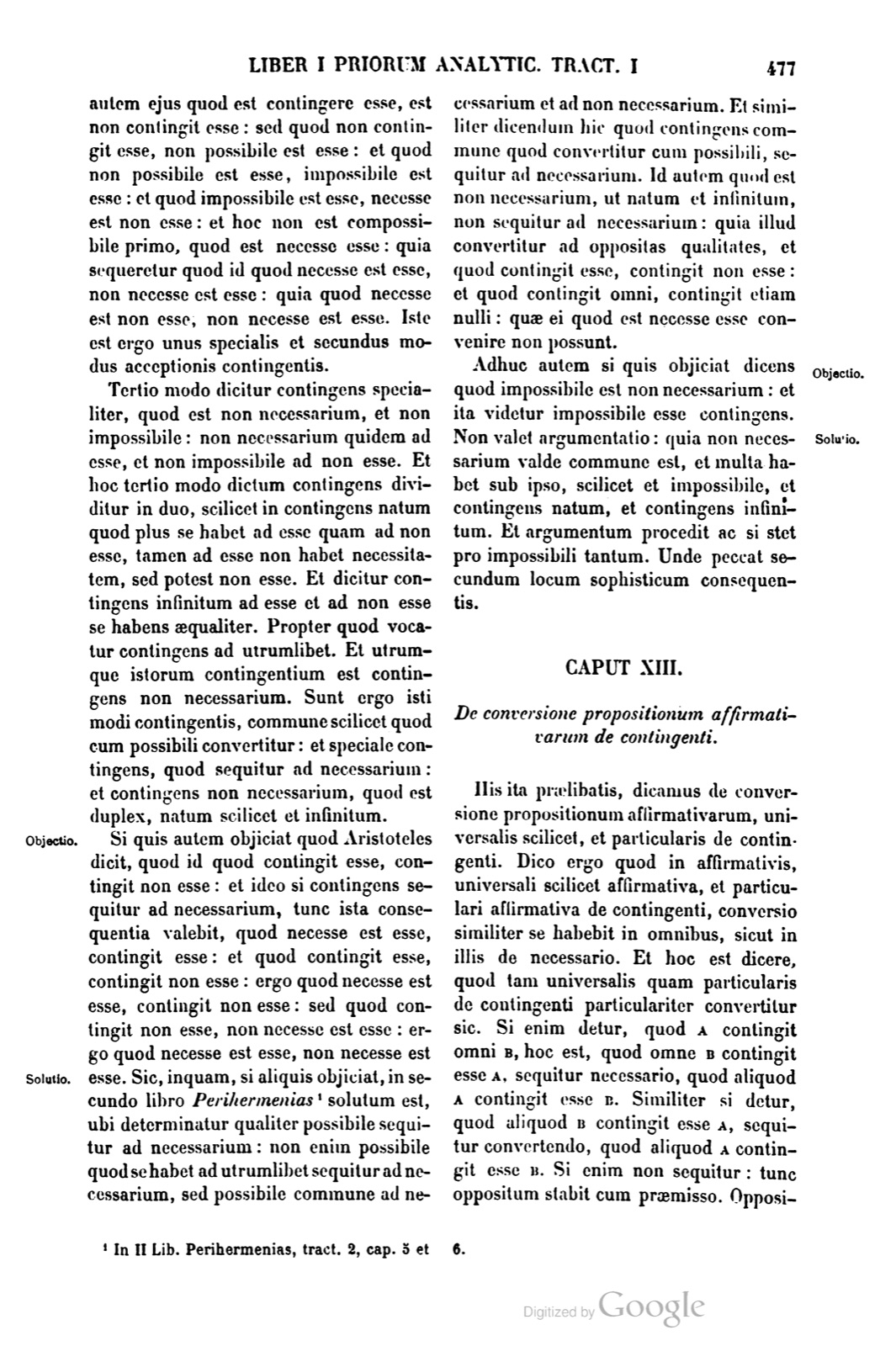
CAPUT XII. De distinctione modorum quibus accipitur contingens. Antequam autem determinemus conversionem propositionum de contingenti, oportet nos distinguere modos contingentis: eo quod multipliciter dicitur, et non in omnibus modis similem habent propositiones de contingenti conversionem. Dicamus igitur quod est contingens quod est necessarium: quia ad necessarium esse sequitur contingere esse: et est contingens non necessarium, quod se habet ad utrumlibet, hoc est, ad esse et ad non esse: et hoc est duorum modorum, scilicet contingens natum, et contingens infinitum, quod aequaliter se habet ad esse et ad non esse. Et tertio modo dicitur contingens possibile, quod jam in praecedentibus ostendimus, est quasi genus ad necessarium et ad non necessarium: ostendimus enim quod possibile sequitur ad necessarium, sicut genus sive universale ad speciem suam: et hoc jamdudum in Perihermenias probatum est: et cum contingens sit convertibile cum possibili, erit etiam contingens hoc sicut genus commune ad contingens necessarium et ad contingens non necessarium, hoc est, ad contingens natum et ad contingens infinitum. Et attende quod ista distinctio contingentis est potius modorum contingentis, quam specierum: et sic est accipienda divisio. Contingens dicitur secundum genus commune, aut secundum acceptionem specialem. Si dicitur secundum genus commune: tunc est contingens quod convertitur cum possibili, et hoc vocatur contingens commune: et quidam vocant ipsum altum, eo quod non descendit ad modum specialem: et multa accidunt sive conveniunt ei ratione communitatis talis, quae non conveniunt specialibus modis contingentis: et ratione talium quae sibi singulariter conveniunt ponitur hic cum aliis modis contingentis: quamvis enim sit commune in singulis inventum, tamen ratione eorum quae sibi propter talem communitatem conveniunt, facit modum specialem diversum ab aliis modis contingentis. Alius autem contingentis modus est, quo dicitur contingere id quod est necessarium: quia sequitur si aliquid necesse est esse, quod illud idem contingit esse: quod sic probatur. Ponatur enim talis consequentia, si necesse illud est esse, contingit esse: quae sequitur, aut non sequitur. Si sequitur, habetur propositum. Si non sequitur, detur oppositum: hoc enim stabit cum primo. Oppositum autem ejus quod est contingere esse, est non contingit esse: sed quod non contingit esse, non possibile est esse: et quod non possibile est esse, impossibile est esse: et quod impossibile est esse, necesse est non esse: et hoc non est compossibile primo, quod est necesse esse: quia sequeretur quod id quod necesse est esse, non necesse est esse: quia quod necesse est non esse, non necesse est esse. Iste est ergo unus specialis et secundus modus acceptionis contingentis. Tertio modo dicitur contingens specialiter, quod est non necessarium, et non impossibile: non necessarium quidem ad esse, et non impossibile ad non esse. Et hoc tertio modo dictum contingens dividitur in duo, scilicet in contingens natum quod plus se habet ad esse quam ad non esse, tamen ad esse non habet necessitatem, sed potest non esse. Et dicitur contingens infinitum ad esse et ad non esse se habens aequaliter. Propter quod vocatur contingens ad utrumlibet. Et utrumque istorum contingentium est contingens non necessarium. Sunt ergo isti modi contingentis, commune scilicet quod cum possibili convertitur: et speciale contingens, quod sequitur ad necessarium: et contingens non necessarium, quod est duplex, natum scilicet et infinitum. Si quis autem objiciat quod Aristoteles dicit, quod id quod contingit esse, contingit non esse: et ideo si contingens sequitur ad necessarium, tunc ista consequentia valebit, quod necesse est esse, contingit esse: et quod contingit esse, contingit non esse: ergo quod necesse est esse, contingit non esse: sed quod contingit non esse, non necesse est esse: ergo quod necesse est esse, non necesse est esse. Sic, inquam, si aliquis objiciat, in secundo libro Perihermenias 1 solutum est, ubi determinatur qualiter possibile sequitur ad necessarium: non enim possibile quod se habet ad utrumlibet sequitur ad necessarium, sed possibile commune ad necessarium et ad non necessarium. Et similiter dicendum hic quod contingens commune quod convertitur cum possibili, sequitur ad necessarium. Id autem quod est non necessarium, ut natum et infinitum, non sequitur ad necessarium: quia illud convertitur ad oppositas qualitates, et quod contingit esse, contingit non esse: et quod contingit omni, contingit etiam nulli: quae ei quod est necesse esse convenire non possunt. Adhuc autem si quis objiciat dicens quod impossibile est non necessarium: et ita videtur impossibile esse contingens. Non valet argumentatio: quia non necessarium valde commune est, et multa habet sub ipso, scilicet et impossibile, et contingens natum, et contingens infinitum. Et argumentum procedit ac si stet pro impossibili tantum. Unde peccat secundum locum sophisticum consequentis.
CHAPTER XII. On the distinction of the modes in which the contingent is taken. But before we determine the conversion of propositions about the contingent, we must distinguish the modes of the contingent, because it is said in many ways, and propositions about the contingent do not have a similar conversion in all modes. Therefore let us say that there is a contingent which is necessary, because upon necessary being there follows contingent being; and there is a non-necessary contingent, which holds itself to either side, that is, to being and to non-being; and this is of two modes, namely the native contingent and the infinite contingent, which holds itself equally to being and to non-being. And in a third mode the possible contingent is spoken of, which we have already shown in the preceding matters to be as it were a genus to the necessary and to the non-necessary; for we have shown that the possible follows upon the necessary as a genus or universal upon its species. And this was proved long ago in On Interpretation. And since contingent is convertible with possible, this contingent too will be as a common genus to the necessary contingent and to the non-necessary contingent, that is, to the native contingent and to the infinite contingent. And attend that this distinction of the contingent is rather of modes of the contingent than of species; and the division must be taken in this way. The contingent is said according to a common genus or according to a special acceptance. If it is said according to the common genus, then it is the contingent which is converted with the possible, and this is called the common contingent; and some call it high, because it does not descend to a special mode. And many things happen or belong to it by reason of such commonness which do not belong to the special modes of the contingent; and by reason of such things which belong to it singularly, it is put here with the other modes of the contingent. For although it is common and found in each, nevertheless by reason of those things which belong to it because of such commonness, it makes a special mode diverse from the other modes of the contingent. But another mode of the contingent is that by which that which is necessary is said to contingently be, because if something necessarily is, it follows that the same thing contingently is. This is proved in this way. Let such a consequence be posited: if that necessarily is, it contingently is. This consequence either follows or does not follow. If it follows, the proposed point is had. If it does not follow, let the opposite be granted, for this will stand with the first. But the opposite of this, contingently to be, is: it does not contingently be. But what does not contingently be is not possible to be; and what is not possible to be is impossible to be; and what is impossible to be is necessary not to be. And this is not compossible with the first, which is: it is necessary to be, because it would follow that what is necessary to be is not necessary to be, because what is necessary not to be is not necessary to be. Therefore this is one special and second mode of the acceptance of the contingent. In a third mode the contingent is said specially: that which is non-necessary and not impossible; non-necessary indeed with respect to being and not impossible with respect to not being. And the contingent said in this third mode is divided into two, namely into the native contingent, which is more disposed to being than to non-being, yet does not have necessity with respect to being, but can not be; and the infinite contingent is said to be what holds itself equally to being and to non-being. On account of this it is called contingent to either side. And each of these contingents is a non-necessary contingent. Therefore these are the modes of the contingent: namely the common, which is converted with the possible; the special contingent, which follows upon the necessary; and the non-necessary contingent, which is twofold, namely native and infinite. But if someone objects that Aristotle says that what contingently is contingently is not, and therefore, if the contingent follows upon the necessary, then this consequence will be valid: what is necessary to be contingently is; and what contingently is contingently is not; therefore what is necessary to be contingently is not; but what contingently is not is not necessary to be; therefore what is necessary to be is not necessary to be. If, I say, someone objects in this way, it has been solved in the second book of On Interpretation 1, where it is determined how the possible follows upon the necessary. For the possible which holds itself to either side does not follow upon the necessary, but the common possible follows upon the necessary and upon the non-necessary. And similarly one must say here that the common contingent, which is converted with the possible, follows upon the necessary. But that which is non-necessary, such as the native and the infinite, does not follow upon the necessary, because it is converted to opposite qualities: both that what contingently is contingently is not, and that what contingently belongs to every also contingently belongs to none; and these cannot suit that which is necessary to be. Further, if someone objects by saying that the impossible is non-necessary, and thus it seems that the impossible is contingent, the argumentation is not valid, because non-necessary is very common and has many things under it, namely both impossible, native contingent, and infinite contingent. And the argument proceeds as if it stood for the impossible only. Hence it sins according to the sophistical place of the consequent.
Notes
- In book II of On Interpretation, treatise 2, chapters 5 and 6. (In II Lib. Perihermenias, tract. 2, cap. 5 et 6.) ↩
If a page does not appear, its photograph has not been uploaded yet.