Works › Prior Analytics, Books I–II
Volume 1 · pp. 480–482
Chapter XIV. On the Conversion of Negatives Concerning the Contingent.
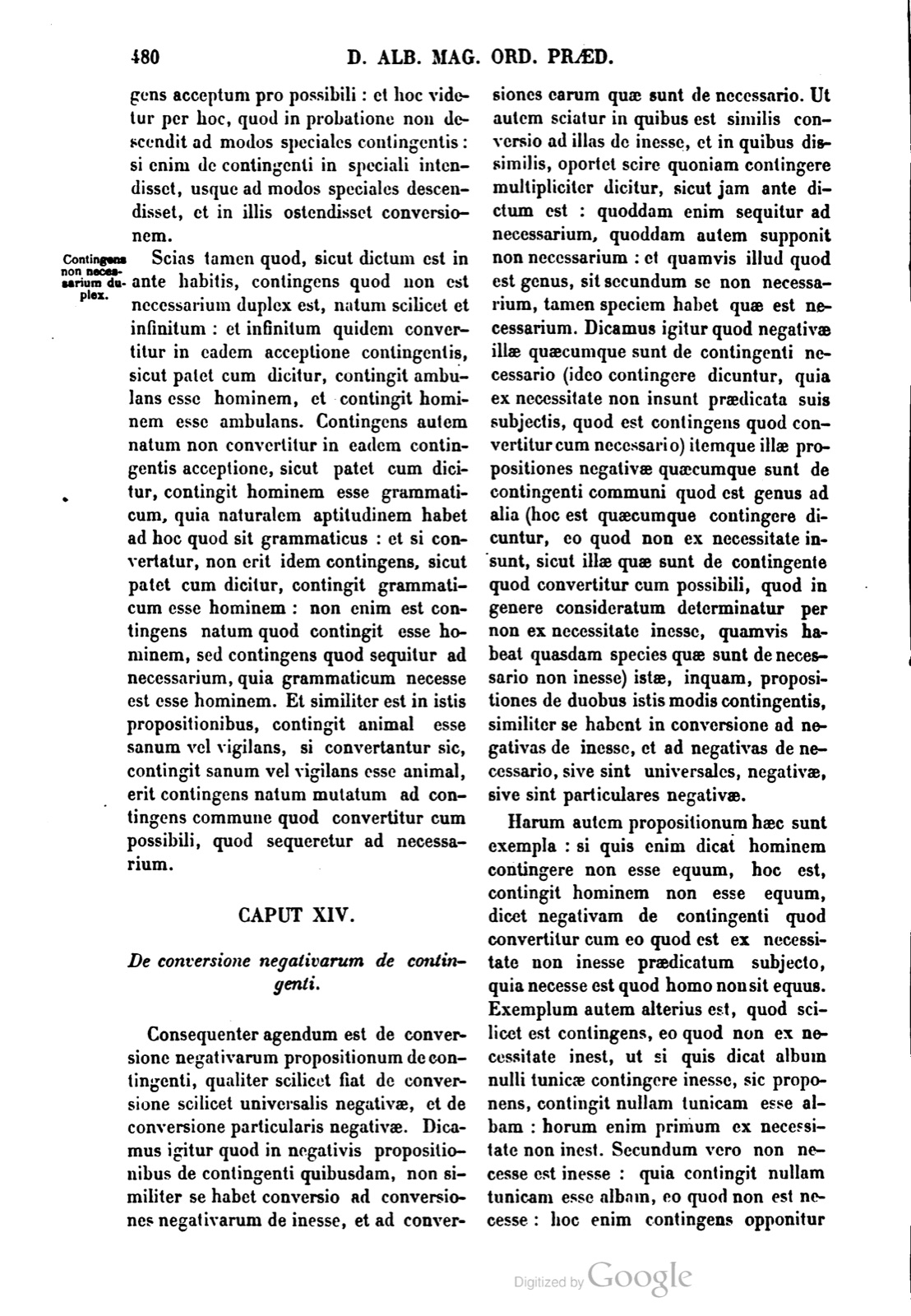
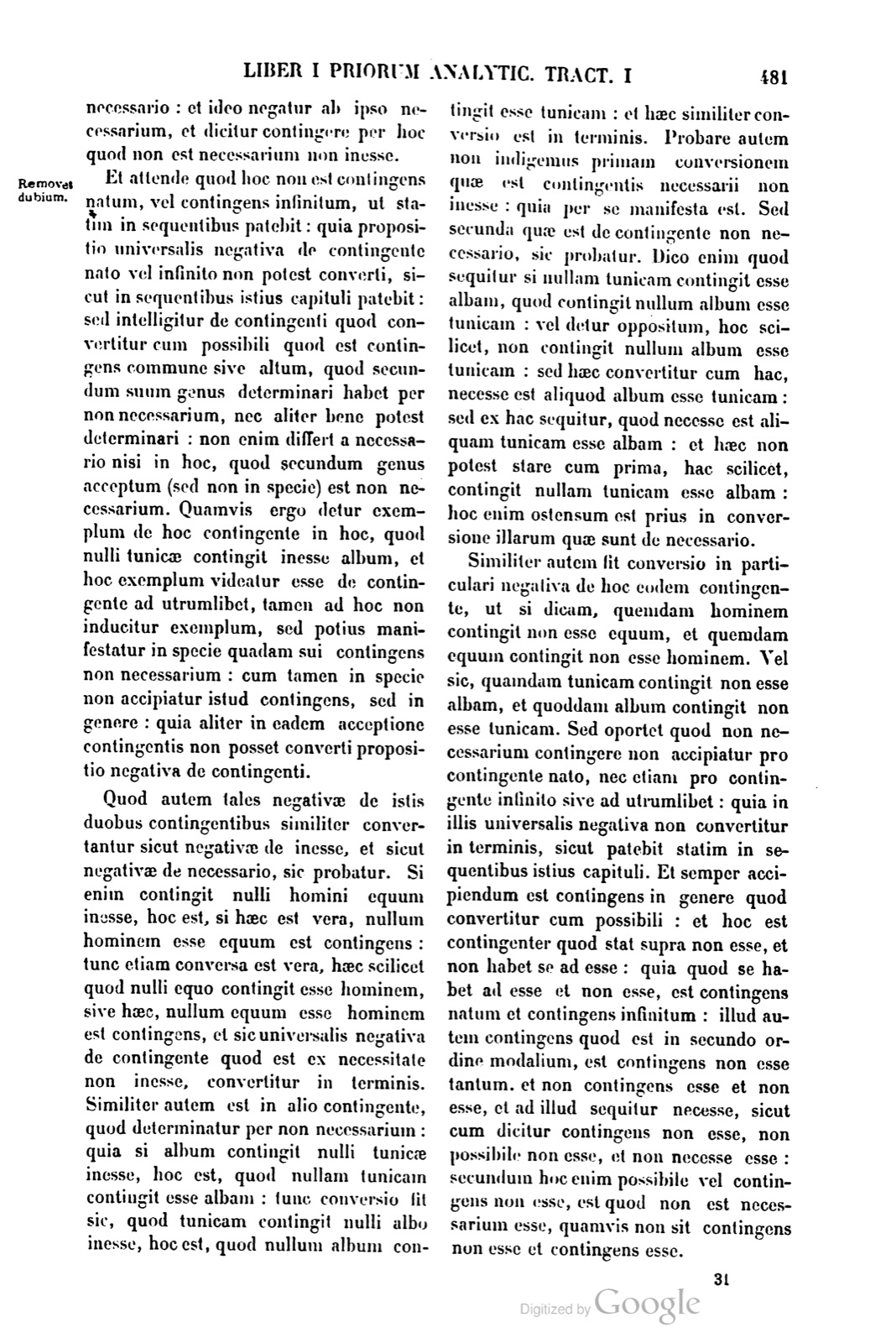
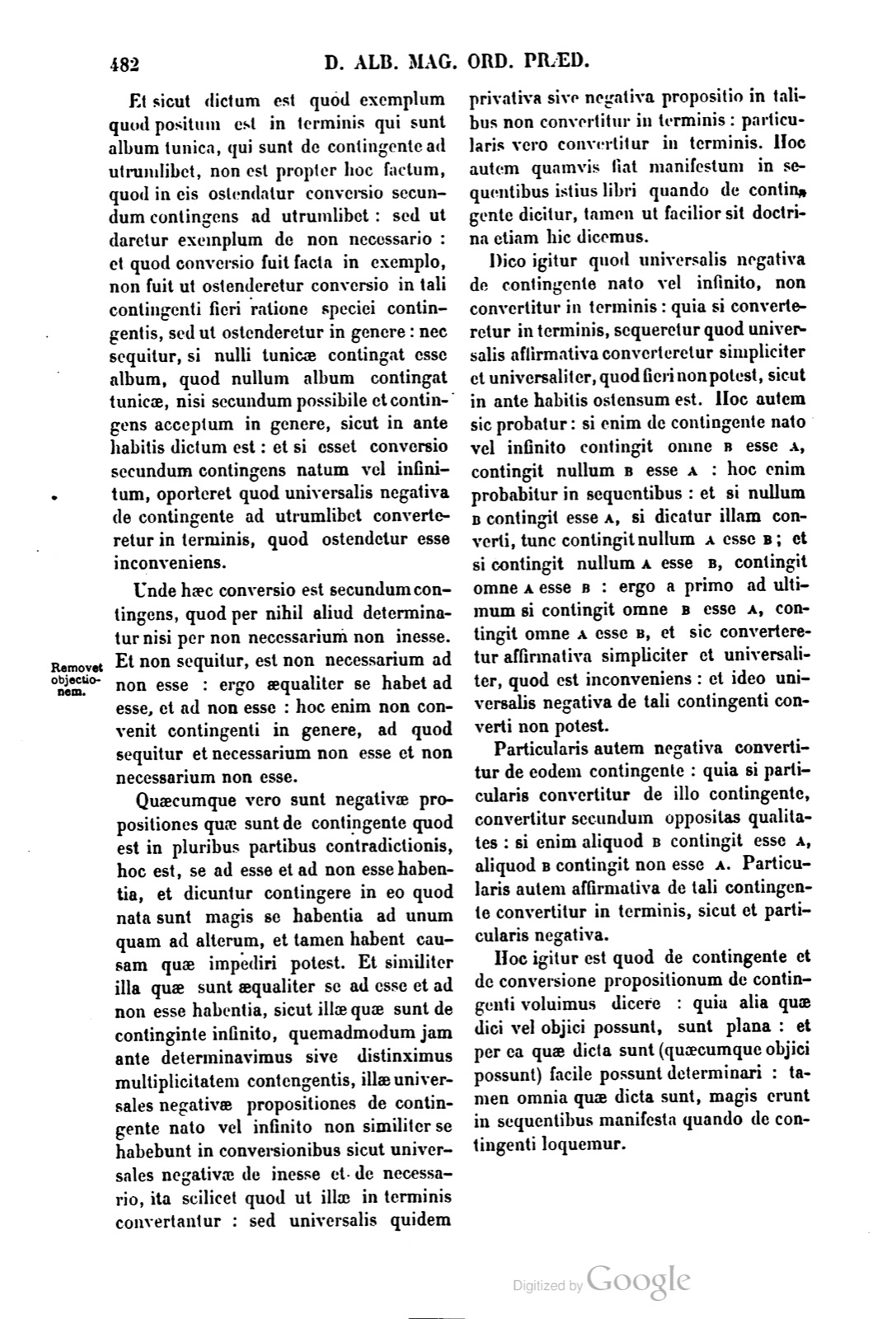
CAPUT XIV. De conversione negativarum de contingenti. Consequenter agendum est de conversione negativarum propositionum de contingenti, qualiter scilicet fiat de conversione scilicet universalis negativae, et de conversione particularis negativae. Dicamus igitur quod in negativis propositionibus de contingenti quibusdam, non similiter se habet conversio ad conversiones negativarum de inesse, et ad conversiones earum quae sunt de necessario. Ut autem sciatur in quibus est similis conversio ad illas de inesse, et in quibus dissimilis, oportet scire quoniam contingere multipliciter dicitur, sicut jam ante dictum est: quoddam enim sequitur ad necessarium, quoddam autem supponit non necessarium: et quamvis illud quod est genus, sit secundum se non necessarium, tamen speciem habet quae est necessarium. Dicamus igitur quod negativae illae quaecumque sunt de contingenti necessario, ideo contingere dicuntur, quia ex necessitate non insunt praedicata suis subjectis, quod est contingens quod convertitur cum necessario, itemque illae propositiones negativae quaecumque sunt de contingenti communi quod est genus ad alia, hoc est quaecumque contingere dicuntur, eo quod non ex necessitate insunt, sicut illae quae sunt de contingente quod convertitur cum possibili, quod in genere consideratum determinatur per non ex necessitate inesse, quamvis habeat quasdam species quae sunt de necessario non inesse, istae, inquam, propositiones de duobus istis modis contingentis, similiter se habent in conversione ad negativas de inesse, et ad negativas de necessario, sive sint universales negativae, sive sint particulares negativae. Harum autem propositionum haec sunt exempla: si quis enim dicat hominem contingere non esse equum, hoc est, contingit hominem non esse equum, dicet negativam de contingenti quod convertitur cum eo quod est ex necessitate non inesse praedicatum subjecto, quia necesse est quod homo non sit equus. Exemplum autem alterius est, quod scilicet est contingens, eo quod non ex necessitate inest, ut si quis dicat album nulli tunicae contingere inesse, sic proponens, contingit nullam tunicam esse albam: horum enim primum ex necessitate non inest. Secundum vero non necesse est inesse: quia contingit nullam tunicam esse albam, eo quod non est necesse: hoc enim contingens opponitur necessario: et ideo negatur ab ipso necessarium, et dicitur contingere per hoc quod non est necessarium non inesse. Et attende quod hoc non est contingens natum, vel contingens infinitum, ut statim in sequentibus patebit: quia propositio universalis negativa de contingente nato vel infinito non potest converti, sicut in sequentibus istius capituli patebit: sed intelligitur de contingenti quod convertitur cum possibili quod est contingens commune sive altum, quod secundum suum genus determinari habet per non necessarium, nec aliter bene potest determinari: non enim differt a necessario nisi in hoc, quod secundum genus acceptum, sed non in specie, est non necessarium. Quamvis ergo detur exemplum de hoc contingente in hoc, quod nulli tunicae contingit inesse album, et hoc exemplum videatur esse de contingente ad utrumlibet, tamen ad hoc non inducitur exemplum, sed potius manifestatur in specie quadam sui contingens non necessarium: cum tamen in specie non accipiatur istud contingens, sed in genere: quia aliter in eadem acceptione contingentis non posset converti propositio negativa de contingenti. Quod autem tales negativae de istis duobus contingentibus similiter convertantur sicut negativae de inesse, et sicut negativae de necessario, sic probatur. Si enim contingit nulli homini equum inesse, hoc est, si haec est vera, nullum hominem esse equum est contingens: tunc etiam conversa est vera, haec scilicet quod nulli equo contingit esse hominem, sive haec, nullum equum esse hominem est contingens, et sic universalis negativa de contingente quod est ex necessitate non inesse, convertitur in terminis. Similiter autem est in alio contingente, quod determinatur per non necessarium: quia si album contingit nulli tunicae inesse, hoc est, quod nullam tunicam contingit esse albam: tunc conversio fit sic, quod tunicam contingit nulli albo inesse, hoc est, quod nullum album contingit esse tunicam: et haec similiter conversio est in terminis. Probare autem non indigemus primam conversionem quae est contingentis necessarii non inesse: quia per se manifesta est. Sed secunda quae est de contingente non necessario, sic probatur. Dico enim quod sequitur si nullam tunicam contingit esse albam, quod contingit nullum album esse tunicam: vel detur oppositum, hoc scilicet, non contingit nullum album esse tunicam: sed haec convertitur cum hac, necesse est aliquod album esse tunicam: sed ex hac sequitur, quod necesse est aliquam tunicam esse albam: et haec non potest stare cum prima, hac scilicet, contingit nullam tunicam esse albam: hoc enim ostensum est prius in conversione illarum quae sunt de necessario. Similiter autem fit conversio in particulari negativa de hoc eodem contingente, ut si dicam, quemdam hominem contingit non esse equum, et quemdam equum contingit non esse hominem. Vel sic, quamdam tunicam contingit non esse albam, et quoddam album contingit non esse tunicam. Sed oportet quod non necessarium contingere non accipiatur pro contingente nato, nec etiam pro contingente infinito sive ad utrumlibet: quia in illis universalis negativa non convertitur in terminis, sicut patebit statim in sequentibus istius capituli. Et semper accipiendum est contingens in genere quod convertitur cum possibili: et hoc est contingenter quod stat supra non esse, et non habet se ad esse: quia quod se habet ad esse et non esse, est contingens natum et contingens infinitum: illud autem contingens quod est in secundo ordine modalium, est contingens non esse tantum, et non contingens esse et non esse, et ad illud sequitur necesse, sicut cum dicitur contingens non esse, non possibile non esse, et non necesse esse: secundum hoc enim possibile vel contingens non esse, est quod non est necessarium esse, quamvis non sit contingens non esse et contingens esse. Et sicut dictum est quod exemplum quod positum est in terminis qui sunt album tunica, qui sunt de contingente ad utrumlibet, non est propter hoc factum, quod in eis ostendatur conversio secundum contingens ad utrumlibet: sed ut daretur exemplum de non necessario: et quod conversio fuit facta in exemplo, non fuit ut ostenderetur conversio in tali contingenti fieri ratione speciei contingentis, sed ut ostenderetur in genere: nec sequitur, si nulli tunicae contingat esse album, quod nullum album contingat tunicae, nisi secundum possibile et contingens acceptum in genere, sicut in ante habitis dictum est: et si esset conversio secundum contingens natum vel infinitum, oporteret quod universalis negativa de contingente ad utrumlibet converteretur in terminis, quod ostendetur esse inconveniens. Unde haec conversio est secundum contingens, quod per nihil aliud determinatur nisi per non necessarium non inesse. Et non sequitur, est non necessarium ad non esse: ergo aequaliter se habet ad esse, et ad non esse: hoc enim non convenit contingenti in genere, ad quod sequitur et necessarium non esse et non necessarium non esse. Quaecumque vero sunt negativae propositiones quae sunt de contingente quod est in pluribus partibus contradictionis, hoc est, se ad esse et ad non esse habentia, et dicuntur contingere in eo quod nata sunt magis se habentia ad unum quam ad alterum, et tamen habent causam quae impediri potest. Et similiter illa quae sunt aequaliter se ad esse et ad non esse habentia, sicut illae quae sunt de contingente infinito, quemadmodum jam ante determinavimus sive distinximus multiplicitatem contingentis, illae universales negativae propositiones de contingente nato vel infinito non similiter se habebunt in conversionibus sicut universales negativae de inesse et de necessario, ita scilicet quod ut illae in terminis convertantur: sed universalis quidem privativa sive negativa propositio in talibus non convertitur in terminis: particularis vero convertitur in terminis. Hoc autem quamvis fiat manifestum in sequentibus istius libri quando de contingente dicitur, tamen ut facilior sit doctrina etiam hic dicemus. Dico igitur quod universalis negativa de contingente nato vel infinito, non convertitur in terminis: quia si converteretur in terminis, sequeretur quod universalis affirmativa converteretur simpliciter et universaliter, quod fieri non potest, sicut in ante habitis ostensum est. Hoc autem sic probatur: si enim de contingente nato vel infinito contingit omne B esse A, contingit nullum B esse A: hoc enim probabitur in sequentibus: et si nullum B contingit esse A, si dicatur illam converti, tunc contingit nullum A esse B; et si contingit nullum A esse B, contingit omne A esse B: ergo a primo ad ultimum si contingit omne B esse A, contingit omne A esse B, et sic converteretur affirmativa simpliciter et universaliter, quod est inconveniens: et ideo universalis negativa de tali contingenti converti non potest. Particularis autem negativa convertitur de eodem contingente: quia si particularis convertitur de illo contingente, convertitur secundum oppositas qualitates: si enim aliquod B contingit esse A, aliquod B contingit non esse A. Particularis autem affirmativa de tali contingente convertitur in terminis, sicut et particularis negativa. Hoc igitur est quod de contingente et de conversione propositionum de contingenti voluimus dicere: quia alia quae dici vel objici possunt, sunt plana: et per ea quae dicta sunt, quaecumque objici possunt, facile possunt determinari: tamen omnia quae dicta sunt, magis erunt in sequentibus manifesta quando de contingenti loquemur.
CHAPTER XIV. On the conversion of negatives concerning the contingent. Consequently one must deal with the conversion of negative propositions about the contingent, namely how conversion is made of the universal negative and of the particular negative. Therefore let us say that in some negative propositions about the contingent, conversion does not hold itself similarly to the conversions of negatives about being-in and to the conversions of those which are about the necessary. But so that it may be known in which cases conversion is similar to those about being-in and in which cases it is dissimilar, one must know that to contingently be is said in many ways, as has already been said before: for one follows upon the necessary, but another supposes the non-necessary; and although that which is the genus is non-necessary according to itself, nevertheless it has a species which is necessary. Therefore let us say that all those negatives which are about the necessary contingent are called contingent because the predicates are not in their subjects by necessity, which is the contingent that is converted with the necessary; likewise all those negative propositions which are about the common contingent that is a genus to the others, that is, all those that are called contingent because they do not belong by necessity, such as those which are about the contingent which is converted with the possible, which, considered in the genus, is determined through not belonging by necessity, although it has certain species which are about necessary not-belonging: these propositions, I say, about these two modes of the contingent, hold themselves similarly in conversion to negatives about being-in and to negatives about the necessary, whether they are universal negatives or particular negatives. Examples of these propositions are the following. For if someone says that human being contingently is not a horse, that is, it contingently happens that a human being is not a horse, he will say a negative about the contingent which is converted with that in which the predicate is by necessity not in the subject, because it is necessary that a human being not be a horse. But the example of the other is one which is contingent because it does not belong by necessity, as if someone says that white contingently belongs to no tunic, proposing thus: it contingently happens that no tunic is white. Of these, the first by necessity does not belong. But the second does not necessarily belong, because it contingently happens that no tunic is white, for this is not necessary; for this contingent is opposed to the necessary, and therefore the necessary is denied from it, and it is called contingent through this, that it is not necessary not to belong. And attend that this is not the native contingent or the infinite contingent, as will immediately be clear in what follows, because a universal negative proposition about the native or infinite contingent cannot be converted, as will be clear in what follows in this chapter; but it is understood of the contingent which is converted with the possible, which is the common or high contingent, which according to its genus has to be determined through the non-necessary, nor can it well be determined otherwise. For it does not differ from the necessary except in this, that according to the genus taken, but not in species, it is non-necessary. Therefore, although an example of this contingent is given in this, that white contingently belongs to no tunic, and this example seems to be about the contingent to either side, nevertheless the example is not introduced for this, but rather a non-necessary contingent is manifested in a certain species of itself, while nevertheless this contingent is not taken in species but in genus, because otherwise a negative proposition about the contingent could not be converted in the same acceptance of the contingent. That such negatives about these two contingents are converted similarly to negatives about being-in and to negatives about the necessary is proved thus. For if it contingently happens that horse belongs to no human being, that is, if this is true, that no human being is a horse is contingent, then the converted proposition is also true, namely this, that it contingently happens that no horse is a human being, or this, that no horse is a human being is contingent; and thus a universal negative about the contingent which is from necessary not-belonging is converted in terms. But it is similar in the other contingent, which is determined through the non-necessary, because if white contingently belongs to no tunic, that is, that it contingently happens that no tunic is white, then the conversion is made in this way: that tunic contingently belongs to no white thing, that is, that it contingently happens that no white thing is a tunic; and this conversion likewise is in terms. But we do not need to prove the first conversion, which is of the necessary contingent not-belonging, because it is manifest through itself. But the second, which is about the non-necessary contingent, is proved in this way. For I say that if it contingently happens that no tunic is white, it follows that it contingently happens that no white thing is a tunic; or let the opposite be granted, namely this, it does not contingently happen that no white thing is a tunic. But this is converted with this: it is necessary that some white thing is a tunic. But from this it follows that it is necessary that some tunic is white; and this cannot stand with the first, namely this, it contingently happens that no tunic is white. For this was shown before in the conversion of those propositions which are about the necessary. Similarly, conversion is made in the particular negative about this same contingent, as if I say, it contingently happens that a certain human being is not a horse, and it contingently happens that a certain horse is not a human being. Or thus: it contingently happens that a certain tunic is not white, and it contingently happens that some white thing is not a tunic. But one must make sure that non-necessary contingent being is not taken for the native contingent, nor even for the infinite contingent or the contingent to either side, because in those the universal negative is not converted in terms, as will immediately be clear in what follows in this chapter. And the contingent must always be taken in the genus which is converted with the possible. And this is the contingent which stands above not-being and does not hold itself to being; because what holds itself to being and non-being is the native contingent and the infinite contingent. But that contingent which is in the second order of modal propositions is a contingent not-being only, and not a contingent being and not-being; and the necessary follows upon it, as when it is said, contingent not-being, not possible not to be, and not necessary to be. According to this, possible or contingent not-being is what is not necessary to be, although it is not contingent not-being and contingent being. And as it has been said that the example which was posited in the terms white and tunic, which are of the contingent to either side, was not made for this reason, that in them conversion according to the contingent to either side would be shown, but so that an example of the non-necessary would be given; and that the conversion was made in the example was not so that conversion would be shown to happen in such a contingent by reason of the species of the contingent, but so that it would be shown in the genus. Nor does it follow, if it contingently happens that white belongs to no tunic, that it contingently happens that no white thing belongs to a tunic, except according to the possible and contingent taken in the genus, as was said in what preceded. And if there were conversion according to the native or infinite contingent, the universal negative about the contingent to either side would have to be converted in terms, which will be shown to be unfitting. Hence this conversion is according to the contingent which is determined by nothing other than non-necessary not-belonging. And it does not follow: it is non-necessary with respect to not-being; therefore it holds itself equally to being and to not-being. For this does not suit the contingent in the genus, upon which both necessary not-being and non-necessary not-being follow. But all negative propositions which are about the contingent that is in several parts of a contradiction, that is, those holding themselves to being and to non-being and said to contingently be in that they are native and hold themselves more to one than to the other, and yet have a cause which can be impeded, and similarly those which hold themselves equally to being and to non-being, as are those about the infinite contingent, just as we have already determined or distinguished the multiplicity of the contingent: those universal negative propositions about the native or infinite contingent will not hold themselves in conversions similarly to universal negatives about being-in and about the necessary, namely in such a way that they are converted in terms as those are. Rather, the universal privative or negative proposition in such cases is not converted in terms, but the particular is converted in terms. Although this will be made manifest in what follows in this book when the contingent is discussed, nevertheless, so that the teaching may be easier, we shall also say it here. Therefore I say that the universal negative about the native or infinite contingent is not converted in terms, because if it were converted in terms, it would follow that the universal affirmative would be converted simply and universally, which cannot happen, as was shown in the preceding matters. This is proved in this way: if concerning the native or infinite contingent it contingently happens that every B is A, it contingently happens that no B is A, for this will be proved in what follows; and if it contingently happens that no B is A, if that were said to be converted, then it contingently happens that no A is B; and if it contingently happens that no A is B, it contingently happens that every A is B. Therefore from the first to the last, if it contingently happens that every B is A, it contingently happens that every A is B, and thus an affirmative would be converted simply and universally, which is unfitting. And therefore the universal negative about such a contingent cannot be converted. But the particular negative about the same contingent is converted, because if the particular is converted concerning that contingent, it is converted according to opposite qualities; for if some B contingently is A, some B contingently is not A. But the particular affirmative about such a contingent is converted in terms, just as the particular negative is. This, therefore, is what we wished to say about the contingent and about the conversion of propositions about the contingent, because the other things that can be said or objected are plain; and through the things that have been said, whatever can be objected can easily be determined. Nevertheless all the things that have been said will be more manifest in what follows when we speak about the contingent.
If a page does not appear, its photograph has not been uploaded yet.