Works › Prior Analytics, Books I–II
Volume 1 · pp. 474–476
Chapter XI. On the Conversion of Propositions Concerning the Necessary.
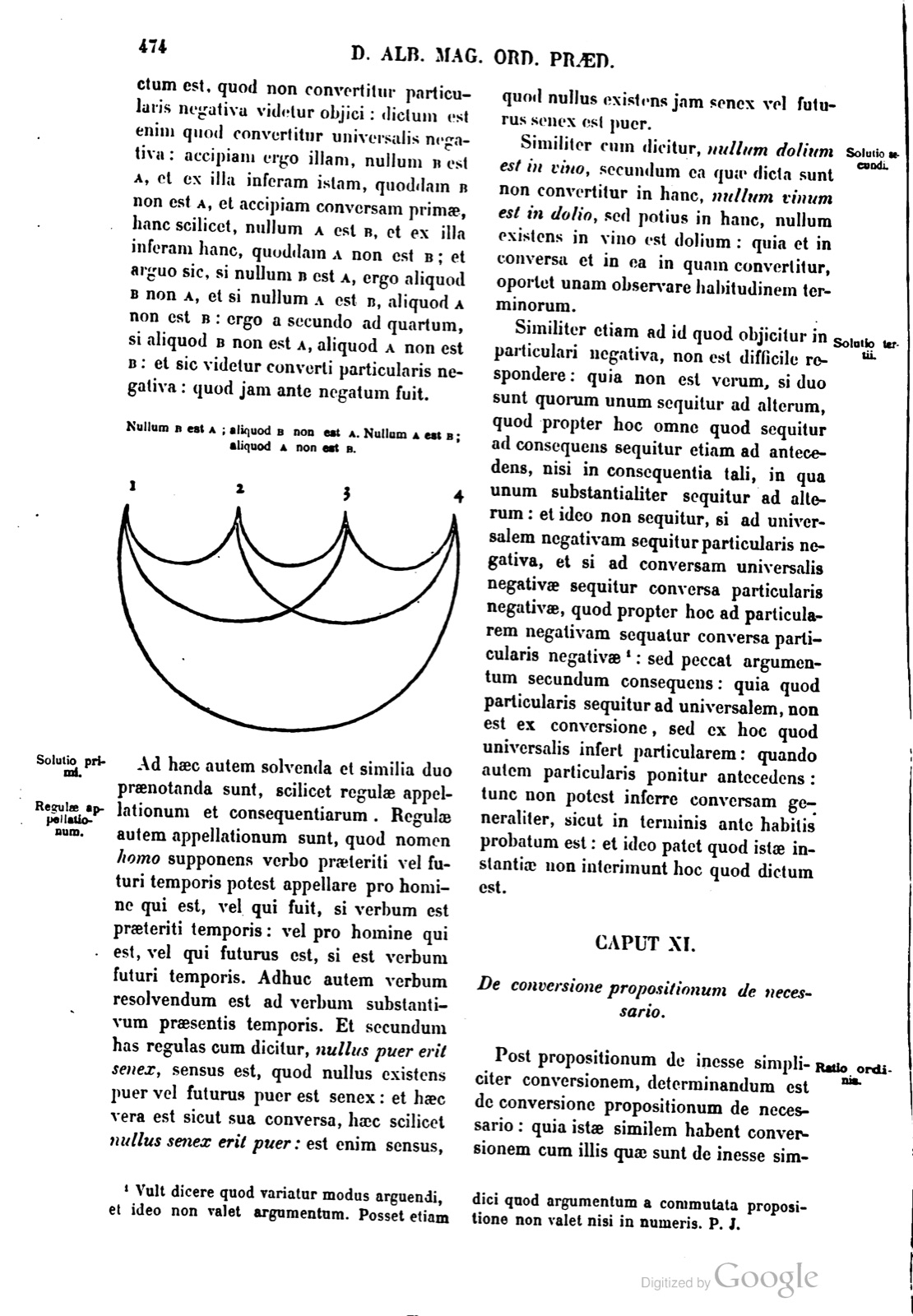
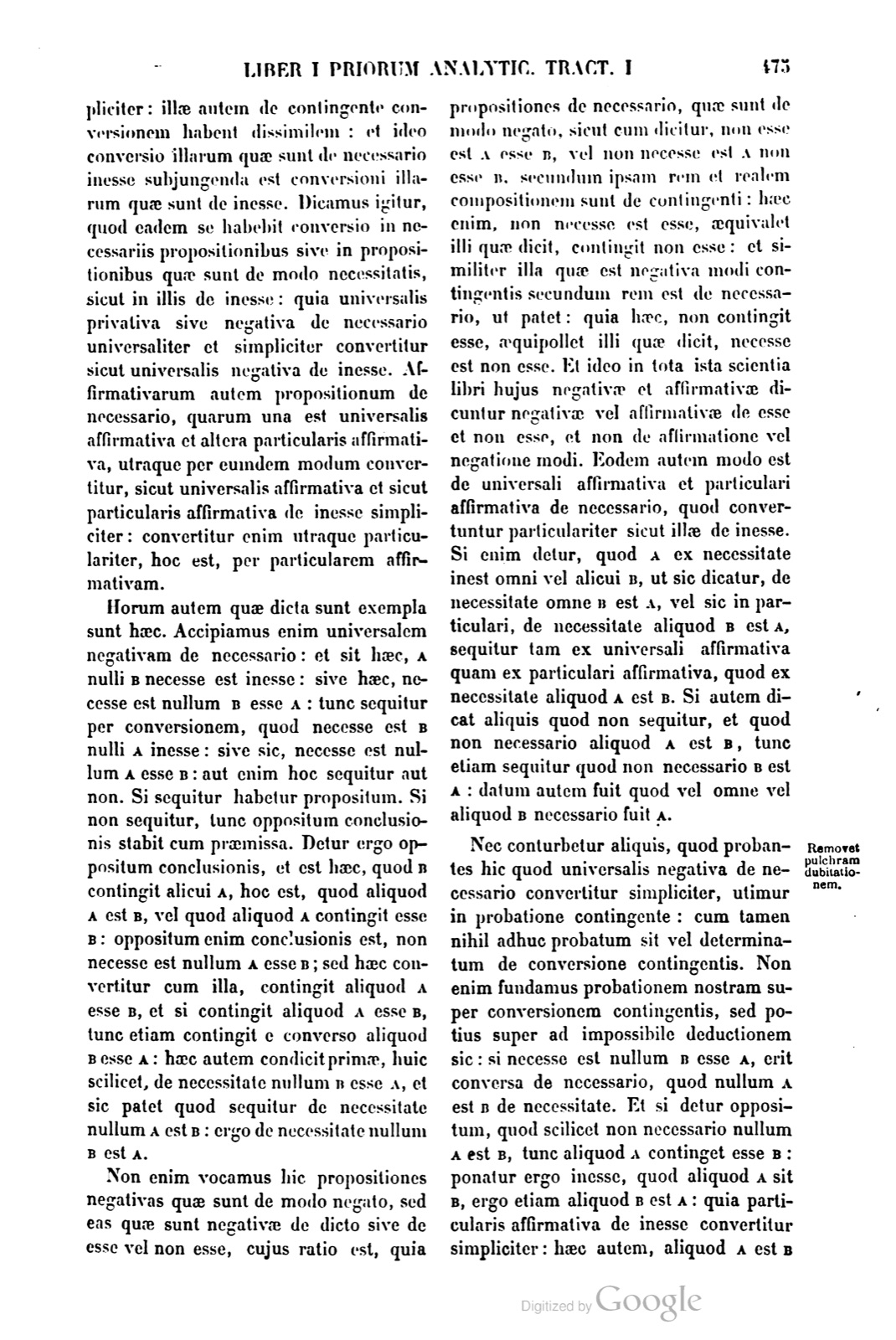
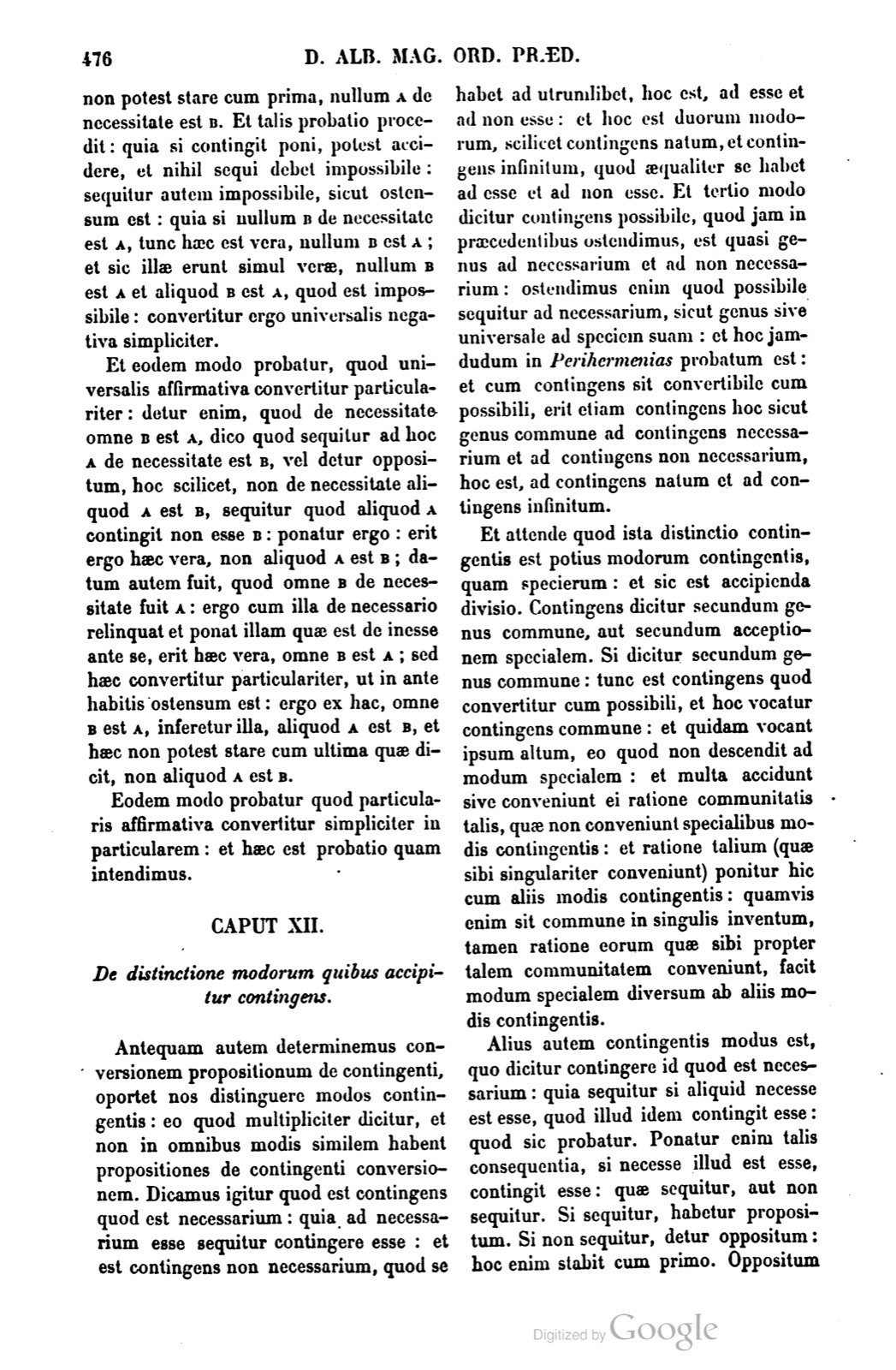
CAPUT XI. De conversione propositionum de necessario. Post propositionum de inesse simpliciter conversionem, determinandum est de conversione propositionum de necessario: quia istae similem habent conversionem cum illis quae sunt de inesse simpliciter: illae autem de contingente conversionem habent dissimilem: et ideo conversio illarum quae sunt de necessario inesse subjungenda est conversioni illarum quae sunt de inesse. Dicamus igitur, quod eadem se habebit conversio in necessariis propositionibus sive in propositionibus quae sunt de modo necessitatis, sicut in illis de inesse: quia universalis privativa sive negativa de necessario universaliter et simpliciter convertitur sicut universalis negativa de inesse. Affirmativarum autem propositionum de necessario, quarum una est universalis affirmativa et altera particularis affirmativa, utraque per eundem modum convertitur, sicut universalis affirmativa et sicut particularis affirmativa de inesse simpliciter: convertitur enim utraque particulariter, hoc est, per particularem affirmativam. Horum autem quae dicta sunt exempla sunt haec. Accipiamus enim universalem negativam de necessario: et sit haec, A nulli B necesse est inesse: sive haec, necesse est nullum B esse A: tunc sequitur per conversionem, quod necesse est B nulli A inesse: sive sic, necesse est nullum A esse B: aut enim hoc sequitur aut non. Si sequitur habetur propositum. Si non sequitur, tunc oppositum conclusionis stabit cum praemissa. Detur ergo oppositum conclusionis, et est haec, quod B contingit alicui A, hoc est, quod aliquod A est B, vel quod aliquod A contingit esse B: oppositum enim conclusionis est, non necesse est nullum A esse B; sed haec convertitur cum illa, contingit aliquod A esse B, et si contingit aliquod A esse B, tunc etiam contingit e converso aliquod B esse A: haec autem condicit primae, huic scilicet, de necessitate nullum B esse A, et sic patet quod sequitur de necessitate nullum A est B: ergo de necessitate nullum B est A. Non enim vocamus hic propositiones negativas quae sunt de modo negato, sed eas quae sunt negativae de dicto sive de esse vel non esse, cujus ratio est, quia propositiones de necessario, quae sunt de modo negato, sicut cum dicitur, non esse est A esse B, vel non necesse est A non esse B, secundum ipsam rem et realem compositionem sunt de contingenti: haec enim, non necesse est esse, aequivalet illi quae dicit, contingit non esse: et similiter illa quae est negativa modi contingentis secundum rem est de necessario, ut patet: quia haec, non contingit esse, aequipollet illi quae dicit, necesse est non esse. Et ideo in tota ista scientia libri hujus negativae et affirmativae dicuntur negativae vel affirmativae de esse et non esse, et non de affirmatione vel negatione modi. Eodem autem modo est de universali affirmativa et particulari affirmativa de necessario, quod convertuntur particulariter sicut illae de inesse. Si enim detur, quod A ex necessitate inest omni vel alicui B, ut sic dicatur, de necessitate omne B est A, vel sic in particulari, de necessitate aliquod B est A, sequitur tam ex universali affirmativa quam ex particulari affirmativa, quod ex necessitate aliquod A est B. Si autem dicat aliquis quod non sequitur, et quod non necessario aliquod A est B, tunc etiam sequitur quod non necessario B est A: datum autem fuit quod vel omne vel aliquod B necessario fuit A. Nec conturbetur aliquis, quod probantes hic quod universalis negativa de necessario convertitur simpliciter, utimur in probatione contingente: cum tamen nihil adhuc probatum sit vel determinatum de conversione contingentis. Non enim fundamus probationem nostram super conversionem contingentis, sed potius super ad impossibile deductionem sic: si necesse est nullum B esse A, erit conversa de necessario, quod nullum A est B de necessitate. Et si detur oppositum, quod scilicet non necessario nullum A est B, tunc aliquod A continget esse B: ponatur ergo inesse, quod aliquod A sit B, ergo etiam aliquod B est A: quia particularis affirmativa de inesse convertitur simpliciter: haec autem, aliquod A est B, non potest stare cum prima, nullum A de necessitate est B. Et talis probatio procedit: quia si contingit poni, potest accidere, et nihil sequi debet impossibile: sequitur autem impossibile, sicut ostensum est: quia si nullum B de necessitate est A, tunc haec est vera, nullum B est A; et sic illae erunt simul verae, nullum B est A et aliquod B est A, quod est impossibile: convertitur ergo universalis negativa simpliciter. Et eodem modo probatur, quod universalis affirmativa convertitur particulariter: detur enim, quod de necessitate omne B est A, dico quod sequitur ad hoc A de necessitate est B, vel detur oppositum, hoc scilicet, non de necessitate aliquod A est B, sequitur quod aliquod A contingit non esse B: ponatur ergo: erit ergo haec vera, non aliquod A est B; datum autem fuit, quod omne B de necessitate fuit A: ergo cum illa de necessario relinquat et ponat illam quae est de inesse ante se, erit haec vera, omne B est A; sed haec convertitur particulariter, ut in ante habitis ostensum est: ergo ex hac, omne B est A, inferetur illa, aliquod A est B, et haec non potest stare cum ultima quae dicit, non aliquod A est B. Eodem modo probatur quod particularis affirmativa convertitur simpliciter in particularem: et haec est probatio quam intendimus.
CHAPTER XI. On the conversion of propositions concerning the necessary. After the conversion of propositions about being-in simply, one must determine the conversion of propositions about the necessary, because these have a similar conversion to those which are about being-in simply; but those about the contingent have a dissimilar conversion. And therefore the conversion of those which are about necessary being-in must be joined after the conversion of those which are about being-in. Therefore let us say that conversion will hold itself in necessary propositions, or in propositions which are of the mode of necessity, in the same way as in those about being-in, because the universal privative or negative about the necessary is converted universally and simply just as the universal negative about being-in is. But of affirmative propositions about the necessary, of which one is universal affirmative and the other particular affirmative, each is converted through the same mode as the universal affirmative and as the particular affirmative about being-in simply; for each is converted particularly, that is, through a particular affirmative. Examples of the things that have been said are these. Let us take the universal negative about the necessary, and let it be this: it is necessary that A be in no B, or this: it is necessary that no B be A. Then it follows through conversion that it is necessary that B be in no A, or thus, it is necessary that no A be B. For either this follows or it does not. If it follows, the proposed point is had. If it does not follow, then the opposite of the conclusion will stand with the premise. Therefore let the opposite of the conclusion be granted, and it is this, that B happens to be in some A, that is, that some A is B, or that some A contingently is B. For the opposite of the conclusion is: it is not necessary that no A be B; but this is converted with that which says, some A contingently is B; and if some A contingently is B, then conversely some B also contingently is A. But this contradicts the first, namely this: of necessity no B is A; and thus it is clear that of necessity no A is B follows. Therefore of necessity no B is A. For here we do not call negative propositions those which are of a negated mode, but those which are negative of the dictum or of being and non-being. The reason for this is that propositions about the necessary which are of a negated mode, as when it is said, not to be is A to be B, or it is not necessary that A not be B, according to the thing itself and the real composition are about the contingent. For this, it is not necessary to be, is equivalent to that which says, it contingently is not; and similarly that proposition which is negative of the contingent mode is according to the thing about the necessary, as is clear, because this, it does not contingently be, is equivalent to that which says, it is necessary not to be. And therefore in this whole science of this book, negatives and affirmatives are called negative or affirmative concerning being and non-being, and not concerning the affirmation or negation of the mode. In the same way it is with the universal affirmative and particular affirmative about the necessary, that they are converted particularly like those about being-in. For if it is granted that A of necessity is in every or some B, so that it is said thus, of necessity every B is A, or thus in particular, of necessity some B is A, it follows both from the universal affirmative and from the particular affirmative that of necessity some A is B. But if someone says that it does not follow, and that not of necessity some A is B, then it also follows that not of necessity B is A; but it had been granted that either every or some B was necessarily A. Nor should anyone be troubled that, when proving here that the universal negative about the necessary is converted simply, we use a contingent in the proof, although nothing has yet been proved or determined about the conversion of the contingent. For we do not found our proof upon the conversion of the contingent, but rather upon deduction to the impossible in this way: if it is necessary that no B be A, the converted proposition about the necessary will be that no A is B of necessity. And if the opposite is granted, namely that not necessarily no A is B, then some A will contingently be B. Therefore let it be posited in being-in, that some A is B; therefore some B too is A, because the particular affirmative about being-in is converted simply. But this, some A is B, cannot stand with the first, no A of necessity is B. And such a proof proceeds because if it can contingently be posited, it can happen, and nothing impossible ought to follow; but an impossible follows, as has been shown, because if no B of necessity is A, then this is true, no B is A; and so these will be true at once, no B is A and some B is A, which is impossible. Therefore the universal negative is converted simply. And in the same way it is proved that the universal affirmative is converted particularly. For let it be granted that of necessity every B is A; I say that to this it follows that A of necessity is B, or let the opposite be granted, namely this, that not of necessity some A is B. It follows that some A contingently is not B. Therefore let it be posited; therefore this will be true, not some A is B. But it was granted that every B of necessity was A; therefore, since that proposition about the necessary leaves behind and posits before itself that proposition which is about being-in, this will be true, every B is A. But this is converted particularly, as was shown in the preceding matters; therefore from this, every B is A, that one will be inferred, some A is B, and this cannot stand with the last, which says, not some A is B. In the same way it is proved that the particular affirmative is converted simply into a particular; and this is the proof which we intend.
If a page does not appear, its photograph has not been uploaded yet.