Works › Prior Analytics, Books I–II
Volume 1 · pp. 473–474
Chapter X. On the Solution of Instances Which Seem to Be Against the Introduced Conversions.
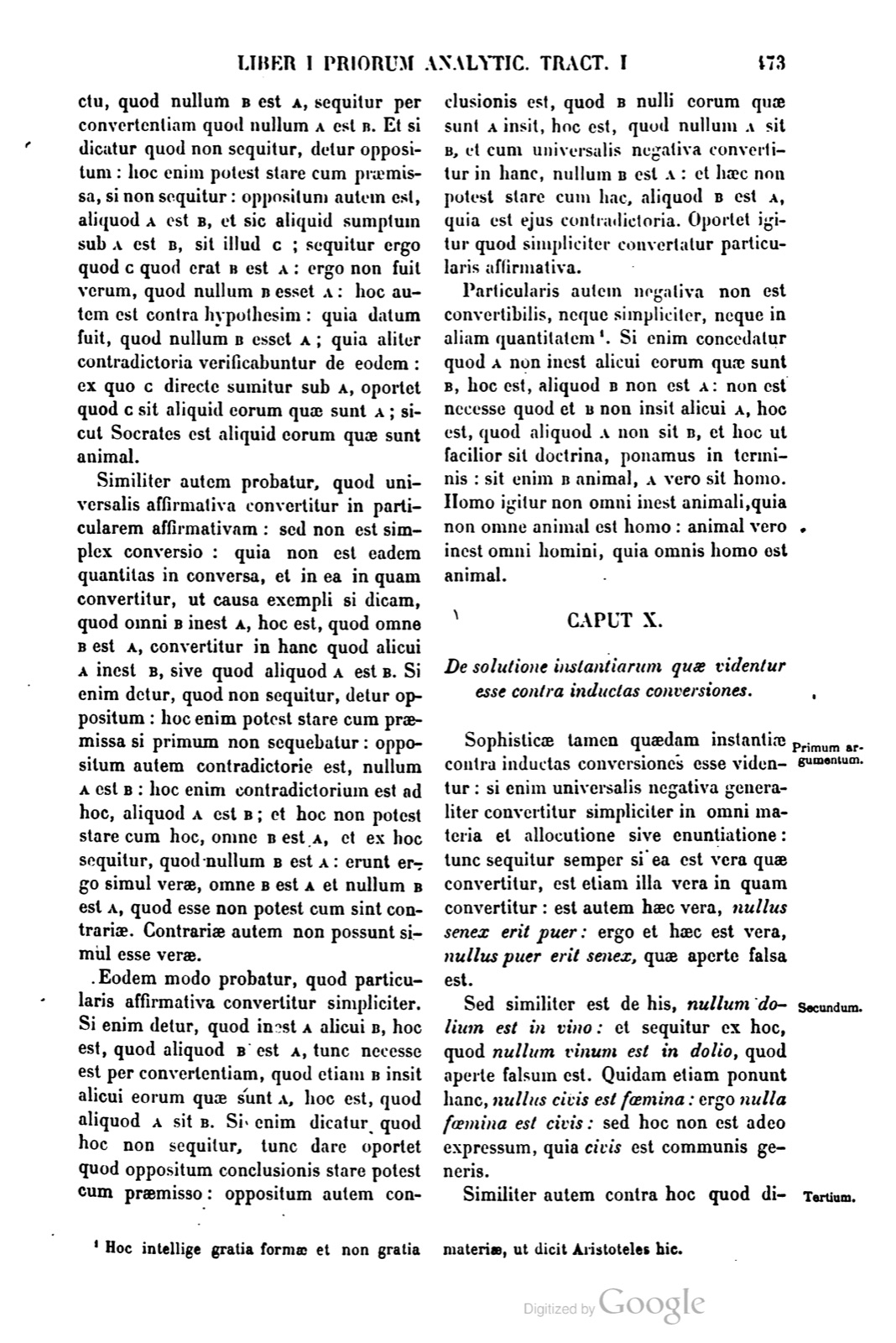
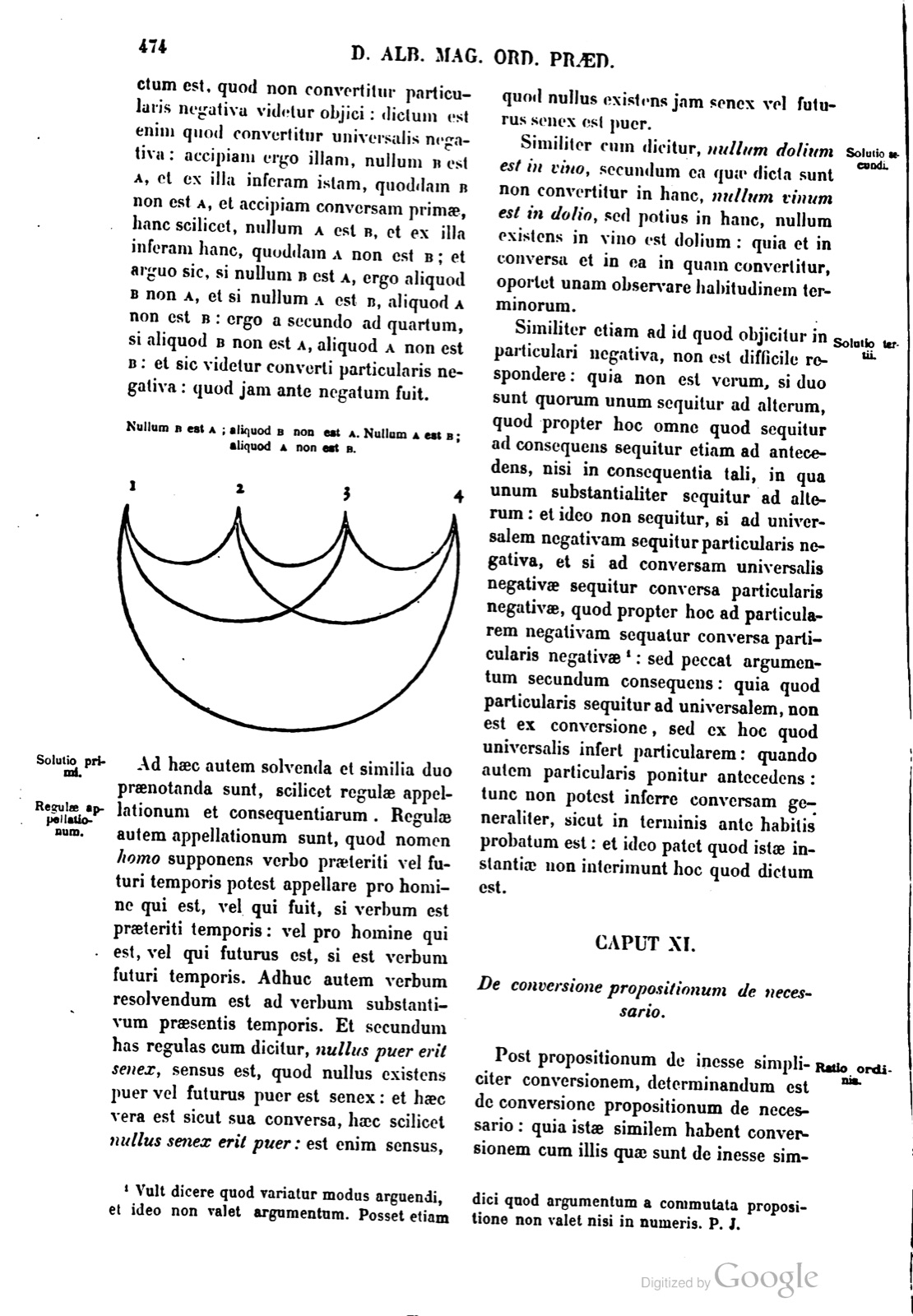
CAPUT X. De solutione instantiarum quae videntur esse contra inductas conversiones. Sophisticae tamen quaedam instantiae contra inductas conversiones esse videntur: si enim universalis negativa generaliter convertitur simpliciter in omni materia et allocutione sive enuntiatione: tunc sequitur semper si ea est vera quae convertitur, est etiam illa vera in quam convertitur: est autem haec vera, nullus senex erit puer: ergo et haec est vera, nullus puer erit senex, quae aperte falsa est. Sed similiter est de his, nullum dolium est in vino: et sequitur ex hoc, quod nullum vinum est in dolio, quod aperte falsum est. Quidam etiam ponunt hanc, nullus civis est foemina: ergo nulla foemina est civis: sed hoc non est adeo expressum, quia civis est communis generis. Similiter autem contra hoc quod dictum est, quod non convertitur particularis negativa videtur objici: dictum est enim quod convertitur universalis negativa: accipiam ergo illam, nullum B est A, et ex illa inferam istam, quoddam B non est A, et accipiam conversam primae, hanc scilicet, nullum A est B, et ex illa inferam hanc, quoddam A non est B; et arguo sic, si nullum B est A, ergo aliquod B non A, et si nullum A est B, aliquod A non est B: ergo a secundo ad quartum, si aliquod B non est A, aliquod A non est B: et sic videtur converti particularis negativa: quod jam ante negatum fuit. Ad haec autem solvenda et similia duo praenotanda sunt, scilicet regulae appellationum et consequentiarum. Regulae autem appellationum sunt, quod nomen homo supponens verbo praeteriti vel futuri temporis potest appellare pro homine qui est, vel qui fuit, si verbum est praeteriti temporis: vel pro homine qui est, vel qui futurus est, si est verbum futuri temporis. Adhuc autem verbum resolvendum est ad verbum substantivum praesentis temporis. Et secundum has regulas cum dicitur, nullus puer erit senex, sensus est, quod nullus existens puer vel futurus puer est senex: et haec vera est sicut sua conversa, haec scilicet nullus senex erit puer: est enim sensus, quod nullus existens jam senex vel futurus senex est puer. Similiter cum dicitur, nullum dolium est in vino, secundum ea quae dicta sunt non convertitur in hanc, nullum vinum est in dolio, sed potius in hanc, nullum existens in vino est dolium: quia et in conversa et in ea in quam convertitur, oportet unam observare habitudinem terminorum. Similiter etiam ad id quod objicitur in particulari negativa, non est difficile respondere: quia non est verum, si duo sunt quorum unum sequitur ad alterum, quod propter hoc omne quod sequitur ad consequens sequitur etiam ad antecedens, nisi in consequentia tali, in qua unum substantialiter sequitur ad alterum: et ideo non sequitur, si ad universalem negativam sequitur particularis negativa, et si ad conversam universalis negativae sequitur conversa particularis negativae, quod propter hoc ad particularem negativam sequatur conversa particularis negativae 1: sed peccat argumentum secundum consequens: quia quod particularis sequitur ad universalem, non est ex conversione, sed ex hoc quod universalis infert particularem: quando autem particularis ponitur antecedens: tunc non potest inferre conversam generaliter, sicut in terminis ante habitis probatum est: et ideo patet quod istae instantiae non interimunt hoc quod dictum est.
CHAPTER X. On the solution of instances which seem to be against the introduced conversions. Nevertheless certain sophistical instances seem to be against the introduced conversions. For if a universal negative is converted simply in general in every matter and utterance or enunciation, then it always follows, if that proposition which is converted is true, that the proposition into which it is converted is also true. But this is true: no old man will be a boy. Therefore this too is true: no boy will be an old man, which is plainly false. But it is similar in these: no jar is in wine; and from this it follows that no wine is in a jar, which is plainly false. Some also posit this: no citizen is a woman; therefore no woman is a citizen. But this is not so clear, because citizen is of common gender. Similarly, against what has been said, namely that a particular negative is not converted, it seems to be objected thus: for it has been said that a universal negative is converted. Therefore I shall take that one, no B is A, and from it infer this, some B is not A, and I shall take the converse of the first, namely this, no A is B, and from it infer this, some A is not B; and I argue thus: if no B is A, therefore some B is not A; and if no A is B, some A is not B; therefore, from the second to the fourth, if some B is not A, some A is not B. And thus the particular negative seems to be converted, which was already denied before. But for solving these and similar things, two things must be noted beforehand, namely the rules of appellations and of consequences. Now the rules of appellations are that the noun human being, supposing with a verb of past or future time, can appell for the human being who is or who was, if the verb is of past time, or for the human being who is or who will be, if it is a verb of future time. Further, the verb must be resolved to the substantive verb of present time. And according to these rules, when it is said, no boy will be an old man, the sense is that no existing boy or future boy is an old man; and this is true, as is its converse, namely this: no old man will be a boy. For the sense is that no one now existing as old or going to be old is a boy. Similarly, when it is said, no jar is in wine, according to the things that have been said it is not converted into this, no wine is in a jar, but rather into this, nothing existing in wine is a jar, because both in the converted proposition and in that into which it is converted one disposition of the terms must be observed. Similarly, also with respect to what is objected in the particular negative, it is not difficult to respond: because it is not true, if there are two things of which one follows upon the other, that on account of this everything which follows upon the consequent also follows upon the antecedent, except in such a consequence in which one substantially follows upon the other. And therefore it does not follow that, if the particular negative follows upon the universal negative, and if the converted particular negative follows upon the converted universal negative, on account of this the converted particular negative follows upon the particular negative 1. Rather, the argument sins according to the consequent, because that the particular follows upon the universal is not from conversion, but from this, that the universal infers the particular. But when the particular is put as antecedent, then it cannot generally infer the converted proposition, as was proved in the terms previously had; and therefore it is clear that these instances do not destroy what has been said.
Notes
- He means to say that the mode of arguing is varied, and therefore the argument is not valid. It could also be said that an argument from a changed proposition is valid only in numbers. P. J. (Vult dicere quod variatur modus arguendi, et ideo non valet argumentum. Posset etiam dici quod argumentum a commutata propositione non valet nisi in numeris. P. J.) ↩
If a page does not appear, its photograph has not been uploaded yet.