Works › Prior Analytics, Books I–II
Volume 1 · pp. 472–473
Chapter IX. On the Conversion of Propositions According to Terms.
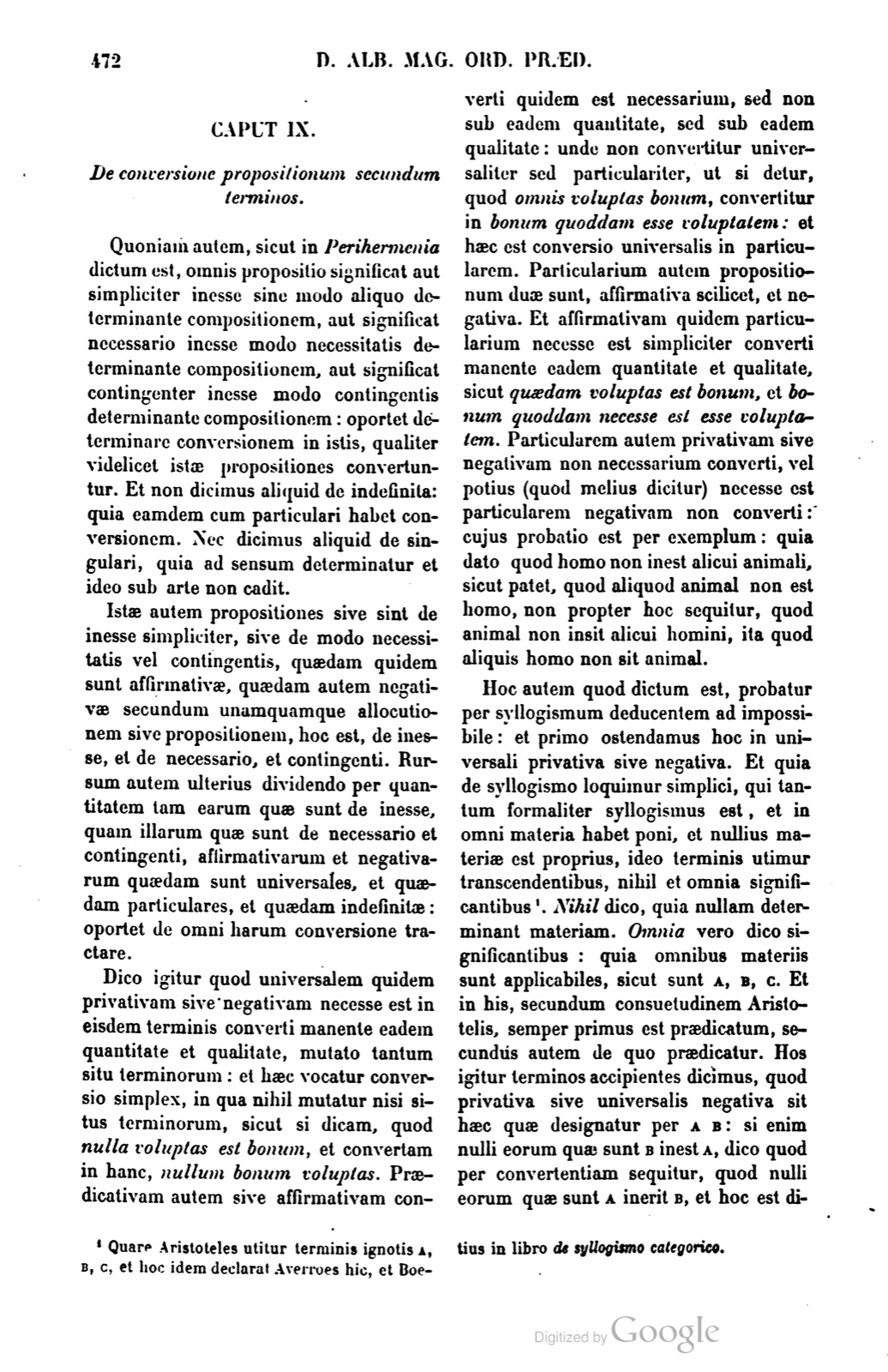
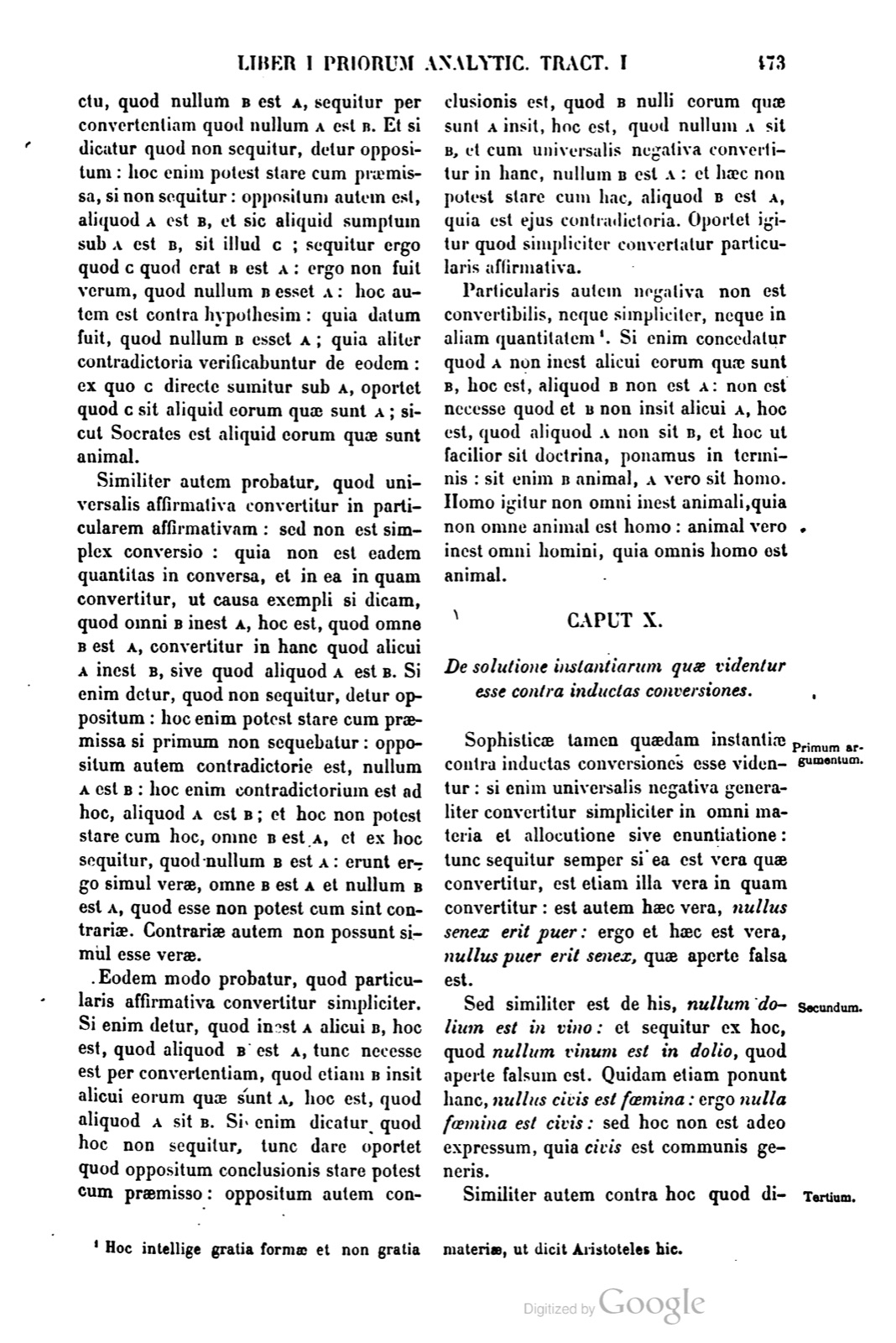
CAPUT IX. De conversione propositionum secundum terminos. Quoniam autem, sicut in Perihermenia dictum est, omnis propositio significat aut simpliciter inesse sine modo aliquo determinante compositionem, aut significat necessario inesse modo necessitatis determinante compositionem, aut significat contingenter inesse modo contingentis determinante compositionem: oportet determinare conversionem in istis, qualiter videlicet istae propositiones convertuntur. Et non dicimus aliquid de indefinita: quia eamdem cum particulari habet conversionem. Nec dicimus aliquid de singulari, quia ad sensum determinatur et ideo sub arte non cadit. Istae autem propositiones sive sint de inesse simpliciter, sive de modo necessitatis vel contingentis, quaedam quidem sunt affirmativae, quaedam autem negativae secundum unamquamque allocutionem sive propositionem, hoc est, de inesse, et de necessario, et contingenti. Rursum autem ulterius dividendo per quantitatem tam earum quae sunt de inesse, quam illarum quae sunt de necessario et contingenti, affirmativarum et negativarum quaedam sunt universales, et quaedam particulares, et quaedam indefinitae: oportet de omni harum conversione tractare. Dico igitur quod universalem quidem privativam sive negativam necesse est in eisdem terminis converti manente eadem quantitate et qualitate, mutato tantum situ terminorum: et haec vocatur conversio simplex, in qua nihil mutatur nisi situs terminorum, sicut si dicam, quod nulla voluptas est bonum, et convertam in hanc, nullum bonum voluptas. Praedicativam autem sive affirmativam converti quidem est necessarium, sed non sub eadem quantitate, sed sub eadem qualitate: unde non convertitur universaliter sed particulariter, ut si detur, quod omnis voluptas bonum, convertitur in bonum quoddam esse voluptatem: et haec est conversio universalis in particularem. Particularium autem propositionum duae sunt, affirmativa scilicet, et negativa. Et affirmativam quidem particularium necesse est simpliciter converti manente eadem quantitate et qualitate, sicut quaedam voluptas est bonum, et bonum quoddam necesse est esse voluptatem. Particularem autem privativam sive negativam non necessarium converti, vel potius, quod melius dicitur, necesse est particularem negativam non converti: cujus probatio est per exemplum: quia dato quod homo non inest alicui animali, sicut patet, quod aliquod animal non est homo, non propter hoc sequitur, quod animal non insit alicui homini, ita quod aliquis homo non sit animal. Hoc autem quod dictum est, probatur per syllogismum deducentem ad impossibile: et primo ostendamus hoc in universali privativa sive negativa. Et quia de syllogismo loquimur simplici, qui tantum formaliter syllogismus est, et in omni materia habet poni, et nullius materiae est proprius, ideo terminis utimur transcendentibus, nihil et omnia significantibus 1. Nihil dico, quia nullam determinant materiam. Omnia vero dico significantibus: quia omnibus materiis sunt applicabiles, sicut sunt A, B, C. Et in his, secundum consuetudinem Aristotelis, semper primus est praedicatum, secundus autem de quo praedicatur. Hos igitur terminos accipientes dicimus, quod privativa sive universalis negativa sit haec quae designatur per A B: si enim nulli eorum quae sunt B inest A, dico quod per convertentiam sequitur, quod nulli eorum quae sunt A inerit B, et hoc est dictu, quod nullum B est A, sequitur per convertentiam quod nullum A est B. Et si dicatur quod non sequitur, detur oppositum: hoc enim potest stare cum praemissa, si non sequitur: oppositum autem est, aliquod A est B, et sic aliquid sumptum sub A est B, sit illud C; sequitur ergo quod C quod erat B est A: ergo non fuit verum, quod nullum B esset A: hoc autem est contra hypothesim: quia datum fuit, quod nullum B esset A; quia aliter contradictoria verificabuntur de eodem: ex quo C directe sumitur sub A, oportet quod A sit aliquid eorum quae sunt A; sicut Socrates est aliquid eorum quae sunt animal. Similiter autem probatur, quod universalis affirmativa convertitur in particularem affirmativam: sed non est simplex conversio: quia non est eadem quantitas in conversa, et in ea in quam convertitur, ut causa exempli si dicam, quod omni B inest A, hoc est, quod omne B est A, convertitur in hanc quod alicui A inest B, sive quod aliquod A est B. Si enim detur, quod non sequitur, detur oppositum: hoc enim potest stare cum praemissa si primum non sequebatur: oppositum autem contradictorie est, nullum A est B: hoc enim contradictorium est ad hoc, aliquod A est B; et hoc non potest stare cum hoc, omne B est A, et ex hoc sequitur, quod nullum B est A: erunt ergo simul verae, omne B est A et nullum B est A, quod esse non potest cum sint contrariae. Contrariae autem non possunt simul esse verae. Eodem modo probatur, quod particularis affirmativa convertitur simpliciter. Si enim detur, quod inest A alicui B, hoc est, quod aliquod B est A, tunc necesse est per convertentiam, quod etiam B insit alicui eorum quae sunt A, hoc est, quod aliquod A sit B. Si enim dicatur quod hoc non sequitur, tunc dare oportet quod oppositum conclusionis stare potest cum praemisso: oppositum autem conclusionis est, quod B nulli eorum quae sunt A insit, hoc est, quod nullum A sit B, et cum universalis negativa convertitur in hanc, nullum B est A: et haec non potest stare cum hac, aliquod B est A, quia est ejus contradictoria. Oportet igitur quod simpliciter convertatur particularis affirmativa. Particularis autem negativa non est convertibilis, neque simpliciter, neque in aliam quantitatem 2. Si enim concedatur quod A non inest alicui eorum quae sunt B, hoc est, aliquod B non est A: non est necesse quod et B non insit alicui A, hoc est, quod aliquod A non sit B, et hoc ut facilior sit doctrina, ponamus in terminis: sit enim B animal, A vero sit homo. Homo igitur non omni inest animali, quia non omne animal est homo: animal vero inest omni homini, quia omnis homo est animal.
CHAPTER IX. On the conversion of propositions according to terms. But since, as was said in On Interpretation, every proposition signifies either to be-in simply, without some mode determining the composition, or signifies to be-in necessarily, with the mode of necessity determining the composition, or signifies to be-in contingently, with the mode of the contingent determining the composition, one must determine conversion in these, namely how these propositions are converted. And we say nothing about the indefinite, because it has the same conversion as the particular. Nor do we say anything about the singular, because it is determined to sense and therefore does not fall under art. But these propositions, whether they are of being-in simply, or of the mode of necessity or contingency, are some affirmative and some negative according to each utterance or proposition, that is, concerning being-in, concerning the necessary, and concerning the contingent. Further, by dividing still further according to quantity, both of those which are about being-in and of those which are about the necessary and the contingent, some of the affirmatives and negatives are universal, some particular, and some indefinite. One must treat of the conversion of all these. Therefore I say that the universal privative or negative must be converted in the same terms, the same quantity and quality remaining, with only the position of the terms changed; and this is called simple conversion, in which nothing is changed except the position of the terms, as if I say that no pleasure is a good, and convert it into this: no good is pleasure. But the predicative or affirmative must indeed be converted, yet not under the same quantity, but under the same quality. Hence it is not converted universally but particularly; for example, if it is granted that every pleasure is a good, it is converted into: some good is pleasure; and this is the conversion of a universal into a particular. But of particular propositions there are two, namely affirmative and negative. And the affirmative of particulars must be converted simply, the same quantity and quality remaining, as: some pleasure is a good, and some good must be pleasure. But the particular privative or negative does not have to be converted; or rather, what is said better, the particular negative must not be converted. The proof of this is by example, because, when it is granted that human being is not in some animal, as is clear since some animal is not a human being, it does not on account of this follow that animal is not in some human being, so that some human being is not an animal. But what has been said is proved by a syllogism leading to the impossible; and first let us show this in the universal privative or negative. And because we are speaking of simple syllogism, which is only formally a syllogism and has to be posited in every matter and is proper to no matter, therefore we use transcendent terms, signifying nothing and all things 1. I say nothing, because they determine no matter. But I say that they signify all things because they are applicable to all matters, as are A, B, C. And in these, according to the custom of Aristotle, the first is always the predicate, but the second is that about which it is predicated. Therefore, taking these terms, we say that the privative or universal negative is this which is designated by A B: for if A is in none of the things which are B, I say that through convertence it follows that B will be in none of the things which are A; and this is to say that from no B is A it follows through convertence that no A is B. And if it is said that it does not follow, let the opposite be granted, for this can stand with the premise if it does not follow. But the opposite is: some A is B; and so something taken under A is B; let that be C. Therefore it follows that C, which was B, is A. Therefore it was not true that no B was A. But this is contrary to the hypothesis, because it had been granted that no B was A; otherwise contradictories will be verified of the same thing. Since C is directly taken under A, A must be something of those things which are A, just as Socrates is something of those things which are animal. Similarly it is proved that a universal affirmative is converted into a particular affirmative. But it is not a simple conversion, because the quantity is not the same in the converted proposition and in that into which it is converted. For example, if I say that A is in every B, that is, that every B is A, it is converted into this, that B is in some A, or that some A is B. For if it is granted that it does not follow, let the opposite be granted; for this can stand with the premise if the first did not follow. But the opposite contradictorily is: no A is B, for this is contradictory to this, some A is B. And this cannot stand with this, every B is A; and from this it follows that no B is A. Therefore these will be true at once: every B is A and no B is A, which cannot be, since they are contraries. But contraries cannot be true at once. In the same way it is proved that a particular affirmative is converted simply. For if it is granted that A is in some B, that is, that some B is A, then through convertence it is necessary that B too is in some of those things which are A, that is, that some A is B. For if it is said that this does not follow, then one must grant that the opposite of the conclusion can stand with the premise. But the opposite of the conclusion is that B is in none of those things which are A, that is, that no A is B; and since the universal negative is converted into this, no B is A; and this cannot stand with this, some B is A, because it is its contradictory. Therefore the particular affirmative must be converted simply. But a particular negative is not convertible, neither simply nor into another quantity 2. For if it is granted that A is not in some of those things which are B, that is, that some B is not A, it is not necessary that B too is not in some A, that is, that some A is not B. And, so that the teaching may be easier, let us posit this in terms: let B be animal, but let A be human being. Therefore human being is not in every animal, because not every animal is a human being; but animal is in every human being, because every human being is an animal.
Notes
- Why Aristotle uses unknown terms A, B, C; and Averroes declares this same thing here, and Boethius in the book On the Categorical Syllogism. (Quare Aristoteles utitur terminis ignotis A, B, C, et hoc idem declarat Averroes hic, et Boetius in libro de syllogismo categorico.) ↩
- Understand this for the sake of form and not for the sake of matter, as Aristotle says here. (Hoc intellige gratia formae et non gratia materiae, ut dicit Aristoteles hic.) ↩
If a page does not appear, its photograph has not been uploaded yet.