Works › Prior Analytics, Books I–II
Volume 1 · p. 471
Chapter VIII, Continuation from Page 471.
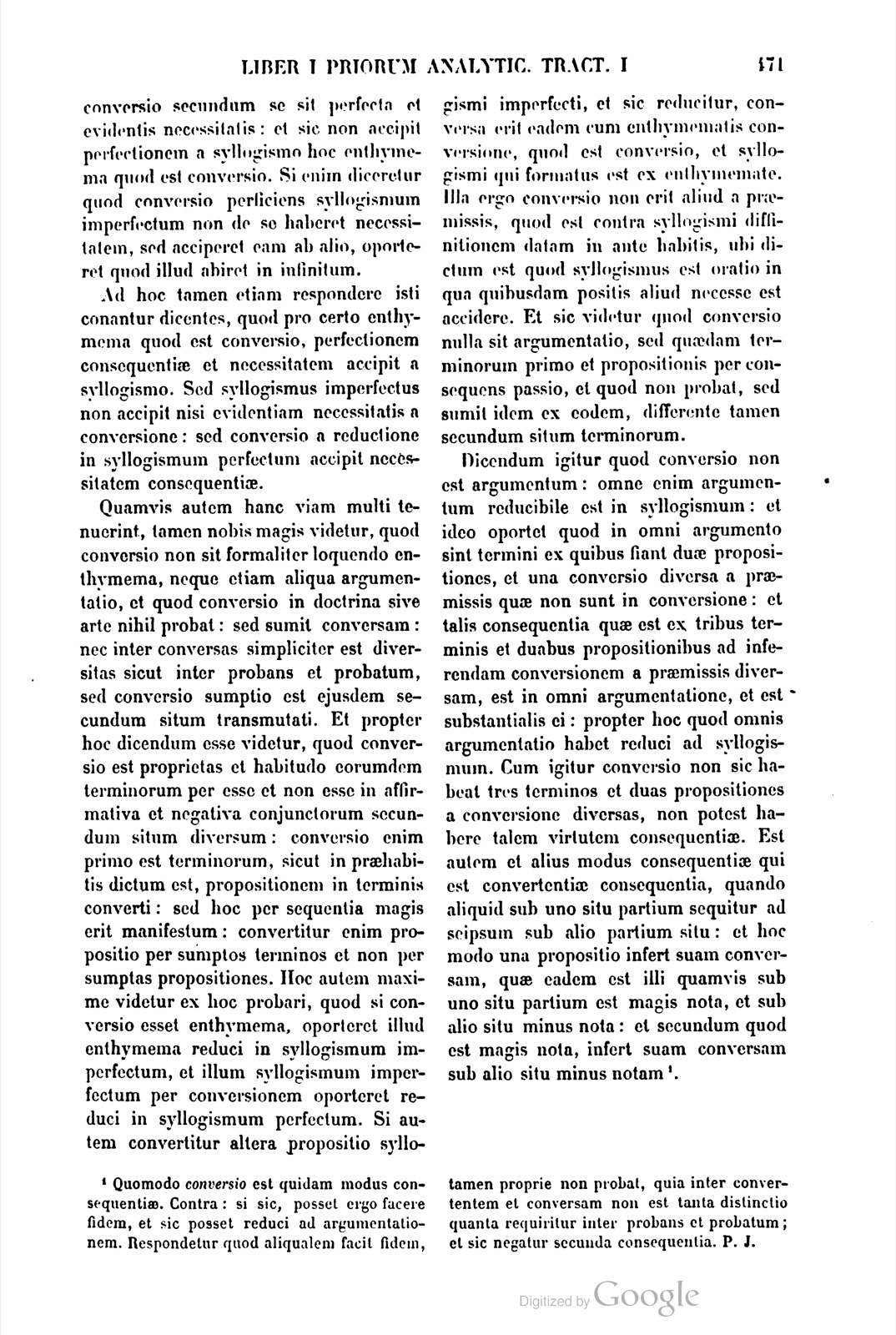
conversio secundum se sit perfecta et evidentis necessitatis: et sic non accipit perfectionem a syllogismo hoc enthymema quod est conversio. Si enim diceretur quod conversio perficiens syllogismum imperfectum non de se haberet necessitatem, sed acciperet eam ab alio, oporteret quod illud abiret in infinitum. Ad hoc tamen etiam respondere isti conantur dicentes, quod pro certo enthymema quod est conversio, perfectionem consequentiae et necessitatem accipit a syllogismo. Sed syllogismus imperfectus non accipit nisi evidentiam necessitatis a conversione: sed conversio a reductione in syllogismum perfectum accipit necessitatem consequentiae. Quamvis autem hanc viam multi tenuerint, tamen nobis magis videtur, quod conversio non sit formaliter loquendo enthymema, neque etiam aliqua argumentatio, et quod conversio in doctrina sive arte nihil probat: sed sumit conversam: nec inter conversas simpliciter est diversitas sicut inter probans et probatum, sed conversio sumptio est ejusdem secundum situm transmutati. Et propter hoc dicendum esse videtur, quod conversio est proprietas et habitudo eorumdem terminorum per esse et non esse in affirmativa et negativa conjunctorum secundum situm diversum: conversio enim primo est terminorum, sicut in praehabitis dictum est, propositionem in terminis converti: sed hoc per sequentia magis erit manifestum: convertitur enim propositio per sumptos terminos et non per sumptas propositiones. Hoc autem maxime videtur ex hoc probari, quod si conversio esset enthymema, oporteret illud enthymema reduci in syllogismum imperfectum, et illum syllogismum imperfectum per conversionem oporteret reduci in syllogismum perfectum. Si autem convertitur altera propositio syllogismi imperfecti, et sic reducitur, conversa erit eadem cum enthymematis conversione, quod est conversio, et syllogismi qui formatus est ex enthymemate. Illa ergo conversio non erit aliud a praemissis, quod est contra syllogismi diffinitionem datam in ante habitis, ubi dictum est quod syllogismus est oratio in qua quibusdam positis aliud necesse est accidere. Et sic videtur quod conversio nulla sit argumentatio, sed quaedam terminorum primo et propositionis per consequens passio, et quod non probat, sed sumit idem ex eodem, differente tamen secundum situm terminorum. Dicendum igitur quod conversio non est argumentum: omne enim argumentum reducibile est in syllogismum: et ideo oportet quod in omni argumento sint termini ex quibus fiant duae propositiones, et una conversio diversa a praemissis quae non sunt in conversione: et talis consequentia quae est ex tribus terminis et duabus propositionibus ad inferendam conversionem a praemissis diversam, est in omni argumentatione, et est substantialis ei: propter hoc quod omnis argumentatio habet reduci ad syllogismum. Cum igitur conversio non sic habeat tres terminos et duas propositiones a conversione diversas, non potest habere talem virtutem consequentiae. Est autem et alius modus consequentiae qui est convertentiae consequentia, quando aliquid sub uno situ partium sequitur ad seipsum sub alio partium situ: et hoc modo una propositio infert suam conversam, quae eadem est illi quamvis sub uno situ partium est magis nota, et sub alio situ minus nota: et secundum quod est magis nota, infert suam conversam sub alio situ minus notam 1.
conversion according to itself is perfect and of evident necessity; and thus this enthymeme which is conversion does not receive perfection from a syllogism. For if it were said that conversion perfecting an imperfect syllogism did not have necessity of itself but received it from another, that other would have to go off to infinity. Nevertheless, they also try to respond to this by saying that certainly the enthymeme which is conversion receives the perfection and necessity of consequence from the syllogism. But the imperfect syllogism receives only the evidence of necessity from conversion; but conversion receives the necessity of consequence from reduction into a perfect syllogism. But although many have held this way, nevertheless it seems more to us that conversion, formally speaking, is not an enthymeme, nor even any argumentation, and that conversion in doctrine or art proves nothing, but takes the converted proposition. Nor between converted propositions is there simply a diversity such as there is between what proves and what is proved; rather, conversion is a taking of the same thing transmuted according to position. And for this reason it seems that one must say that conversion is a property and disposition of the same terms, joined through being and non-being in affirmative and negative propositions, according to a diverse position. For conversion is first of terms, as was said in what preceded, namely that a proposition is converted in terms; but this will be more manifest through what follows, for a proposition is converted through the terms taken and not through propositions taken. But this seems especially to be proved from this: that if conversion were an enthymeme, that enthymeme would have to be reduced into an imperfect syllogism, and that imperfect syllogism would have to be reduced through conversion into a perfect syllogism. But if the other proposition of the imperfect syllogism is converted, and it is reduced in this way, the converted proposition will be the same as the conversion of the enthymeme, which is conversion, and as that of the syllogism which has been formed from the enthymeme. Therefore that conversion will not be something other than the premises, which is contrary to the definition of syllogism given in the preceding matters, where it was said that a syllogism is a speech in which, when certain things have been posited, something other must happen of necessity. And thus it seems that conversion is no argumentation, but first a certain passion of terms and consequently of proposition, and that it does not prove but takes the same from the same, differing nevertheless according to the position of the terms. Therefore one must say that conversion is not an argument: for every argument is reducible to syllogism; and therefore in every argument there must be terms from which two propositions are made, and one conversion diverse from the premises which are not in the conversion. And such a consequence, which is from three terms and two propositions for inferring a conversion diverse from the premises, is in every argumentation and is substantial to it, because every argumentation has to be reduced to syllogism. Since, therefore, conversion does not in this way have three terms and two propositions diverse from conversion, it cannot have such a power of consequence. But there is also another mode of consequence, which is the consequence of convertence, when something under one position of the parts follows to itself under another position of the parts; and in this way one proposition infers its converted proposition, which is the same as it, although under one position of the parts it is more known and under another position less known; and insofar as it is more known, it infers its converted proposition under another, less known position 1.
Notes
- How conversion is a certain mode of consequence. On the contrary: if this is so, therefore it could produce belief, and thus it could be reduced to argumentation. It is answered that it does produce some belief, yet it does not properly prove, because between the converting proposition and the converted proposition there is not so great a distinction as is required between what proves and what is proved; and thus the second consequence is denied. P. J. (Quomodo conversio est quidam modus consequentiae. Contra: si sic, posset ergo facere fidem, et sic posset reduci ad argumentationem. Respondetur quod aliqualem facit fidem, tamen proprie non probat, quia inter convertentem et conversam non est tanta distinctio quanta requiritur inter probans et probatum; et sic negatur secunda consequentia. P. J.) ↩
If a page does not appear, its photograph has not been uploaded yet.