Works › Prior Analytics, Books I–II
Volume 1 · pp. 469–470
Chapter VIII. How Conversion Is a Principle of an Imperfect Syllogism, and What Conversion Is.
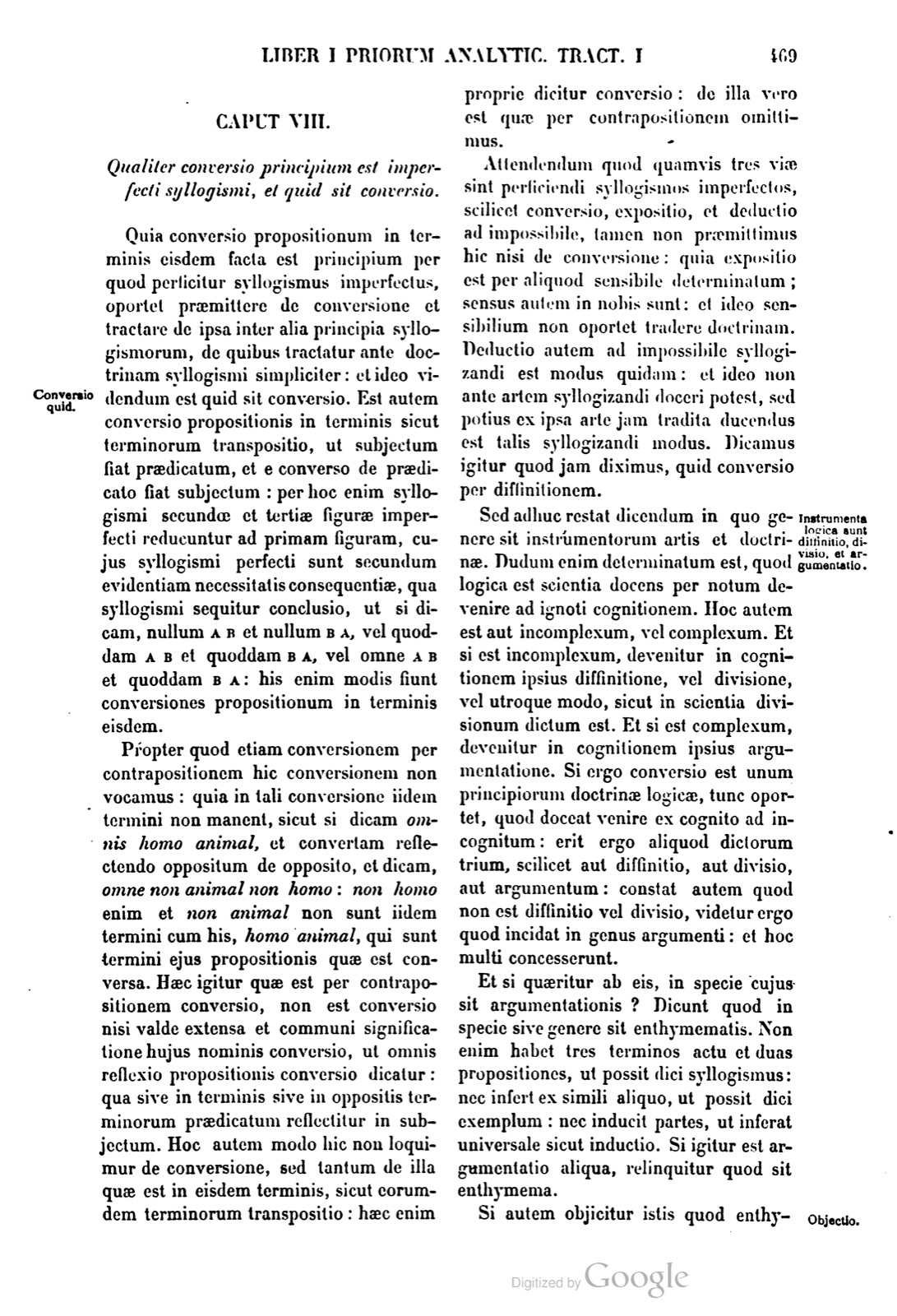
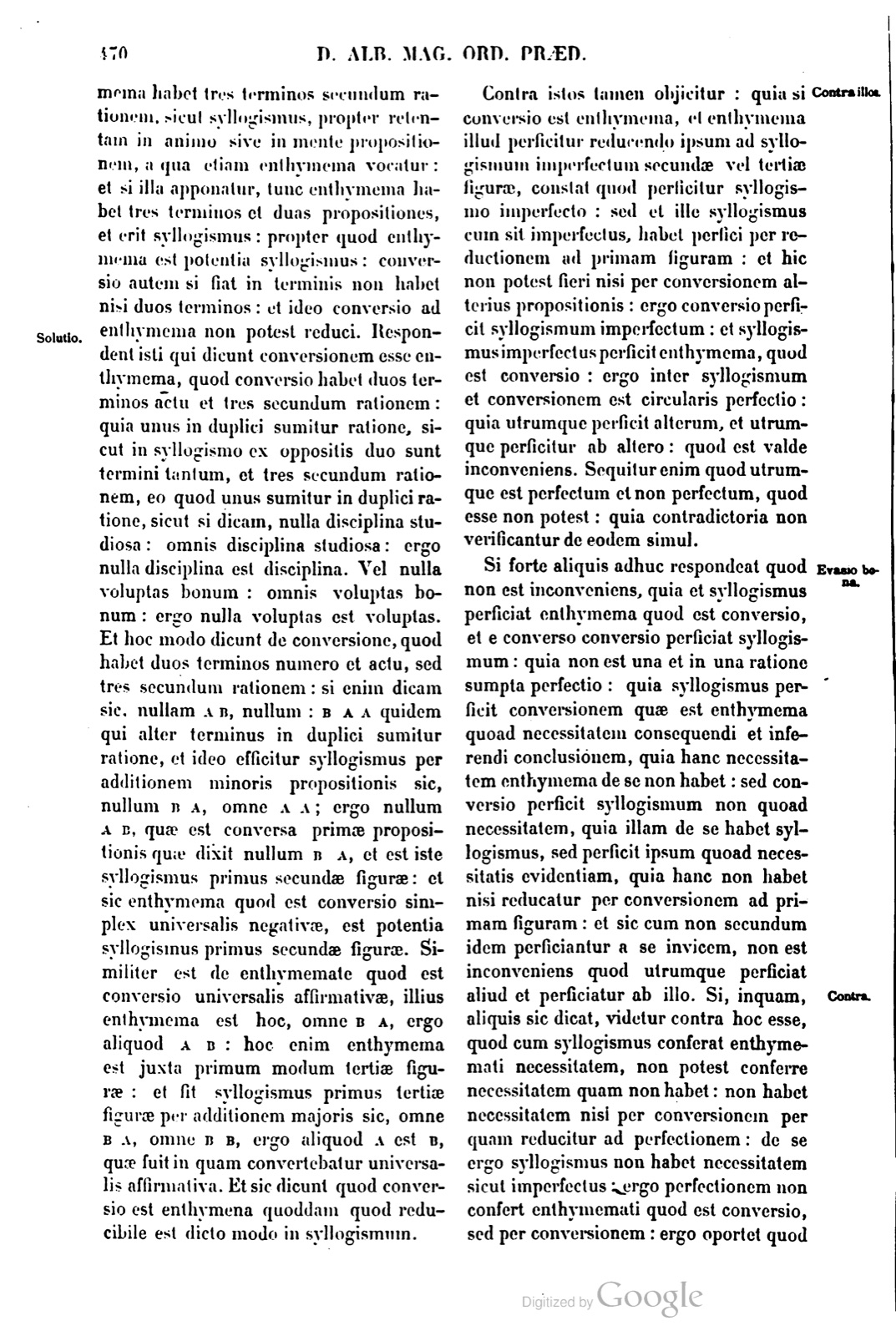
CAPUT VIII. Qualiter conversio principium est imperfecti syllogismi, et quid sit conversio. Quia conversio propositionum in terminis eisdem facta est principium per quod perficitur syllogismus imperfectus, oportet praemittere de conversione et tractare de ipsa inter alia principia syllogismorum, de quibus tractatur ante doctrinam syllogismi simpliciter: et ideo videndum est quid sit conversio. Est autem conversio propositionis in terminis sicut terminorum transpositio, ut subjectum fiat praedicatum, et e converso de praedicato fiat subjectum: per hoc enim syllogismi secundae et tertiae figurae imperfecti reducuntur ad primam figuram, cujus syllogismi perfecti sunt secundum evidentiam necessitatis consequentiae, qua syllogismi sequitur conclusio, ut si dicam, nullum A B et nullum B A, vel quoddam A B et quoddam B A, vel omne A B et quoddam B A: his enim modis fiunt conversiones propositionum in terminis eisdem. Propter quod etiam conversionem per contrapositionem hic conversionem non vocamus: quia in tali conversione iidem termini non manent, sicut si dicam, omnis homo animal, et convertam reflectendo oppositum de opposito, et dicam, omne non animal non homo: non homo enim et non animal non sunt iidem termini cum his, homo animal, qui sunt termini ejus propositionis quae est conversa. Haec igitur quae est per contrapositionem conversio, non est conversio nisi valde extensa et communi significatione hujus nominis conversio, ut omnis reflexio propositionis conversio dicatur: qua sive in terminis sive in oppositis terminorum praedicatum reflectitur in subjectum. Hoc autem modo hic non loquimur de conversione, sed tantum de illa quae est in eisdem terminis, sicut eorumdem terminorum transpositio: haec enim proprie dicitur conversio: de illa vero quae est per contrapositionem omittimus. Attendendum quod quamvis tres viae sint perficiendi syllogismos imperfectos, scilicet conversio, expositio, et deductio ad impossibile, tamen non praemittimus hic nisi de conversione: quia expositio est per aliquod sensibile determinatum; sensus autem in nobis sunt: et ideo sensibilium non oportet tradere doctrinam. Deductio autem ad impossibile syllogizandi est modus quidam: et ideo non ante artem syllogizandi doceri potest, sed potius ex ipsa arte jam tradita ducendus est talis syllogizandi modus. Dicamus igitur quod jam diximus, quid conversio per diffinitionem. Sed adhuc restat dicendum in quo genere sit instrumentorum artis et doctrinae. Dudum enim determinatum est, quod logica est scientia docens per notum devenire ad ignoti cognitionem. Hoc autem est aut incomplexum, vel complexum. Et si est incomplexum, devenitur in cognitionem ipsius diffinitione, vel divisione, vel utroque modo, sicut in scientia divisionum dictum est. Et si est complexum, devenitur in cognitionem ipsius argumentatione. Si ergo conversio est unum principiorum doctrinae logicae, tunc oportet, quod doceat venire ex cognito ad incognitum: erit ergo aliquod dictorum trium, scilicet aut diffinitio, aut divisio, aut argumentum: constat autem quod non est diffinitio vel divisio, videtur ergo quod incidat in genus argumenti: et hoc multi concesserunt. Et si quaeritur ab eis, in specie cujus sit argumentationis? Dicunt quod in specie sive genere sit enthymematis. Non enim habet tres terminos actu et duas propositiones, ut possit dici syllogismus: nec infert ex simili aliquo, ut possit dici exemplum: nec inducit partes, ut inferat universale sicut inductio. Si igitur est argumentatio aliqua, relinquitur quod sit enthymema. Si autem objicitur istis quod enthymema habet tres terminos secundum rationem, sicut syllogismus, propter retentam in animo sive in mente propositionem, a qua etiam enthymema vocatur: et si illa apponatur, tunc enthymema habet tres terminos et duas propositiones, et erit syllogismus: propter quod enthymema est potentia syllogismus: conversio autem si fiat in terminis non habet nisi duos terminos: et ideo conversio ad enthymema non potest reduci. Respondent isti qui dicunt conversionem esse enthymema, quod conversio habet duos terminos actu et tres secundum rationem: quia unus in duplici sumitur ratione, sicut in syllogismo ex oppositis duo sunt termini tantum, et tres secundum rationem, eo quod unus sumitur in duplici ratione, sicut si dicam, nulla disciplina studiosa: omnis disciplina studiosa: ergo nulla disciplina est disciplina. Vel nulla voluptas bonum: omnis voluptas bonum: ergo nulla voluptas est voluptas. Et hoc modo dicunt de conversione, quod habet duos terminos numero et actu, sed tres secundum rationem: si enim dicam sic, nullam A B, nullum B A. A quidem qui alter terminus in duplici sumitur ratione, et ideo efficitur syllogismus per additionem minoris propositionis sic, nullum B A, omne A A; ergo nullum A B, quae est conversa primae propositionis quae dixit nullum B A, et est iste syllogismus primus secundae figurae: et sic enthymema quod est conversio simplex universalis negativae, est potentia syllogismus primus secundae figurae. Similiter est de enthymemate quod est conversio universalis affirmativae, illius enthymema est hoc, omne B A, ergo aliquod A B: hoc enim enthymema est juxta primum modum tertiae figurae: et fit syllogismus primus tertiae figurae per additionem majoris sic, omne B A, omne B B, ergo aliquod A est B, quae fuit in quam convertebatur universalis affirmativa. Et sic dicunt quod conversio est enthymema quoddam quod reducibile est dicto modo in syllogismum. Contra istos tamen objicitur: quia si conversio est enthymema, et enthymema illud perficitur reducendo ipsum ad syllogismum imperfectum secundae vel tertiae figurae, constat quod perficitur syllogismo imperfecto: sed et ille syllogismus cum sit imperfectus, habet perfici per reductionem ad primam figuram: et hic non potest fieri nisi per conversionem alterius propositionis: ergo conversio perficit syllogismum imperfectum: et syllogismus imperfectus perficit enthymema, quod est conversio: ergo inter syllogismum et conversionem est circularis perfectio: quia utrumque perficit alterum, et utrumque perficitur ab altero: quod est valde inconveniens. Sequitur enim quod utrumque est perfectum et non perfectum, quod esse non potest: quia contradictoria non verificantur de eodem simul. Si forte aliquis adhuc respondeat quod non est inconveniens, quia et syllogismus perficiat enthymema quod est conversio, et e converso conversio perficiat syllogismum: quia non est una et in una ratione sumpta perfectio: quia syllogismus perficit conversionem quae est enthymema quoad necessitatem consequendi et inferendi conclusionem, quia hanc necessitatem enthymema de se non habet: sed conversio perficit syllogismum non quoad necessitatem, quia illam de se habet syllogismus, sed perficit ipsum quoad necessitatis evidentiam, quia hanc non habet nisi reducatur per conversionem ad primam figuram: et sic cum non secundum idem perficiantur a se invicem, non est inconveniens quod utrumque perficiat aliud et perficiatur ab illo. Si, inquam, aliquis sic dicat, videtur contra hoc esse, quod cum syllogismus conferat enthymemati necessitatem, non potest conferre necessitatem quam non habet: non habet necessitatem nisi per conversionem per quam reducitur ad perfectionem: de se ergo syllogismus non habet necessitatem sicut imperfectus: ergo perfectionem non confert enthymemati quod est conversio, sed per conversionem: ergo oportet quod
CHAPTER VIII. How conversion is a principle of an imperfect syllogism, and what conversion is. Because the conversion of propositions made in the same terms is the principle through which an imperfect syllogism is perfected, one must premise concerning conversion and treat of it among the other principles of syllogisms, concerning which treatment is given before the teaching of syllogism simply. And therefore one must see what conversion is. Now the conversion of a proposition in terms is like a transposition of terms, so that the subject becomes the predicate, and conversely from the predicate the subject is made. For through this imperfect syllogisms of the second and third figure are reduced to the first figure, whose syllogisms are perfect according to the evidence of the necessity of consequence, by which the conclusion follows from the syllogism; as if I should say, no A is B and no B is A, or some A is B and some B is A, or every A is B and some B is A. For in these ways conversions of propositions are made in the same terms. For this reason also we do not here call conversion through contraposition conversion, because in such conversion the same terms do not remain, as if I should say 'every human being is an animal,' and convert it by reflecting the opposite from the opposite, and say, 'every non-animal is a non-human being.' For non-human being and non-animal are not the same terms as these, human being and animal, which are the terms of the proposition that is converted. Therefore the conversion which is through contraposition is not conversion except by a very extended and common signification of this name conversion, so that every reflection of a proposition is called conversion, by which, whether in the terms or in the opposites of the terms, the predicate is reflected into the subject. But here we are not speaking of conversion in this way, but only of that conversion which is in the same terms, as the transposition of the same terms; for this is properly called conversion. But we omit that conversion which is through contraposition. One must attend that, although there are three ways of perfecting imperfect syllogisms, namely conversion, exposition, and deduction to the impossible, nevertheless here we premise only concerning conversion, because exposition is through some determinate sensible thing; but the senses are in us, and therefore one need not hand down teaching about sensibles. But deduction to the impossible is a certain mode of syllogizing; and therefore it cannot be taught before the art of syllogizing, but rather such a mode of syllogizing must be drawn from the art itself once it has already been handed down. Therefore let us say that we have already said what conversion is through definition. But it still remains to be said in what genus of instruments of art and doctrine it is. For it was determined earlier that logic is the science teaching one to come through the known to cognition of the unknown. Now this unknown is either incomplex or complex. And if it is incomplex, one comes to cognition of it by definition, or by division, or in both ways, as has been said in the science of divisions. And if it is complex, one comes to cognition of it by argumentation. Therefore if conversion is one of the principles of logical doctrine, then it must teach one to come from the known to the unknown. Therefore it will be one of the three things stated, namely either definition, or division, or argument. But it is clear that it is not definition or division; therefore it seems that it falls into the genus of argument, and many have granted this. And if it is asked by them in the species of which argumentation it is, they say that it is in the species or genus of enthymeme. For it does not have three terms in act and two propositions, so that it could be called a syllogism; nor does it infer from something similar, so that it could be called an example; nor does it induce parts, so that it may infer the universal as induction does. Therefore, if it is some argumentation, it remains that it is an enthymeme. But if someone objects to them that an enthymeme has three terms according to reason, as syllogism does, because of the proposition retained in the soul or in the mind, from which also enthymeme is named; and if that proposition is added, then the enthymeme has three terms and two propositions and will be a syllogism, on account of which an enthymeme is a syllogism in potency; but conversion, if it is made in terms, has only two terms, and therefore conversion cannot be reduced to enthymeme. Those who say that conversion is an enthymeme respond that conversion has two terms in act and three according to reason, because one is taken in a twofold account, just as in a syllogism from opposites there are only two terms, and three according to reason, because one is taken in a twofold account; as if I should say, no studious discipline: every discipline studious: therefore no discipline is discipline. Or, no pleasure good: every pleasure good: therefore no pleasure is pleasure. And in this way they say of conversion that it has two terms in number and act, but three according to reason. For if I say thus, no A B, no B A. A indeed, which is the other term, is taken in a twofold account, and therefore a syllogism is effected by the addition of a minor proposition in this way: no B A, every A A; therefore no A B, which is the converted proposition of the first proposition which said no B A, and this is the first syllogism of the second figure. And thus the enthymeme which is the simple conversion of a universal negative is in potency the first syllogism of the second figure. It is similar concerning the enthymeme which is the conversion of a universal affirmative. Its enthymeme is this: every B A, therefore some A B. For this enthymeme is according to the first mode of the third figure; and it becomes the first syllogism of the third figure through the addition of the major in this way: every B A, every B B, therefore some A is B, which was that into which the universal affirmative was converted. And thus they say that conversion is a certain enthymeme which is reducible in the stated way into syllogism. Nevertheless it is objected against them: because if conversion is an enthymeme, and that enthymeme is perfected by reducing it to an imperfect syllogism of the second or third figure, it is clear that it is perfected by an imperfect syllogism. But that syllogism too, since it is imperfect, has to be perfected through reduction to the first figure; and this cannot happen except through the conversion of another proposition. Therefore conversion perfects an imperfect syllogism, and an imperfect syllogism perfects an enthymeme, which is conversion. Therefore between syllogism and conversion there is a circular perfection, because each perfects the other, and each is perfected by the other, which is very unfitting. For it follows that each is perfect and not perfect, which cannot be, because contradictories are not verified of the same thing at once. If perhaps someone still responds that it is not unfitting, because both the syllogism perfects the enthymeme which is conversion and conversely conversion perfects the syllogism, since the perfection taken is not one and in one account; because the syllogism perfects the conversion which is an enthymeme with respect to the necessity of following and inferring the conclusion, since the enthymeme does not have this necessity from itself; but conversion perfects the syllogism not with respect to necessity, because the syllogism has that from itself, but perfects it with respect to the evidence of necessity, because it does not have this unless it is reduced through conversion to the first figure. And thus, since they are not perfected by one another according to the same thing, it is not unfitting that each perfects another and is perfected by it. If, I say, someone speaks in this way, it seems to be against this, that since the syllogism confers necessity on the enthymeme, it cannot confer a necessity which it does not have; but it does not have necessity except through the conversion through which it is reduced to perfection. Therefore of itself the syllogism does not have necessity as an imperfect syllogism; therefore it does not confer perfection on the enthymeme which is conversion, except through conversion; therefore it must be that
If a page does not appear, its photograph has not been uploaded yet.