Works › Prior Analytics, Books I–II
Volume 1 · p. 468
Chapter VII. On Being in a Whole, and on Being Predicated of Every and of No Thing, Which Are Principles of Perfect Syllogisms.
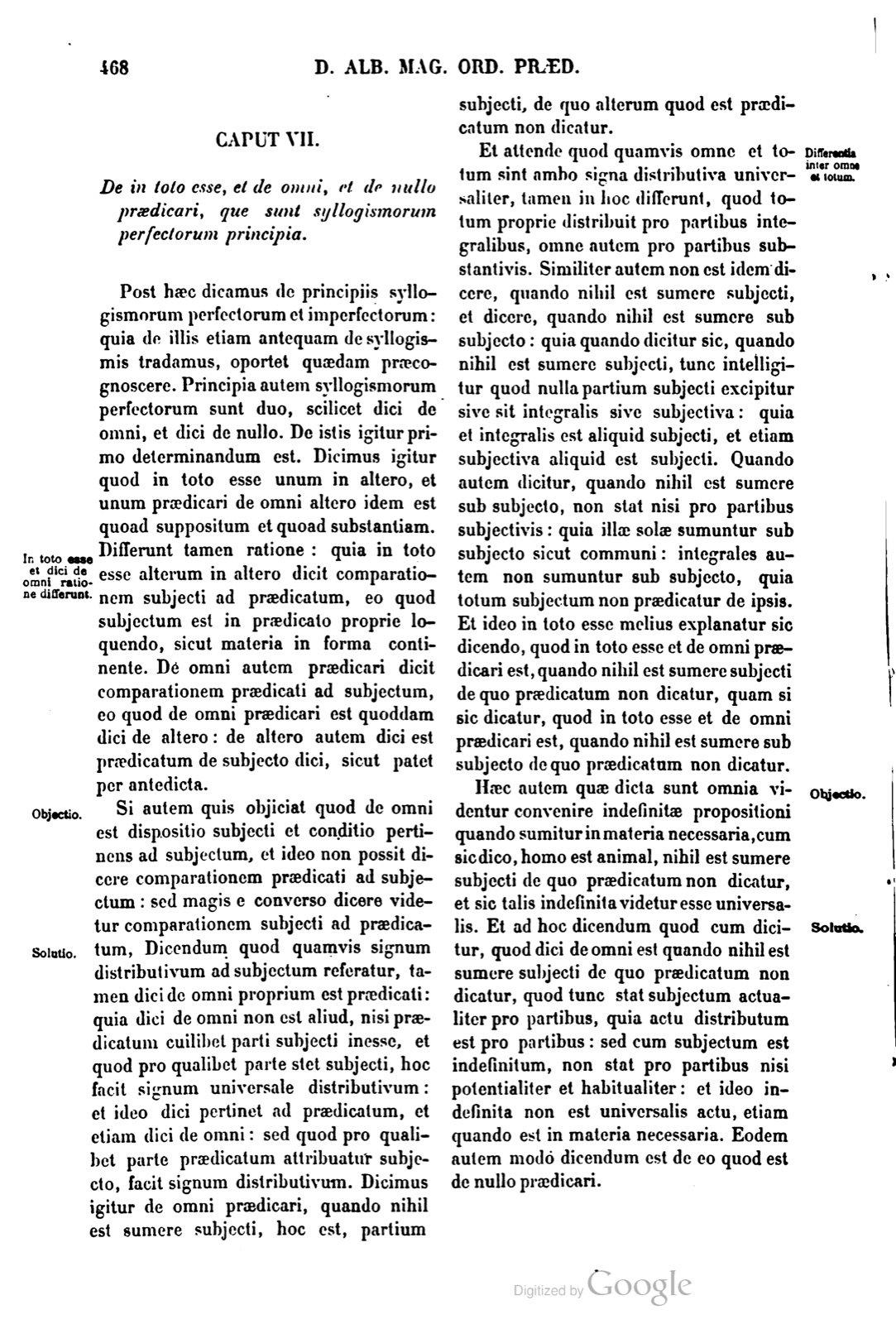
CAPUT VII. De in toto esse, et de omni, et de nullo praedicari, quae sunt syllogismorum perfectorum principia. Post haec dicamus de principiis syllogismorum perfectorum et imperfectorum: quia de illis etiam antequam de syllogismis tradamus, oportet quaedam praecognoscere. Principia autem syllogismorum perfectorum sunt duo, scilicet dici de omni, et dici de nullo. De istis igitur primo determinandum est. Dicimus igitur quod in toto esse unum in altero, et unum praedicari de omni altero idem est quoad suppositum et quoad substantiam. Differunt tamen ratione: quia in toto esse alterum in altero dicit comparationem subjecti ad praedicatum, eo quod subjectum est in praedicato proprie loquendo, sicut materia in forma continente. De omni autem praedicari dicit comparationem praedicati ad subjectum, eo quod de omni praedicari est quoddam dici de altero: de altero autem dici est praedicatum de subjecto dici, sicut patet per antedicta. Si autem quis objiciat quod de omni est dispositio subjecti et conditio pertinens ad subjectum, et ideo non possit dicere comparationem praedicati ad subjectum: sed magis e converso dicere videtur comparationem subjecti ad praedicatum. Dicendum quod quamvis signum distributivum ad subjectum referatur, tamen dici de omni proprium est praedicati: quia dici de omni non est aliud, nisi praedicatum cuilibet parti subjecti inesse, et quod pro qualibet parte stet subjecti, hoc facit signum universale distributivum: et ideo dici pertinet ad praedicatum, et etiam dici de omni: sed quod pro qualibet parte praedicatum attribuatur subjecto, facit signum distributivum. Dicimus igitur de omni praedicari, quando nihil est sumere subjecti, hoc est, partium subjecti, de quo alterum quod est praedicatum non dicatur. Et attende quod quamvis omne et totum sint ambo signa distributiva universaliter, tamen in hoc differunt, quod totum proprie distribuit pro partibus integralibus, omne autem pro partibus substantivis. Similiter autem non est idem dicere, quando nihil est sumere subjecti, et dicere, quando nihil est sumere sub subjecto: quia quando dicitur sic, quando nihil est sumere subjecti, tunc intelligitur quod nulla partium subjecti excipitur sive sit integralis sive subjectiva: quia et integralis est aliquid subjecti, et etiam subjectiva aliquid est subjecti. Quando autem dicitur, quando nihil est sumere sub subjecto, non stat nisi pro partibus subjectivis: quia illae solae sumuntur sub subjecto sicut communi: integrales autem non sumuntur sub subjecto, quia totum subjectum non praedicatur de ipsis. Et ideo in toto esse melius explanatur sic dicendo, quod in toto esse et de omni praedicari est, quando nihil est sumere subjecti de quo praedicatum non dicatur, quam si sic dicatur, quod in toto esse et de omni praedicari est, quando nihil est sumere sub subjecto de quo praedicatum non dicatur. Haec autem quae dicta sunt omnia videntur convenire indefinitae propositioni quando sumitur in materia necessaria, cum sic dico, homo est animal, nihil est sumere subjecti de quo praedicatum non dicatur, et sic talis indefinita videtur esse universalis. Et ad hoc dicendum quod cum dicitur, quod dici de omni est quando nihil est sumere subjecti de quo praedicatum non dicatur, quod tunc stat subjectum actualiter pro partibus, quia actu distributum est pro partibus: sed cum subjectum est indefinitum, non stat pro partibus nisi potentialiter et habitualiter: et ideo indefinita non est universalis actu, etiam quando est in materia necessaria. Eodem autem modo dicendum est de eo quod est de nullo praedicari.
CHAPTER VII. On being in a whole, and on being predicated of every and of no thing, which are principles of perfect syllogisms. After these things let us speak about the principles of perfect and imperfect syllogisms, because concerning them also, before we hand down teaching about syllogisms, some things must be foreknown. But the principles of perfect syllogisms are two, namely to be said of every and to be said of no thing. Therefore these must be determined first. Therefore we say that for one thing to be in a whole in another, and for one thing to be predicated of every other, are the same as to the supposit and as to substance. Nevertheless they differ in account, because for one thing to be in a whole in another says a comparison of the subject to the predicate, because, properly speaking, the subject is in the predicate as matter in containing form. But to be predicated of every says the comparison of the predicate to the subject, because to be predicated of every is a certain being said of another; but to be said of another is for the predicate to be said of the subject, as is clear through what has been said before. But if someone objects that 'of every' is a disposition of the subject and a condition pertaining to the subject, and therefore cannot say a comparison of the predicate to the subject, but rather seems conversely to say a comparison of the subject to the predicate, one must say that although the distributive sign is referred to the subject, nevertheless to be said of every is proper to the predicate. For to be said of every is nothing other than that the predicate is in each part of the subject, and that the subject stands for any part whatever; this is effected by the universal distributive sign. And therefore to be said pertains to the predicate, and so does to be said of every; but that the predicate be attributed to the subject for any part whatever is effected by the distributive sign. Therefore we say that something is predicated of every when there is nothing of the subject to take, that is, of the parts of the subject, of which the other thing which is the predicate is not said. And attend that although every and whole are both distributive signs universally, nevertheless they differ in this: that whole properly distributes for integral parts, but every for substantive parts. Similarly it is not the same to say 'when there is nothing to take of the subject' and to say 'when there is nothing to take under the subject,' because when it is said in this way, when there is nothing to take of the subject, then it is understood that none of the parts of the subject is excepted, whether it be integral or subjective, because an integral part too is something of the subject, and a subjective part too is something of the subject. But when it is said, when there is nothing to take under the subject, it stands only for subjective parts, because those alone are taken under the subject as under a common thing; but integral parts are not taken under the subject, because the whole subject is not predicated of them. And therefore being in the whole is better explained by saying that being in the whole and being predicated of every is when there is nothing of the subject to take of which the predicate is not said, than if it were said thus, that being in the whole and being predicated of every is when there is nothing to take under the subject of which the predicate is not said. But all these things which have been said seem to suit an indefinite proposition when it is taken in necessary matter, when I say thus, 'a human being is an animal': there is nothing of the subject to take of which the predicate is not said, and so such an indefinite seems to be universal. To this one must say that when it is said that to be said of every is when there is nothing of the subject to take of which the predicate is not said, then the subject stands actually for the parts, because it is actually distributed for the parts; but when the subject is indefinite, it does not stand for the parts except potentially and habitually. And therefore an indefinite is not actually universal, even when it is in necessary matter. The same must be said about what it is to be predicated of no thing.
If a page does not appear, its photograph has not been uploaded yet.