Works › Prior Analytics, Books I–II
Volume 1 · p. 467
Chapter VI. Which Syllogism Is Perfect and Which Imperfect.
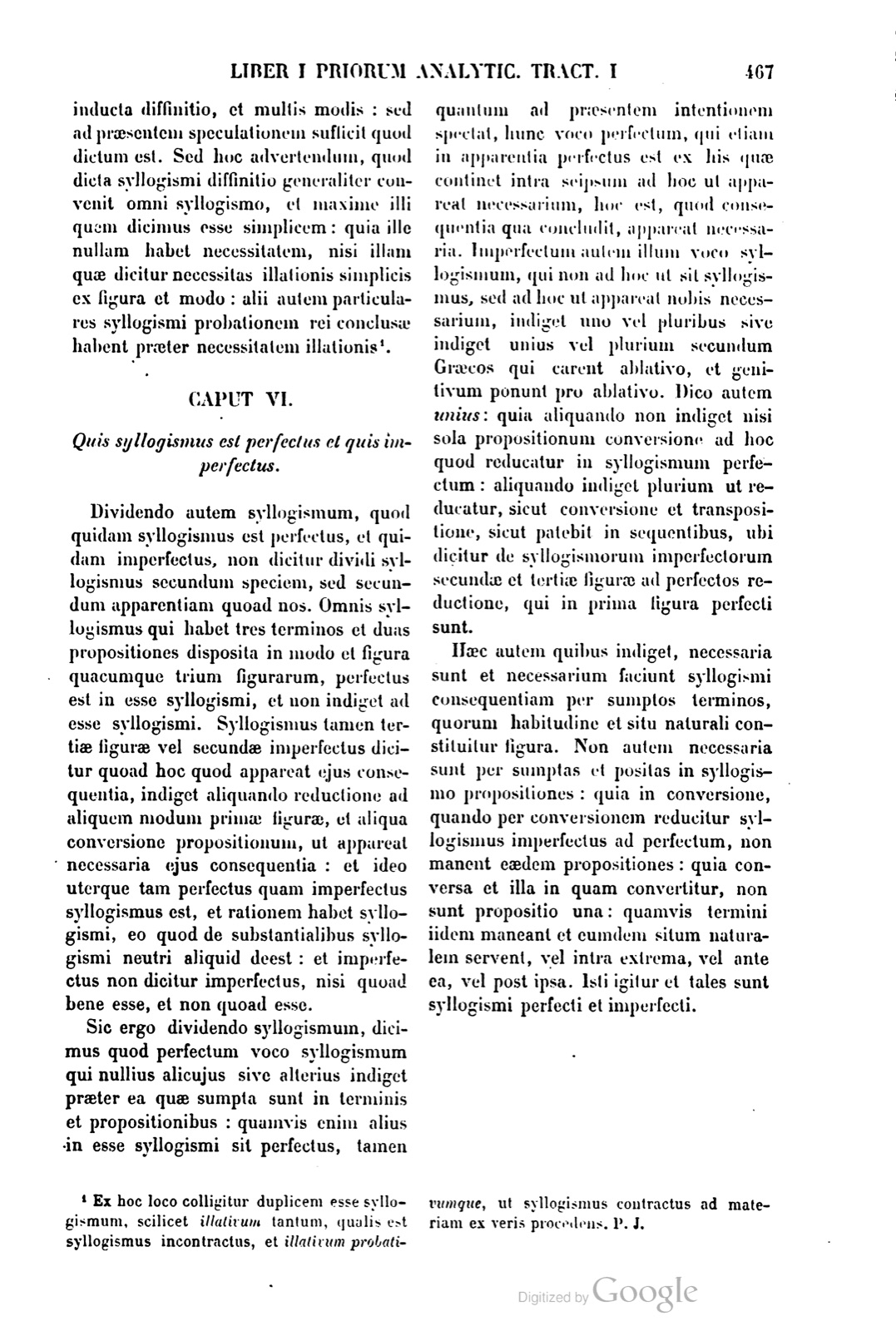
CAPUT VI. Quis syllogismus est perfectus et quis imperfectus. Dividendo autem syllogismum, quod quidam syllogismus est perfectus, et quidam imperfectus, non dicitur dividi syllogismus secundum speciem, sed secundum apparentiam quoad nos. Omnis syllogismus qui habet tres terminos et duas propositiones disposita in modo et figura quacumque trium figurarum, perfectus est in esse syllogismi, et non indiget ad esse syllogismi. Syllogismus tamen tertiae figurae vel secundae imperfectus dicitur quoad hoc quod appareat ejus consequentia, indiget aliquando reductione ad aliquem modum primae figurae, et aliqua conversione propositionum, ut appareat necessaria ejus consequentia: et ideo uterque tam perfectus quam imperfectus syllogismus est, et rationem habet syllogismi, eo quod de substantialibus syllogismi neutri aliquid deest: et imperfectus non dicitur imperfectus, nisi quoad bene esse, et non quoad esse. Sic ergo dividendo syllogismum, dicimus quod perfectum voco syllogismum qui nullius alicujus sive alterius indiget praeter ea quae sumpta sunt in terminis et propositionibus: quamvis enim alius in esse syllogismi sit perfectus, tamen quantum ad praesentem intentionem spectat, hunc voco perfectum, qui etiam in apparentia perfectus est ex his quae continet intra seipsum ad hoc ut appareat necessarium, hoc est, quod consequentia qua concludit, appareat necessaria. Imperfectum autem illum voco syllogismum, qui non ad hoc ut sit syllogismus, sed ad hoc ut appareat nobis necessarium, indiget uno vel pluribus sive indiget unius vel plurium secundum Graecos qui carent ablativo, et genitivum ponunt pro ablativo. Dico autem unius: quia aliquando non indiget nisi sola propositionum conversione ad hoc quod reducatur in syllogismum perfectum: aliquando indiget plurium ut reducatur, sicut conversione et transpositione, sicut patebit in sequentibus, ubi dicitur de syllogismorum imperfectorum secundae et tertiae figurae ad perfectos reductione, qui in prima figura perfecti sunt. Haec autem quibus indiget, necessaria sunt et necessarium faciunt syllogismi consequentiam per sumptos terminos, quorum habitudine et situ naturali constituitur figura. Non autem necessaria sunt per sumptas et positas in syllogismo propositiones: quia in conversione, quando per conversionem reducitur syllogismus imperfectus ad perfectum, non manent eaedem propositiones: quia conversa et illa in quam convertitur, non sunt propositio una: quamvis termini iidem maneant et eumdem situm naturalem servent, vel intra extrema, vel ante ea, vel post ipsa. Isti igitur et tales sunt syllogismi perfecti et imperfecti.
CHAPTER VI. Which syllogism is perfect and which imperfect. But when dividing syllogism by saying that one syllogism is perfect and another imperfect, syllogism is not said to be divided according to species, but according to appearance with respect to us. Every syllogism which has three terms and two propositions arranged in the mode and figure of whichever of the three figures is perfect in the being of syllogism and does not need anything for the being of syllogism. Nevertheless a syllogism of the third figure or of the second is called imperfect with respect to this, that in order that its consequence may appear, it sometimes needs reduction to some mode of the first figure and some conversion of propositions, so that its consequence may appear necessary; and therefore each, both the perfect and the imperfect, is a syllogism and has the account of syllogism, because neither lacks anything of the substantial constituents of syllogism. And the imperfect is not called imperfect except with respect to well-being, and not with respect to being. Therefore, dividing syllogism in this way, we say that I call perfect a syllogism which needs no something or other thing beyond those things which have been taken in the terms and propositions. For although another is perfect in the being of syllogism, nevertheless, so far as the present intention is concerned, I call this one perfect, which even in appearance is perfect from those things which it contains within itself for this, that it may appear necessary, that is, that the consequence by which it concludes may appear necessary. But I call that syllogism imperfect which, not for this that it be a syllogism, but for this that it appear necessary to us, needs one or many things, or needs of one or many things according to the Greeks, who lack the ablative and put the genitive in place of the ablative. But I say 'of one' because sometimes it needs nothing except the conversion alone of propositions for this, that it be reduced into a perfect syllogism; sometimes it needs many things in order to be reduced, such as conversion and transposition, as will be clear in what follows, where there is discussion of the reduction of imperfect syllogisms of the second and third figure to perfect ones, which are perfect in the first figure. But these things which it needs are necessary and make the consequence of the syllogism necessary through the terms taken, by whose disposition and natural position the figure is constituted. But they are not necessary through the propositions taken and posited in the syllogism, because in conversion, when an imperfect syllogism is reduced to a perfect one through conversion, the same propositions do not remain, because the converted proposition and that into which it is converted are not one proposition, although the same terms remain and preserve the same natural position, either within the extremes, or before them, or after them. Therefore these and such are perfect and imperfect syllogisms.
If a page does not appear, its photograph has not been uploaded yet.