Works › Prior Analytics, Books I–II
Volume 1 · pp. 465–467
Chapter V. What Syllogism Is According to Definition.
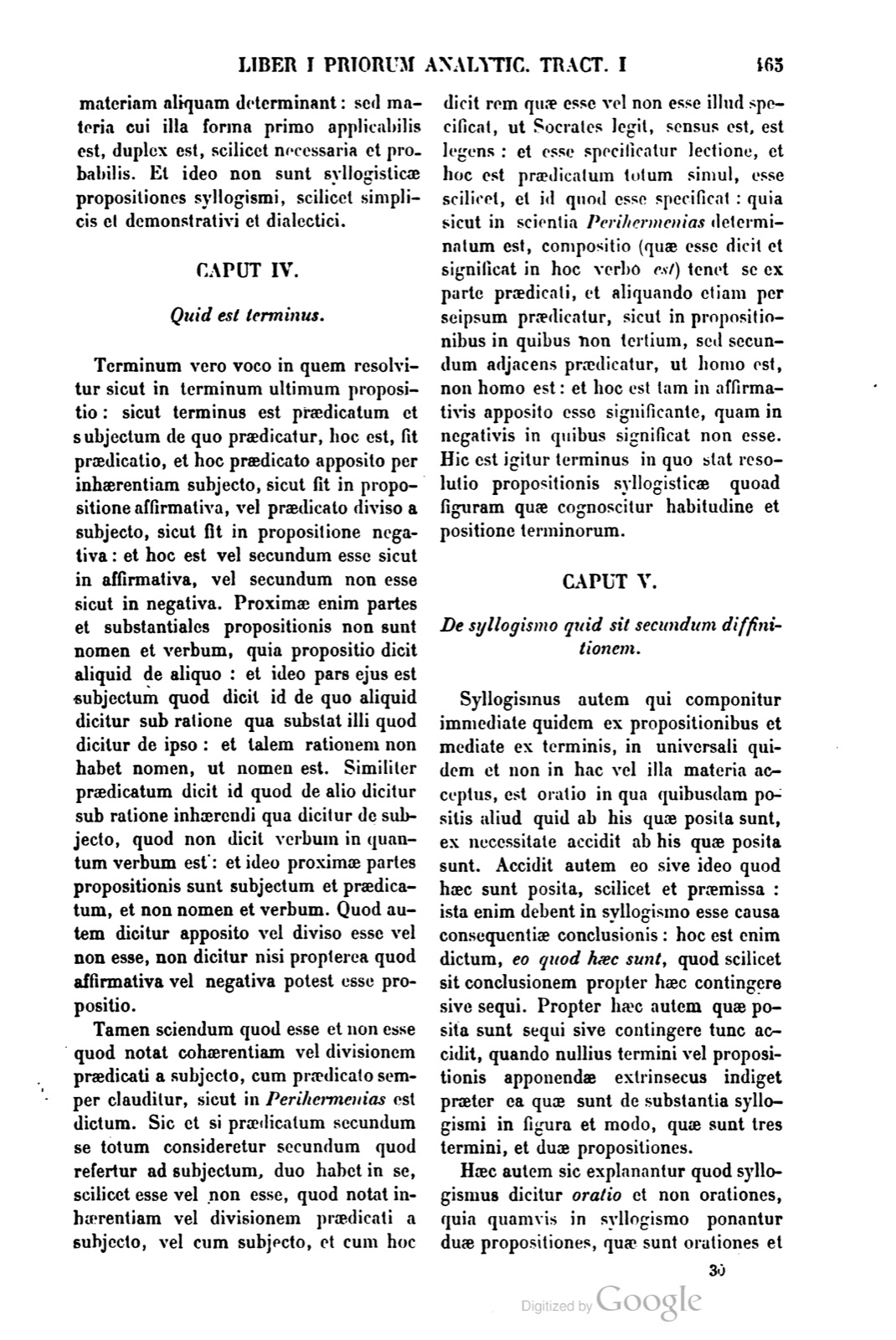
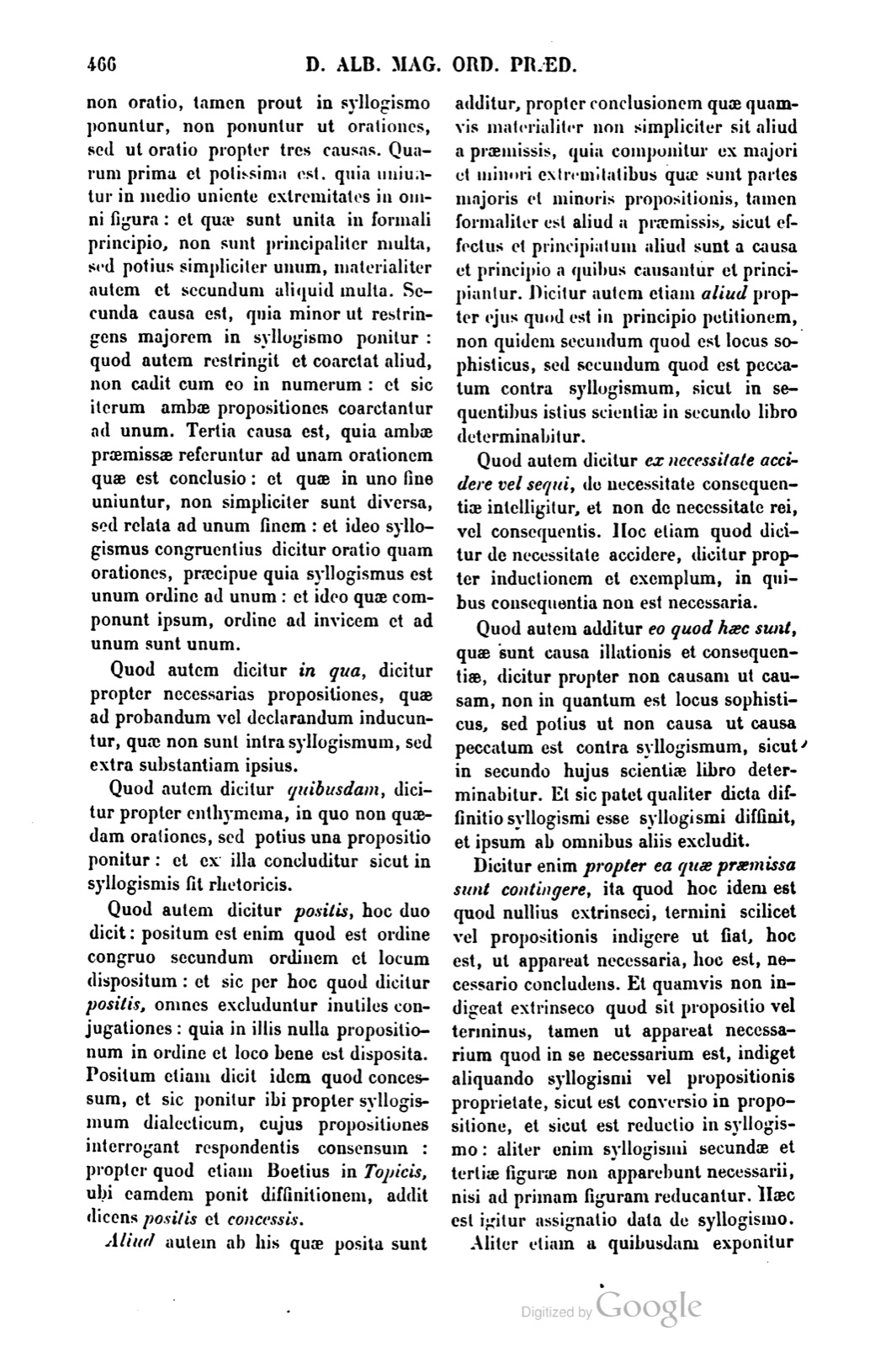
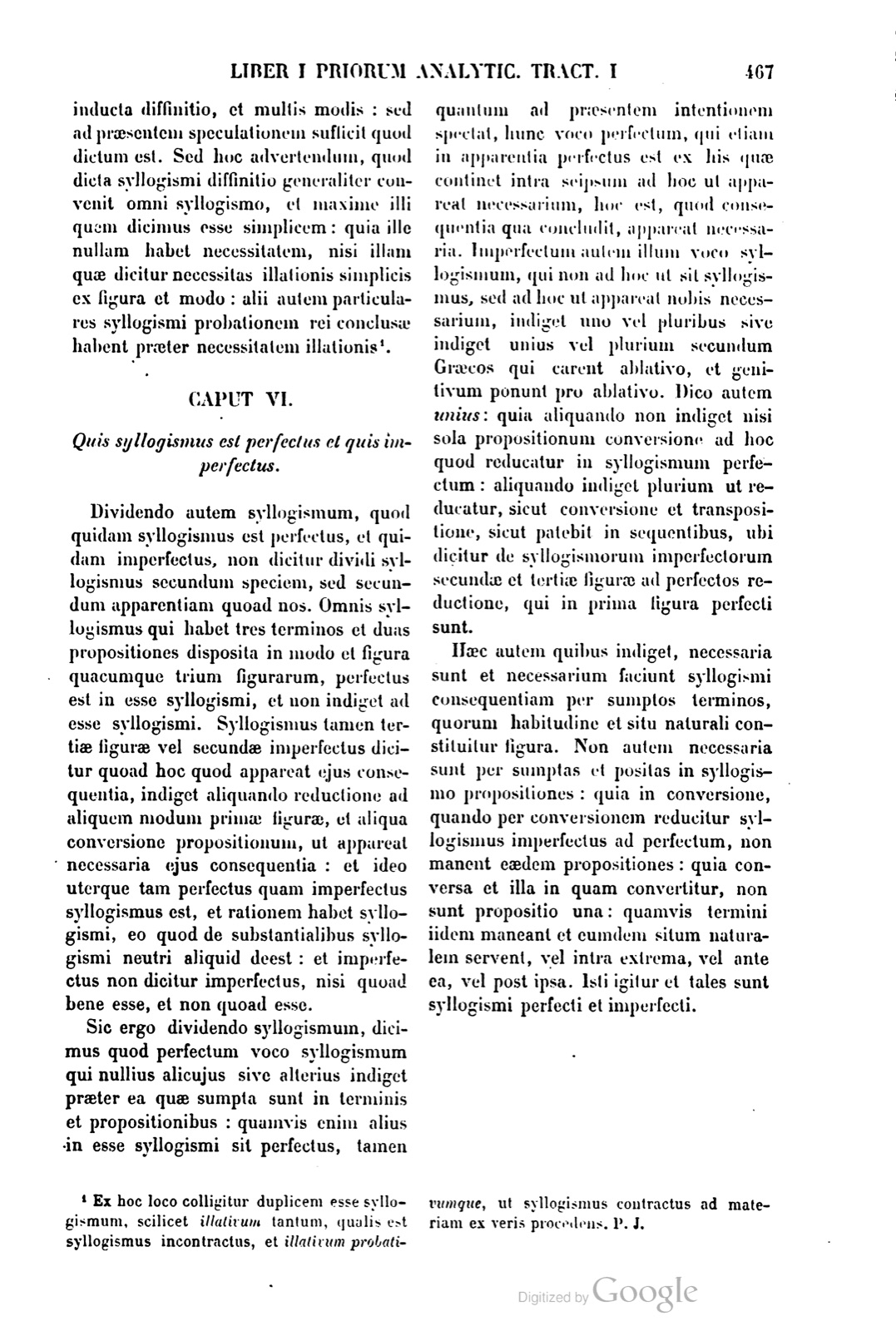
CAPUT V. De syllogismo quid sit secundum diffinitionem. Syllogismus autem qui componitur immediate quidem ex propositionibus et mediate ex terminis, in universali quidem et non in hac vel illa materia acceptus, est oratio in qua quibusdam positis aliud quid ab his quae posita sunt, ex necessitate accidit ab his quae posita sunt. Accidit autem eo sive ideo quod haec sunt posita, scilicet et praemissa: ista enim debent in syllogismo esse causa consequentiae conclusionis: hoc est enim dictum, eo quod haec sunt, quod scilicet sit conclusionem propter haec contingere sive sequi. Propter haec autem quae posita sunt sequi sive contingere tunc accidit, quando nullius termini vel propositionis apponendae extrinsecus indiget praeter ea quae sunt de substantia syllogismi in figura et modo, quae sunt tres termini, et duae propositiones. Haec autem sic explanantur quod syllogismus dicitur oratio et non orationes, quia quamvis in syllogismo ponantur duae propositiones, quae sunt orationes et non oratio, tamen prout in syllogismo ponuntur, non ponuntur ut orationes, sed ut oratio propter tres causas. Quarum prima et potissima est, quia uniuntur in medio uniente extremitates in omni figura: et quae sunt unita in formali principio, non sunt principaliter multa, sed potius simpliciter unum, materialiter autem et secundum aliquid multa. Secunda causa est, quia minor ut restringens majorem in syllogismo ponitur: quod autem restringit et coarctat aliud, non cadit cum eo in numerum: et sic iterum ambae propositiones coarctantur ad unum. Tertia causa est, quia ambae praemissae referuntur ad unam orationem quae est conclusio: et quae in uno fine uniuntur, non simpliciter sunt diversa, sed relata ad unum finem: et ideo syllogismus congruentius dicitur oratio quam orationes, praecipue quia syllogismus est unum ordine ad unum: et ideo quae componunt ipsum, ordine ad invicem et ad unum sunt unum. Quod autem dicitur in qua, dicitur propter necessarias propositiones, quae ad probandum vel declarandum inducuntur, quae non sunt intra syllogismum, sed extra substantiam ipsius. Quod autem dicitur quibusdam, dicitur propter enthymema, in quo non quaedam orationes, sed potius una propositio ponitur: et ex illa concluditur sicut in syllogismis fit rhetoricis. Quod autem dicitur positis, hoc duo dicit: positum est enim quod est ordine congruo secundum ordinem et locum dispositum: et sic per hoc quod dicitur positis, omnes excluduntur inutiles conjugationes: quia in illis nulla propositionum in ordine et loco bene est disposita. Positum etiam dicit idem quod concessum, et sic ponitur ibi propter syllogismum dialecticum, cujus propositiones interrogant respondentis consensum: propter quod etiam Boetius in Topicis, ubi eamdem ponit diffinitionem, addit dicens positis et concessis. Aliud autem ab his quae posita sunt additur, propter conclusionem quae quamvis materialiter non simpliciter sit aliud a praemissis, quia componitur ex majori et minori extremitatibus quae sunt partes majoris et minoris propositionis, tamen formaliter est aliud a praemissis, sicut effectus et principiatum aliud sunt a causa et principio a quibus causantur et principiantur. Dicitur autem etiam aliud propter ejus quod est in principio petitionem, non quidem secundum quod est locus sophisticus, sed secundum quod est peccatum contra syllogismum, sicut in sequentibus istius scientiae in secundo libro determinabitur. Quod autem dicitur ex necessitate accidere vel sequi, de necessitate consequentiae intelligitur, et non de necessitate rei, vel consequentis. Hoc etiam quod dicitur de necessitate accidere, dicitur propter inductionem et exemplum, in quibus consequentia non est necessaria. Quod autem additur eo quod haec sunt, quae sunt causa illationis et consequentiae, dicitur propter non causam ut causam, non in quantum est locus sophisticus, sed potius ut non causa ut causa peccatum est contra syllogismum, sicut in secundo hujus scientiae libro determinabitur. Et sic patet qualiter dicta diffinitio syllogismi esse syllogismi diffinit, et ipsum ab omnibus aliis excludit. Dicitur enim propter ea quae praemissa sunt contingere, ita quod hoc idem est quod nullius extrinseci, termini scilicet vel propositionis indigere ut fiat, hoc est, ut appareat necessaria, hoc est, necessario concludens. Et quamvis non indigeat extrinseco quod sit propositio vel terminus, tamen ut appareat necessarium quod in se necessarium est, indiget aliquando syllogismi vel propositionis proprietate, sicut est conversio in propositione, et sicut est reductio in syllogismo: aliter enim syllogismi secundae et tertiae figurae non apparebunt necessarii, nisi ad primam figuram reducantur. Haec est igitur assignatio data de syllogismo. Aliter etiam a quibusdam exponitur inducta diffinitio, et multis modis: sed ad praesentem speculationem sufficit quod dictum est. Sed hoc advertendum, quod dicta syllogismi diffinitio generaliter convenit omni syllogismo, et maxime illi quem dicimus esse simplicem: quia ille nullam habet necessitatem, nisi illam quae dicitur necessitas illationis simplicis ex figura et modo: alii autem particulares syllogismi probationem rei conclusae habent praeter necessitatem illationis 1.
CHAPTER V. What syllogism is according to definition. But a syllogism, which is composed immediately from propositions and mediately from terms, when taken universally and not in this or that matter, is a speech in which, when certain things have been posited, something other than the things which have been posited follows of necessity from the things which have been posited. It follows by this, or for this reason, that these things have been posited, namely also the premises; for in a syllogism these must be the cause of the consequence of the conclusion. For this is what is said by 'because these things are,' namely that the conclusion happens or follows on account of these things. But to follow or happen on account of these things which have been posited then occurs when it needs no term or proposition to be added from outside beyond those things which belong to the substance of syllogism in figure and mode, which are three terms and two propositions. These things are explained thus: syllogism is called speech and not speeches because, although two propositions are put in a syllogism, which are speeches and not speech, nevertheless, as they are put in the syllogism, they are not put as speeches but as speech for three causes. The first and most powerful of these is that they are united in the middle term uniting the extremes in every figure; and things which are united in a formal principle are not principally many, but rather simply one, though materially and in a certain respect many. The second cause is that the minor is put in the syllogism as restricting the major; but what restricts and narrows another does not fall with it into number, and thus again both propositions are narrowed to one. The third cause is that both premises are referred to one speech, which is the conclusion; and things which are united in one end are not simply diverse, but related to one end. Therefore syllogism is more fittingly called speech than speeches, especially because syllogism is one thing ordered to one thing; and therefore the things which compose it, by order to one another and to one thing, are one. But what is said, 'in which,' is said on account of necessary propositions, which are brought in for proving or declaring and which are not within the syllogism, but outside its substance. But what is said, 'certain things,' is said on account of the enthymeme, in which not certain speeches but rather one proposition is put, and from that it is concluded, as happens in rhetorical syllogisms. But what is said, 'having been posited,' says two things. For what is posited is what has been arranged in fitting order according to order and place; and so through the phrase 'having been posited' all useless conjunctions are excluded, because in those no proposition is well arranged in order and place. The posited also says the same as the granted, and thus it is put there on account of the dialectical syllogism, whose propositions ask for the consent of the respondent; for this reason Boethius too in the Topics, where he sets down the same definition, adds by saying 'having been posited and granted.' But 'something other than the things which have been posited' is added on account of the conclusion, which, although materially it is not simply something other than the premises, because it is composed from the major and minor extremes which are parts of the major and minor proposition, nevertheless formally it is something other than the premises, just as an effect and a thing principled are other than the cause and principle by which they are caused and principled. It is also called 'other' on account of the petition of that which is in the principle, not indeed insofar as it is a sophistical place, but insofar as 'non-cause as cause' is a sin against syllogism, as will be determined in what follows of this science in the second book. But what is said, 'to happen or follow from necessity,' is understood of the necessity of consequence and not of the necessity of the thing or of the consequent. This too, that it is said to happen from necessity, is said on account of induction and example, in which the consequence is not necessary. But what is added, 'because these things are,' which are the cause of the inference and consequence, is said on account of non-cause as cause, not insofar as it is a sophistical place, but rather insofar as non-cause as cause is a fault against syllogism, as will be determined in the second book of this science. And thus it is clear how the stated definition of syllogism defines the being of syllogism and excludes it from all other things. For it is said 'to happen on account of those things which have been premised,' so that this is the same as to need no extrinsic thing, namely no term or proposition, in order to come to be, that is, in order to appear necessary, that is, necessarily concluding. And although it does not need an extrinsic thing in order that it be a proposition or a term, nevertheless, in order that what is necessary in itself appear necessary, it sometimes needs a property of syllogism or of proposition, such as conversion in proposition and reduction in syllogism; for otherwise syllogisms of the second and third figure will not appear necessary unless they are reduced to the first figure. This, therefore, is the assignment given concerning syllogism. The introduced definition is also explained otherwise by some, and in many ways; but for the present speculation what has been said suffices. Yet this must be noticed: that the stated definition of syllogism generally suits every syllogism, and especially that which we call simple, because it has no necessity except that which is called the necessity of simple inference from figure and mode; but the other particular syllogisms have proof of the concluded thing in addition to the necessity of inference 1.
Notes
- From this passage it is gathered that syllogism is twofold, namely only inferential, such as an uncontracted syllogism is, and inferential and probative, as a syllogism contracted to matter and proceeding from truths. P. J. (Ex hoc loco colligitur duplicem esse syllogismum, scilicet illativum tantum, qualis est syllogismus incontractus, et illativum probativumque, ut syllogismus contractus ad materiam ex veris procedens. P. J.) ↩
If a page does not appear, its photograph has not been uploaded yet.