Works › Prior Analytics, Books I–II
Volume 1 · p. 465
Chapter IV. What a Term Is.
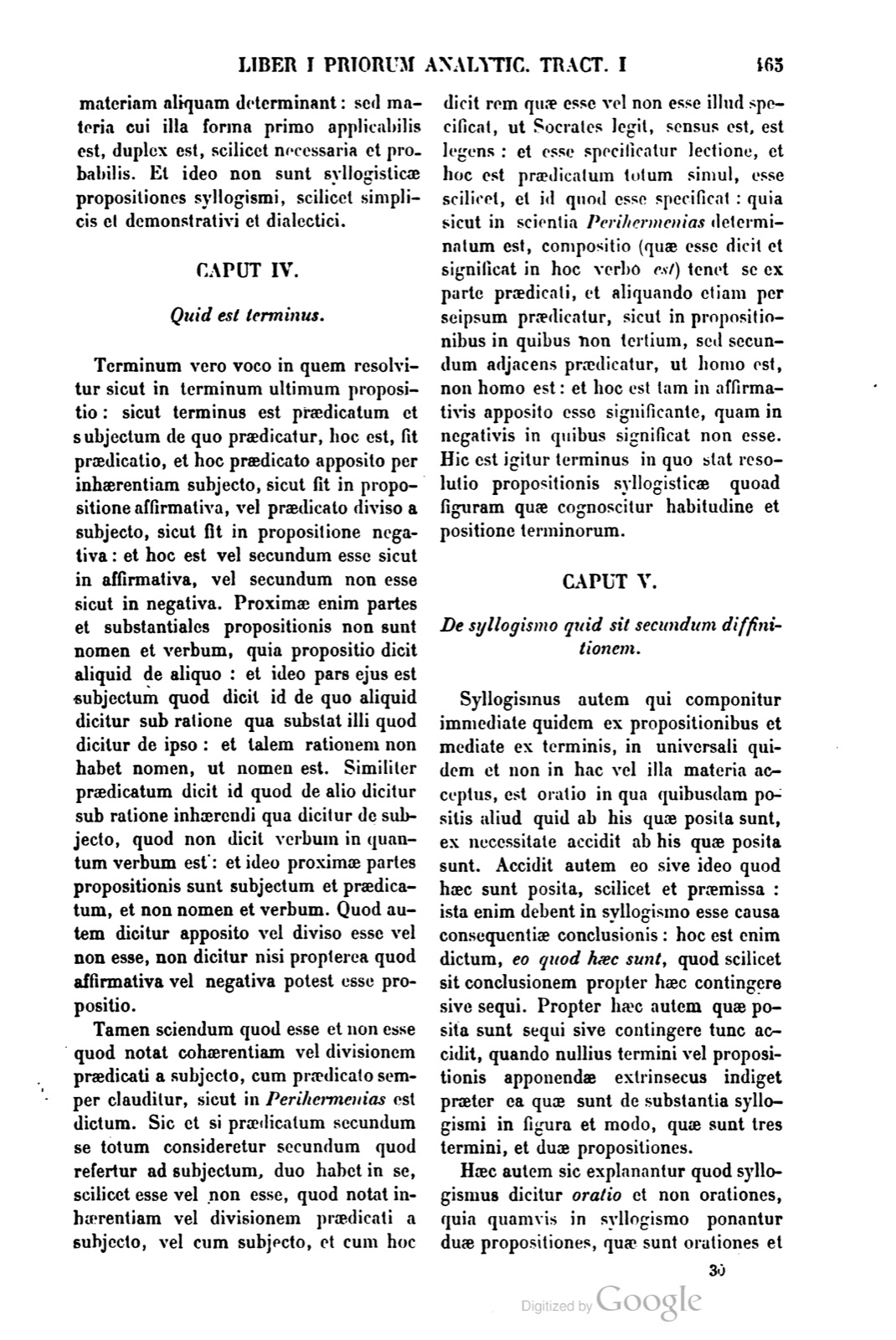
CAPUT IV. Quid est terminus. Terminum vero voco in quem resolvitur sicut in terminum ultimum propositio: sicut terminus est praedicatum et subjectum de quo praedicatur, hoc est, fit praedicatio, et hoc praedicato apposito per inhaerentiam subjecto, sicut fit in propositione affirmativa, vel praedicato diviso a subjecto, sicut fit in propositione negativa: et hoc est vel secundum esse sicut in affirmativa, vel secundum non esse sicut in negativa. Proximae enim partes et substantiales propositionis non sunt nomen et verbum, quia propositio dicit aliquid de aliquo: et ideo pars ejus est subjectum quod dicit id de quo aliquid dicitur sub ratione qua substat illi quod dicitur de ipso: et talem rationem non habet nomen, ut nomen est. Similiter praedicatum dicit id quod de alio dicitur sub ratione inhaerendi qua dicitur de subjecto, quod non dicit verbum in quantum verbum est: et ideo proximae partes propositionis sunt subjectum et praedicatum, et non nomen et verbum. Quod autem dicitur apposito vel diviso esse vel non esse, non dicitur nisi propterea quod affirmativa vel negativa potest esse propositio. Tamen sciendum quod esse et non esse quod notat cohaerentiam vel divisionem praedicati a subjecto, cum praedicato semper clauditur, sicut in Perihermenias est dictum. Sic et si praedicatum secundum se totum consideretur secundum quod refertur ad subjectum, duo habet in se, scilicet esse vel non esse, quod notat inhaerentiam vel divisionem praedicati a subjecto, vel cum subjecto, et cum hoc dicit rem quae esse vel non esse illud specificat, ut Socrates legit, sensus est, est legens: et esse specificatur lectione, et hoc est praedicatum totum simul, esse scilicet, et id quod esse specificat: quia sicut in scientia Perihermenias determinatum est, compositio quae esse dicit et significat in hoc verbo est tenet se ex parte praedicati, et aliquando etiam per seipsum praedicatur, sicut in propositionibus in quibus non tertium, sed secundum adjacens praedicatur, ut homo est, non homo est: et hoc est tam in affirmativis apposito esse significante, quam in negativis in quibus significat non esse. Hic est igitur terminus in quo stat resolutio propositionis syllogisticae quoad figuram quae cognoscitur habitudine et positione terminorum.
CHAPTER IV. What a term is. But I call that a term into which a proposition is resolved as into an ultimate term, just as the term is the predicate and the subject about which it is predicated, that is, predication is made; and this is with the predicate joined to the subject through inherence, as happens in an affirmative proposition, or with the predicate divided from the subject, as happens in a negative proposition. And this is either according to being, as in the affirmative, or according to non-being, as in the negative. For the proximate and substantial parts of a proposition are not noun and verb, because proposition says something about something; and therefore its part is the subject, which says that about which something is said, under the account by which it stands under that which is said of it. And a noun, as noun, does not have such an account. Similarly, the predicate says that which is said of another under the account of inhering by which it is said of the subject, which a verb does not say insofar as it is a verb; and therefore the proximate parts of a proposition are subject and predicate, and not noun and verb. But that being or non-being is said to be joined or divided is said only because a proposition can be affirmative or negative. Nevertheless one must know that being and non-being, which note the coherence or division of the predicate from the subject, are always enclosed with the predicate, as was said in On Interpretation. Thus too, if the predicate is considered as a whole according to itself as it is referred to the subject, it has two things in itself, namely being or non-being, which notes the inherence or division of the predicate from the subject or with the subject, and with this it says the thing which specifies that being or non-being. For example, in 'Socrates reads,' the sense is 'he is reading'; and being is specified by reading, and this is the whole predicate at once, namely being and that which specifies being. For, as was determined in the science of On Interpretation, composition, which says and signifies being in this verb 'is,' holds itself on the side of the predicate, and sometimes is also predicated through itself, as in propositions in which not a third adjacent but a second adjacent is predicated, as 'a human being is,' 'a non-human being is.' And this is both in affirmatives, with joined being signifying, and in negatives in which it signifies non-being. This, therefore, is the term in which the resolution of the syllogistic proposition stands with respect to the figure which is known by the disposition and position of the terms.
If a page does not appear, its photograph has not been uploaded yet.