Works › Prior Analytics, Books I–II
Volume 1 · pp. 461–465
Chapter III. What a Proposition Is.
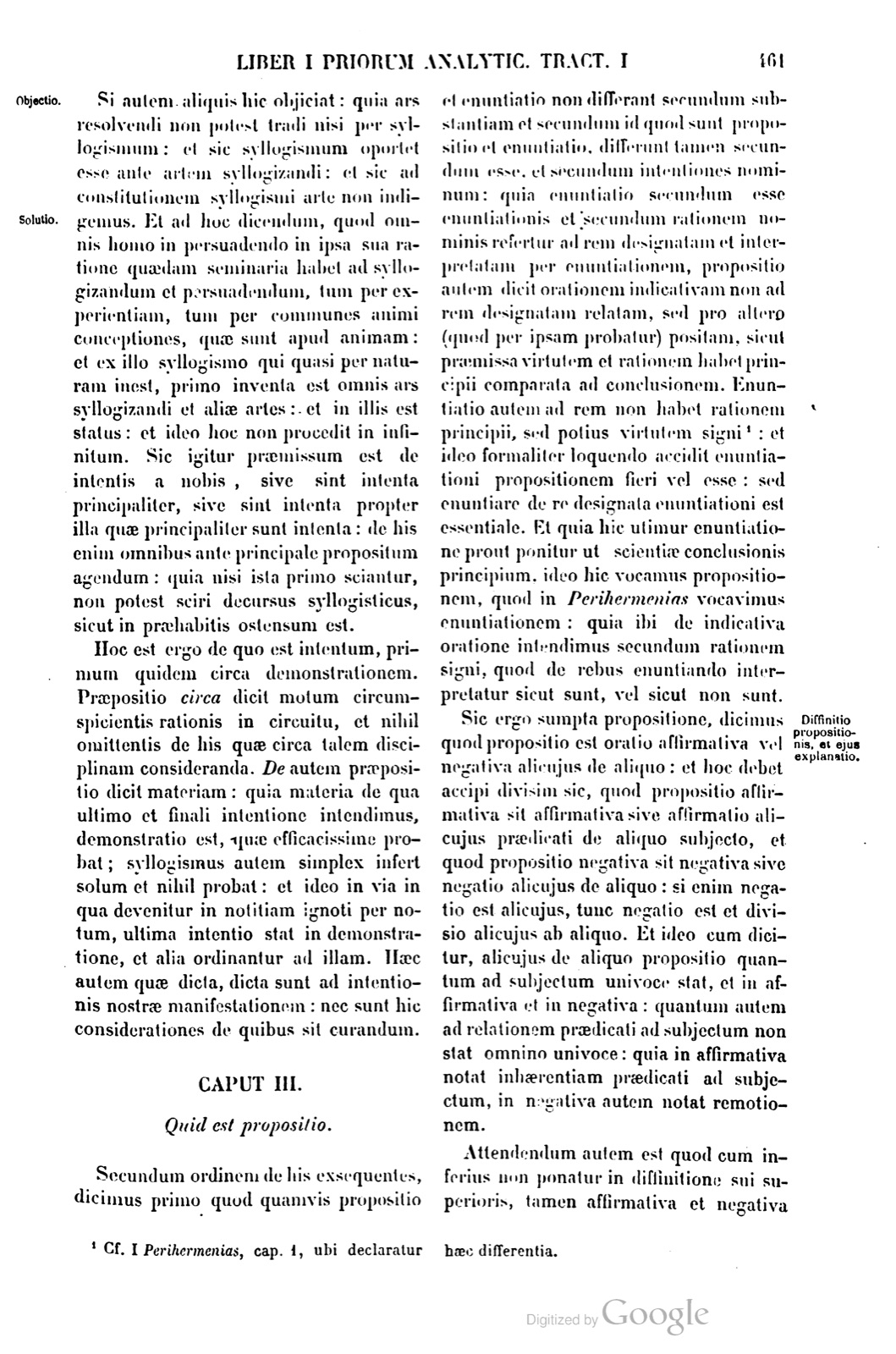
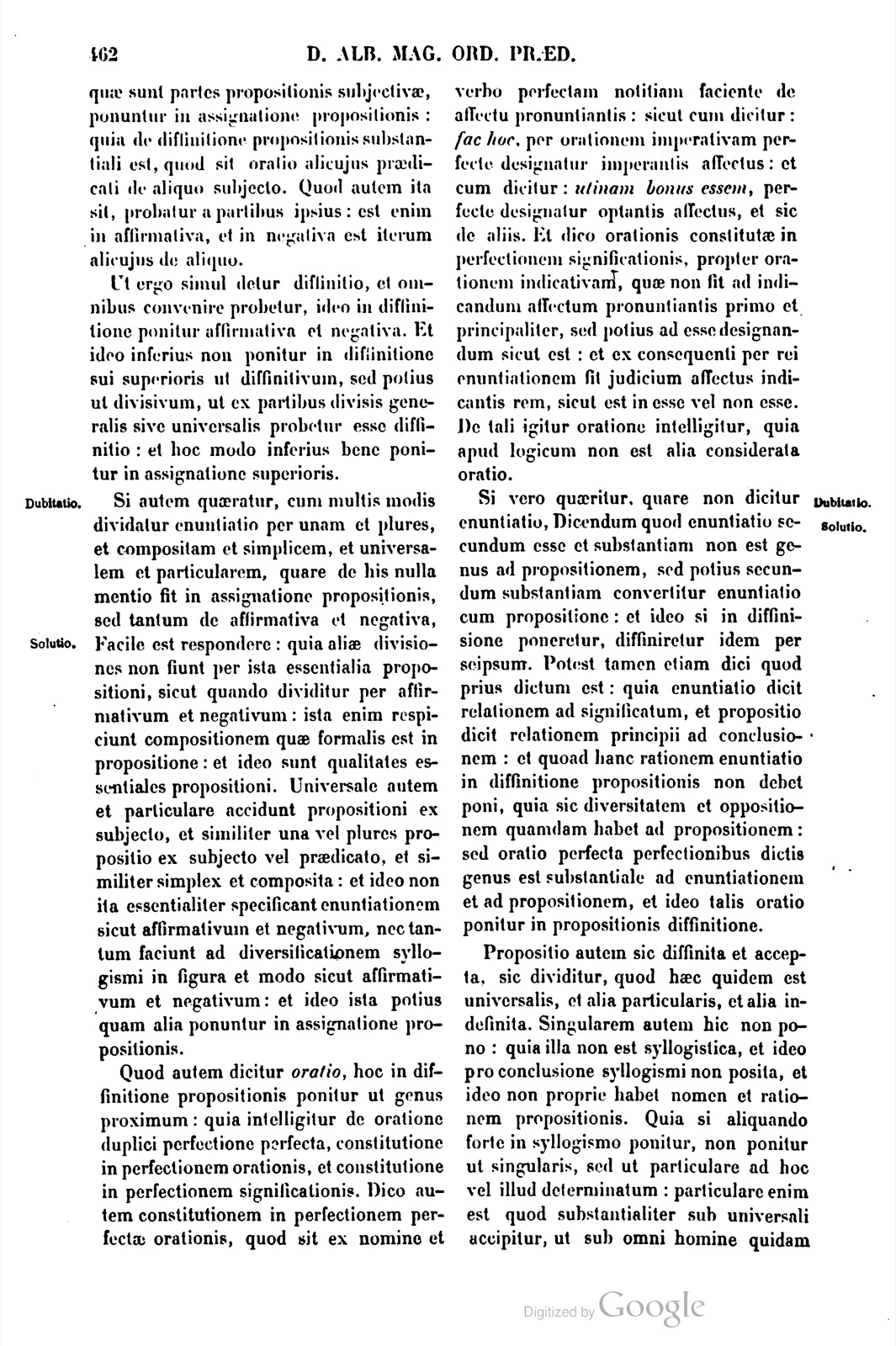
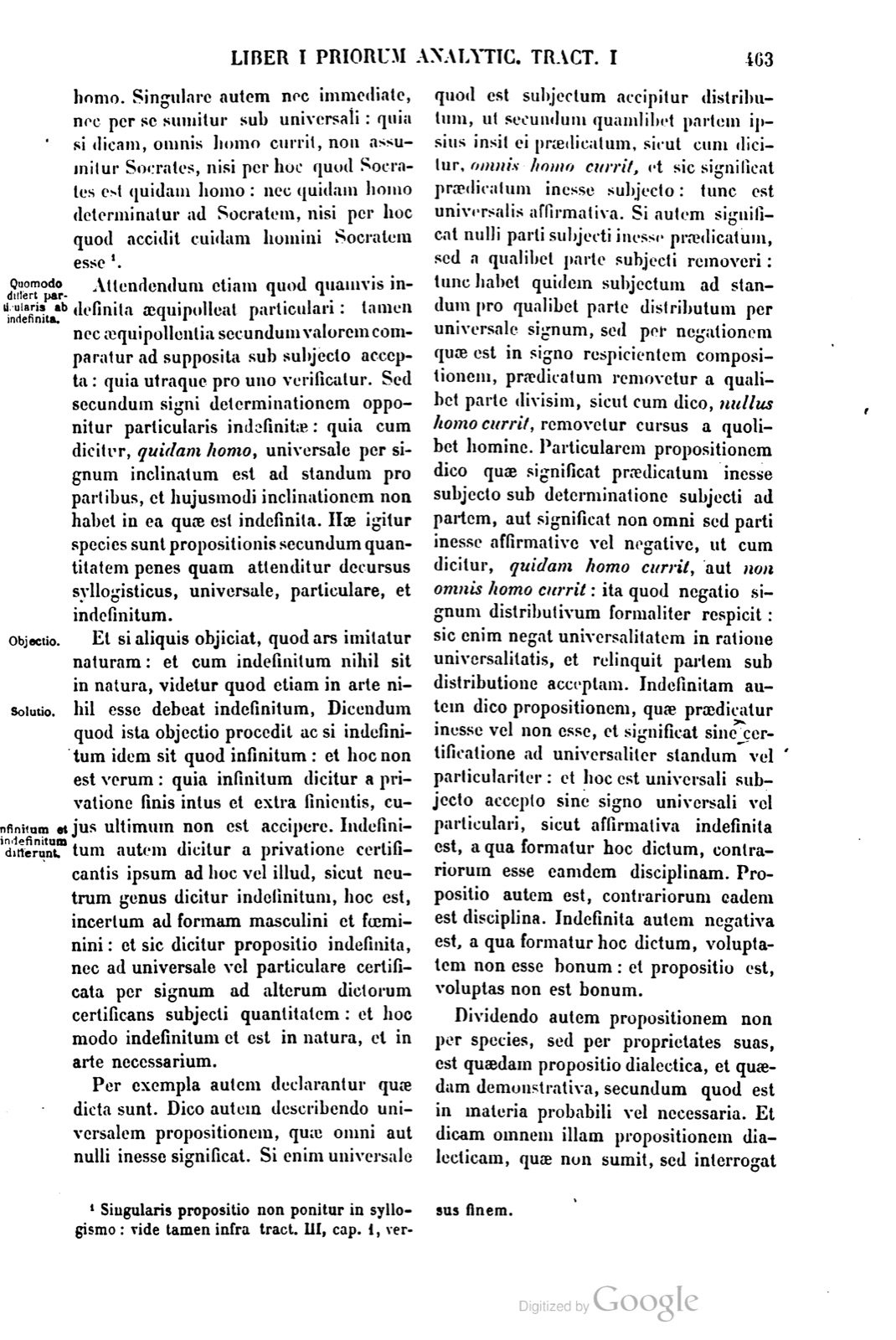
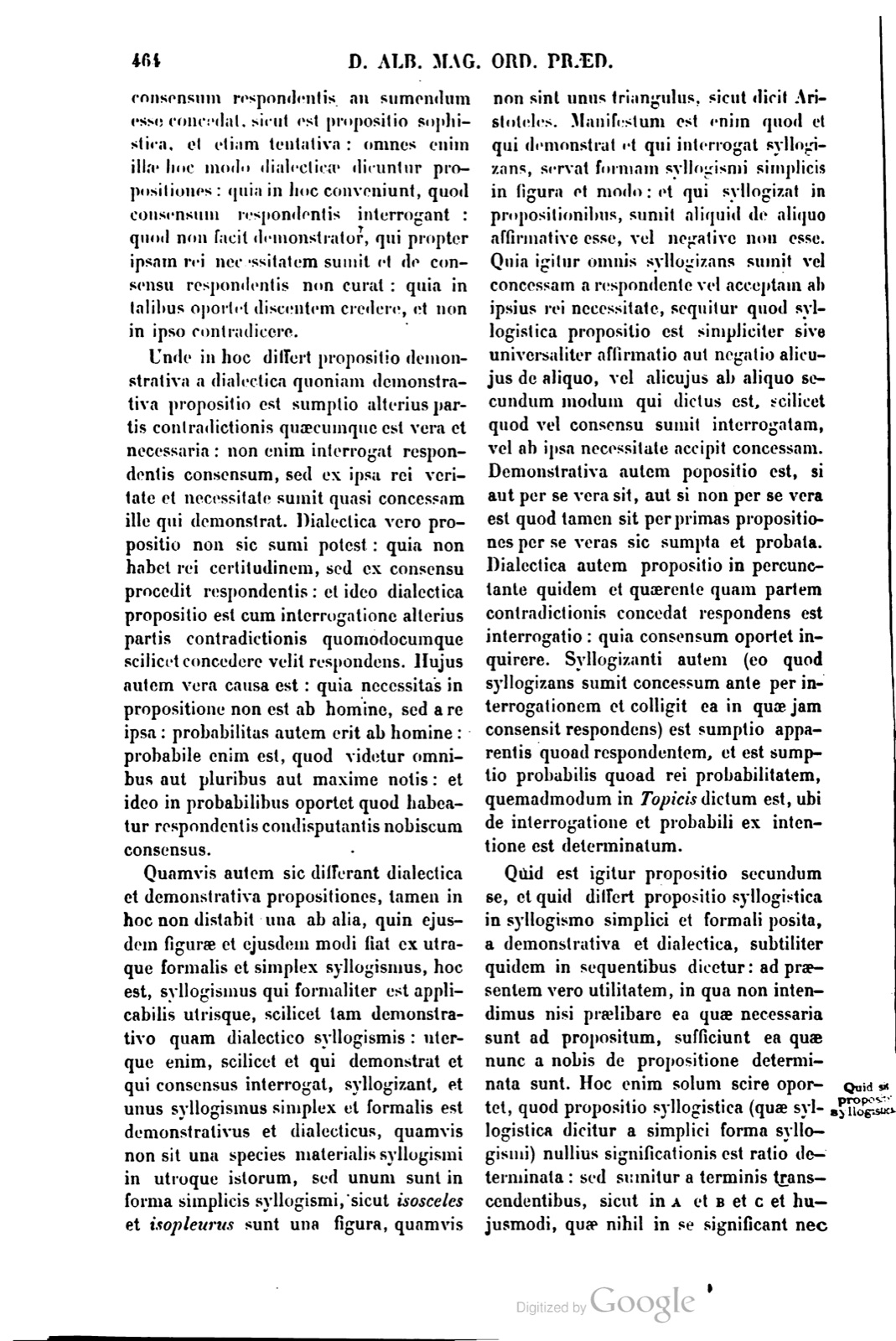
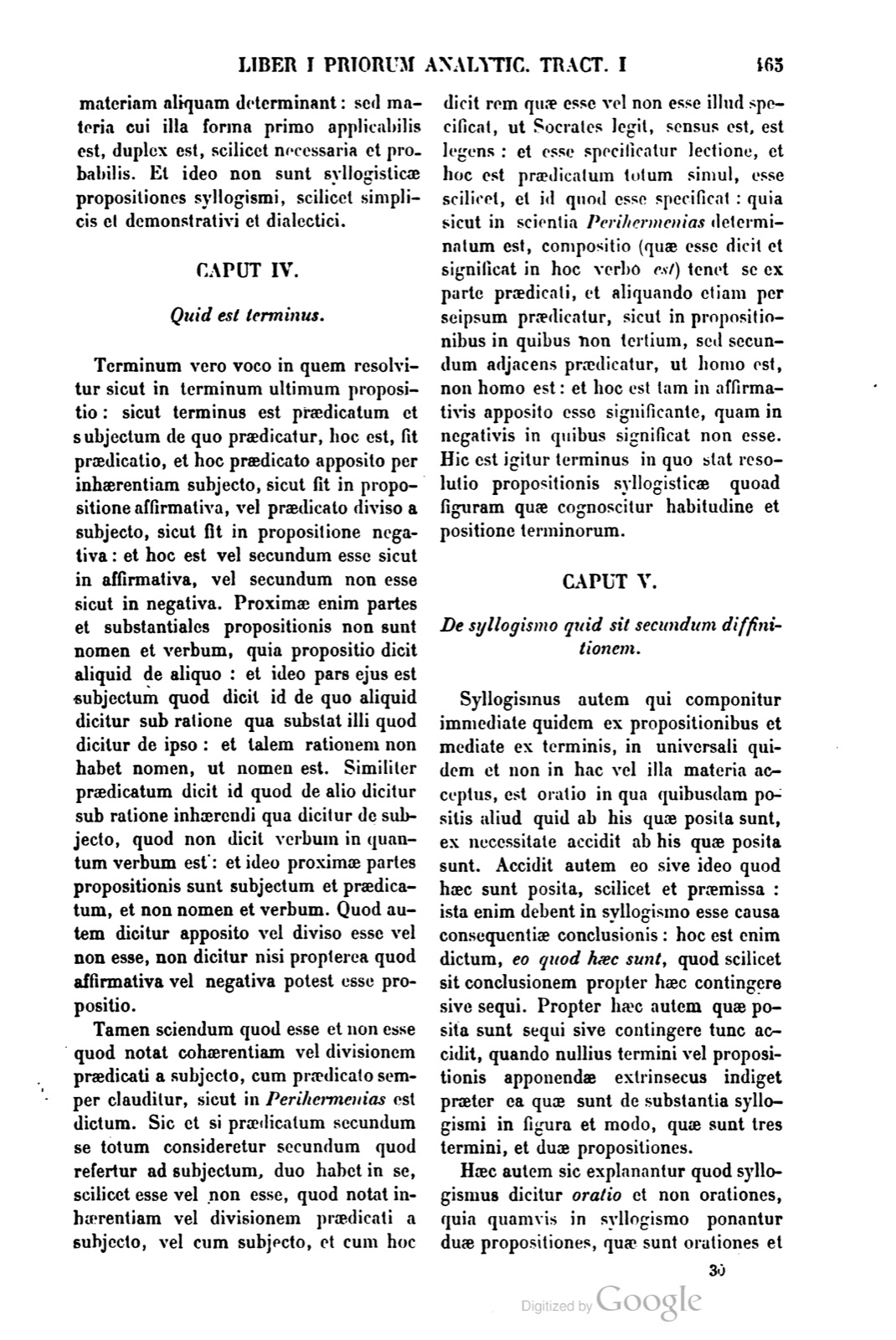
CAPUT III. Quid est propositio. Secundum ordinem de his exsequentes, dicimus primo quod quamvis propositio et enuntiatio non differant secundum substantiam et secundum id quod sunt propositio et enuntiatio, differunt tamen secundum esse, et secundum intentiones nominum: quia enuntiatio secundum esse enuntiationis et secundum rationem nominis refertur ad rem designatam et interpretatam per enuntiationem; propositio autem dicit orationem indicativam non ad rem designatam relatam, sed pro altero quod per ipsam probatur positam, sicut praemissa virtutem et rationem habet principii comparata ad conclusionem. Enuntiatio autem ad rem non habet rationem principii, sed potius virtutem signi 1: et ideo formaliter loquendo accidit enuntiationi propositionem fieri vel esse: sed enuntiare de re designata enuntiationi est essentiale. Et quia hic utimur enuntiatione prout ponitur ut scientiae conclusionis principium, ideo hic vocamus propositionem, quod in Perihermenias vocavimus enuntiationem: quia ibi de indicativa oratione intendimus secundum rationem signi, quod de rebus enuntiando interpretatur sicut sunt, vel sicut non sunt. Sic ergo sumpta propositione, dicimus quod propositio est oratio affirmativa vel negativa alicujus de aliquo: et hoc debet accipi divisim sic, quod propositio affirmativa sit affirmativa sive affirmatio alicujus praedicati de aliquo subjecto, et quod propositio negativa sit negativa sive negatio alicujus de aliquo: si enim negatio est alicujus, tunc negatio est et divisio alicujus ab aliquo. Et ideo cum dicitur, alicujus de aliquo propositio quantum ad subjectum univoce stat, et in affirmativa et in negativa: quantum autem ad relationem praedicati ad subjectum non stat omnino univoce: quia in affirmativa notat inhaerentiam praedicati ad subjectum, in negativa autem notat remotionem. Attendendum autem est quod cum inferius non ponatur in diffinitione sui superioris, tamen affirmativa et negativa quae sunt partes propositionis subjectivae, ponuntur in assignatione propositionis: quia de diffinitione propositionis substantiali est, quod sit oratio alicujus praedicati de aliquo subjecto. Quod autem ita sit, probatur a partibus ipsius: est enim in affirmativa, et in negativa est iterum alicujus de aliquo. Ut ergo simul detur diffinitio, et omnibus convenire probetur, ideo in diffinitione ponitur affirmativa et negativa. Et ideo inferius non ponitur in diffinitione sui superioris ut diffinitivum, sed potius ut divisivum, ut ex partibus divisis generalis sive universalis probetur esse diffinitio: et hoc modo inferius bene ponitur in assignatione superioris. Si autem quaeratur, cum multis modis dividatur enuntiatio per unam et plures, et compositam et simplicem, et universalem et particularem, quare de his nulla mentio fit in assignatione propositionis, sed tantum de affirmativa et negativa, facile est respondere: quia aliae divisiones non fiunt per ista essentialia propositioni, sicut quando dividitur per affirmativum et negativum: ista enim respiciunt compositionem quae formalis est in propositione: et ideo sunt qualitates essentiales propositioni. Universale autem et particulare accidunt propositioni ex subjecto, et similiter una vel plures propositio ex subjecto vel praedicato, et similiter simplex et composita: et ideo non ita essentialiter specificant enuntiationem sicut affirmativum et negativum, nec tantum faciunt ad diversificationem syllogismi in figura et modo sicut affirmativum et negativum: et ideo ista potius quam alia ponuntur in assignatione propositionis. Quod autem dicitur oratio, hoc in diffinitione propositionis ponitur ut genus proximum: quia intelligitur de oratione duplici perfectione perfecta, constitutione in perfectionem orationis, et constitutione in perfectionem significationis. Dico autem constitutionem in perfectionem perfectae orationis, quod sit ex nomine et verbo perfectam notitiam faciente de affectu pronuntiantis: sicut cum dicitur: fac hoc, per orationem imperativam perfecte designatur imperantis affectus: et cum dicitur: utinam bonus essem, perfecte designatur optantis affectus, et sic de aliis. Et dico orationis constitutae in perfectionem significationis, propter orationem indicativam, quae non fit ad indicandum affectum pronuntiantis primo et principaliter, sed potius ad esse designandum sicut est: et ex consequenti per rei enuntiationem fit judicium affectus indicantis rem, sicut est in esse vel non esse. De tali igitur oratione intelligitur, quia apud logicum non est alia considerata oratio. Si vero quaeritur, quare non dicitur enuntiatio, dicendum quod enuntiatio secundum esse et substantiam non est genus ad propositionem, sed potius secundum substantiam convertitur enuntiatio cum propositione: et ideo si in diffinitione poneretur, diffiniretur idem per seipsum. Potest tamen etiam dici quod prius dictum est: quia enuntiatio dicit relationem ad significatum, et propositio dicit relationem principii ad conclusionem: et quoad hanc rationem enuntiatio in diffinitione propositionis non debet poni, quia sic diversitatem et oppositionem quamdam habet ad propositionem: sed oratio perfecta perfectionibus dictis genus est substantiale ad enuntiationem et ad propositionem, et ideo talis oratio ponitur in propositionis diffinitione. Propositio autem sic diffinita et accepta, sic dividitur, quod haec quidem est universalis, et alia particularis, et alia indefinita. Singularem autem hic non pono: quia illa non est syllogistica, et ideo pro conclusione syllogismi non posita, et ideo non proprie habet nomen et rationem propositionis. Quia si aliquando forte in syllogismo ponitur, non ponitur ut singularis, sed ut particulare ad hoc vel illud determinatum: particulare enim est quod substantialiter sub universali accipitur, ut sub omni homine quidam homo. Singulare autem nec immediate, nec per se sumitur sub universali: quia si dicam, omnis homo currit, non assumitur Socrates, nisi per hoc quod Socrates est quidam homo: nec quidam homo determinatur ad Socratem, nisi per hoc quod accidit cuidam homini Socratem esse 2. Attendendum etiam quod quamvis indefinita aequipolleat particulari: tamen nec aequipollentia secundum valorem comparatur ad supposita sub subjecto accepta: quia utraque pro uno verificatur. Sed secundum signi determinationem opponitur particularis indefinitae: quia cum dicitur, quidam homo, universale per signum inclinatum est ad standum pro partibus, et hujusmodi inclinationem non habet in ea quae est indefinita. Hae igitur species sunt propositionis secundum quantitatem penes quam attenditur decursus syllogisticus, universale, particulare, et indefinitum. Et si aliquis objiciat, quod ars imitatur naturam: et cum indefinitum nihil sit in natura, videtur quod etiam in arte nihil esse debeat indefinitum. Dicendum quod ista objectio procedit ac si indefinitum idem sit quod infinitum: et hoc non est verum: quia infinitum dicitur a privatione finis intus et extra finientis, cujus ultimum non est accipere. Indefinitum autem dicitur a privatione certificantis ipsum ad hoc vel illud, sicut neutrum genus dicitur indefinitum, hoc est, incertum ad formam masculini et foeminini: et sic dicitur propositio indefinita, nec ad universale vel particulare certificata per signum ad alterum dictorum certificans subjecti quantitatem: et hoc modo indefinitum et est in natura, et in arte necessarium. Per exempla autem declarantur quae dicta sunt. Dico autem describendo universalem propositionem, quae omni aut nulli inesse significat. Si enim universale quod est subjectum accipitur distributum, ut secundum quamlibet partem ipsius insit ei praedicatum, sicut cum dicitur, omnis homo currit, et sic significat praedicatum inesse subjecto: tunc est universalis affirmativa. Si autem significat nulli parti subjecti inesse praedicatum, sed a qualibet parte subjecti removeri: tunc habet quidem subjectum ad standum pro qualibet parte distributum per universale signum, sed per negationem quae est in signo respicientem compositionem, praedicatum removetur a qualibet parte divisim, sicut cum dico, nullus homo currit, removetur cursus a quolibet homine. Particularem propositionem dico quae significat praedicatum inesse subjecto sub determinatione subjecti ad partem, aut significat non omni sed parti inesse affirmative vel negative, ut cum dicitur, quidam homo currit, aut non omnis homo currit: ita quod negatio signum distributivum formaliter respicit: sic enim negat universalitatem in ratione universalitatis, et relinquit partem sub distributione acceptam. Indefinitam autem dico propositionem, quae praedicatur inesse vel non esse, et significat sine certificatione ad universaliter standum vel particulariter: et hoc est universali subjecto accepto sine signo universali vel particulari, sicut affirmativa indefinita est, a qua formatur hoc dictum, contrariorum esse eamdem disciplinam. Propositio autem est, contrariorum eadem est disciplina. Indefinita autem negativa est, a qua formatur hoc dictum, voluptatem non esse bonum: et propositio est, voluptas non est bonum. Dividendo autem propositionem non per species, sed per proprietates suas, est quaedam propositio dialectica, et quaedam demonstrativa, secundum quod est in materia probabili vel necessaria. Et dicam omnem illam propositionem dialecticam, quae non sumit, sed interrogat consensum respondentis an sumendum esse concedat, sicut est propositio sophistica, et etiam tentativa: omnes enim illae hoc modo dialecticae dicuntur propositiones: quia in hoc conveniunt, quod consensum respondentis interrogant: quod non facit demonstrator, qui propter ipsam rei necessitatem sumit et de consensu respondentis non curat: quia in talibus oportet discentem credere, et non in ipso contradicere. Unde in hoc differt propositio demonstrativa a dialectica quoniam demonstrativa propositio est sumptio alterius partis contradictionis quaecumque est vera et necessaria: non enim interrogat respondentis consensum, sed ex ipsa rei veritate et necessitate sumit quasi concessam ille qui demonstrat. Dialectica vero propositio non sic sumi potest: quia non habet rei certitudinem, sed ex consensu procedit respondentis: et ideo dialectica propositio est cum interrogatione alterius partis contradictionis quomodocumque scilicet concedere velit respondens. Hujus autem vera causa est: quia necessitas in propositione non est ab homine, sed a re ipsa: probabilitas autem erit ab homine: probabile enim est, quod videtur omnibus aut pluribus aut maxime notis: et ideo in probabilibus oportet quod habeatur respondentis condisputantis nobiscum consensus. Quamvis autem sic differant dialectica et demonstrativa propositiones, tamen in hoc non distabit una ab alia, quin ejusdem figurae et ejusdem modi fiat ex utraque formalis et simplex syllogismus, hoc est, syllogismus qui formaliter est applicabilis utrisque, scilicet tam demonstrativo quam dialectico syllogismis: uterque enim, scilicet et qui demonstrat et qui consensus interrogat, syllogizant, et unus syllogismus simplex et formalis est demonstrativus et dialecticus, quamvis non sit una species materialis syllogismi in utroque istorum, sed unum sunt in forma simplicis syllogismi, sicut isosceles et isopleurus sunt una figura, quamvis non sint unus triangulus, sicut dicit Aristoteles. Manifestum est enim quod et qui demonstrat et qui interrogat syllogizans, servat formam syllogismi simplicis in figura et modo: et qui syllogizat in propositionibus, sumit aliquid de aliquo affirmative esse, vel negative non esse. Quia igitur omnis syllogizans sumit vel concessam a respondente vel acceptam ab ipsius rei necessitate, sequitur quod syllogistica propositio est simpliciter sive universaliter affirmatio aut negatio alicujus de aliquo, vel alicujus ab aliquo secundum modum qui dictus est, scilicet quod vel consensu sumit interrogatam, vel ab ipsa necessitate accipit concessam. Demonstrativa autem propositio est, si aut per se vera sit, aut si non per se vera est quod tamen sit per primas propositiones per se veras sic sumpta et probata. Dialectica autem propositio in percunctante quidem et quaerente quam partem contradictionis concedat respondens est interrogatio: quia consensum oportet inquirere. Syllogizanti autem eo quod syllogizans sumit concessum ante per interrogationem et colligit ea in quae jam consensit respondens est sumptio apparentis quoad respondentem, et est sumptio probabilis quoad rei probabilitatem, quemadmodum in Topicis dictum est, ubi de interrogatione et probabili ex intentione est determinatum. Quid est igitur propositio secundum se, et quid differt propositio syllogistica in syllogismo simplici et formali posita, a demonstrativa et dialectica, subtiliter quidem in sequentibus dicetur: ad praesentem vero utilitatem, in qua non intendimus nisi praelibare ea quae necessaria sunt ad propositum, sufficiunt ea quae nunc a nobis de propositione determinata sunt. Hoc enim solum scire oportet, quod propositio syllogistica quae syllogistica dicitur a simplici forma syllogismi nullius significationis est ratio determinata: sed sumitur a terminis transcendentibus, sicut in A et B et C et hujusmodi, quae nihil in se significant nec materiam aliquam determinant: sed materia cui illa forma primo applicabilis est, duplex est, scilicet necessaria et probabilis. Et ideo non sunt syllogisticae propositiones syllogismi, scilicet simplicis et demonstrativi et dialectici.
CHAPTER III. What a proposition is. Pursuing these matters according to order, we say first that, although proposition and enunciation do not differ according to substance and according to that which they are, proposition and enunciation, nevertheless they differ according to being and according to the intentions of the names. For enunciation, according to the being of enunciation and according to the account of the name, is referred to the thing designated and interpreted through the enunciation; but proposition says an indicative speech not referred to the thing designated, but placed for another thing, which is proved through it, just as a premise has the power and account of a principle when compared to a conclusion. But enunciation does not have the account of a principle with respect to the thing, but rather the power of a sign 1; and therefore, speaking formally, it is accidental to enunciation to become or to be a proposition, but to enunciate concerning the designated thing is essential to enunciation. And because here we use enunciation as it is posited as a principle of the science of conclusion, therefore here we call that a proposition which in On Interpretation we called an enunciation, because there we intend indicative speech according to the account of a sign, which by enunciating about things interprets them as they are, or as they are not. Therefore, with proposition taken in this way, we say that a proposition is an affirmative or negative speech of something about something; and this must be taken divisively in this way: that an affirmative proposition is affirmative, or the affirmation of some predicate about some subject, and that a negative proposition is negative, or the negation of something about something. For if negation is of something, then negation is also a division of something from something. And therefore when it is said, 'a proposition of something about something,' as to the subject it stands univocally, both in the affirmative and in the negative; but as to the relation of the predicate to the subject it does not stand wholly univocally, because in the affirmative it notes the inherence of the predicate in the subject, but in the negative it notes removal. One must attend, however, that although the inferior is not put in the definition of its superior, nevertheless affirmative and negative, which are subjective parts of proposition, are put in the assignment of proposition, because it belongs to the substantial definition of proposition that it is a speech of some predicate about some subject. That this is so is proved from its parts: for it is of something about something in the affirmative, and again it is of something about something in the negative. Therefore, so that the definition may be given at once and be proved to suit all, affirmative and negative are put in the definition. And therefore the inferior is not put in the definition of its superior as defining, but rather as dividing, so that from the divided parts the definition may be proved to be general or universal; and in this way the inferior is well put in the assignment of the superior. But if it is asked, since enunciation is divided in many ways, by one and many, by composite and simple, by universal and particular, why no mention is made of these in the assignment of proposition, but only of affirmative and negative, it is easy to answer: because the other divisions are not made through things that are essential to proposition, as when it is divided by affirmative and negative. For these regard the composition which is formal in proposition, and therefore they are essential qualities of proposition. But universal and particular accrue to proposition from the subject, and similarly one or many propositions from the subject or predicate, and similarly simple and composite; and therefore they do not specify enunciation so essentially as affirmative and negative do, nor do they do so much for the diversification of syllogism in figure and mode as affirmative and negative do; and therefore these rather than the others are put in the assignment of proposition. But that it is called speech is put in the definition of proposition as the proximate genus, because it is understood of speech perfected by a twofold perfection: constitution in the perfection of speech, and constitution in the perfection of signification. By constitution in the perfection of perfect speech I mean that it consists of noun and verb, making perfect knowledge of the affection of the one pronouncing; as when it is said, 'Do this,' through imperative speech the affection of the one commanding is perfectly designated; and when it is said, 'Would that I were good,' the affection of the one wishing is perfectly designated, and so with the others. And I speak of speech constituted in the perfection of signification because of indicative speech, which is not made for indicating the affection of the one pronouncing first and principally, but rather for designating being as it is; and consequently, through the enunciation of the thing, a judgment of the affection of the one indicating the thing is made, as it is in being or non-being. Therefore this is understood of such speech, because among the logician no other speech is considered. But if it is asked why it is not called enunciation, one must say that enunciation according to being and substance is not a genus with respect to proposition, but rather according to substance enunciation is converted with proposition; and therefore, if it were placed in the definition, the same thing would be defined through itself. Yet it can also be said what was said before: that enunciation says a relation to the signified, and proposition says the relation of a principle to a conclusion; and with respect to this account enunciation ought not to be put in the definition of proposition, because in this way it has a certain diversity and opposition to proposition. But speech perfected by the perfections mentioned is a substantial genus with respect to enunciation and proposition, and therefore such speech is put in the definition of proposition. But proposition thus defined and taken is divided in this way: that one is universal, another particular, and another indefinite. I do not put the singular here, because it is not syllogistic, and therefore, since it is not posited for the conclusion of a syllogism, it does not properly have the name and account of proposition. For if at some time perhaps it is put in a syllogism, it is not put as singular, but as particular to this or that determinate thing; for the particular is what is taken substantially under the universal, as under every human being some human being is taken. But the singular is taken under the universal neither immediately nor through itself, because if I say 'every human being runs,' Socrates is not assumed except through the fact that Socrates is some human being; nor is some human being determined to Socrates except through the fact that it happens to some human being to be Socrates 2. One must also attend that, although an indefinite is equivalent to a particular, nevertheless the equivalence according to value is not compared to the supposits taken under the subject, because each is verified for one. But according to the determination of the sign, the particular is opposed to the indefinite, because when it is said 'some human being,' the universal through the sign is inclined to stand for the parts, and it does not have an inclination of this sort in that proposition which is indefinite. Therefore these are the species of proposition according to quantity, according to which syllogistic movement is attended to: universal, particular, and indefinite. And if someone objects that art imitates nature, and since the indefinite is nothing in nature, it seems that in art too nothing ought to be indefinite, one must say that this objection proceeds as though indefinite were the same as infinite; and this is not true, because infinite is said from the privation of an end finishing within and without, whose last thing cannot be taken. But indefinite is said from the privation of something certifying it to this or that, just as the neuter gender is called indefinite, that is, uncertain with respect to the masculine and feminine form. And thus a proposition is called indefinite, not certified to the universal or the particular by a sign certifying the quantity of the subject to one of the said alternatives; and in this way the indefinite both exists in nature and is necessary in art. The things that have been said are made clear by examples. I say, describing the universal proposition, that it signifies being in every or in none. For if the universal which is the subject is taken as distributed, so that according to any part whatever of it the predicate is in it, as when it is said 'every human being runs,' and thus it signifies the predicate to be in the subject, then it is a universal affirmative. But if it signifies the predicate to be in no part of the subject, but to be removed from every part of the subject, then it has the subject distributed through a universal sign for standing for any part whatever, but through the negation which is in the sign and regards composition the predicate is removed divisively from any part whatever, as when I say 'no human being runs,' running is removed from every human being. I call a particular proposition one which signifies that the predicate is in the subject under the determination of the subject to a part, or signifies that it is not in every but in a part, affirmatively or negatively, as when it is said 'some human being runs' or 'not every human being runs,' in such a way that the negation formally regards the distributive sign; for thus it negates universality in the account of universality, and leaves the part taken under distribution. But I call indefinite a proposition which is predicated to be or not to be, and signifies without certification for standing universally or particularly; and this is with a universal subject taken without a universal or particular sign, as is the indefinite affirmative from which this dictum is formed: that there is the same discipline of contraries. But the proposition is: of contraries there is the same discipline. The indefinite negative, however, is that from which this dictum is formed: that pleasure is not good; and the proposition is: pleasure is not good. But when dividing proposition not by species but by its properties, one proposition is dialectical and another demonstrative, according as it is in probable or necessary matter. And I shall call every such proposition dialectical which does not take, but asks, the consent of the respondent whether he grants that it must be taken, as is a sophistical proposition and also a tentative one. For all those are called dialectical propositions in this way, because they agree in this, that they ask the consent of the respondent, which the demonstrator does not do, since on account of the very necessity of the thing he takes and does not care about the consent of the respondent; because in such matters the learner must believe and not contradict in that very thing. Hence in this the demonstrative proposition differs from the dialectical: because a demonstrative proposition is the taking of either part of a contradiction, whichever is true and necessary. For it does not ask the consent of the respondent, but from the truth and necessity of the thing itself the one who demonstrates takes it as though granted. But a dialectical proposition cannot be taken in this way, because it does not have the certainty of the thing, but proceeds from the consent of the respondent; and therefore a dialectical proposition is with the interrogation of either part of the contradiction, in whatever way namely the respondent wishes to grant. The true cause of this is that necessity in a proposition is not from a human being, but from the thing itself; probability, however, will be from a human being. For probable is what seems so to all, or to many, or to those especially known; and therefore in probable matters the consent of the respondent disputing together with us must be had. But although dialectical and demonstrative propositions differ in this way, nevertheless one will not stand apart from the other in this, that from each there comes to be a formal and simple syllogism of the same figure and of the same mode; that is, a syllogism which is formally applicable to both, namely both to demonstrative and to dialectical syllogisms. For each, both the one who demonstrates and the one who asks consent, syllogizes; and one simple and formal syllogism is demonstrative and dialectical, although there is not one material species of syllogism in each of those, but they are one in the form of simple syllogism, just as isosceles and equilateral are one figure, although they are not one triangle, as Aristotle says. For it is manifest that both the one who demonstrates and the one who asks syllogizing preserve the form of simple syllogism in figure and mode; and the one who syllogizes in propositions takes that something is affirmatively of something, or negatively is not. Therefore, since everyone syllogizing takes either what is granted by a respondent or what is accepted from the necessity of the thing itself, it follows that a syllogistic proposition is simply or universally an affirmation or negation of something about something, or of something from something, according to the mode that has been stated: namely, that either by consent it takes what has been asked, or from necessity itself it accepts what has been granted. But a demonstrative proposition is so if either it is true through itself, or, if it is not true through itself, nevertheless it is thus taken and proved through first propositions true through themselves. But a dialectical proposition, in the one questioning and asking which part of the contradiction the respondent grants, is an interrogation, because consent must be sought. But for the one syllogizing, because the one syllogizing takes what was granted before through interrogation and gathers the things to which the respondent has already consented, it is a taking of what is apparent with respect to the respondent, and it is a probable taking with respect to the probability of the thing, as was said in the Topics, where it was determined intentionally about interrogation and the probable. Therefore what proposition is according to itself, and what difference there is between syllogistic proposition posited in a simple and formal syllogism and demonstrative and dialectical proposition, will indeed be said subtly in what follows; but for the present utility, in which we intend only to taste beforehand those things which are necessary for the proposed matter, those things which have now been determined by us about proposition suffice. For this alone must be known: that a syllogistic proposition, which is called syllogistic from the simple form of syllogism, has no determinate account of signification, but is taken from transcendent terms, as in A and B and C and things of this sort, which signify nothing in themselves and determine no matter. But the matter to which that form is first applicable is twofold, namely necessary and probable. And therefore propositions of syllogism, namely of simple, demonstrative, and dialectical syllogism, are not syllogistic propositions.
Notes
- Compare On Interpretation I, chapter 1, where this difference is declared. (Cf. I Perihermenias, cap. 1, ubi declaratur haec differentia.) ↩
- A singular proposition is not put in a syllogism; nevertheless see below, treatise III, chapter 1, toward the end. (Singularis propositio non ponitur in syllogismo: vide tamen infra tract. III, cap. 1, versus finem.) ↩
If a page does not appear, its photograph has not been uploaded yet.