Works › Prior Analytics, Books I–II
Volume 1 · pp. 460–461
Chapter II. On Those Things About Which the Intention of This Science Is Concerned.
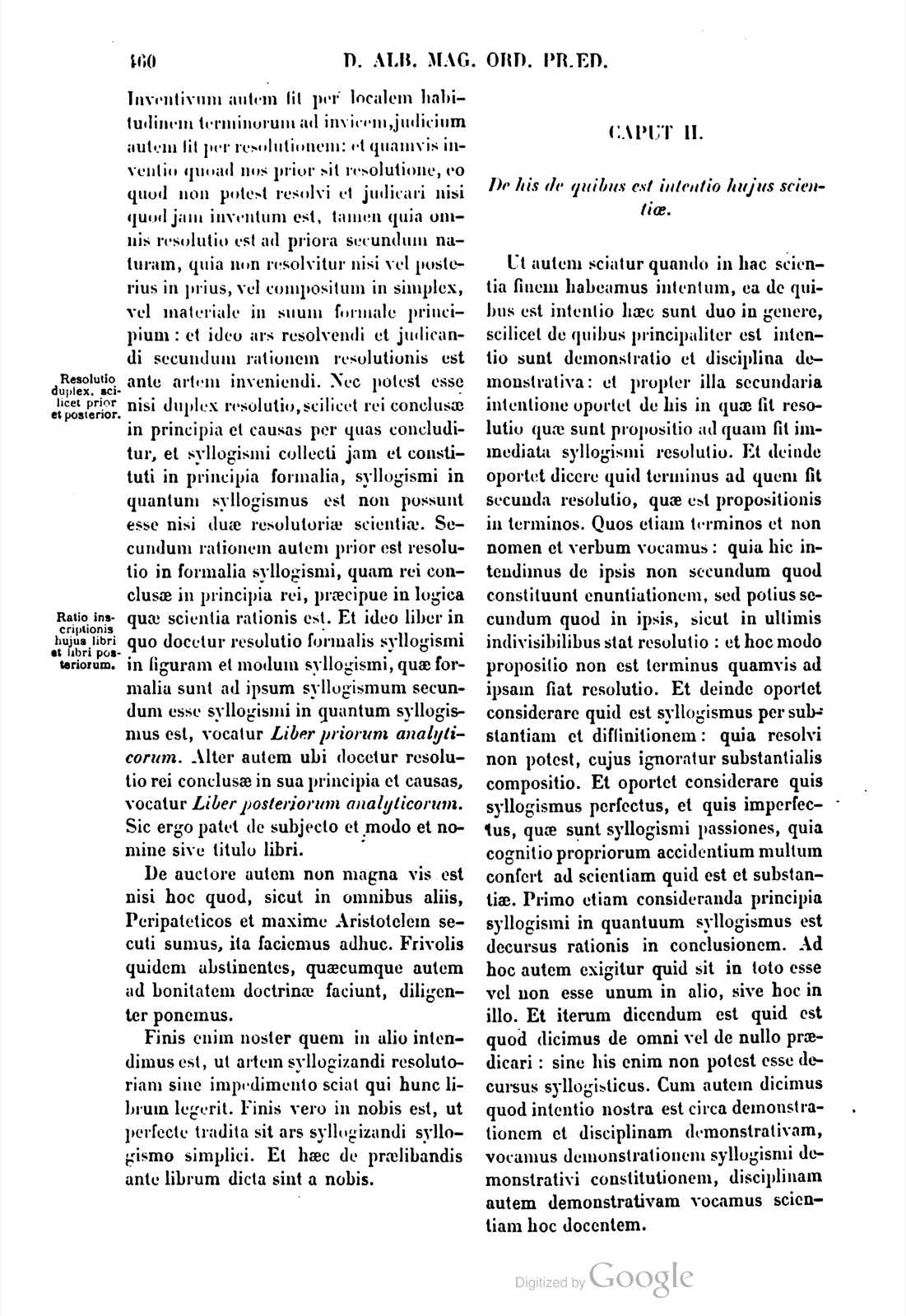
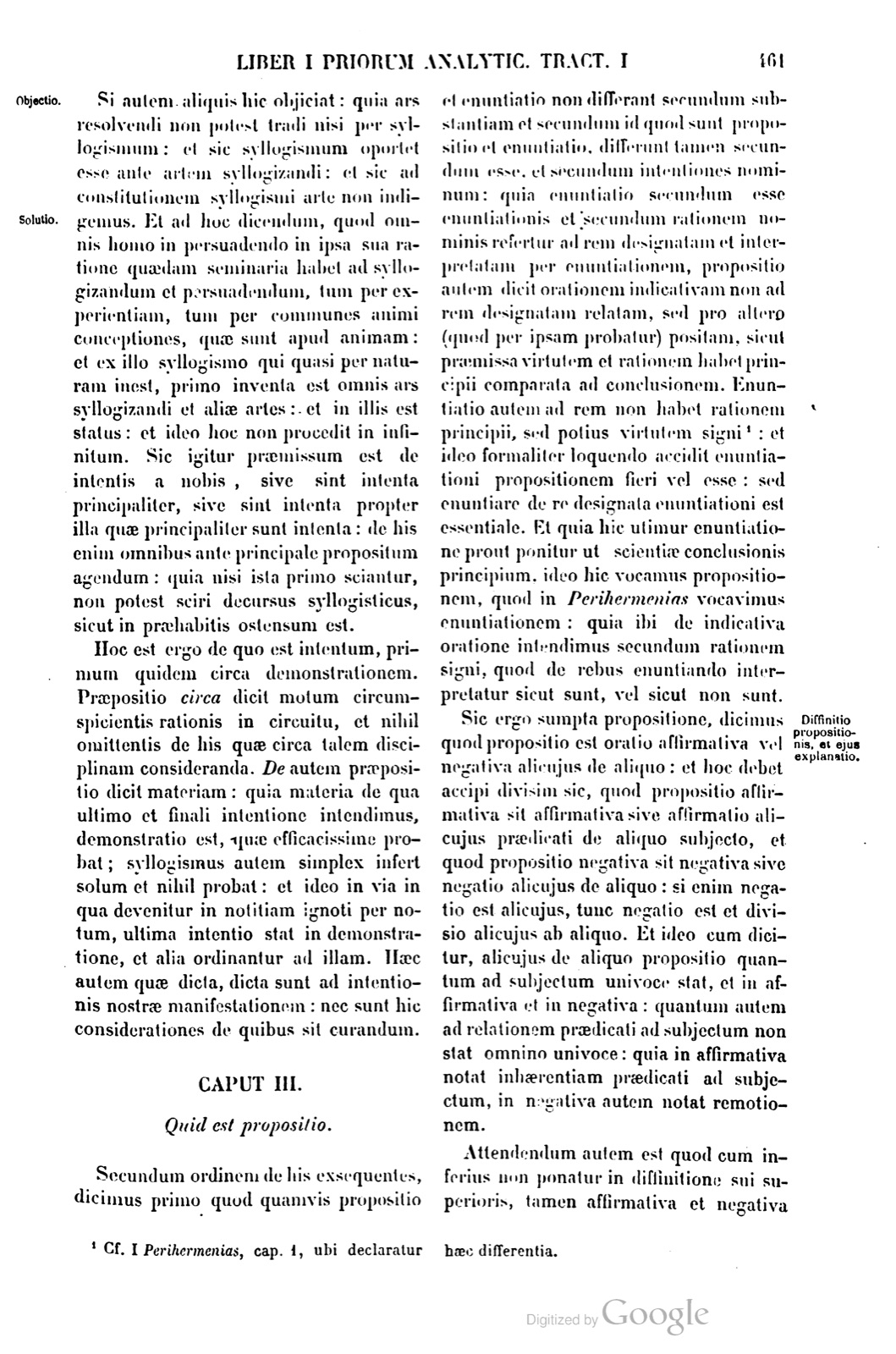
CAPUT II. De his de quibus est intentio hujus scientiae. Ut autem sciatur quando in hac scientia finem habeamus intentum, ea de quibus est intentio haec sunt duo in genere, scilicet de quibus principaliter est intentio sunt demonstratio et disciplina demonstrativa: et propter illa secundaria intentione oportet de his in quae fit resolutio quae sunt propositio ad quam fit immediata syllogismi resolutio. Et deinde oportet dicere quid terminus ad quem fit secunda resolutio, quae est propositionis in terminos. Quos etiam terminos et non nomen et verbum vocamus: quia hic intendimus de ipsis non secundum quod constituunt enuntiationem, sed potius secundum quod in ipsis, sicut in ultimis indivisibilibus stat resolutio: et hoc modo propositio non est terminus quamvis ad ipsam fiat resolutio. Et deinde oportet considerare quid est syllogismus per substantiam et diffinitionem: quia resolvi non potest, cujus ignoratur substantialis compositio. Et oportet considerare quis syllogismus perfectus, et quis imperfectus, quae sunt syllogismi passiones, quia cognitio propriorum accidentium multum confert ad scientiam quid est et substantiae. Primo etiam consideranda principia syllogismi in quantum syllogismus est decursus rationis in conclusionem. Ad hoc autem exigitur quid sit in toto esse vel non esse unum in alio, sive hoc in illo. Et iterum dicendum est quid est quod dicimus de omni vel de nullo praedicari: sine his enim non potest esse decursus syllogisticus. Cum autem dicimus quod intentio nostra est circa demonstrationem et disciplinam demonstrativam, vocamus demonstrationem syllogismi demonstrativi constitutionem, disciplinam autem demonstrativam vocamus scientiam hoc docentem. Si autem aliquis hic objiciat: quia ars resolvendi non potest tradi nisi per syllogismum: et sic syllogismum oportet esse ante artem syllogizandi: et sic ad constitutionem syllogismi arte non indigemus. Et ad hoc dicendum, quod omnis homo in persuadendo in ipsa sua ratione quaedam seminaria habet ad syllogizandum et persuadendum, tum per experientiam, tum per communes animi conceptiones, quae sunt apud animam: et ex illo syllogismo qui quasi per naturam inest, primo inventa est omnis ars syllogizandi et aliae artes: et in illis est status: et ideo hoc non procedit in infinitum. Sic igitur praemissum est de intentis a nobis, sive sint intenta principaliter, sive sint intenta propter illa quae principaliter sunt intenta: de his enim omnibus ante principale propositum agendum: quia nisi ista primo sciantur, non potest sciri decursus syllogisticus, sicut in praehabitis ostensum est. Hoc est ergo de quo est intentum, primum quidem circa demonstrationem. Praepositio circa dicit motum circumspicientis rationis in circuitu, et nihil omittentis de his quae circa talem disciplinam consideranda. De autem praepositio dicit materiam: quia materia de qua ultimo et finali intentione intendimus, demonstratio est, quae efficacissime probat; syllogismus autem simplex infert solum et nihil probat: et ideo in via in qua devenitur in notitiam ignoti per notum, ultima intentio stat in demonstratione, et alia ordinantur ad illam. Haec autem quae dicta, dicta sunt ad intentionis nostrae manifestationem: nec sunt hic considerationes de quibus sit curandum.
CHAPTER II. On those things about which the intention of this science is concerned. But so that it may be known when in this science we have the intended end, the things about which the intention is concerned are these two in genus, namely, the things about which the intention is principally concerned are demonstration and demonstrative discipline. And on account of those, with a secondary intention, one must treat of those things into which resolution is made, which are the proposition, to which the immediate resolution of syllogism is made. And next one must say what a term is, to which the second resolution, namely that of proposition into terms, is made. We also call these terms and not noun and verb, because here we intend them not insofar as they constitute an enunciation, but rather insofar as in them, as in the last indivisibles, resolution stands; and in this way a proposition is not a term, although resolution is made to it. And next one must consider what a syllogism is according to substance and definition, because that whose substantial composition is unknown cannot be resolved. And one must consider which syllogism is perfect and which imperfect; these are passions of syllogism, because knowledge of proper accidents contributes much to the science of what a thing is and to the science of substance. The principles of syllogism also must first be considered insofar as syllogism is a movement of reason into a conclusion. For this it is required to know what it is for one thing to be in a whole or not to be in another, or this in that. And again it must be said what it is that we call being predicated of every or of no thing; for without these there can be no syllogistic movement. But when we say that our intention concerns demonstration and demonstrative discipline, we call demonstration the constitution of demonstrative syllogism; and we call demonstrative discipline the science teaching this. But if someone objects here that the art of resolving cannot be handed down except through syllogism, and so the syllogism must exist before the art of syllogizing, and so we do not need the art for the constitution of syllogism, to this one must say that every human being, in persuading, has in his own reason certain seed-principles for syllogizing and persuading, both through experience and through common conceptions of the mind, which are in the soul. And from that syllogism which exists as it were by nature, every art of syllogizing and the other arts were first discovered; and in those there is a stopping point. And therefore this does not proceed to infinity. Thus, therefore, what is intended by us has been premised, whether they are things intended principally or things intended on account of those which are principally intended. For one must deal with all these things before the principal proposal, because unless these are first known, the syllogistic movement cannot be known, as was shown in what has gone before. This, therefore, is that about which the intention is concerned, first indeed concerning demonstration. The preposition 'concerning' says the movement of a reason looking around in a circuit and omitting nothing of the things that must be considered concerning such a discipline. But the preposition 'about' says the matter, because the matter about which we intend with the last and final intention is demonstration, which proves most efficaciously; but simple syllogism only infers and proves nothing. And therefore, on the way by which one comes to knowledge of the unknown through the known, the last intention stands in demonstration, and the other things are ordered to it. But these things which have been said have been said for the manifestation of our intention, and they are not considerations about which one should be concerned here.
If a page does not appear, its photograph has not been uploaded yet.