Works › Prior Analytics, Books I–II
Volume 1 · pp. 459–460
Book I of the Prior Analytics. Treatise I. On Those Things Which Must Be Premised to the Art. Chapter I. On the Subject, Method, and Name of the Book.
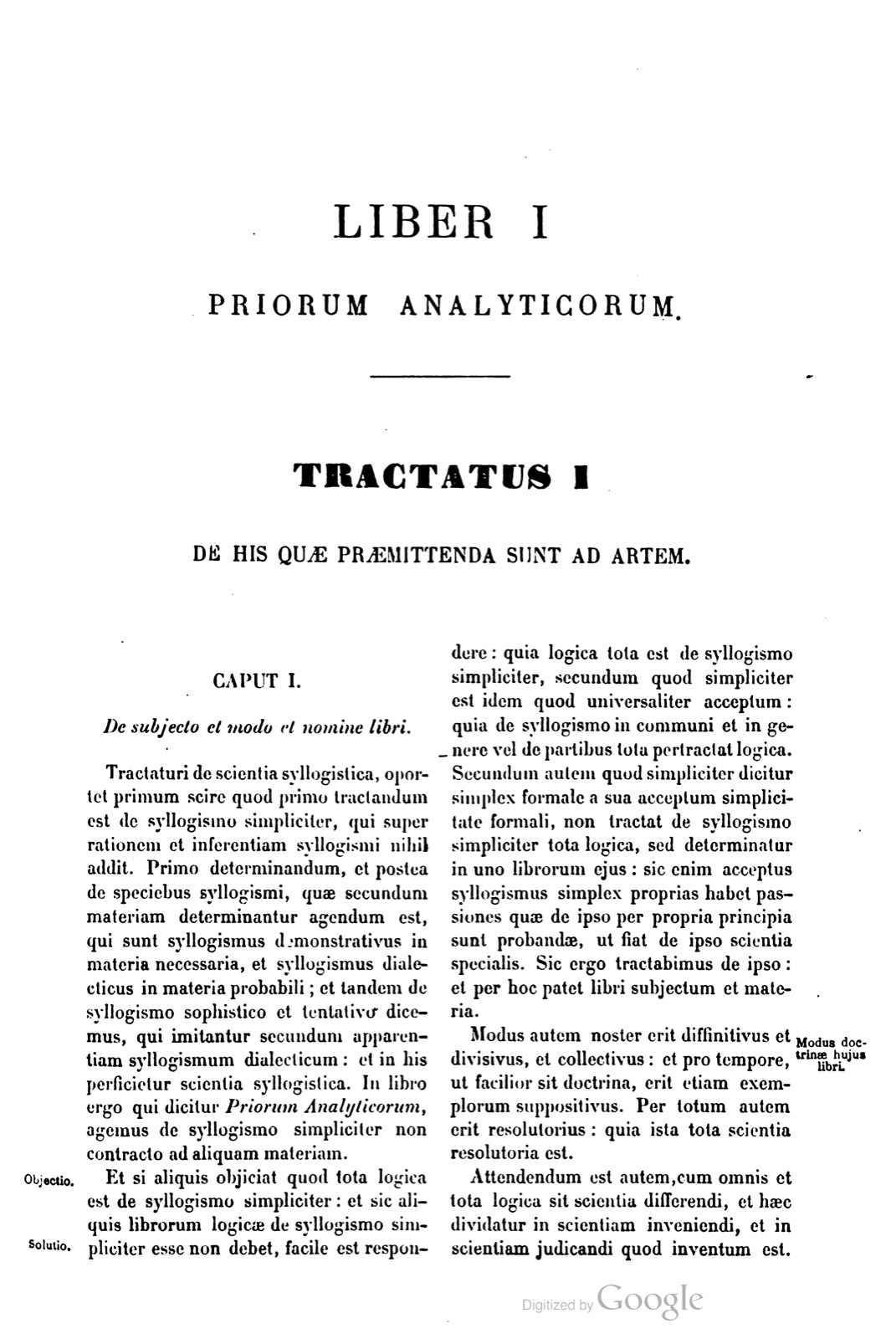
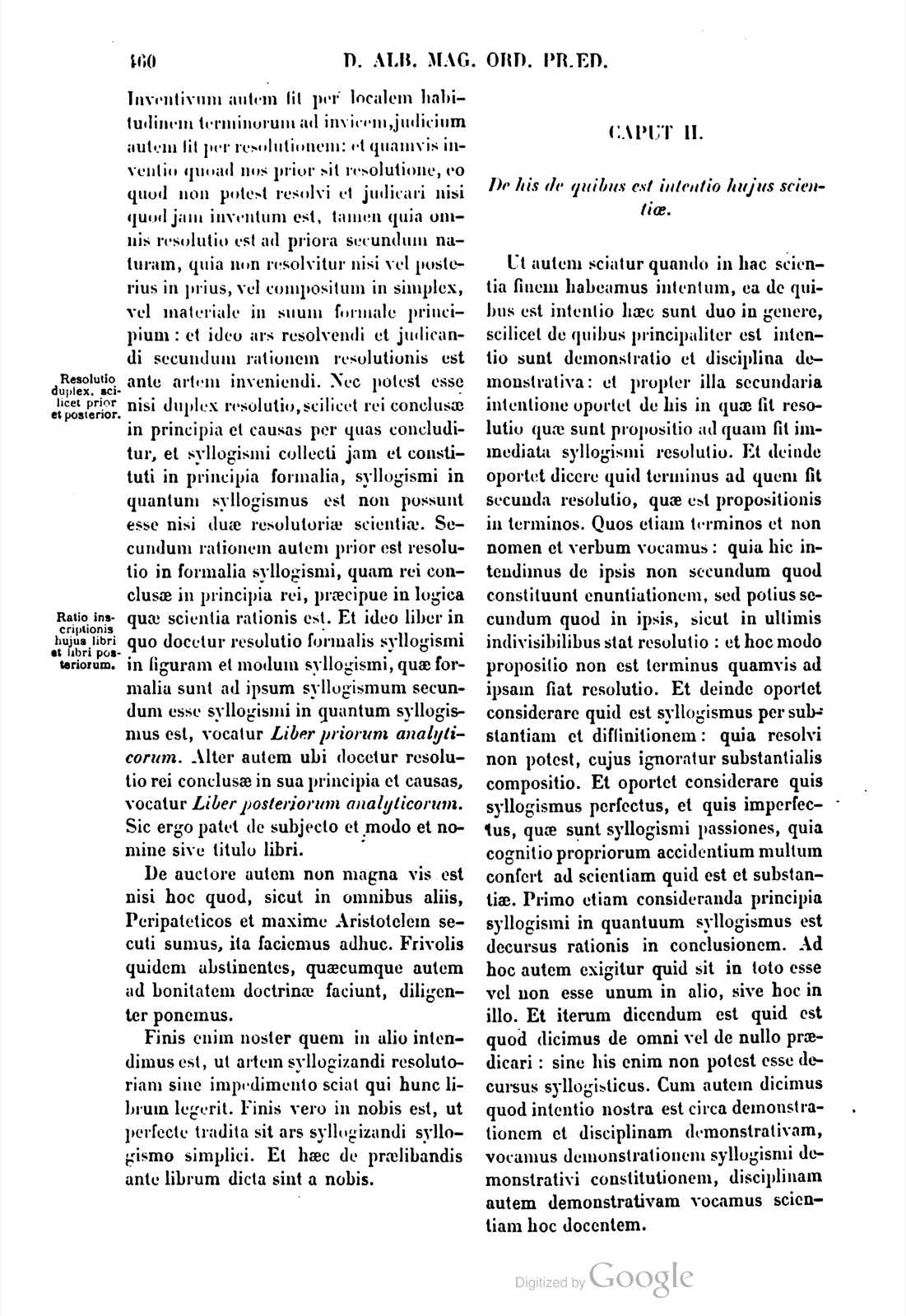
LIBER I PRIORUM ANALYTICORUM. TRACTATUS I. DE HIS QUAE PRAEMITTENDA SUNT AD ARTEM. CAPUT I. De subjecto et modo et nomine libri. Tractaturi de scientia syllogistica, oportet primum scire quod primo tractandum est de syllogismo simpliciter, qui super rationem et inferentiam syllogismi nihil addit. Primo determinandum, et postea de speciebus syllogismi, quae secundum materiam determinantur agendum est, qui sunt syllogismus demonstrativus in materia necessaria, et syllogismus dialecticus in materia probabili; et tandem de syllogismo sophistico et tentativo dicemus, qui imitantur secundum apparentiam syllogismum dialecticum: et in his perficietur scientia syllogistica. In libro ergo qui dicitur Priorum Analyticorum, agemus de syllogismo simpliciter non contracto ad aliquam materiam. Et si aliquis objiciat quod tota logica est de syllogismo simpliciter: et sic aliquis librorum logicae de syllogismo simpliciter esse non debet, facile est respondere: quia logica tota est de syllogismo simpliciter, secundum quod simpliciter est idem quod universaliter acceptum: quia de syllogismo in communi et in genere vel de partibus tota pertractat logica. Secundum autem quod simpliciter dicitur simplex formale a sua acceptum simplicitate formali, non tractat de syllogismo simpliciter tota logica, sed determinatur in uno librorum ejus: sic enim acceptus syllogismus simplex proprias habet passiones quae de ipso per propria principia sunt probandae, ut fiat de ipso scientia specialis. Sic ergo tractabimus de ipso: et per hoc patet libri subjectum et materia. Modus autem noster erit diffinitivus et divisivus, et collectivus: et pro tempore, ut facilior sit doctrina, erit etiam exemplorum suppositivus. Per totum autem erit resolutorius: quia ista tota scientia resolutoria est. Attendendum est autem, cum omnis et tota logica sit scientia differendi, et haec dividatur in scientiam inveniendi, et in scientiam judicandi quod inventum est. Inventivum autem fit per localem habitudinem terminorum ad invicem, judicium autem fit per resolutionem: et quamvis inventio quoad nos prior sit resolutione, eo quod non potest resolvi et judicari nisi quod jam inventum est, tamen quia omnis resolutio est ad priora secundum naturam, quia non resolvitur nisi vel posterius in prius, vel compositum in simplex, vel materiale in suum formale principium: et ideo ars resolvendi et judicandi secundum rationem resolutionis est ante artem inveniendi. Nec potest esse nisi duplex resolutio, scilicet rei conclusae in principia et causas per quas concluditur, et syllogismi collecti jam et constituti in principia formalia, syllogismi in quantum syllogismus est non possunt esse nisi duae resolutoriae scientiae. Secundum rationem autem prior est resolutio in formalia syllogismi, quam rei conclusae in principia rei, praecipue in logica quae scientia rationis est. Et ideo liber in quo docetur resolutio formalis syllogismi in figuram et modum syllogismi, quae formalia sunt ad ipsum syllogismum secundum esse syllogismi in quantum syllogismus est, vocatur Liber priorum analyticorum. Alter autem ubi docetur resolutio rei conclusae in sua principia et causas, vocatur Liber posteriorum analyticorum. Sic ergo patet de subjecto et modo et nomine sive titulo libri. De auctore autem non magna vis est nisi hoc quod, sicut in omnibus aliis, Peripateticos et maxime Aristotelem secuti sumus, ita faciemus adhuc. Frivolis quidem abstinentes, quaecumque autem ad bonitatem doctrinae faciunt, diligenter ponemus. Finis enim noster quem in alio intendimus est, ut artem syllogizandi resolutoriam sine impedimento sciat qui hunc librum legerit. Finis vero in nobis est, ut perfecte tradita sit ars syllogizandi syllogismo simplici. Et haec de praelibandis ante librum dicta sint a nobis.
BOOK I OF THE PRIOR ANALYTICS. TREATISE I. ON THOSE THINGS WHICH MUST BE PREMISSED TO THE ART. CHAPTER I. On the subject, method, and name of the book. Since we are about to treat of syllogistic science, one must first know that the first thing to be treated is the syllogism simply, which adds nothing beyond the account and inference of syllogism. This must first be determined; and afterward one must deal with the species of syllogism, which are determined according to matter: these are the demonstrative syllogism in necessary matter, and the dialectical syllogism in probable matter; and finally we shall speak of the sophistical and tentative syllogism, which according to appearance imitate the dialectical syllogism. And in these syllogistic science will be perfected. Therefore, in the book which is called the Prior Analytics, we shall deal with the syllogism simply, not contracted to some matter. And if someone objects that all logic is about the syllogism simply, and thus that one of the books of logic ought not to be about the syllogism simply, it is easy to answer: because all logic is about the syllogism simply, inasmuch as simply is the same as taken universally, because all logic treats of syllogism in common and in genus, or of its parts. But insofar as simply is said to be a formal simple thing taken from its formal simplicity, all logic does not treat of syllogism simply, but it is determined in one of its books; for a simple syllogism taken in this way has its proper passions, which must be proved of it through proper principles, so that a special science of it may come to be. Therefore we shall treat of it in this way; and through this the subject and matter of the book are clear. Our method, however, will be definitive, divisive, and collective; and for the occasion, so that the teaching may be easier, it will also be suppositive of examples. Through the whole it will be resolutory, because this whole science is resolutory. But one must attend, since each and all logic is the science of differentiating, and this is divided into the science of finding and into the science of judging what has been found. The inventive part, moreover, is made through the local disposition of terms to one another; judgment, however, is made through resolution. And although invention is prior to resolution with respect to us, because nothing can be resolved and judged unless it has already been found, nevertheless, because every resolution is to things prior according to nature, since it is resolved only either from posterior into prior, or from composite into simple, or from material into its formal principle, therefore the art of resolving and judging according to the account of resolution is before the art of finding. Nor can there be anything except a twofold resolution, namely, the resolution of the concluded thing into the principles and causes through which it is concluded, and the resolution of the syllogism already collected and constituted into its formal principles. Of syllogism insofar as it is syllogism, there cannot be more than two resolutory sciences. But according to reason the resolution into the formal principles of syllogism is prior to the resolution of the concluded thing into the principles of the thing, especially in logic, which is a science of reason. And therefore the book in which the formal resolution of syllogism into the figure and mode of syllogism is taught, which are formal with respect to the syllogism itself according to the being of syllogism insofar as it is syllogism, is called the Book of the Prior Analytics. But the other, where the resolution of the concluded thing into its principles and causes is taught, is called the Book of the Posterior Analytics. Thus, therefore, the subject, method, and name or title of the book are clear. But concerning the author there is no great force except this: that, as in all other matters, we have followed the Peripatetics and especially Aristotle, so we shall do still. Refraining from frivolous things, however, we shall diligently set down whatever things conduce to the goodness of doctrine. For our end, which we intend in another, is that one who reads this book may know the resolutory art of syllogizing without impediment. But the end in us is that the art of syllogizing by a simple syllogism be perfectly handed down. And let these things concerning matters to be tasted beforehand before the book have been said by us.
If a page does not appear, its photograph has not been uploaded yet.