Volume 1 · pp. 17–19
Treatise II. On the five universals. Chapter I. How the universal belongs to the consideration of the logician, on the number of universals, and on the usefulness of the book of universals.
A marker with ≈ is an approximate page boundary, placed by measure of the text; the page photographs remain the authority. In the paired views, clicking a page marker brings that page into view.
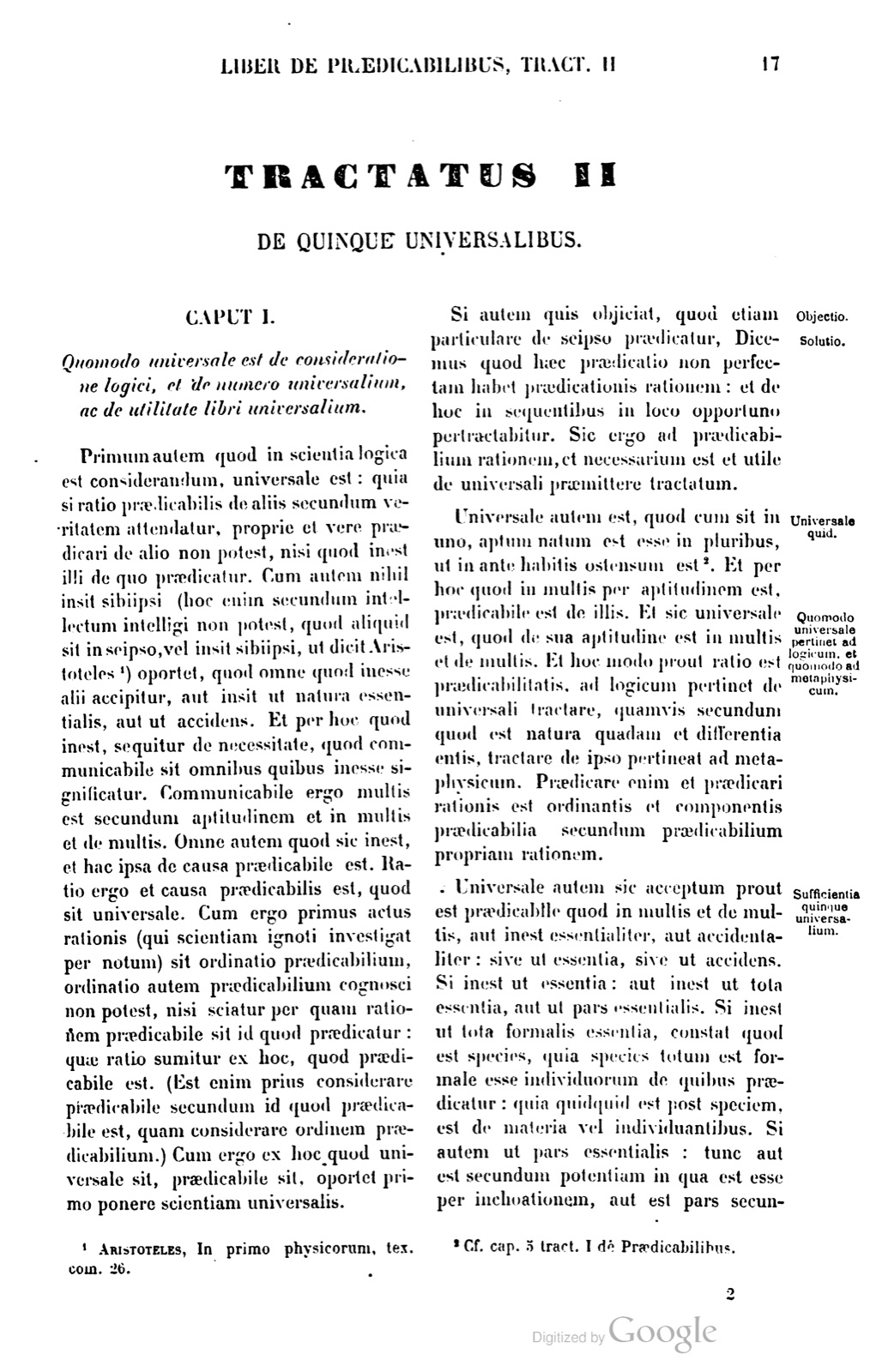
Tractatus II. De quinque universalibus. Caput I. Quomodo universale est de consideratione logici, et de numero universalium, ac de utilitate libri universalium.
Primum autem quod in scientia logica est considerandum, universale est: quia si ratio praedicabilis de aliis secundum veritatem attendatur, proprie et vere praedicari de alio non potest, nisi quod inest illi de quo praedicatur. Cum autem nihil insit sibi ipsi, hoc enim secundum intellectum intelligi non potest, quod aliquid sit in seipso, vel insit sibi ipsi, ut dicit Aristoteles 1, oportet, quod omne quod inesse alii accipitur, aut insit ut natura essentialis, aut ut accidens. Et per hoc quod inest, sequitur de necessitate, quod communicabile sit omnibus quibus inesse significatur. Communicabile ergo multis est secundum aptitudinem et in multis et de multis. Omne autem quod sic inest, et hac ipsa de causa praedicabile est. Ratio ergo et causa praedicabilis est, quod sit universale. Cum ergo primus actus rationis, qui scientiam ignoti investigat per notum, sit ordinatio praedicabilium, ordinatio autem praedicabilium cognosci non potest, nisi sciatur per quam rationem praedicabile sit id quod praedicatur: quae ratio sumitur ex hoc, quod praedicabile est. Est enim prius considerare praedicabile secundum id quod praedicabile est, quam considerare ordinem praedicabilium. Cum ergo ex hoc quod universale sit, praedicabile sit, oportet primo ponere scientiam universalis.
Si autem quis objiciat, quod etiam particulare de seipso praedicatur, dicemus quod haec praedicatio non perfectam habet praedicationis rationem: et de hoc in sequentibus in loco opportuno pertractabitur. Sic ergo ad praedicabilium rationem, et necessarium est et utile de universali praemittere tractatum.
Universale autem est, quod cum sit in uno, aptum natum est esse in pluribus, ut in antehabitis ostensum est 2. Et per hoc quod in multis per aptitudinem est, praedicabile est de illis. Et sic universale est, quod de sua aptitudine est in multis et de multis. Et hoc modo prout ratio est praedicabilitatis, ad logicum pertinet de universali tractare, quamvis secundum quod est natura quaedam et differentia entis, tractare de ipso pertineat ad metaphysicum. Praedicare enim et praedicari rationis est ordinantis et componentis praedicabilia secundum praedicabilium propriam rationem.
Universale autem sic acceptum prout est praedicabile quod in multis et de multis, aut inest essentialiter, aut accidentaliter: sive ut essentia, sive ut accidens. Si inest ut essentia: aut inest ut tota essentia, aut ut pars essentialis. Si inest ut tota formalis essentia, constat quod est species, quia species totum est formale esse individuorum de quibus praedicatur: quia quidquid est post speciem, est de materia vel individuantibus. Si autem ut pars essentialis: tunc aut est secundum potentiam in qua est esse per inchoationem, aut est pars secundum actum in quo est esse secundum actum perfectum. Et priori quidem modo est genus, secundo vero modo est differentia. Si vero inest ut accidens: aut inest ut accidens naturae, quod de ipsius naturae aptitudine causatur et emanat: aut ut accidens commune, quod est accidens individui. Et priori quidem modo est proprium, et secundo modo est accidens vocatum. Et de omnibus his tractare est necessarium logico, propter hoc quod praedicabilium considerat ordinem et praedicatorum compositionem.
Treatise II. On the five universals. Chapter I. How the universal belongs to the consideration of the logician, on the number of universals, and on the usefulness of the book of universals.
But the first thing which must be considered in logical science is the universal, because if the account of what is predicable of others according to truth is attended to, nothing can properly and truly be predicated of another except that which inheres in that of which it is predicated. But since nothing inheres in itself, for this cannot be understood according to intellect, that something is in itself or inheres in itself, as Aristotle says 1, it is necessary that everything which is received as inhering in another either inheres as an essential nature or as an accident. And by the fact that it inheres, it follows of necessity that it is communicable to all in which it is signified to inhere. Therefore it is communicable to many according to aptitude and in many and of many. But everything that inheres in this way is predicable for this very reason. Therefore the account and cause of the predicable is that it is universal. Therefore since the first act of reason, which investigates science of the unknown through the known, is the ordering of predicables, but the ordering of predicables cannot be known unless it is known by what account that which is predicated is predicable, and this account is taken from the fact that it is predicable. For it is prior to consider the predicable according to that which is predicable than to consider the order of predicables. Therefore since it is predicable from the fact that it is universal, it is necessary first to posit the science of the universal.
But if someone objects that even the particular is predicated of itself, we shall say that this predication does not have the perfect account of predication; and this will be treated in what follows in the appropriate place. Thus therefore for the account of predicables it is both necessary and useful to send ahead a treatise concerning the universal.
But the universal is that which, although it is in one, is aptly born to be in many, as was shown in what preceded 2. And through the fact that it is in many by aptitude, it is predicable of them. And thus the universal is what, by its aptitude, is in many and of many. And in this way, insofar as it is the account of predicability, it pertains to the logician to treat of the universal, although insofar as it is a certain nature and difference of being, it pertains to the metaphysician to treat of it. For to predicate and to be predicated belong to reason ordering and composing predicables according to the proper account of predicables.
But the universal so taken, insofar as it is predicable because it is in many and of many, either inheres essentially or accidentally, either as essence or as accident. If it inheres as essence, it inheres either as the whole essence or as an essential part. If it inheres as the whole formal essence, it is agreed that it is species, because species is the whole formal being of the individuals of which it is predicated, because whatever is after species belongs to matter or individuating things. But if it inheres as an essential part, then either it is according to potency in which being exists by beginning, or it is a part according to act in which being exists according to perfected act. In the first mode it is genus, but in the second mode it is difference. But if it inheres as accident, either it inheres as an accident of nature, which is caused and emanates from the aptitude of that nature itself, or as a common accident, which is an accident of the individual. In the first mode it is proper, and in the second mode it is called accident. And it is necessary for the logician to treat of all these, because he considers the order of predicables and the composition of predicates.
Qualiter omnia ista praedicantur per notam compositionis, et qualiter per hoc verbum substantivum est, in sequentibus erit manifestum: sed hic tantum sufficiat, quod quidquid praedicatur, praedicatur non ut pars, sed ut idem secundum esse. Idem autem dico per se, vel per accidens. De his igitur in hoc nostro libro erit tractatus. Nec considerabimus hic res ipsas quibus talia ad ordinem unum praedicabilis referuntur. Hoc enim in libro Praedicamentorum habet determinari. Sed accidens ipsis rebus, quo eorum primum praedicabilium generis habet nomen et rationem, et secundum speciei, et tertium differentiae, quartum vero proprii, quintum autem accidentis. Hoc enim ad istius primi libri pertinet intentionem. Per hoc enim accidentia diversum modum accipiunt praedicandi in quid vel in quale: quamvis conveniant omnia in hoc, quod quodlibet ipsorum est praedicabile: per quod etiam scientia est una, et non multae. Diffiniri autem universale vera diffinitione non potest: quia per hoc quod praedicabile est de multis, non est unius et ejusdem rationis, sed est dictum per prius et posterius de illis de quibus est per ambitum suae communitatis praedicatum.
Tractantes autem de his, modum et ordinem tenebimus Porphyrii. Ut duplex utilitas habeatur nostri operis: et de universalibus habeatur doctrina, et etiam libri Porphyrii habeatur intellectus, quem scripsit ad quemdam Grisarotium suum discipulum. Cum autem sit duplex necessarium, scilicet inevitabile, et utile, ad eam quae est apud Aristotelis libros doctrinam praedicamentorum, quae caeteris doctrinis praedicamentorum praeexcellentior est, nosse quid sit genus, quid differentia, quid species, quid proprium, et quid accidens, secundum quod haec universalia habent rationem praedicabilium, oportet tractare de istis. Inevitabile enim est, secundum quod rationem praedicabilis oportet cognoscere ante praedicabilium ordinem. Utile est secundum quod adminiculum est scire intentionem 3 generis et speciei et differentiae et proprii accidentis, antequam determinetur de his quae in uno genere ordinantur ut species, et antequam determinentur quae ex uno genere dividuntur per oppositas differentias, et antequam assignentur uniuscujusque generis propria, et ampla distinctio generum in substantia, et accidentium genera determinentur.
How all these are predicated through the mark of composition, and how through this substantive verb is, will be manifest in what follows; but here let only this suffice, that whatever is predicated is predicated not as a part, but as the same according to being. But I call it the same either through itself or through accident. Therefore there will be a treatise concerning these in this our book. Nor shall we here consider the things themselves by which such items are referred to one order of the predicable. For this has to be determined in the book of the Predicaments. But we shall consider the accident belonging to those things, by which the first of their predicables has the name and account of genus, the second of species, the third of difference, the fourth of proper, and the fifth of accident. For this pertains to the intention of this first book. For through this the accidents receive a diverse mode of predicating in what a thing is or in what sort of thing; although all agree in this, that any one of them is predicable, through which also the science is one and not many. But the universal cannot be defined by a true definition, because through the fact that it is predicable of many it is not of one and the same account, but is said according to prior and posterior of those things of which it is predicated by the compass of its commonness.
But treating of these things, we shall hold the mode and order of Porphyry, so that a twofold usefulness of our work may be had: both doctrine concerning universals may be had, and also understanding of the book of Porphyry may be had, which he wrote to a certain Grisarotius, his disciple. But since necessary is twofold, namely inevitable and useful, for the doctrine of the predicaments which is in Aristotle's books, which is more excellent than the other doctrines of the predicaments, it is necessary to know what genus is, what difference is, what species is, what proper is, and what accident is, according as these universals have the account of predicables. Therefore one must treat of these. It is inevitable insofar as one must know the account of the predicable before the order of predicables. It is useful insofar as it is an aid to know the intention 3 of genus, species, difference, proper, and accident before determination is made about those things which are ordered in one genus as species, and before the things which are divided from one genus through opposite differences are determined, and before the properties of each genus are assigned and the broad distinction of genera in substance and the genera of accidents are determined.
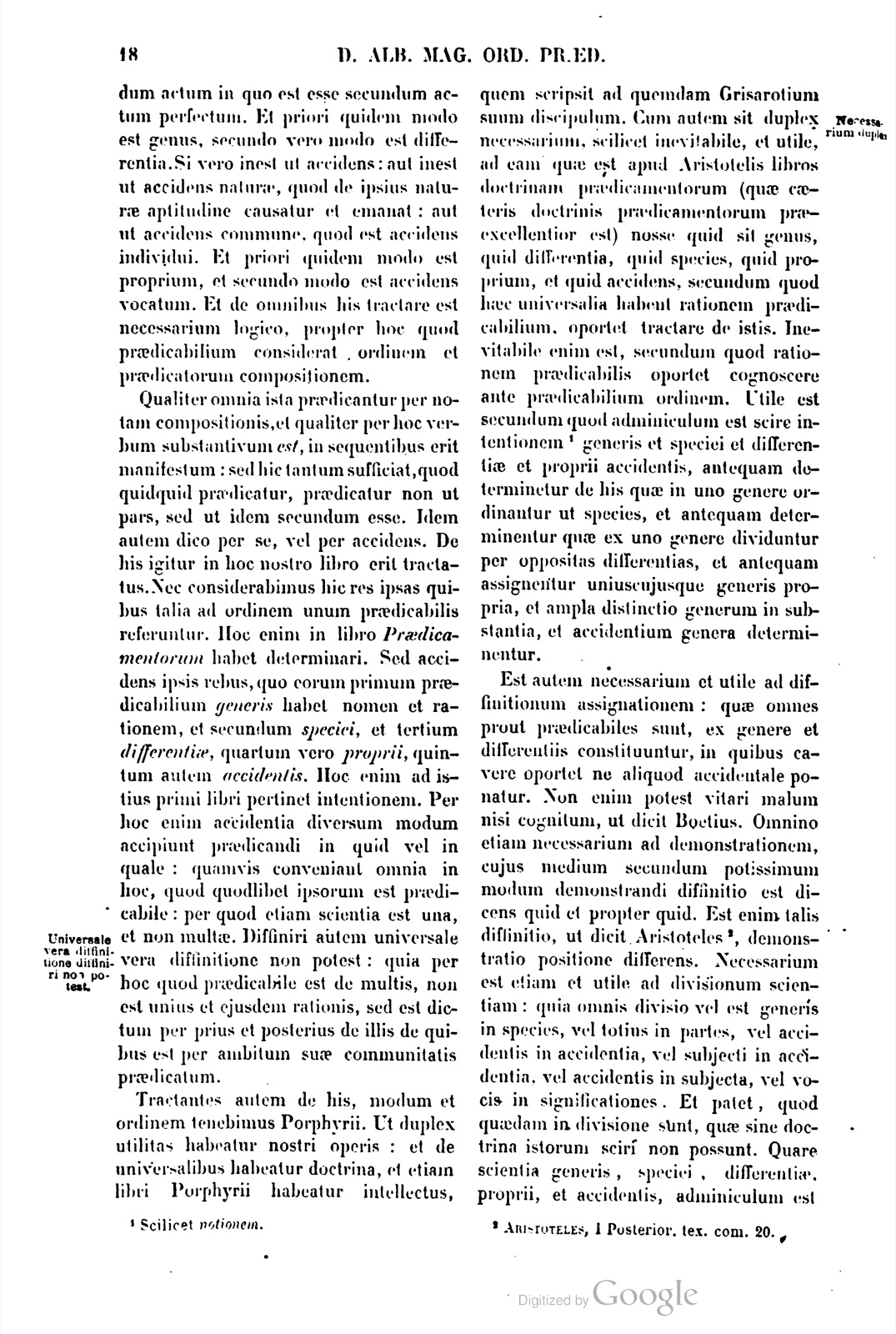
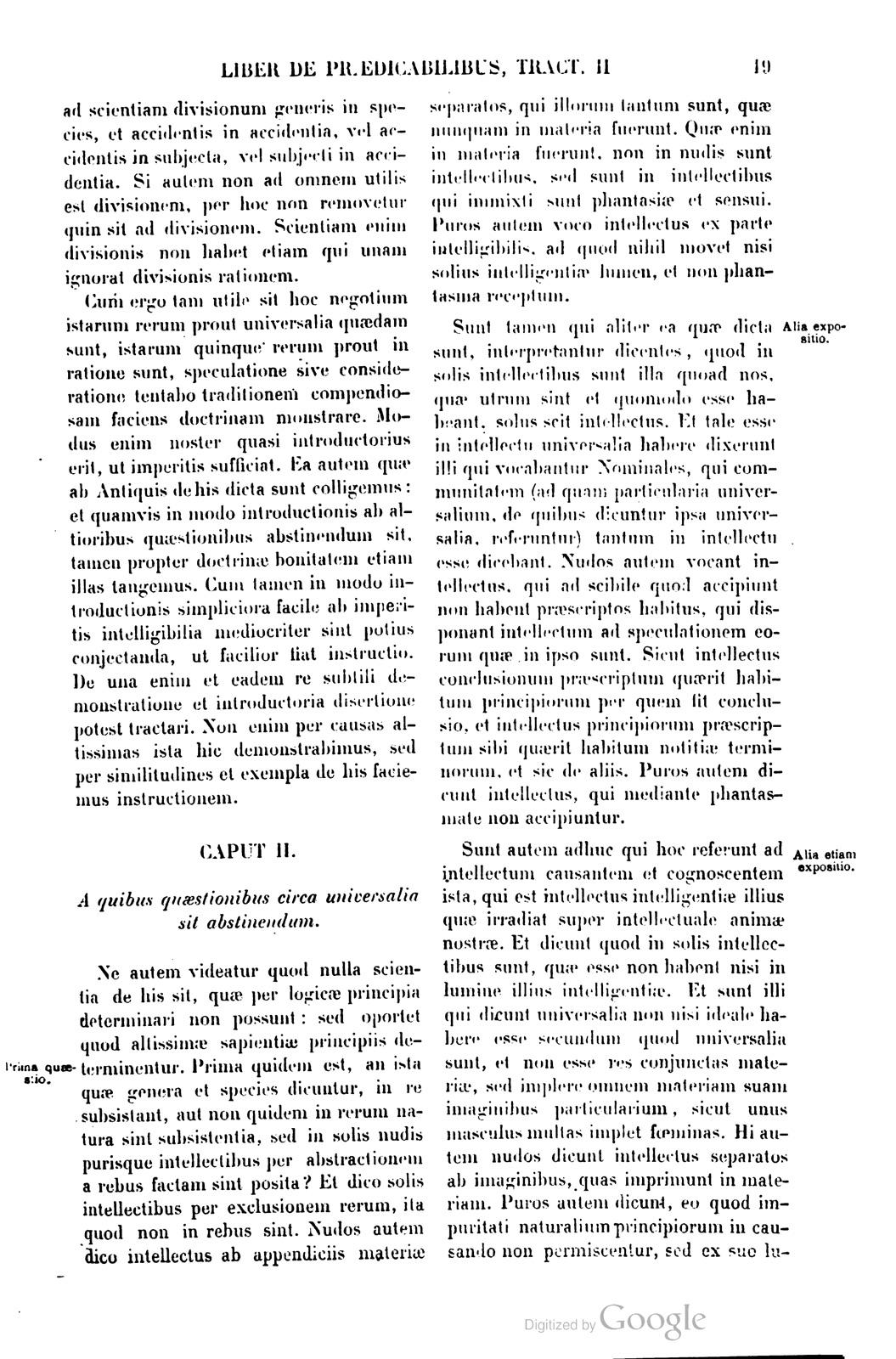
Est autem necessarium et utile ad diffinitionum assignationem: quae omnes prout praedicabiles sunt, ex genere et differentiis constituuntur, in quibus cavere oportet ne aliquod accidentale ponatur. Non enim potest vitari malum nisi cognitum, ut dicit Boetius. Omnino etiam necessarium ad demonstrationem, cujus medium secundum potissimum modum demonstrandi diffinitio est dicens quid et propter quid. Est enim talis diffinitio, ut dicit Aristoteles 4, demonstratio positione differens. Necessarium est etiam et utile ad divisionum scientiam: quia omnis divisio vel est generis in species, vel totius in partes, vel accidentis in accidentia, vel subjecti in accidentia, vel accidentis in subjecta, vel vocis in significationes. Et patet, quod quaedam in divisione sunt, quae sine doctrina istorum sciri non possunt. Quare scientia generis, speciei, differentiae, proprii, et accidentis, adminiculum est ad scientiam divisionum generis in species, et accidentis in accidentia, vel accidentis in subjecta, vel subjecti in accidentia. Si autem non ad omnem utilis est divisionem, per hoc non removetur quin sit ad divisionem. Scientiam enim divisionis non habet etiam qui unam ignorat divisionis rationem.
Cum ergo tam utile sit hoc negotium istarum rerum prout universalia quaedam sunt, istarum quinque rerum prout in ratione sunt, speculatione sive consideratione tentabo traditionem compendiosam faciens doctrinam monstrare. Modus enim noster quasi introductorius erit, ut imperitis sufficiat. Ea autem quae ab Antiquis de his dicta sunt colligemus: et quamvis in modo introductionis ab altioribus quaestionibus abstinendum sit, tamen propter doctrinae bonitatem etiam illas tangemus. Cum tamen in modo introductionis simpliciora facile ab imperitis intelligibilia mediocriter sint potius conjectanda, ut facilior fiat instructio. De una enim et eadem re subtili demonstratione et introductoria disertione potest tractari. Non enim per causas altissimas ista hic demonstrabimus, sed per similitudines et exempla de his faciemus instructionem.
It is also necessary and useful for the assignment of definitions, all of which, insofar as they are predicable, are constituted from genus and differences, in which one must beware lest something accidental be posited. For evil cannot be avoided unless it is known, as Boethius says. It is wholly necessary also for demonstration, whose middle according to the most powerful mode of demonstrating is the definition saying what a thing is and on account of what. For such a definition, as Aristotle says 4, is a demonstration differing by position. It is also necessary and useful for the science of divisions, because every division is either of genus into species, or of a whole into parts, or of accident into accidents, or of subject into accidents, or of accident into subjects, or of a word into significations. And it is clear that there are some things in division which cannot be known without the doctrine of these. Therefore the science of genus, species, difference, proper, and accident is an aid to the science of divisions of genus into species, and of accident into accidents, or of accident into subjects, or of subject into accidents. But if it is not useful for every division, through this it is not removed from being useful for division. For one who is ignorant of one account of division does not have the science of division.
Therefore, since this business concerning these things, insofar as they are certain universals, is so useful, by speculation or consideration of these five things insofar as they are in reason, I shall attempt to show the doctrine by making a compendious handing down. For our mode will be as it were introductory, so that it may suffice for the inexperienced. But we shall gather the things which were said about these by the Ancients; and although in the mode of an introduction one must abstain from the higher questions, nevertheless because of the goodness of doctrine we shall touch on them also. Yet in the mode of an introduction, the simpler things, easily intelligible by the inexperienced, should rather be surmised in a moderate way, so that instruction may be made easier. For one and the same thing can be treated by subtle demonstration and by introductory discourse. For we shall not here demonstrate these things through the highest causes, but through likenesses and examples we shall make instruction concerning them.
Notes
- Aristotle, in the first book of the Physics, text, commentary 26. (Aristoteles, In primo physicorum, tex. com. 26.) ↩
- Compare chapter 5 of treatise I On the Predicables. (Cf. cap. 5 tract. I de Praedicabilibus.) ↩
- That is, the notion. (Scilicet notionem.) ↩
- Aristotle, Posterior Analytics I, text, commentary 20. (Aristoteles, I Posterior, tex. com. 20.) ↩
If a page does not appear, its photograph has not been uploaded yet.