Volume 1 · pp. 14–16
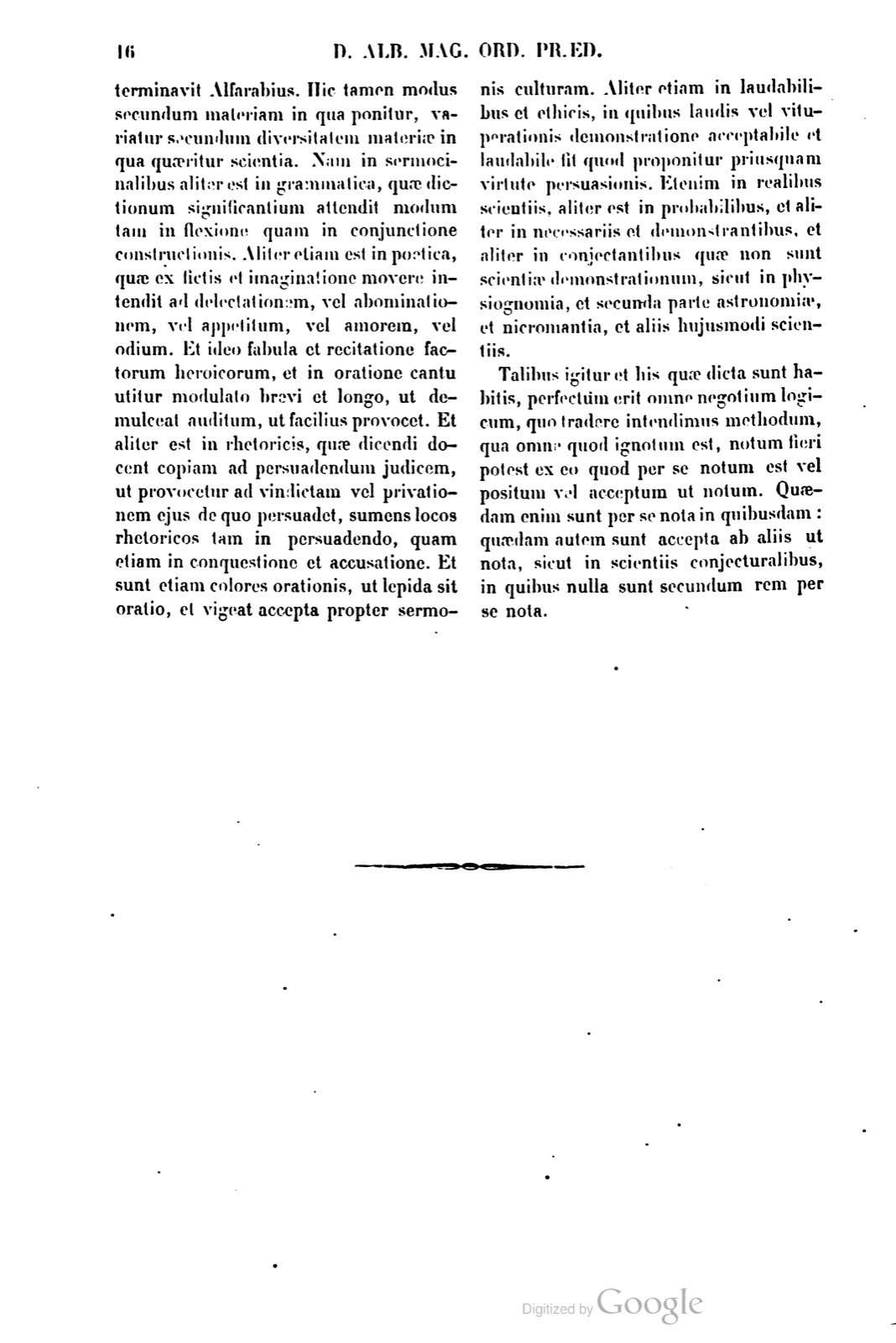
Chapter VII. On the part of logic by which a question concerning the complex is certified, on the necessity of the whole of logic, and that the mode of knowing is varied according to the diversity of matters in which science is sought.
A marker with ≈ is an approximate page boundary, placed by measure of the text; the page photographs remain the authority. In the paired views, clicking a page marker brings that page into view.
Caput VII. De parte logicae qua certificatur quaestio de complexo et de necessitate totius logicae, et quod varietur modus sciendi secundum diversitatem materiarum in quibus quaeritur scientia.
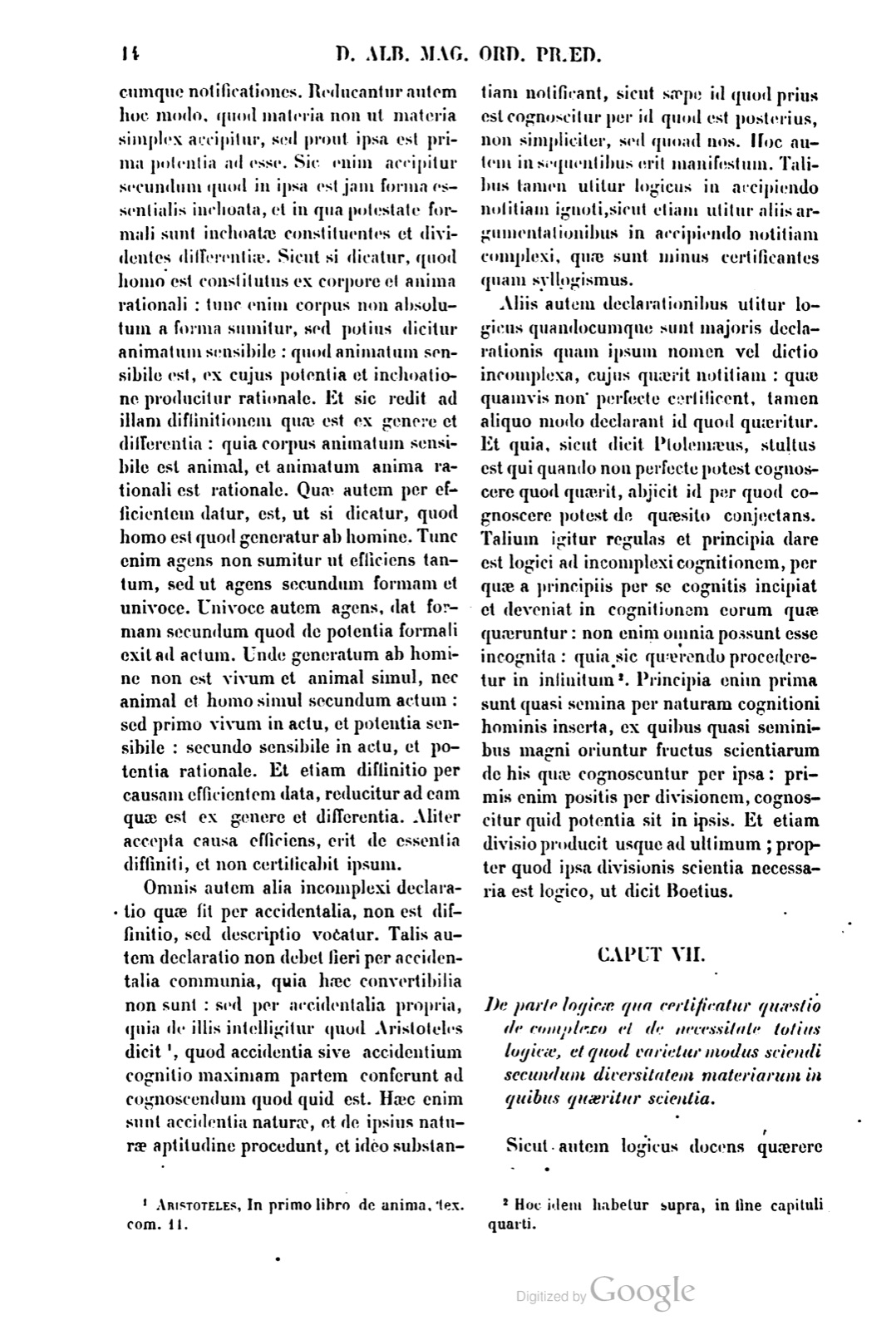
Sicut autem logicus docens quaerere scientiam incomplexi 1, docet instrumentum quo accipiatur notitia illius secundum diffinitionem, et ea quae ad diffinitionem faciunt, et quae diffinitionem circumstant, et quae diffinitionem perficiunt, et ea quae diffinitionem mutant: sic docens accipere scientiam complexi, docet syllogismum qui est illius proprium instrumentum, et docet alias species argumentationum, et principia syllogismi, et ea quae circumstant ipsum, et principia ipsius, et partes, et materiam in qua poni potest forma syllogismi, et aliarum argumentationum forma, et quae syllogismum immutant. Et ideo ea de quibus habet tractare logicus, secundum ista dividuntur et multiplicantur.
Ejus complexi cujus potest accipi scientia, non est differentia: quia sola indicativa oratio est, cujus est esse verum vel falsum 2. Et ideo tantum illius scientia potest accipi: quia scientia tantum veri est. Sed haec est duplex, categorica scilicet, et hypothetica: sive, ut Arabes dicunt, enuntiatio et conjunctio: propter quod duas species docet constituere syllogismorum. Docet enim constituere syllogismum categoricum, et syllogismum hypotheticum, quamvis hypotheticus ad categoricum habeat reduci.
Constructio autem syllogismi dupliciter fit, ut jam diximus in antehabitis, ad inveniendum scilicet, et judicandum. Inventio autem esse non potest, nisi per habitudinem noti ad ignotum, quae habitudo topica est et in topicorum scientia docetur. Judicandi autem scientia per resolutionem inventi est, quod resolvitur aut in formalia syllogismi principia, aut materialia, quae sunt principia certificantia rem per hoc quod sunt causae ejus quod sequitur, et illatum est. Et duae sunt partes, priorum scilicet Analyticorum, et posteriorum Analyticorum: et docere principia et regulas istorum logici proprium est.
Chapter VII. On the part of logic by which a question concerning the complex is certified, on the necessity of the whole of logic, and that the mode of knowing is varied according to the diversity of matters in which science is sought.
But just as the logician, when teaching one to seek science of the incomplex 1, teaches the instrument by which knowledge of it may be received according to definition, and those things which make for definition, and those things which surround definition, and those things which perfect definition, and those things which change definition, so, when teaching one to receive science of the complex, he teaches syllogism, which is its proper instrument, and teaches the other species of argumentations, and the principles of syllogism, and those things which surround it, and its principles and parts, and the matter in which the form of syllogism can be placed, and the form of other argumentations, and the things which alter syllogism. And therefore the things about which the logician has to treat are divided and multiplied according to these.
There is no difference of that complex thing of which science can be received, because the indicative speech alone is that whose property it is to be true or false 2. And therefore only science of it can be received, because science is only of the true. But this is twofold, namely categorical and hypothetical, or, as the Arabs say, enunciation and conjunction; for this reason he teaches how to constitute two species of syllogisms. For he teaches how to constitute the categorical syllogism and the hypothetical syllogism, although the hypothetical has to be reduced to the categorical.
But the construction of a syllogism occurs in two ways, as we have already said in what came before, namely for finding and for judging. But finding cannot exist except through the relation of the known to the unknown, which relation is topical and is taught in the science of topics. But the science of judging is through resolution of what has been found, which is resolved either into formal principles of syllogism, or into material principles, which are principles certifying the thing through this, that they are causes of that which follows and has been inferred. And there are two parts, namely the Prior Analytics and the Posterior Analytics; and it is proper to the logician to teach the principles and rules of these.
Ne autem fiat deceptio circa ea quae dicta sunt, inventa est scientia de sophisticis elenchis. Adhuc autem ne fiat impedimentum ex parte ejus qui quaerit accipere, inventae sunt cautelae tentatoris, in quibus omnibus doctrina logici est, ut scientia complete accipi possit enuntiationis, cujus scientia quaeritur per argumentationem.
Quia vero syllogismus non scitur an sit compositum et complexum quid, nisi sciatur ex quibus et quot et qualibus est, et qualiter conjunctus, ideo habet agere logicus de enuntiatione et partibus et qualitatibus et compositione enuntiationis. Et in his perficitur opus logicum: quae omnia fiunt actu rationis, qui est ratiocinatio, qui actus discursus rationis est ex uno ad aliud. Et ideo tales scientiae a Dionysio vocantur discursivae disciplinae. Non autem potest sic ex uno in aliud discurrere ratio, nisi prius accipiat unum in alio esse divisum per se vel per accidens. Et hoc esse non potest, nisi accipiatur unum esse ordinatum ad aliud per se vel per accidens. Ordo autem est prioris et posterioris secundum naturam et esse: et sic accipit universale et particulare per se vel per accidens. Et sic invenit modum praedicandi unum de altero, vel negandi. Et quoad ordinem inventa est scientia Universalium, et scientia Praedicamentorum. Et quoad modum educendi unum de alio, inventa est scientia divisionum. Rationis enim opus est ordinare, componere, et colligere, et resolvere ea quae collecta sunt: quo opere utitur quasi instrumento in accipiendo scientiam quando procedit a noto ad ignotum: quorum notitia, si perfecte traditur, praeparatus est logicus ad acceptionem scientiae, dummodo sciat cavere errores et fallacias, de quibus sufficienter instruitur in sophisticis elenchis.
Hae igitur sunt partes logicae quae generaliter habent docere modum accipiendi scientiam de quolibet scibili incomplexo vel complexo. Et hoc jam ante nos determinavit Alfarabius. Hic tamen modus secundum materiam in qua ponitur, variatur secundum diversitatem materiae in qua quaeritur scientia. Nam in sermocinalibus aliter est in grammatica, quae dictionum significantium attendit modum tam in flexione quam in conjunctione constructionis. Aliter etiam est in poetica, quae ex fictis et imaginatione movere intendit ad delectationem, vel abominationem, vel appetitum, vel amorem, vel odium. Et ideo fabula et recitatione factorum heroicorum, et in oratione cantu utitur modulato brevi et longo, ut demulceat auditum, ut facilius provocet. Et aliter est in rhetoricis, quae dicendi docent copiam ad persuadendum judicem, ut provocetur ad vindictam vel privationem ejus de quo persuadet, sumens locos rhetoricos tam in persuadendo, quam etiam in conquestione et accusatione. Et sunt etiam colores orationis, ut lepida sit oratio, et vigeat accepta propter sermonis culturam. Aliter etiam in laudabilibus et ethicis, in quibus laudis vel vituperationis demonstratione acceptabile et laudabile fit quod proponitur priusquam virtute persuasionis. Et enim in realibus scientiis, aliter est in probabilibus, et aliter in necessariis et demonstrantibus, et aliter in conjectantibus quae non sunt scientiae demonstrationum, sicut in physiognomia, et secunda parte astronomiae, et nicromantia, et aliis hujusmodi scientiis.
But lest deception occur about the things which have been said, the science concerning sophistical refutations has been found. Again, lest an impediment arise on the part of the one who seeks to receive, the cautions of the tester have been found; in all these the doctrine belongs to the logician, so that science of the enunciation whose science is sought through argumentation may be received completely.
But because syllogism is not known as to whether it is something composed and complex unless it is known from what things, and how many, and of what sort it is, and how it is joined, therefore the logician has to deal with enunciation and the parts and qualities and composition of enunciation. And in these the logical work is perfected; all these things occur by the act of reason, which is reasoning, which act is the discourse of reason from one thing to another. And therefore such sciences are called by Dionysius discursive disciplines. But reason cannot thus run discursively from one thing into another unless it first receives one thing as divided in another through itself or through accident. And this cannot be unless one thing is received as ordered to another through itself or through accident. But order belongs to the prior and posterior according to nature and being; and thus it receives universal and particular through itself or through accident. And thus it finds the mode of predicating one thing of another, or of denying. And with respect to order the science of Universals and the science of Predicaments were found. And with respect to the mode of drawing out one thing from another, the science of divisions was found. For it is the work of reason to order, compose, gather, and resolve the things which have been gathered; reason uses this work as an instrument in receiving science when it proceeds from the known to the unknown. If knowledge of these is handed down perfectly, the logician is prepared for the reception of science, provided that he knows how to beware of errors and fallacies, concerning which he is sufficiently instructed in sophistical refutations.
Therefore these are the parts of logic which generally have to teach the mode of receiving science concerning any knowable thing, whether incomplex or complex. And Alfarabius already determined this before us. Nevertheless this mode is varied according to the matter in which it is placed, according to the diversity of the matter in which science is sought. For in sermocinal matters it is one way in grammar, which attends to the mode of significant dictions both in inflection and in the joining of construction. It is another way in poetics, which intends from fictions and imagination to move toward delight, or aversion, or appetite, or love, or hatred. And therefore it uses fable and the recital of heroic deeds, and in speech uses song modulated by short and long syllables, so that it may soothe the hearing and provoke more easily. And it is another way in rhetorical matters, which teach abundance of speaking for persuading the judge, so that he may be provoked to punishment or privation of that concerning which it persuades, taking rhetorical places both in persuading and also in complaint and accusation. And there are also colors of speech, so that the speech may be charming and may flourish, having been accepted because of cultivation of speech. It is another way also in praiseworthy and ethical matters, in which, by demonstration of praise or blame, what is proposed becomes acceptable and praiseworthy before it does so by the power of persuasion. And indeed in real sciences it is one way in probable matters, another in necessary and demonstrative matters, and another in conjecturing matters which are not sciences of demonstrations, as in physiognomy, in the second part of astronomy, in necromancy, and in other sciences of this sort.
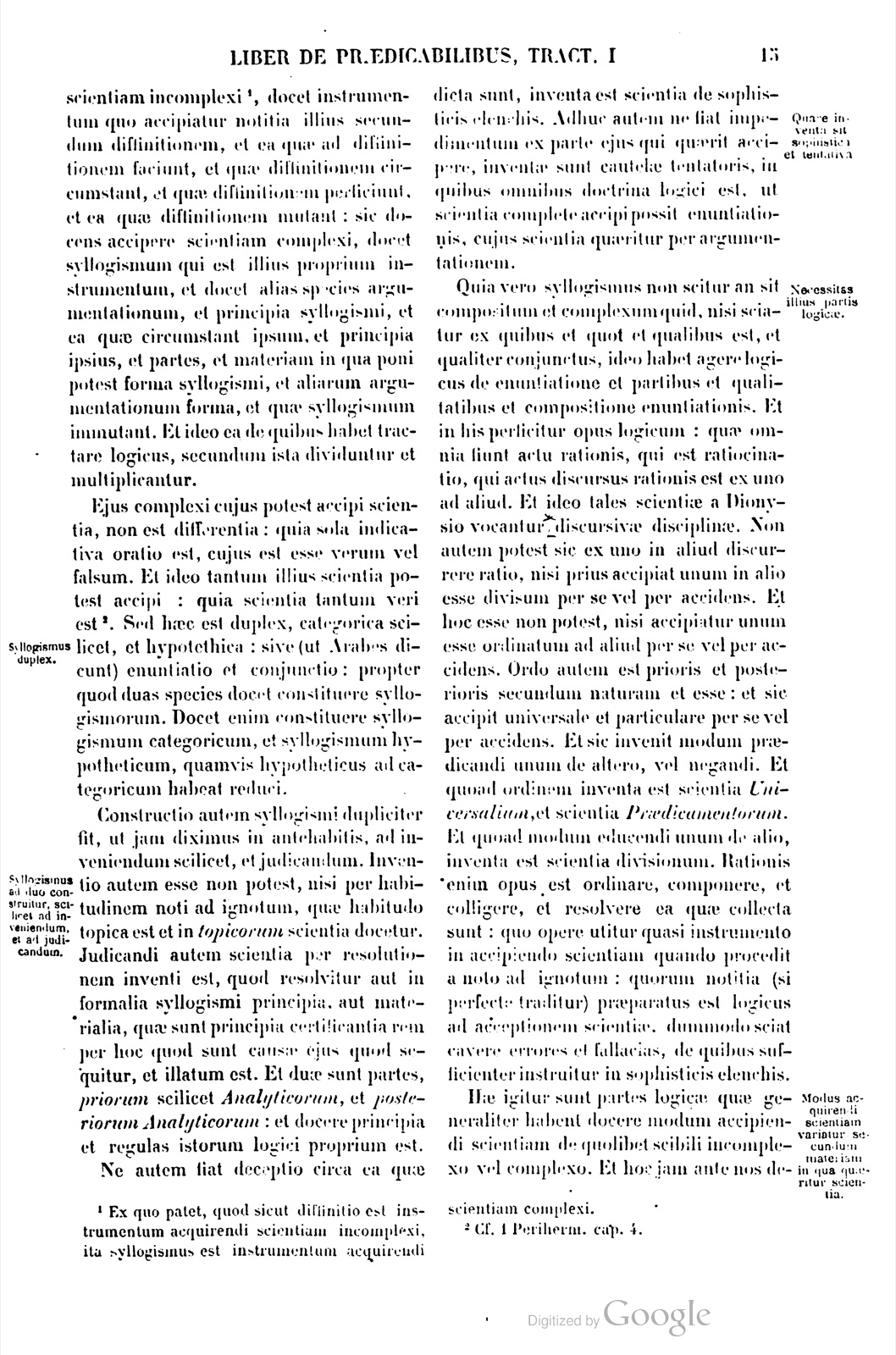
Talibus igitur et his quae dicta sunt habitis, perfectum erit omne negotium logicum, quo tradere intendimus methodum, qua omne quod ignotum est, notum fieri potest ex eo quod per se notum est vel positum vel acceptum ut notum. Quaedam enim sunt per se nota in quibusdam: quaedam autem sunt accepta ab aliis ut nota, sicut in scientiis conjecturalibus, in quibus nulla sunt secundum rem per se nota.
Therefore, once such things and the things which have been said have been had, every logical business will be perfect, by which we intend to hand down the method by which everything that is unknown can be made known from that which is known through itself, or posited, or received as known. For some things are known through themselves in some disciplines, but some are received from others as known, as in conjectural sciences, in which nothing is known through itself according to the thing.
Notes
- From this it is clear that just as definition is the instrument for acquiring science of the incomplex, so syllogism is the instrument for acquiring science of the complex. (Ex quo patet, quod sicut diffinitio est instrumentum acquirendi scientiam incomplexi, ita syllogismus est instrumentum acquirendi scientiam complexi.) ↩
- Compare On Interpretation I, chapter 4. (Cf. 1 Periherm. cap. 4.) ↩
If a page does not appear, its photograph has not been uploaded yet.