Volume 1 · pp. 56–58
Chapter I. On the diverse intentions of species.
A marker with ≈ is an approximate page boundary, placed by measure of the text; the page photographs remain the authority. In the paired views, clicking a page marker brings that page into view.
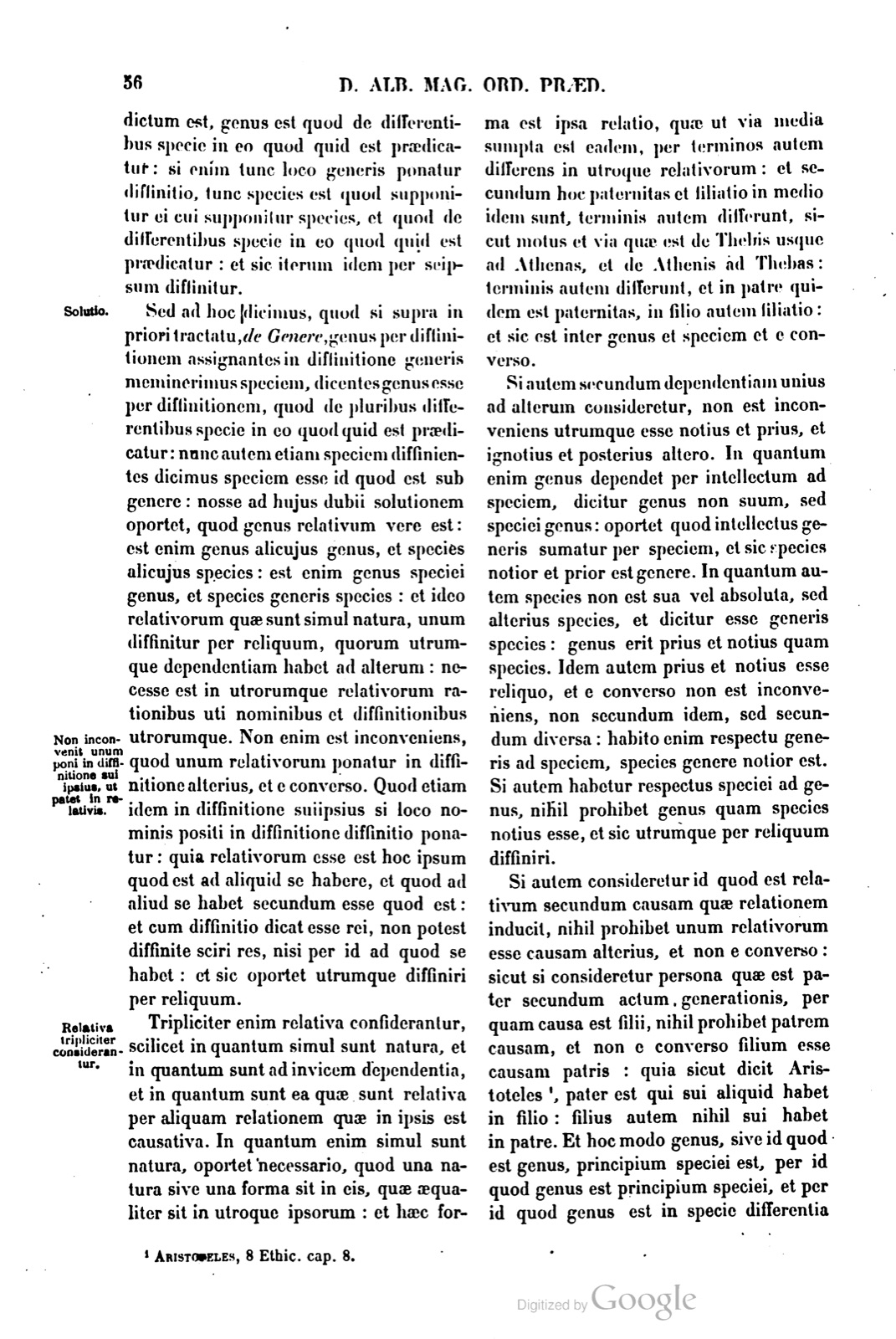
dictum est, genus est quod de differentibus specie in eo quod quid est praedicatur: si enim tunc loco generis ponatur diffinitio, tunc species est quod supponitur ei cui supponitur species, et quod de differentibus specie in eo quod quid est praedicatur: et sic iterum idem per seipsum diffinitur.
Sed ad hoc dicimus, quod si supra in priori tractatu, de Genere, genus per diffinitionem assignantes in diffinitione generis meminerimus speciem, dicentes genus esse per diffinitionem, quod de pluribus differentibus specie in eo quod quid est praedicatur: nunc autem etiam speciem diffinientes dicimus speciem esse id quod est sub genere: nosse ad hujus dubii solutionem oportet, quod genus relativum vere est: est enim genus alicujus genus, et species alicujus species: est enim genus speciei genus, et species generis species: et ideo relativorum quae sunt simul natura, unum diffinitur per reliquum, quorum utrumque dependentiam habet ad alterum: necesse est in utrorumque relativorum rationibus uti nominibus et diffinitionibus utrorumque. Non enim est inconveniens, quod unum relativorum ponatur in diffinitione alterius, et e converso. Quod etiam idem in diffinitione sui ipsius si loco nominis positi in diffinitione diffinitio ponatur: quia relativorum esse est hoc ipsum quod est ad aliquid se habere, et quod ad aliud se habet secundum esse quod est: et cum diffinitio dicat esse rei, non potest diffinite sciri res, nisi per id ad quod se habet: et sic oportet utrumque diffiniri per reliquum.
Tripliciter enim relativa considerantur, scilicet inquantum simul sunt natura, et inquantum sunt ad invicem dependentia, et in quantum sunt ea quae sunt relativa per aliquam relationem quae in ipsis est causativa. In quantum enim simul sunt natura, oportet necessario, quod una natura sive una forma sit in eis, quae aequaliter sit in utroque ipsorum: et haec forma est ipsa relatio, quae ut via media sumpta est eadem, per terminos autem differens in utroque relativorum: et secundum hoc paternitas et filiatio in medio idem sunt, terminis autem differunt, sicut motus et via quae est de Thebis usque ad Athenas, et de Athenis ad Thebas: terminis autem differunt, et in patre quidem est paternitas, in filio autem filiatio: et sic est inter genus et speciem et e converso.
Si autem secundum dependentiam unius ad alterum consideretur, non est inconveniens utrumque esse notius et prius, et ignotius et posterius altero. In quantum enim genus dependet per intellectum ad speciem, dicitur genus non suum, sed speciei genus: oportet quod intellectus generis sumatur per speciem, et sic species notior et prior est genere. Inquantum autem species non est sua vel absoluta, sed alterius species, et dicitur esse generis species: genus erit prius et notius quam species. Idem autem prius et notius esse reliquo, et e converso non est inconveniens, non secundum idem, sed secundum diversa: habito enim respectu generis ad speciem, species genere notior est. Si autem habetur respectus speciei ad genus, nihil prohibet genus quam species notius esse, et sic utrumque per reliquum diffiniri.
Si autem consideretur id quod est relativum secundum causam quae relationem inducit, nihil prohibet unum relativorum esse causam alterius, et non e converso: sicut si consideretur persona quae est pater secundum actum generationis, per quam causa est filii, nihil prohibet patrem causam, et non e converso filium esse causam patris: quia sicut dicit Aristoteles 1, pater est qui sui aliquid habet in filio: filius autem nihil sui habet in patre. Et hoc modo genus, sive id quod est genus, principium speciei est, per id quod genus est principium speciei, et per id quod genus est in specie differentia constitutiva formatum et distinctum. Species autem nihil sui habet in genere per modum illum. Et sic unum diffinitur per reliquum, et non e converso. Et haec est distinctio Alfarabii et Avicennae.
it was said that genus is what is predicated of things differing in species in that which is what; for if then the definition is put in the place of genus, then species is what is placed under that under which species is placed, and what is predicated of things differing in species in that which is what; and thus again the same is defined through itself.
But to this we say that if above, in the earlier treatise On Genus, when assigning genus by definition, we made mention of species in the definition of genus, saying by definition that genus is what is predicated of several things differing in species in that which is what, but now also defining species we say that species is that which is under genus: for the solution of this doubt one must know that genus is truly relative. For genus is the genus of something, and species is the species of something; for genus is the genus of species, and species is the species of genus. And therefore, of relatives which are simultaneous by nature, one is defined through the other, each of which has dependence on the other; it is necessary in the notions of each of the relatives to use the names and definitions of both. For it is not unfitting that one of relatives be placed in the definition of the other, and conversely. This also happens, that the same is in the definition of itself if the definition is put in the place of the name placed in the definition, because the being of relatives is this very thing, to have itself toward something, and that which has itself toward another does so according to the being which it is. And since definition states the being of the thing, a thing cannot be definitely known except through that to which it has itself; and thus each must be defined through the other.
For relatives are considered triply, namely insofar as they are simultaneous by nature, insofar as they are dependent on one another, and insofar as they are those things which are relatives through some relation which is causative in them. Insofar as they are simultaneous by nature, it is necessarily required that one nature or one form be in them, which is equally in each of them; and this form is the relation itself, which taken as a middle way is the same, but differs by the terms in each of the relatives. And according to this, paternity and filiation are the same in the middle, but differ in the terms, just as the motion and way which is from Thebes to Athens and from Athens to Thebes differ by terms. In the father indeed there is paternity, but in the son filiation; and thus it is between genus and species and conversely.
But if it is considered according to the dependence of one on the other, it is not unfitting that each be better known and prior, and less known and posterior, than the other. For insofar as genus depends through intellect on species, genus is called not its own genus, but the genus of species; the understanding of genus must be taken through species, and thus species is better known and prior to genus. But insofar as species is not its own or absolute, but is species of another and is said to be species of genus, genus will be prior and better known than species. But that the same thing be prior and better known than the other, and conversely, is not unfitting, not according to the same respect, but according to diverse respects. For with the respect of genus to species held, species is better known than genus. But if the respect of species to genus is held, nothing prevents genus from being better known than species, and thus each from being defined through the other.
But if that which is relative is considered according to the cause which induces the relation, nothing prevents one of relatives from being the cause of the other, and not conversely; as if the person who is father is considered according to the act of generation through which he is the cause of the son, nothing prevents the father from being cause and, conversely, the son from not being the cause of the father; because, as Aristotle says 1, the father is he who has something of himself in the son; but the son has nothing of himself in the father. And in this way genus, or that which is genus, is the principle of species through that by which genus is the principle of species, and through that by which genus is in species formed and distinguished by constitutive difference. But species has nothing of itself in genus in that mode. And thus one is defined through the other, and not conversely. And this is the distinction of Alfarabi and Avicenna.
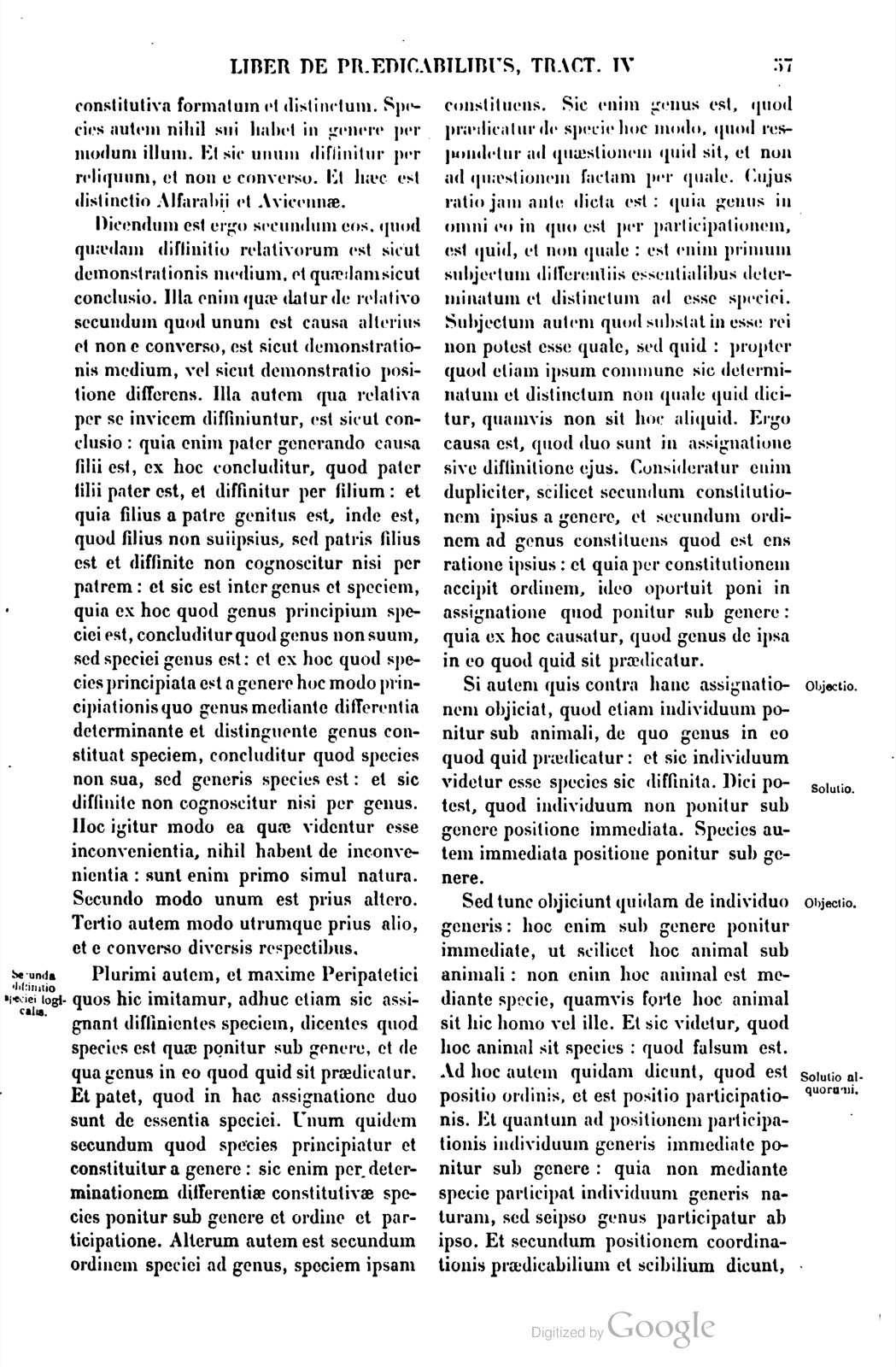
Dicendum est ergo secundum eos, quod quaedam diffinitio relativorum est sicut demonstrationis medium, et quaedam sicut conclusio. Illa enim quae datur de relativo secundum quod unum est causa alterius et non e converso, est sicut demonstrationis medium, vel sicut demonstratio positione differens. Illa autem qua relativa per se invicem diffiniuntur, est sicut conclusio: quia enim pater generando causa filii est, ex hoc concluditur, quod pater filii pater est, et diffinitur per filium: et quia filius a patre genitus est, inde est, quod filius non sui ipsius, sed patris filius est et diffinite non cognoscitur nisi per patrem: et sic est inter genus et speciem, quia ex hoc quod genus principium speciei est, concluditur quod genus non suum, sed speciei genus est: et ex hoc quod species principiata est a genere hoc modo principiationis quo genus mediante differentia determinante et distinguente genus constituat speciem, concluditur quod species non sua, sed generis species est: et sic diffinite non cognoscitur nisi per genus. Hoc igitur modo ea quae videntur esse inconvenientia, nihil habent de inconvenientia: sunt enim primo simul natura. Secundo modo unum est prius altero. Tertio autem modo utrumque prius alio, et e converso diversis respectibus.
Plurimi autem, et maxime Peripatetici quos hic imitamur, adhuc etiam sic assignant diffinientes speciem, dicentes quod species est quae ponitur sub genere, et de qua genus in eo quod quid sit praedicatur. Et patet, quod in hac assignatione duo sunt de essentia speciei. Unum quidem secundum quod species principiatur et constituitur a genere: sic enim per determinationem differentiae constitutivae species ponitur sub genere et ordine et participatione. Alterum autem est secundum ordinem speciei ad genus, speciem ipsam constituens. Sic enim genus est, quod praedicatur de specie hoc modo, quod respondetur ad quaestionem quid sit, et non ad quaestionem factam per quale. Cujus ratio jam ante dicta est: quia genus in omni eo in quo est per participationem, est quid, et non quale: est enim primum subjectum differentiis essentialibus determinatum et distinctum ad esse speciei. Subjectum autem quod substat in esse rei non potest esse quale, sed quid: propter quod etiam ipsum commune sic determinatum et distinctum non quale quid dicitur, quamvis non sit hoc aliquid. Ergo causa est, quod duo sunt in assignatione sive diffinitione ejus. Consideratur enim dupliciter, scilicet secundum constitutionem ipsius a genere, et secundum ordinem ad genus constituens quod est ens ratione ipsius: et quia per constitutionem accipit ordinem, ideo oportuit poni in assignatione quod ponitur sub genere: quia ex hoc causatur, quod genus de ipsa in eo quod quid sit praedicatur.
Si autem quis contra hanc assignationem objiciat, quod etiam individuum ponitur sub animali, de quo genus in eo quod quid praedicatur: et sic individuum videtur esse species sic diffinita. Dici potest, quod individuum non ponitur sub genere positione immediata. Species autem immediata positione ponitur sub genere.
Sed tunc objiciunt quidam de individuo generis: hoc enim sub genere ponitur immediate, ut scilicet hoc animal sub animali: non enim hoc animal est mediante specie, quamvis forte hoc animal sit hic homo vel ille. Et sic videtur, quod hoc animal sit species: quod falsum est.
Ad hoc autem quidam dicunt, quod est positio ordinis, et est positio participationis. Et quantum ad positionem participationis individuum generis immediate ponitur sub genere: quia non mediante specie participat individuum generis naturam, sed seipso genus participatur ab ipso. Et secundum positionem coordinationis praedicabilium et scibilium dicunt, quod non ponitur immediate sub genere nisi species, et individuum per speciem quod post speciem ordinatur.
Therefore according to them one must say that one definition of relatives is as the middle of demonstration, and another as a conclusion. For that which is given of a relative insofar as one is the cause of the other and not conversely is as the middle of demonstration, or as a demonstration differing by position. But that by which relatives are defined through one another is as a conclusion: for because the father by generating is the cause of the son, from this it is concluded that the father is father of a son and is defined through the son; and because the son is begotten by the father, thence it is that the son is not the son of himself, but the son of the father, and is not definitely known except through the father. And so it is between genus and species, because from this, that genus is the principle of species, it is concluded that genus is not its own, but the genus of species; and from this, that species is principled by genus by this mode of principiation in which genus, by means of difference determining and distinguishing genus, constitutes species, it is concluded that species is not its own, but species of genus; and thus it is not definitely known except through genus. Therefore in this way those things which seem to be unfitting have nothing of unfittingness: for first they are simultaneous by nature. In a second mode one is prior to the other. But in a third mode each is prior to the other, and conversely, by diverse respects.
But very many, and especially the Peripatetics whom we imitate here, still also assign species thus when defining it, saying that species is what is placed under genus, and of which genus is predicated in that which is what. And it is clear that in this assignment two things belong to the essence of species. One is according as species is principled and constituted by genus; for thus through the determination of constitutive difference species is placed under genus both by order and by participation. The other is according to the order of species to genus, constituting species itself. For thus genus is what is predicated of species in such a way that answer is given to the question what it is, and not to a question made through quale. The reason for this has already been given: because genus in everything in which it is through participation is what, and not quale; for it is the first subject determined and distinguished by essential differences to the being of species. But the subject which stands under in the being of the thing cannot be quale, but what; on account of which even the common itself, thus determined and distinguished, is not called quale quid, although it is not this something. Therefore the cause is that there are two things in its assignment or definition. For it is considered in two ways, namely according to its constitution by genus and according to order to the genus constituting what is a being by reason of it; and because it receives order through constitution, therefore it had to be placed in the assignment that it is placed under genus, because from this it is caused that genus is predicated of it in that which is what.
But if someone objects against this assignment that even the individual is placed under animal, of which genus is predicated in that which is what, and thus the individual seems to be species as thus defined, it can be said that the individual is not placed under genus by immediate position. But species is placed under genus by immediate position.
But then certain people object about the individual of genus; for this is placed immediately under genus, as namely this animal under animal. For this animal is not through the mediation of species, although perhaps this animal is this man or that man. And thus it seems that this animal is species, which is false.
But to this certain people say that there is a position of order and there is a position of participation. And as regards the position of participation, the individual of genus is placed immediately under genus, because not by means of species does the individual of genus participate the nature of genus, but by itself genus is participated by it. And according to the position of coordination of predicables and knowables, they say that only species is placed immediately under genus, and the individual through species which is ordered after species.
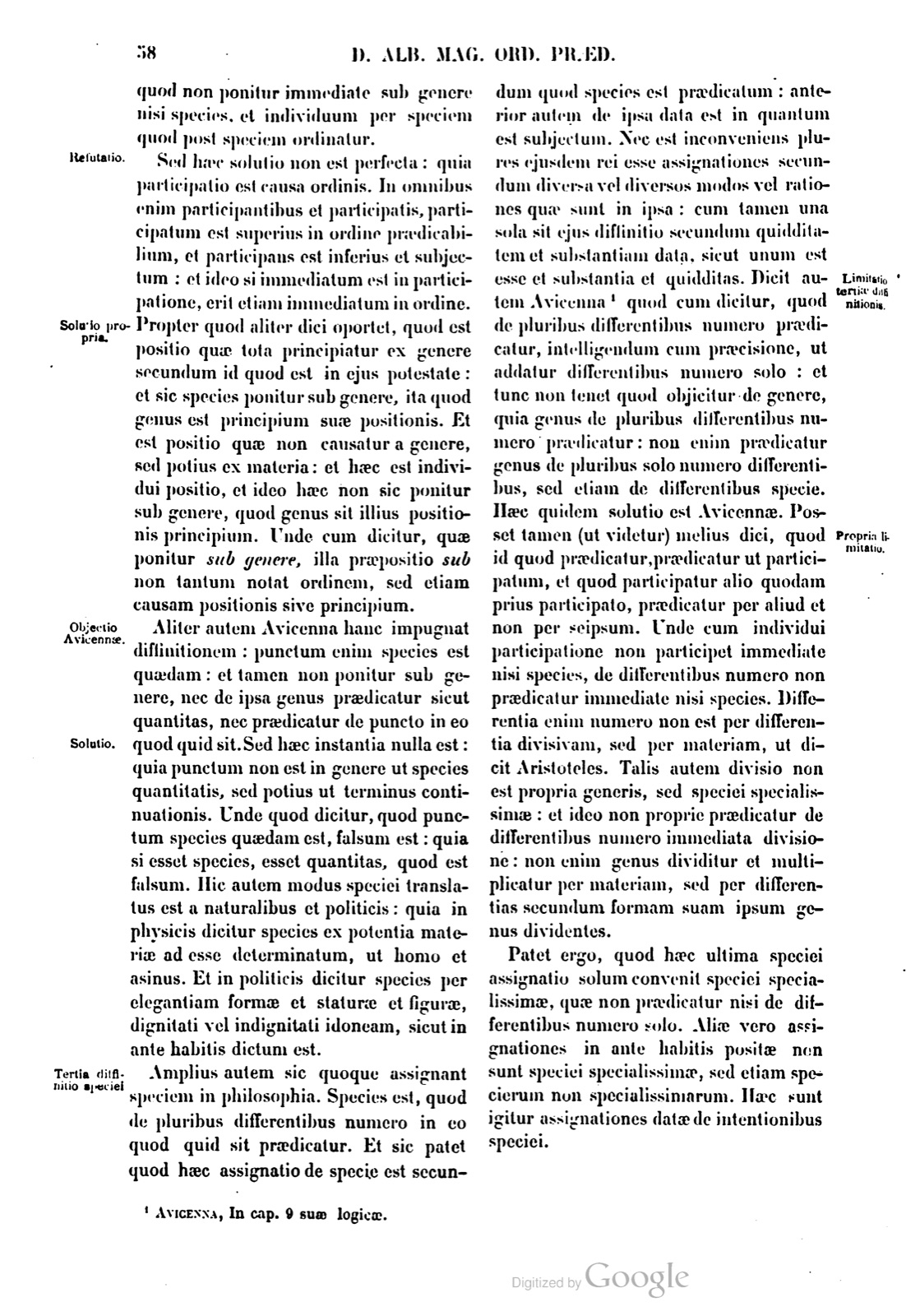
Sed haec solutio non est perfecta: quia participatio est causa ordinis. In omnibus enim participantibus et participatis, participatum est superius in ordine praedicabilium, et participans est inferius et subjectum: et ideo si immediatum est in participatione, erit etiam immediatum in ordine. Propter quod aliter dici oportet, quod est positio quae tota principiatur ex genere secundum id quod est in ejus potestate: et sic species ponitur sub genere, ita quod genus est principium suae positionis. Et est positio quae non causatur a genere, sed potius ex materia: et haec est individui positio, et ideo haec non sic ponitur sub genere, quod genus sit illius positionis principium. Unde cum dicitur, quae ponitur sub genere, illa praepositio sub non tantum notat ordinem, sed etiam causam positionis sive principium.
Aliter autem Avicenna hanc impugnat diffinitionem 2: punctum enim species est quaedam: et tamen non ponitur sub genere, nec de ipsa genus praedicatur sicut quantitas, nec praedicatur de puncto in eo quod quid sit. Sed haec instantia nulla est: quia punctum non est in genere ut species quantitatis, sed potius ut terminus continuationis. Unde quod dicitur, quod punctum species quaedam est, falsum est: quia si esset species, esset quantitas, quod est falsum. Hic autem modus speciei translatus est a naturalibus et politicis: quia in physicis dicitur species ex potentia materiae ad esse determinatum, ut homo et asinus. Et in politicis dicitur species per elegantiam formae et staturae et figurae, dignitati vel indignitati idoneam, sicut in ante habitis dictum est.
Amplius autem sic quoque assignant speciem in philosophia. Species est, quod de pluribus differentibus numero in eo quod quid sit praedicatur. Et sic patet quod haec assignatio de specie est secundum quod species est praedicatum: anterior autem de ipsa data est in quantum est subjectum. Nec est inconveniens plures ejusdem rei esse assignationes secundum diversa vel diversos modos vel rationes quae sunt in ipsa: cum tamen una sola sit ejus diffinitio secundum quidditatem et substantiam data, sicut unum est esse et substantia et quidditas. Dicit autem Avicenna quod cum dicitur, quod de pluribus differentibus numero praedicatur, intelligendum cum praecisione, ut addatur differentibus numero solo: et tunc non tenet quod objicitur de genere, quia genus de pluribus differentibus numero praedicatur: non enim praedicatur genus de pluribus solo numero differentibus, sed etiam de differentibus specie. Haec quidem solutio est Avicennae. Posset tamen, ut videtur, melius dici, quod id quod praedicatur, praedicatur ut participatum, et quod participatur alio quodam prius participato, praedicatur per aliud et non per seipsum. Unde cum individui participatione non participet immediate nisi species, de differentibus numero non praedicatur immediate nisi species. Differentia enim numero non est per differentiam divisivam, sed per materiam, ut dicit Aristoteles. Talis autem divisio non est propria generis, sed speciei specialissimae: et ideo non proprie praedicatur de differentibus numero immediata divisione: non enim genus dividitur et multiplicatur per materiam, sed per differentias secundum formam suam ipsum genus dividentes.
Patet ergo, quod haec ultima speciei assignatio solum convenit speciei specialissimae, quae non praedicatur nisi de differentibus numero solo. Aliae vero assignationes in ante habitis positae non sunt speciei specialissimae, sed etiam specierum non specialissimarum. Haec sunt igitur assignationes datae de intentionibus speciei.
But this solution is not perfect, because participation is the cause of order. For in all participants and participated things, the participated is higher in the order of predicables, and the participant is lower and subject. And therefore, if it is immediate in participation, it will also be immediate in order. On account of this one must speak otherwise: that there is a position which is wholly principled from genus according to that which is in its potency; and thus species is placed under genus, so that genus is the principle of its position. And there is a position which is not caused by genus, but rather from matter; and this is the position of the individual. And therefore this is not so placed under genus that genus is the principle of that position. Hence when it is said what is placed under genus, that preposition under marks not only order but also the cause or principle of the position.
But Avicenna attacks this definition in another way 2: for a point is a certain species, and nevertheless it is not placed under genus, nor is genus, such as quantity, predicated of it, nor is it predicated of point in that which is what. But this instance is nothing, because point is not in the genus as a species of quantity, but rather as the term of continuation. Whence when it is said that point is a certain species, this is false, because if it were species, it would be quantity, which is false. But this mode of species has been transferred from natural and political things, because in physical things species is said from the potency of matter to determinate being, as man and ass. And in political things species is said through elegance of form and stature and figure, suitable to dignity or indignity, as was said above.
Moreover they also assign species thus in philosophy. Species is what is predicated of several things differing in number in that which is what. And thus it is clear that this assignment concerning species is according as species is a predicate, while the earlier one was given concerning it insofar as it is a subject. Nor is it unfitting that there be several assignments of the same thing according to diverse things or diverse modes or notions which are in it, while nevertheless there is one definition of it given according to quiddity and substance, just as being and substance and quiddity are one. But Avicenna says that when it is said that it is predicated of several things differing in number, it must be understood with precision, so that differing in number alone is added; and then what is objected about genus does not hold, because genus is predicated of several things differing in number. For genus is not predicated of several things differing in number alone, but also of things differing in species. This indeed is the solution of Avicenna. Nevertheless, as it seems, it could be said better that what is predicated is predicated as participated, and what is participated through some other thing previously participated is predicated through another and not through itself. Hence, since by the participation of the individual nothing is participated immediately except species, only species is predicated immediately of things differing in number. For difference in number is not through divisive difference, but through matter, as Aristotle says. But such a division is not proper to genus, but to the most special species; and therefore it is not properly predicated of things differing in number by immediate division. For genus is not divided and multiplied through matter, but through differences dividing the genus itself according to its own form.
Therefore it is clear that this last assignment of species belongs only to the most special species, which is predicated only of things differing in number alone. But the other assignments placed above are not of the most special species only, but also of species which are not most special. These, therefore, are the assignments given concerning the intentions of species.
If a page does not appear, its photograph has not been uploaded yet.