Volume 1 · pp. 19–20
Chapter II. From which questions concerning universals one must abstain.
A marker with ≈ is an approximate page boundary, placed by measure of the text; the page photographs remain the authority. In the paired views, clicking a page marker brings that page into view.
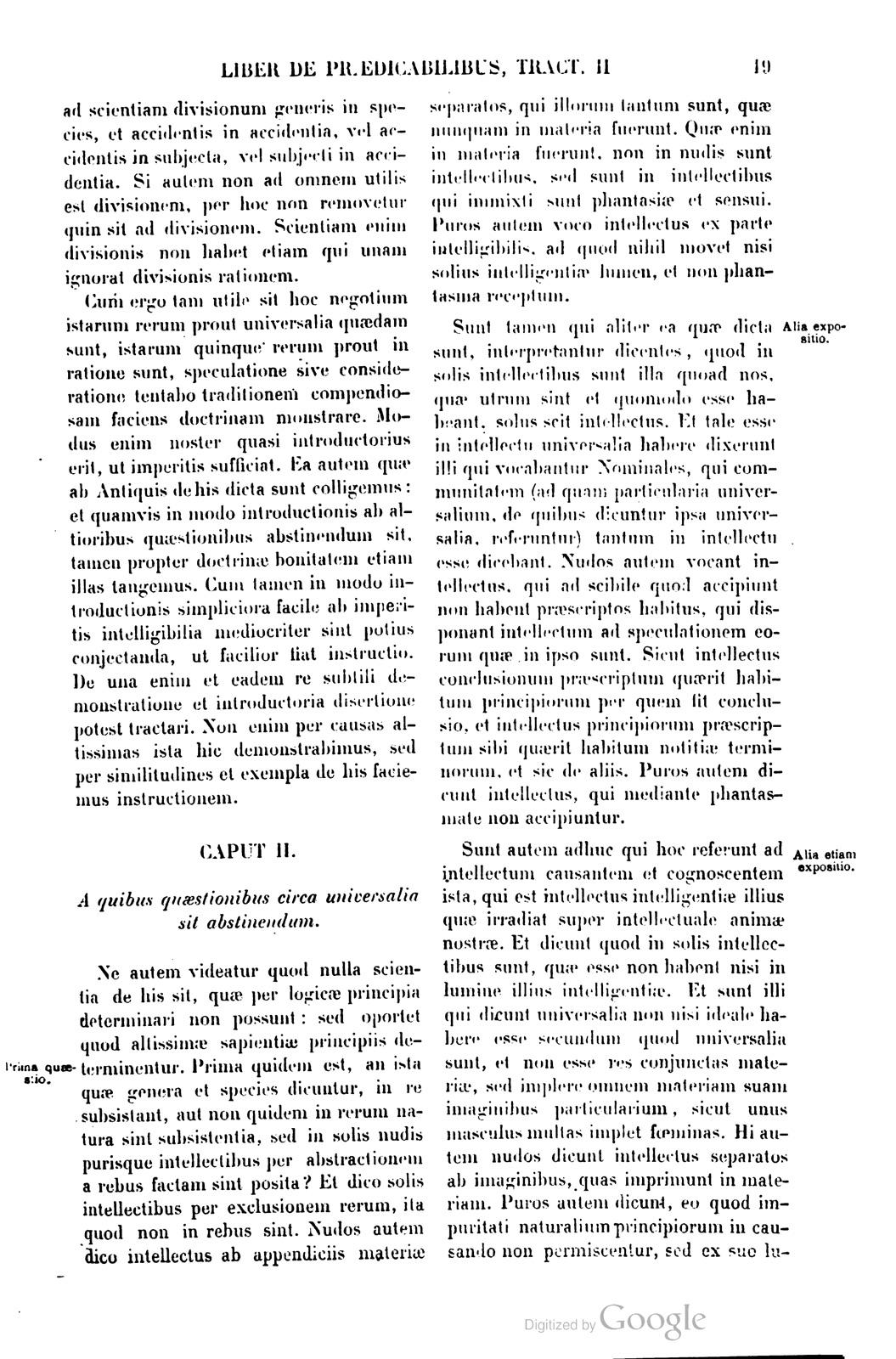
Caput II. A quibus quaestionibus circa universalia sit abstinendum.
Ne autem videatur quod nulla scientia de his sit, quae per logicae principia determinari non possunt: sed oportet quod altissimae sapientiae principiis determinentur. Prima quidem est, an ista quae genera et species dicuntur, in re subsistant, aut non quidem in rerum natura sint subsistentia, sed in solis nudis purisque intellectibus per abstractionem a rebus factam sint posita? Et dico solis intellectibus per exclusionem rerum, ita quod non in rebus sint. Nudos autem dico intellectus ab appendiciis materiae separatos, qui illorum tantum sunt, quae nunquam in materia fuerunt. Quae enim in materia fuerunt, non in nudis sunt intellectibus, sed sunt in intellectibus qui immixti sunt phantasiae et sensui. Puros autem voco intellectus ex parte intelligibilis, ad quod nihil movet nisi solius intelligentiae lumen, et non phantasma receptum.
Sunt tamen qui aliter ea quae dicta sunt, interpretantur dicentes, quod in solis intellectibus sunt illa quoad nos, quae utrum sint et quomodo esse habeant, solus scit intellectus. Et tale esse in intellectu universalia habere dixerunt illi qui vocabantur Nominales, qui communitatem, ad quam particularia universalium, de quibus dicuntur ipsa universalia, referuntur, tantum in intellectu esse dicebant. Nudos autem vocant intellectus, qui ad scibile quod accipiunt non habent praescriptos habitus, qui disponant intellectum ad speculationem eorum quae in ipso sunt. Sicut intellectus conclusionum praescriptum quaerit habitum principiorum per quem fit conclusio, et intellectus principiorum praescriptum sibi quaerit habitum notitiae terminorum, et sic de aliis. Puros autem dicunt intellectus, qui mediante phantasmate non accipiuntur.
Sunt autem adhuc qui hoc referunt ad intellectum causantem et cognoscentem ista, qui est intellectus intelligentiae illius quae irradiat super intellectuale animae nostrae. Et dicunt quod in solis intellectibus sunt, quae esse non habent nisi in lumine illius intelligentiae. Et sunt illi qui dicunt universalia non nisi ideale habere esse secundum quod universalia sunt, et non esse res conjunctas materiae, sed implere omnem materiam suam imaginibus particularium, sicut unus masculus multas implet feminas. Hi autem nudos dicunt intellectus separatos ab imaginibus, quas imprimunt in materiam. Puros autem dicunt, eo quod impuritati naturalium principiorum in causando non permiscentur, sed ex suae lumine producunt formas universales, quae per distantiam ab ipsis impuritati materialium principiorum permiscentur, et tunc particulantur et determinantur.
Chapter II. From which questions concerning universals one must abstain.
But lest it seem that there is no science concerning these things which cannot be determined through the principles of logic, it must be said rather that they must be determined by the principles of the highest wisdom. The first question is whether those things which are called genera and species subsist in reality, or whether they are not indeed subsisting in the nature of things, but are posited only in bare and pure intellects through abstraction made from things. And I say in intellects alone by exclusion of things, so that they are not in things. But I call intellects bare when they are separated from the appendages of matter, and are only of those things which were never in matter. For things which were in matter are not in bare intellects, but are in intellects which are mixed with phantasy and sense. But I call intellects pure from the side of the intelligible, to which nothing moves except the light of intelligence alone, and not a received phantasm.
Yet there are those who interpret the things which have been said otherwise, saying that those things are in intellects alone with respect to us, of which only intellect knows whether they are and how they have being. And those who were called Nominales said that universals have such being in intellect; they said that the commonness to which the particulars of universals, concerning which the universals themselves are said, are referred exists only in intellect. But they call those intellects bare which, with respect to the knowable thing which they receive, do not have prescribed habits that dispose the intellect to speculation of the things that are in it. As the intellect of conclusions seeks a prescribed habit of principles through which the conclusion is made, and the intellect of principles seeks for itself a prescribed habit of knowledge of terms, and so concerning the others. But they call those intellects pure which are not received by means of a phantasm.
There are still others who refer this to the intellect causing and knowing those things, which is the intellect of that intelligence which radiates upon the intellectual part of our soul. And they say that those things are in intellects alone which have no being except in the light of that intelligence. And these are those who say that universals, insofar as they are universals, have only ideal being, and are not things joined to matter, but fill all their matter with images of particulars, as one male fills many females. But these call intellects bare when they are separated from the images which they impress into matter. They call them pure because in causing they are not mixed with the impurity of natural principles, but from its light they produce universal forms, which through distance from them are mixed with the impurity of material principles, and then are particularized and determined.
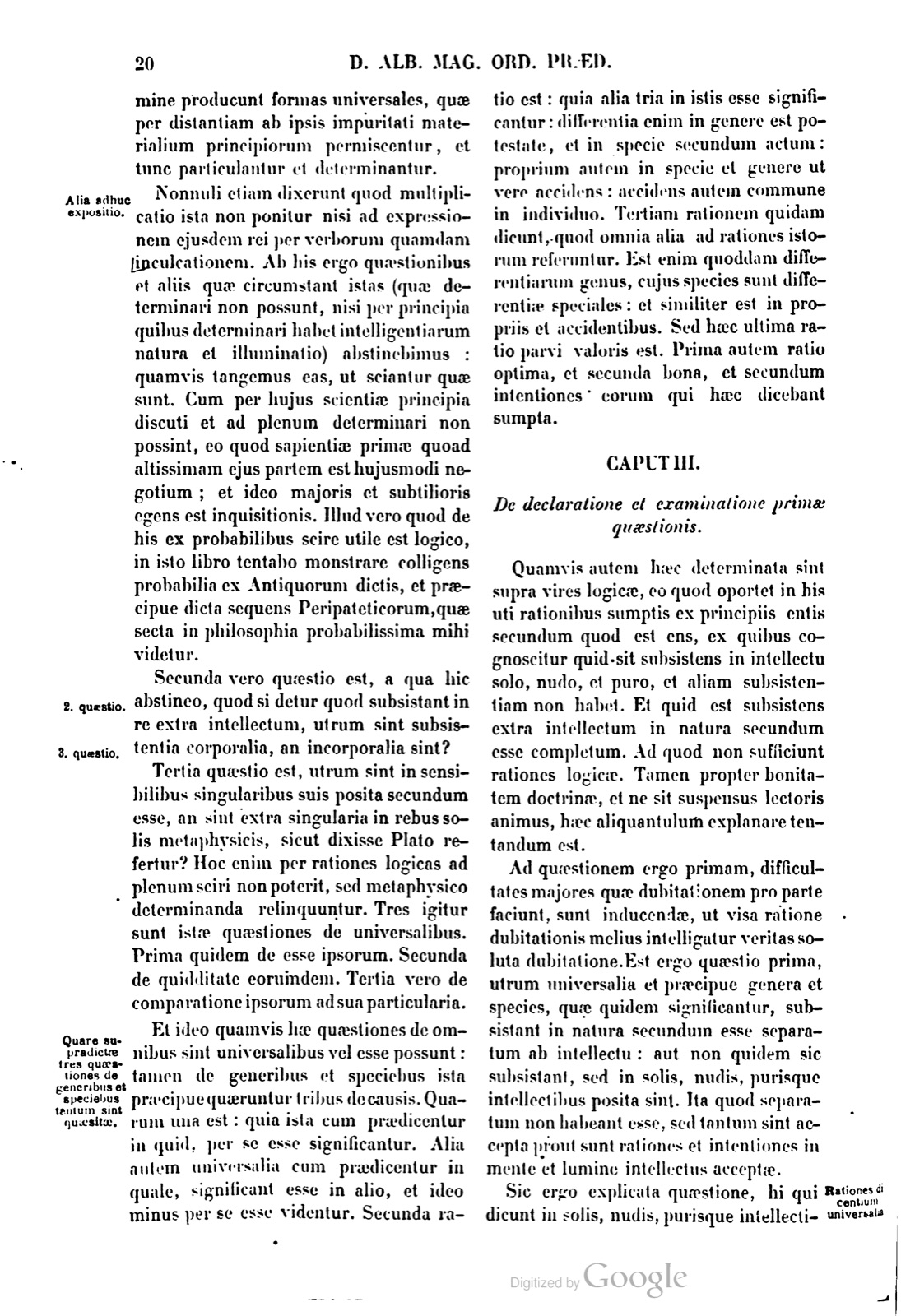
Nonnulli etiam dixerunt quod multiplicatio ista non ponitur nisi ad expressionem ejusdem rei per verborum quamdam inculcationem. Ab his ergo quaestionibus et aliis quae circumstant istas, quae determinari non possunt, nisi per principia quibus determinari habet intelligentiarum natura et illuminatio, abstinebimus: quamvis tangemus eas, ut sciantur quae sunt. Cum per hujus scientiae principia discuti et ad plenum determinari non possint, eo quod sapientiae primae quoad altissimam ejus partem est hujusmodi negotium; et ideo majoris et subtilioris egens est inquisitionis. Illud vero quod de his ex probabilibus scire utile est logico, in isto libro tentabo monstrare colligens probabilia ex Antiquorum dictis, et praecipue dicta sequens Peripateticorum, quae secta in philosophia probabilissima mihi videtur.
Secunda vero quaestio est, a qua hic abstineo, quod si detur quod subsistant in re extra intellectum, utrum sint subsistentia corporalia, an incorporalia sint? Tertia quaestio est, utrum sint in sensibilibus singularibus suis posita secundum esse, an sint extra singularia in rebus solis metaphysicis, sicut dixisse Plato refertur? Hoc enim per rationes logicas ad plenum sciri non poterit, sed metaphysico determinanda relinquuntur. Tres igitur sunt istae quaestiones de universalibus. Prima quidem de esse ipsorum. Secunda de quidditate eorumdem. Tertia vero de comparatione ipsorum ad sua particularia. Et ideo quamvis hae quaestiones de omnibus sint universalibus vel esse possunt: tamen de generibus et speciebus ista praecipue quaeruntur tribus de causis. Quarum una est: quia ista cum praedicentur in quid, per se esse significantur. Alia autem universalia cum praedicentur in quale, significant esse in alio, et ideo minus per se esse videntur. Secunda ratio est: quia alia tria in istis esse significantur: differentia enim in genere est potestate, et in specie secundum actum: proprium autem in specie et genere ut vere accidens: accidens autem commune in individuo. Tertiam rationem quidam dicunt, quod omnia alia ad rationes istorum referuntur. Est enim quoddam differentiarum genus, cujus species sunt differentiae speciales: et similiter est in propriis et accidentibus. Sed haec ultima ratio parvi valoris est. Prima autem ratio optima, et secunda bona, et secundum intentiones eorum qui haec dicebant sumpta.
Some also said that this multiplication is posited only for the expression of the same thing through a certain inculcation of words. Therefore from these questions, and from others which surround these, which cannot be determined except through principles by which the nature and illumination of intelligences has to be determined, we shall abstain, although we shall touch them so that what they are may be known. Since they cannot be discussed and fully determined through the principles of this science, because a business of this kind belongs to first wisdom with respect to its highest part; and therefore it needs a greater and subtler inquiry. But what it is useful for the logician to know about these things from probabilities, I shall attempt to show in this book, gathering probabilities from the sayings of the Ancients, and especially following the sayings of the Peripatetics, which sect seems to me the most probable in philosophy.
The second question, from which I here abstain, is this: if it is granted that they subsist in reality outside intellect, whether they are subsisting corporeal things or are incorporeal. The third question is whether they are posited according to being in their sensible singulars, or whether they are outside singulars in metaphysical things alone, as Plato is reported to have said. For this cannot be known fully through logical reasons, but such things are left to be determined by the metaphysician. Therefore these are three questions concerning universals. The first is concerning their being. The second is concerning their quiddity. The third is concerning their comparison to their particulars. And therefore although these questions concern all universals or can concern them, nevertheless they are especially asked concerning genera and species for three causes. One of these is that, since these are predicated in what a thing is, they are signified as being through themselves. But the other universals, since they are predicated in what sort of thing, signify being in another, and therefore they seem less to be through themselves. The second reason is that the other three are signified to be in these: for difference is in genus in power, and in species according to act; proper is in species and genus as a true accident; but common accident is in the individual. Some give a third reason, that all the others are referred to the accounts of these. For there is a certain genus of differences, whose species are special differences; and it is similar in propers and accidents. But this last reason is of little value. The first reason is best, and the second good, and taken according to the intentions of those who said these things.
If a page does not appear, its photograph has not been uploaded yet.