JERUSALEM, called before Jebus or Salem. Some call it Solyma or Ierosolyma; the Hebrews Jeruschalaim or Jeruschelem. This word may signify the vision of Peace, or the possession or inheritance of Peace. Joshua gave it to
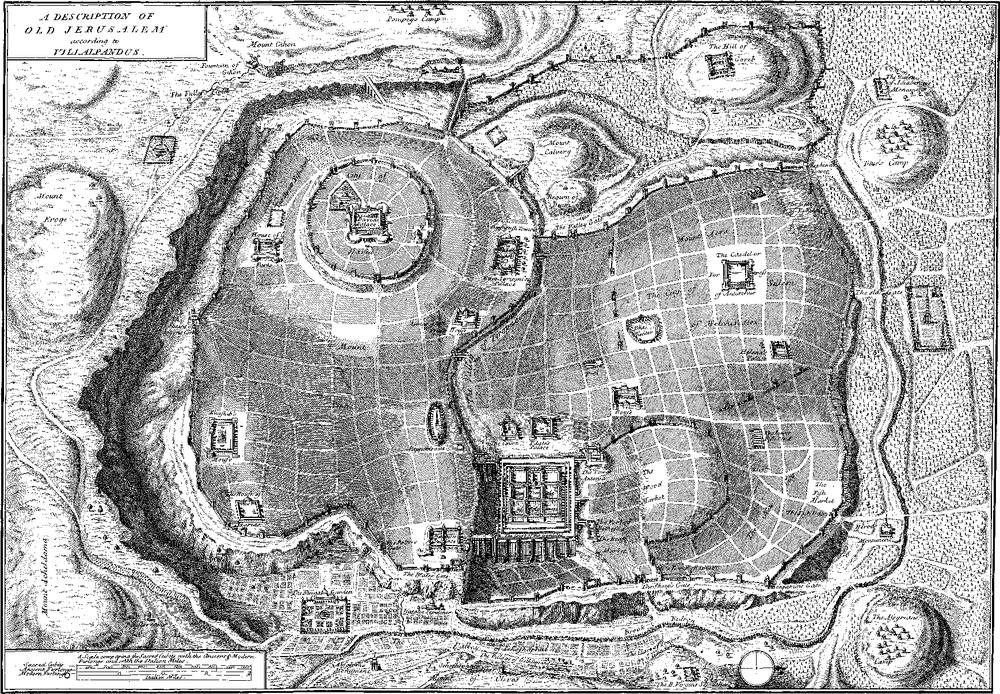
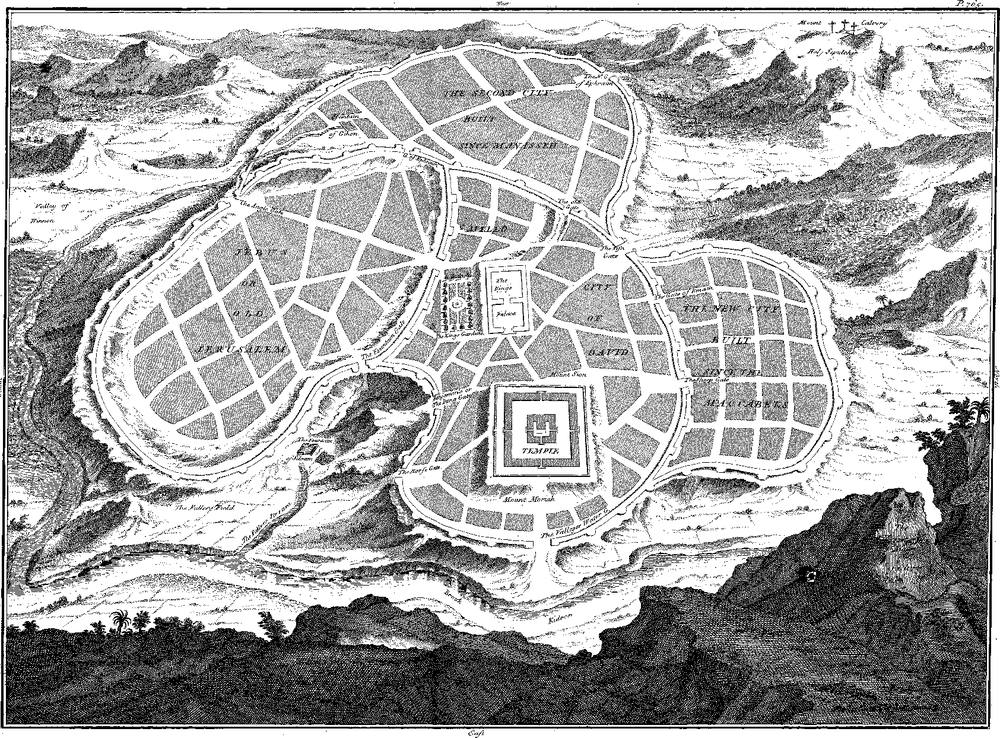
Josh. xviii. 18. to the Tribe of Benjamin. He took and put to death the King of Jerusalem in the famous battle of Gibeon; and there is all the probability that can be, Josh. x. 23, 40. xii. 10.that he did not leave this city alone in the midst of the country without reducing it, as he had done the rest. Notwithstanding, it must be confess’d, that it is no where said to have been taken by him. Nay, it appears from other passages, that the Jebusites continued in possession 2 Sam. v. 6, 7.of it till David’s time; and it is said expressly, that the children of Benjamin did Judg. i. 21.not drive the Jebusites out of Jerusalem.
On the other side, this City appears to have been within the division of the Tribe Josh. xv. 63.of Judah. It is said in Joshua, That the children of Judah could not drive out the Jebusites Judg. i. 8.the inhabitants of Jerusalem; and in the Book of Judges we read, that the children of Judah took and burnt Jerusalem. Lastly, David, who was of the Tribe of Judah, no sooner was acknowledged King by all Israel, but he marched against Jerusalem, and reduced it to his obedience, drove the Jebusites out of it, and made it the Seat of his Kingdom. In a word, the Ps. lxxviii. 68.Psalmist does very clearly make Jerusalem to be a part of Judah, when he says, that the Lord chose not Ephraim, but the Tribe of Judah and Mount Sion. In order to reconcile these different Texts, it may be said, that Jerusalem being upon the frontiers of the two Tribes, it is sometimes made a part of one, and sometimes of the other; that Benjamin had most right to it by Joshua’s division of the country, and Judah by right of conquest, having twice subdued it; first under the Judges, and afterwards under David.
After that the Lord had declared Jerusalem to be the place which he had See Joseph. de Bello Jud. l. 4. c. 6. & l. 3. c. 5.chosen for his Habitation, and for his Temple, it was looked upon as the Metropolis of the whole Nation, and belonging to all the Israelites in common. It did not therefore properly belong either to Benjamin or Judah.
The City of Jerusalem was built upon one or two Hills, and was encompassed all Ps. cxxiv. 2. Strabo, l. 16.round with Mountains. Montes in circuitu ejus. It was situated in a stony and barren soil, and was about sixty furlongs in length, according to Strabo. The territory and places adjacent to Jerusalem, were well watered, having the fountains of Gihon and Siloam, and the brook Kidron at the foot of its walls; and besides these, the waters of Ethan, which Pilate had convey’d through Aqueducts into the City. The ancient City Joseph. l.Bello.1. c. 15. de of Jerusalem or Jebus, which David took from the Jebusites, was not very large. It was seated upon a Mountain southward of the Temple. The opposite Mountain, situated to the north, is Sion, where David built a new City, which he called the City of David, wherein was the Royal Palace, and the Temple of the Lord. The Temple was built upon Mount Moriah, which was one of the little Hills belonging 1 Kings ix. 15, 24. xi. 27.to Mount Sion1.
Between these two Mountains lay the Valley of Millo, which formerly separated ancient Jebus from the City of David, but was afterwards filled up by David and Solomon, in order to join the two Cities. After the reign of Manasseh, there is mention made of a new City, called the Second, which was inclosed with walls by this Prince2. The Maccabees made still some farther additions to it, and considerably enlarged it on the north side3, by inclosing a third Hill, and making it part of Jerusalem. Josephus speaks again of a fourth Hill called Bezetha, which Agrippa joined to the City, and began to encompass with walls. This new City lay to the North of the Temple, along the Brook Kidron. Wherefore Jerusalem was at no time so large, as when it was attacked by the Romans. It was then three and thirty furlongs in circumference, which make four miles and an hundred and five and twenty paces, or a league and almost an half, at three miles to a league. Which is farther confirmed Joseph. de Bello, l. 6. c. 6.by what the same Josephus says, who informs us, that the wall of circumvallation, which Titus made about the City, was nine and thirty furlongs, which make four miles, eight hundred seventy five paces, or something more than a league and an half. Others describe it to be of a much larger extent. See Villalpandus for the affirmative, and M. Reland for the negative. Palæstin. t. 2. l. 3. p. 836, 837.
We shall not undertake to describe all the publick and private Edifices of this celebrated City. The old ones are almost intirely unknown to us: and those which Josephus speaks of, and describes to us, have little or no relation to the Bible, which we proposed principally to illustrate in this work. We shall give you a description of the Temple in the particular Article belonging to it: we shall speak likewise of the Synagogues in another place. The Plan, which we have given of Jerusalem, excuses us from repeating here many things, which may be seen, by casting an eye only on this description. The Gates, which we have mentioned, were not perhaps exactly in the place where we put them: but in matters of this nature, whether we will or no, something must be allowed for conjectures. I have spoken of the Fish-pool, which was in the Sheep-market, in its proper place, under Bethzaida or Bethesda. I have said something likewise of the fountains Siloam and Gihon.
It is an opinion generally entertain’d, that Melchisedek was King of Jerusalem; not but that there is some difficulty in this Hieron. Ep. ad Evangelum. Gen. xiv. 18.matter. St. Jerom thinks, that the City of Salem, whereof Melchisedek is said in Scripture to have been King, was a village near Scythopolis, where the ruins of this Prince’s Palace were still visible in his time; which were so extraordinary, as to shew sufficiently what formerly had been the magnificence of this Edifice. The Author of the Paschal Chronicle says likewise, that he saw the village where was formerly the Reland. Palæit. l. 3. p. 976, and 833.dwelling-place of Melchisedek. M. Reland, in like manner, will not believe that Melchisedek reigned at Salem. We chuse rather to follow the opinion of the generality of the Fathers and Interpreters, since there is nothing in it contrary to Scripture, which sometimes calls Jerusalem, Salem; since likewise they who are of the contrary opinion are not agreed concerning the situation of the City of Salem, which they affirm to have been the place of Melchisedek’s residence.
The Jebusites were masters of it during the time of Moses, Joshua, and the Judges, and till the beginning of David’s reign. It is the conjecture of some, that Joshua took it from them, as has been already observed by us. The children of Judah, after the death of Joshua, got possession of it4: but either they could not keep it, or they took only the lower Town, the Citadel continuing in the power of the Jebusites. And this is the first time that this City is said distinctly in the sacred Text to have been taken: the second time is set down at the beginning of David’s reign. No sooner did this Prince perceive himself to be well settled on the 2 Sam. v. 6.Throne of Israel, but he march’d against Jerusalem. The City was so strong, that the Jebusites, who were in possession of it, boasted that they would defend it only with the blind and lame. But David forced it, and drove out the Jebusites, and chose it to be the Capital of his Kingdom. From that In the year of the World 2956, before J. C. 1044, before the Vulgar Æra 1048.time Jerusalem became the theatre of many important actions; so that to write the History of this City, would be to undertake a recital of almost the whole sacred History.
David embelished and considerably augmented it: but Solomon added so many great and beautiful works, that he made it one of the finest Cities in the East. Under the reign of Rehoboam, the son and 1 Kings xiv. successor of Solomon, it was taken and pillaged 25, 26, 27. by Shishak King of Egypt. This Prince carried away all the treasures of In the year of the World 3033, before J. C. 967, before the Vulgar Æra 971. 2 Kings xii. 17. & 2 Chron. xxiv. 24, 25.the Temple and of the Royal Palace.
Hazael King of Syria being come against Jerusalem, and threatning to take it, Joash King of Judah redeemed the City with a great sum of money; which he sent to the King of Syria, in order to oblige him to raise the siege. To this end he made use of all the treasures of God’s house, and of the palace, that he might thereby be enabled to satisfy the avarice of Hazael, who notwithstanding, sent against him, the year following, an army, which defeated that of Judah, took several Princes, killed them, and left Joash himself languishing under violent diseases.
In the year of the World 3178, before J. C. 822, before the Vulgar Æra 826. 2 Kings xiv. 13. & 2 Chron. xxv. 23.Some time after, Joash King of Judah, having rashly declared war against Amaziah King of Israel, this last Prince defeated the army of Judah, took Joash prisoner; and entring Jerusalem, carried away all the treasures, which were in the Temple and the royal Palace, demolished four hundred cubits of the City-walls, from the gate of Ephraim to the Angle-gate, and then returned to Samaria.
Necho King of Egypt returning from his expedition against Carchemish on the Euphrates, entred Jerusalem, took Jehoahaz, whom the people of Judah had set upon the throne of Josiah, put Eliakim or Jehoiakim in his place, and carried Jehoahaz, into Egypt, where he died. We do not read in Scripture, that Necho pillaged the City or the Temple, but he imposed a Tax on all the land, of an hundred talents of silver, and ten talents of gold, which Jehoiakim was obliged to pay by levying a capitation or Tax upon all the people in proportion to their fortunes. It appears by Ezekiel, that Jehoahaz had attacked Necho, or at least had made a resolute resistance before he surrendred himself to him. Thy mother is a lioness, she lay down among lions, she nourished her whelps among lions. And she brought up one of her whelps, (meaning Jehoahaz) it became a young lion, and it learned to catch the prey, it devoured men. The nations also heard of him, he was taken in their pit, and they brought him with chains into the land of Egypt.
In the year of the World 3398, before J. C. 602, before the Vulgar Æra 606. 2 Kings xxiv. 1, &c. Dan. i. 1. Jer. xxv. 1. 2 Chron. xxxvi. 6.Nebuchadnezzar being come into Judæa b, in the fourth year of Jehoiakim the King of Judah’s reign c, laid siege to Jerusalem, which was then tributary to the Kings of Egypt; and having subjected it to the dominion of the Chaldæans, he left Jehoiakim there, whom he designed at first to carry with him in irons to Babylon. Thus the different passages wherein this event is spoken of, are reconciled; some whereof imply, that Jehoiakim was carried to Babylon, and others that he reigned at Jerusalem. He did reign there, but as a Prince depending on Nebuchadnezzar, as he reigned there before by the courtesy of the Kings of Egypt. At the end of In the year of the World 3400, or 3401, before J. C. 599, before the Vulgar Æra 603.three years, he grew weary of this submission, and took arms against Nebuchadnezzar. The King of Chaldæa being then busied in other affairs, could not so soon reduce Jehoiakim; he sent only some troops against him of the Chaldæans, Syrians, Moabites, and Ammonites, who ravaged Judæa, and carried three thousand and three and twenty Jews to Babylon. In the Jer. lii. 28.seventh year of Jehoiakim, of the World 3401; and four years after, of the World 3405, which was the eleventh year of Jehoiakim, they entred Jerusalem, took and put to death this Prince, and cast his body into a common sewer.
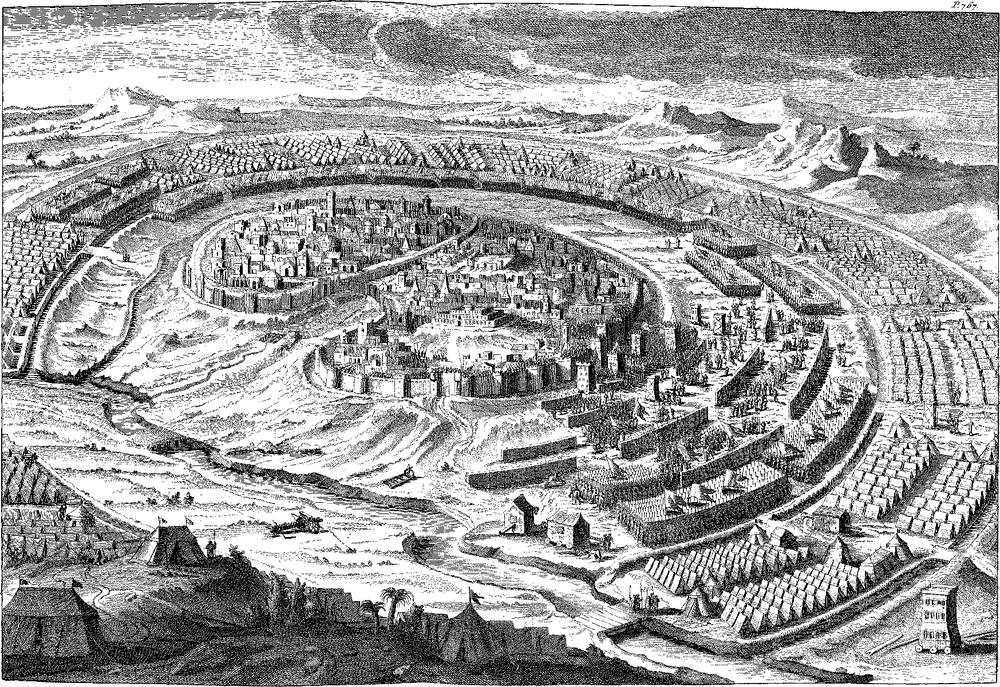
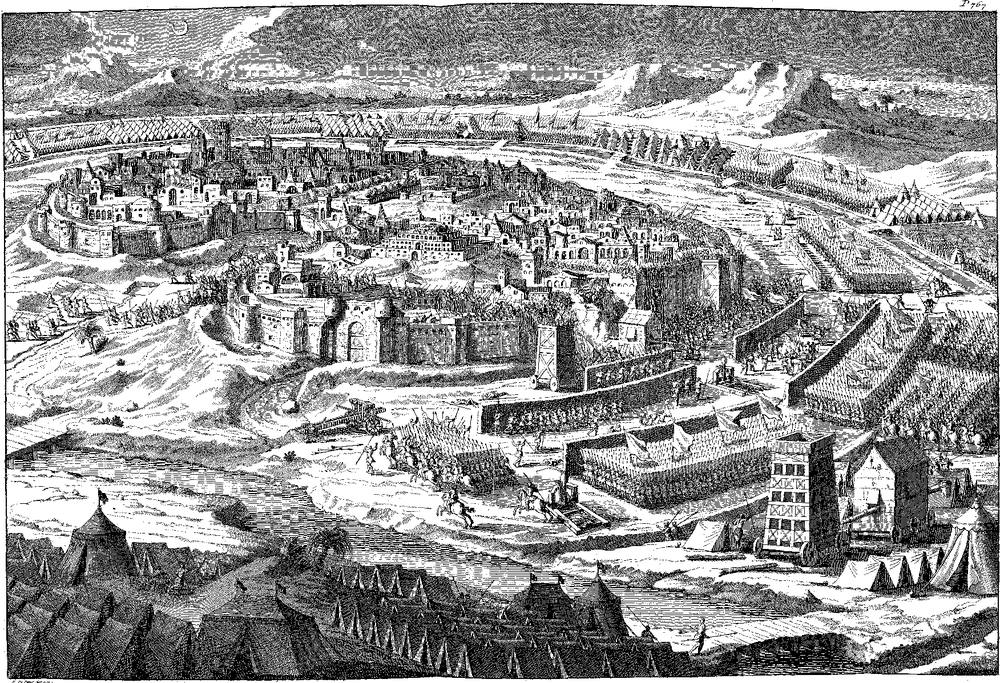
2 Kings xxiv. 2, 3, 4.Jehoiachin his son succeeded him; but after a reign of three months and ten days, Nebuchadnezzar coming to besiege Jerusalem, Jehoiachin was obliged to surrender; the city was again taken by the Chaldæans, and the treasures of the Temple and royal Palace carried to Babylon. Lastly, 2 Kings xxv. 10, &c.Nebuchadnezzar took Jerusalem the fourth and last time, in the year of the World 3416, before the Vulgar Æra 588, and in the eleventh year of Zedekiah.
Ezek. xvii. 15—18. Jer. xxxiv. 8, &c. In the year of the World 3412.The occasion of this war was as follows: Zedekiah, in the seventh year of his reign took secret measures with Hophrah or Apries King of Egypt, to shake off the yoke of the Chaldæans; and two years after he declared himself openly, and refused to pay tribute to Nebuchadnezzar. This Prince being quite tired with the infidelity and inconstancy of the Jews, resolved to exterminate this perfidious Nation, to destroy their Kingdom, and transport the Inhabitants thereof beyond the Euphrates. He came therefore with a powerful army against Jerusalem, and arrived in Judæa at the beginning of the year of the World 3414, which was a Sabbatical Year, wherein the King and people were to dismiss their Slaves, according to the Law of the Lord, which requires the Hebrew Slaves to be set at liberty every seven years: this was immediately executed, and the Slaves continued free as long as the King of Babylon was taken up with the investiture of the city. But the King of Egypt advancing with his army to succour Jerusalem, and Nebuchadnezzar breaking up the siege in order to repel him, the Jews took their Slaves again, without troubling themselves either about their word, or the Law of God. This is what Jeremiah reproaches them with in very strong terms, at the same time as he is threatning them with the greatest calamities. In the mean time Nebuchadnezzar gave the King of Egypt battle, and after he had overcome him, and put him to flight, return’d to the siege of Jerusalem, took it, burnt and destroy’d both the City and the Temple, and carried the Princes and the People away into captivity. So that we may reckon the City of Jerusalem to have been taken nine times before the Babylonish captivity.
Observations on the blockade and siege of Jerusalem by Nebuchadnezzar.☞ Of all the Cities most celebrated in antiquity, none is more famous than Jerusalem, as well for its magnificent buildings, as for the many sieges it has sustained. The last and most memorable is that which it maintain’d against Titus, at the head of 2 Kings xxv.his Romans, under the empire of Vespasian. All the most profound and wonderful effects of Art were put in practice at this siege; the courage and resistance of the besieged was nothing inferior to the skill, valour, and obstinacy of the besiegers. All the calamities which generally accompany long defences, fell upon this unhappy City, as Jeremiah Jerem. ix. Joseph. de Bello Jud. l. v. c. 13.had foretold; pestilence and famine were as destructive to it, as the fury of its enemies. In a word, this was the last effect of God’s wrath, which determined the fate and utter annihilation of this proud city, thus to punish the ingratitude and perfidiousness of the Jews. The description which Josephus has given us of it, is so admirable, and written with so much art, that there is no one, however understanding in the affairs of war, who could acquit himself with more capacity than he has done. But let us return to the siege of this City by Nebuchadnezzar, which at present we are to speak of.
The sacred Author, after his usual manner, is so far from giving us a particular and circumstantial account of this siege, that he passes over the most necessary circumstances. Those Readers who know nothing of what belongs to War, trouble themselves very little about it; but they who are perfectly acquainted with this art, are sensibly concerned to find no particular relation in Historians, of so many gallant actions as were then perform’d, whereof we have but a very imperfect sketch remaining. However, as the Scripture in certain places reports some circumstances and practices, which it omits in others; by adding every thing together, we may be led to the discovery of the Jewish method in the art of attacking and defending.
The situation of Jerusalem, the strength of its walls, and the resistance of the besieged, rendred this City almost impregnable, and consequently the sieges very long. Wherefore Nebuchadnezzar, upon his setting down before the Town, did not attempt to take it by assault, but was concontent to block it up at first, with two lines drawn round it; that is to say, with a circumvallation and contravallation. The King of Egypt having taken the field, in order to come speedily to the succour of the Joseph. Antiq. l. x. c. 10.place, Nebuchadnezzar march’d to meet him, defeated him, and put him to flight. This movement of the King of Babylon will not suffer us to doubt his drawing a line of contravallation against the sallies of the inhabitants, whom King Zedekiah commanded in person, and a line of circumvallation against the enemies without the City; for although the sacred Writer in the second verse says, That the city was shut up by the line of circumvallation till the eleventh year of King Zedekiah; this however is no declaration that but one line only was drawn: the words of the first verse prove sufficiently, that two lines were contrived, one against the City, the other against the Succours which were expected. Circumdederunt eam, & extruxerunt in circuitu ejus munitiones. They invironed the town, and made intrenchments quite round.
We see in this siege, as well as in many others mention’d in the Scripture, that lines of circumvallation and contravallation were known and practised by the Asiatick people, long before the Greeks and Romans, and that these were not the inventors of them. I believe it will not be unseasonable to produce here what I have said thereupon, in my Comment on Comment. sur Polyb. tom. 2. p.449,450.Polybius. The method of encompassing Towns with a Ditch and Intrenchment against the besieged, and another without towards the open country, with the camp between these two lines, was in use among the Asiatick nations, long before the Greeks and Romans, and perhaps many ages before Moses. When thou shalt besiege a city, says this great Legislator, and the siege shall be long, and thou shalt have encompassed it with machines in order to destroy it, thou shalt not cut down fruit-trees, nor ravage the country round about, by destroying all the trees with axes; because they are but wood, and not men, who might encrease the number of thine enemies. If they are only wild trees which produce no fruit, thou may’st cut them down to make machines of them, or fortifications against the city.
Comment. sur le Deut. c. xx. 19.The means and precautions following were made use of when Cities were extremely strong and well peopled; the enemy then blocked them up by a line or counter-line, with a ditch palissaded within, and sometimes enclosed with a parapet, the ground whereof was supported by a work with fascines. “ Such were properly the “ ditches, walls, palissades, and terrasses, “ with which the City was incompassed, “ in Hebrew called Matzur, says Dom Isai. xxix. 2, 3.“ Calmet; and all this could not be done “ without using the trees in the country.” What we are to admire in the works of this sort, is, that in the framing of them, they were altogether like those of the Greeks and Romans, excepting the Towers wherewith they were flanked. I do not observe any in the Hebrew camps, or in those of the several people they were at war with, before the siege of Jerusalem by Nebuchadnezzar.
There are so many passages in the sacred Writers, which plainly describe lines of circumvallation and contravallation, that to produce them all would be superfluous; we shall confine ourselves to what Isaiah only says of them: I will distress Ariel; I will camp against thee round about, and will lay siege against thee with a mount, and I will raise forts against thee. The Prophet speaks of these sorts of works, Idem. xxxvii. 33.as of something which was not new in his time: and elsewhere he promises King Hezekiah, that Sennacherib would not besiege Jerusalem, nor undertake any thing against it, and that it should not be encompassed with either intrenchments or terrasses: which signifies nothing more than that the King of Assyria should not invest it, nor surround it with a line of circumvallation.
The Prophet goes still farther; he distinguishes the line with which places are invironed, from terrasses; and I believe that these terrasses do not always signify high elevations of earth, which command the walls, or equal them almost in height, upon which towers were erected, or machines for throwing any thing, and where archers, slingers, and others employ’d in services of this nature, were placed: this is Dom Calmet’s opinion, and I think he is mistaken; they were only coverts round the borders of the ditch, like our trenches, where the slingers and archers were continually at work, secure against the defence made by the Town, while they annoy’d it every way. We see in several places of Scripture, that works of this kind were not only serviceable for such uses, but farther for a contravallation, to check and streighten the besieged.
It is very probable, that Nebuchadnezzar did not at first besiege the City in form, but only blocked it up, having intelligence, that the King of Egypt with his whole army was marching to the succour of the place: for he must have necessarily guarded his circumvallation, to prevent any relief from getting into the City, and have left a large body of troops to defend the works, capable of making head against the sallies of the besieged; which would have weakened him so much, that he could never have gone to meet the King of Egypt, who would not have failed to cut off his provisions, and attack him, while the besieged, with the King at the head of them, would have sallied out vigorously upon him: but he prevented all this. He marched out to meet the Egyptian army, and after he had defeated it, and put it to flight, he returned to Jerusalem, opened the siege in form, ordered all the machines to be set up against the walls, battered it for a long time, so that it being distressed by famine, and the breach made, all the men of war fled by night, by the way of the gate between two walls, which is by the King’s garden, (now the Chaldæans were against the city round about) and the King went the way toward the plain. The Chaldæans therefore entred the City through the breach, and made themselves masters of it after a siege of two years and an half, in the eleventh year of the reign of Zedekiah, on the ninth day of the fourth month, that is to say, on Jer. xxxix. 2.Wednesday the 27th of July, in the year of the World 3416.
Some will be surprized to see machines of every kind made use of in this siege, Towers, Battering-Rams, Balistæ and Catapultæ, which the Greeks made use of in their sieges; they were all known to the people of Asia, and no one can in the least doubt the King of Chaldæa’s making use of them at the siege of Jerusalem, since Ezekiel speaks of them so clearly in different Ezek. iv. 2. xxi. 22. Ibid. xxvi.places of his book, and particularly in his prophecy against Tyre: Nebuchadnezzar King of Babylon shall come with horses and chariots, with horsemen and numerous troops; he shall incompass thee on every side with intrenchments and terrasses; he shall lift up his buckler against thee; he shall set engines of war against thy walls, and with his axes he shall break down thy towers. Can any thing be more particular? No one therefore can question the Chaldæans putting in practice the method of covering themselves in their way from the camp to the batteries by parallels, which the French call blindeés, or something else equivalent to them: there was nothing more simple and easy; and I find it again practised in the last siege of Jerusalem by Titus.
Joseph. Antiq. l. x. c. 11.Josephus says, that the Chaldæans having entred the City about midnight, went up directly to the Temple, and that King Zedekiah and his people escaped in the dark, and fled through narrow passes into the Wilderness; but that the Chaldæans having got intelligence of them from deserters, set out by break of day in pursuit of them, and stop’d them in the plain of Jericho. Dio. l. 66. p. 747.The sacred Writer says almost the same thing: Zedekiah went the way toward the plain, and the army of the Chaldæans pursued after the King, and overtook him in the plains of Jericho, and all his army were scattered from him. The Rabbins affirm, that Zedekiah fled through a subterraneous way, which led from the palace belonging to the Kings of Judah to the plains of Jericho; they might be believed in this particular, if they did not add some extravagancies to it, after their usual manner. They say, that the King intending to make his escape by this subterraneous passage, God permitted a Hind to follow him without, and go as far above as he went under-ground, and that the Chaldæans pursuing after the Hind, found unexpectedly the King coming out of the covered way. As to the subterraneous passage, there is nothing incredible in it: the Scripture and Josephus make no mention of it; but Dio, who is cited by Dom Calmet, tells us, where he is speaking of the last siege of Jerusalem, “ That the “ Jews had subterraneous conveyances, “ which passing under the walls, opened “ at a great distance from thence into “ the plain.”
Having therefore taken the King, they brought him to the King of Babylon at Riblah, and they gave judgement upon him. This verse demonstrates to us, that Nebuchadnezzar observing the siege to draw out into length, resigned the conduct of it to his Generals, and that he was not at Jerusalem when it was taken, but at Riblah, which some believe to be Apamea in Syria, upon the Orontes.
After the Captivity of Babylon, Jerusalem was rebuilt and repeopled, in the year of the World 3468, before Jesus Christ 532, before the Vulgar Æra 536, which is the first year of Cyrus’s reign at Babylon. But the Walls and Gates belonging to it, were not rebuilt till after the return of Nehemiah, in the year of the World 3550, before the Vulgar Æra 454. Alexander the Great, after he had taken Tyre, entred Jerusalem, in the year of the World 3672, before Jesus Christ 328, before the Vulgar Æra 332.
After the death of this Prince5, Jerusalem remained in the power of the Kings of Egypt; and Ptolemy the Son of Lagus, took Jerusalem by stratagem6, if the accounts of Aristæus and Josephus are to be credited7, and carried into captivity about an hundred thousand men, whom he had taken in Judæa. The same Josephus8 says, that Ptolemy Euergetes King of Egypt, came likewise to Jerusalem, and there offered many sacrifices of thanksgiving. Lastly, Ptolemy Philopator, after the victory, which he had obtained over Antiochus the Great, near the City of Raphia, came to Jerusalem, went to the Temple, and there offered sacrifices: but the Priests hindred him from going into the Sanctuary, which so provoked him, that he resolved to put all the Jews to death who In the year of the World 2787, before J. C. 213, before the Vulgar Æra 217.were in Egypt; and this he had executed, had not God in a very miraculous manner protected his people, as is related at length in the third book of Maccabees.
Antiochus the Great having recovered Cœle-Syria and Judæa from the King of Egypt, came to Jerusalem, where he was very well received by the Jews, who furnished provisions for his Army and his Elephants, and assisted him to reduce the garrison, which Scopas had left in the citadel of Jerusalem. In acknowledgement for these good services, Antiochus omitted nothing that was necessary to re-establish Jerusalem in its former splendor; he granted large privileges to the Jews, and gave great sums for the Sacrifices of the Temple. Seleucus the son and successor of Antiochus the Great, was not so favourable to the Jews, as Antiochus had been. He sent Heliodorus to the Temple of Jerusalem9, to take from thence the treasures which belonged to it; but he was forced to return without doing any thing, after having been very ill handled by Angels, who appeared to him in the Temple.
Antiochus Epiphanes, brother and successor to Seleucus, came to Jerusalem10, and was received there by Jason, who had usurped the High-Priesthood, with great honours, with the light of flambeaus, and the loud acclamations of the people. At this time he did no mischief. But three years after, in the year of the World 3834, being informed that the inhabitants of Jerusalem had express’d some joy upon a false report that he was dead in Egypt, he conceived so much indignation against them, that at his return, he besieged the city, pillaged it, carried away all the gold, and most of the rich vessels belonging to the Temple, and killed above fourscore thousand men.
Two years after11, he sent one Apollonius to Jerusalem, the collector of his revenues, with secret orders to pillage and burn the city. This man in all appearance came at first with a peaceable spirit; but he fell suddenly upon the city, made a great slaughter in it, took a rich booty, set fire to the place, destroy’d most of the houses, and reserved so much only, as he ordered to be enclosed within walls at the upper end of the city, near the Temple of the Lord, where he built a Citadel, and left a strong garison. Jerusalem was then forsaken by its own inhabitants, and left in the hands of the Gentiles. In the year following, 3837, the Sacrifices were interrupted in the Temple, the statue of Jupiter Olympius was placed upon the Altar, and the abomination of desolation was seen in the House of God. Things continued in 1 Macc. i. 62.this condition for three years12. Judas Maccabæus having defeated Nicanor, Gorgias, and Lysias, went up to Jerusalem, purified 1 Macc.iv. 36, &c.the Temple, and restored the Sacrifices.
The year following, Antiochus Eupator was received by Judas Maccabæus in Jerusalem13, after the peace which had been concluded between them. This Prince honoured the Temple, and made presents to it. But before he left the city, he gave directions for pulling down the wall, which was between the Temple and the Citadel, and secured the Holy Place 1 Macc. vi. 2 Macc. xiii. 4 Macc. ii.from the attempts of the Syrians. This Citadel, which always kept Jerusalem depending on the Kings of Syria, stood six and twenty years, from the year of the World 3836 to 3862, when it was taken and demolished by Judas Maccabæus.
Antiochus Sidetes enraged at the great mischiefs which Simon Maccabæus had done him, made war with John Hircanus his son and successor. He came into Judæa, and after he had ravaged the open country, he compelled Hircanus to retreat to Jerusalem, where he besieged him; but he met with a vigorous resistance from the besieged, incamp’d at the distance of two furlongs, or two hundred and fifty paces from the Temple, towards the north part of the city, and erected an hundred and thirty Towers, upon which he placed a great number of soldiers, to drive away all those who defended the walls. And as they were carrying on the sap, they discovered the foundations of them to be laid on wood; Antiochus therefore set fire to it, which threw down a great part of the wall: but the besieged appeared upon the breach, and stop’d the effort of their enemies, who designed to get an entrance this way into the city. At the same time Hircanus made a vigorous sally on the besiegers, and compell’d Antiochus and his people to retreat to a good distance from the Town; after which, Hircanus returned, and burnt the Towers which had been erected by Antiochus.
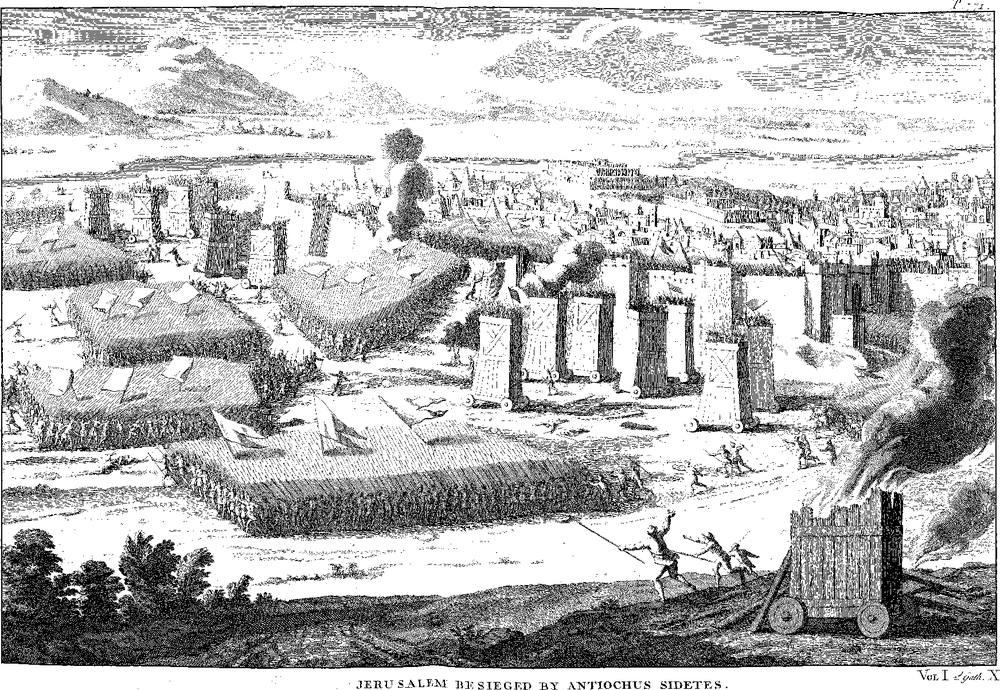
I am very much surprized at Polybius’s silence Observations on the siege of Jerusalem by Antiochus Sidetes.with regard to the Jews, and the several wars carried on against this nation by the Kings named Antiochus, and particularly by Antiochus Sidetes; for the Greek Author here named is very circumstantial in his account of the expeditions of these Princes; notwithstanding which, he makes no mention of the Maccabees, and says not a word of so many battles and memorable sieges: in short, one would think, that King Hircanus, and this famous siege of Jerusalem by Sidetes, whom Josephus calls Soter, were all imaginary. Livy is no better informed than Polybius; we find nothing of the Jews in other contemporary Authors, nor in any but such as wrote long after. What can we think or believe of this silence?
This siege of Jerusalem happened about the end of the year 3869. Josephus, who has described it, relates some particular circumstances, which we do not read in the fourth book of Maccabees. He says, ” That Antiochus divided his army ” into four bodies, in Antiq. l. 13. c. 16.order by this means ” to inclose the whole place ; that he was ” very much incommoded by the want of ” water, which inconveniency was remedied by plenty of rain;” that he made a double circumvallation, very great and very wide, to cut off all communication between those within and others without: that the besieged on their part made many sallies, with great loss to the besiegers, when they happen’d not to be upon their guard; and when they were, the others retreated easily into the city. He adds farther this particular: Hircanus observing, that the number of unserviceable mouths which were in the place, might occasion an unprofitable consumption of his provisions, forced them all out, and retained those only who were in the vigour of their age, and for that reason fit for war; but Antiochus prevented them from getting into the open country, and so they continued wandering up and down within the inclosure of the city-walls, where they miserably perished with hunger. In the mean time, the Feast of Tabernacles coming on, the besieged touched with compassion for their fellow-citizens, permitted them to return into the city, &c. It is with some regret that we find the sacred Historians do not give us the whole detail of these so famous sieges.
Sidetes doubtless marched with a great provision of Troops, warlike Machines, and all things necessary for a long Siege, which he had reason to expect from his remembrance of preceding ones; for this city always made a stout resistance, which was owing not only to the strength and height of its walls, but to the bravery likewise of the besieged.
Sidetes incamped in the north part of the city, and erected an hundred and thirty towers, upon which he posted soldiers to drive away all those who appeared upon the walls. And in the mean time, the miners were employ’d in sapping the foundations of the wall. Josephus mentions only an hundred towers with three stories, which were very sufficient, not to say too many. It is surprizing that he should take no notice of Rams, and that they should endeavour only to make a way by subterraneous passages even under the foundations of the city-walls: but to what purpose were all these Towers near each other, and upon the whole front of the attack, if they had no design of battering it above, as well as below, whither the besieged might have come, and made the undertaking useless and ineffectual? I very much question their proceeding in this way: for I do not consider near so much the great expence of these Towers, as the difficulty of finding wood to build them with, in a country which must have been very much unprovided with it: for it is rare to find any in Provinces ravaged with almost continual Wars. Besides, these Towers become useless, when people intend to reduce a Town by subterraneous Galleries under the foundations of the ramparts, where too a prodigious quantity of Timber is necessary.
The Walls of Jerusalem were very strong and high, as the Author of the Maccabees informs us: and Josephus, who has given us a very exact description of them, makes them to be of a very surprizing height. The Archers posted in these Towers, which ran upon Wheels, prevented certainly any one’s appearing on the Fortifications; but to what purpose was this precaution, since they made their way only by subterraneous passages to the foundations of the City-walls? Was it with a design of hindering those, when the walls should fall, who were upon the fortifications, from incommoding their enemies who should go upon the Assault? This was too inconsiderable for so great a provision of Towers. For my part, I am of opinion, that Battering-Rams, and all the Machines in use at this time, were employ’d; and we must believe, that Antiochus took as much pains to destroy the walls above, as under ground.
The besiegers shortened mightily their work of sapping; for they found the City-walls built on Piles, so that they had nothing to do but to remove the earth from between the Piles, and fill the void places with combustible matter, and fascines, which they set on fire, and so made a large breach, by thus overthrowing the wall. Afterwards Antiochus storm’d the City with great fury, but the besieged defended themselves with so much bravery and vigour, that the besiegers were repulsed with dishonour : And at the same time, Hircanus sallying out upon the enemy, killed abundance of them, and obliged Antiochus and his people to retire to a good distance from the city. This sally must have been very fierce and bloody, since Antiochus’s troops were forced to draw off farther from the place, and without doubt abandon their intrenchments; nevertheless Hircanus did not think it proper to engage himself farther, but prudently returned, and was content with setting fire to all the Towers above mentioned, and reducing them to ashes. It appears by the sequel of the story, that Antiochus was charm’d with the gallant resistance of the Jews, and that he could not forbear having a particular esteem for Hircanus: For the Feast of Tabernacles coming on, Hircanus sent to desire a suspension of arms till after the solemnity, (that is to say, for eight days ;) which the King granted, and sent even Sacrifices to the Temple, and Presents in gold and silver; and the High-Priest commanded the Priests to receive what the King sent; the liberality and piety of Antiochus engaged Hircanus and his people to sue to him for peace: the King consented, and entred the city. Hircanus received him there, together with the principal Officers of his army, and gave them a great entertainment.
Antiochus got clear of this affair like a man of capacity, and more gloriously than he had reason to expect; his generosity engaged the High-Priest to desire peace of him, and altho’ it was not very honourable to the Jews, the consequence shewed, that it conduced much to their greatness and elevation.
This peace may be reckoned among the most uncommon ones, for it lasted not only during the whole reign of Antiochus, but long after the death of this Prince, who perished unhappily in a war which he was carrying on against the Parthians. And Hircanus, who followed him as his friend, took the opportunity of his death to make himself master of several good places; he recovered all the Towns which had belonged to the Jews, subdued the Idumæans, received all his neighbours under his protection, who promised him to live in peace, and in obedience to him: lastly, he renewed the ancient alliance, which 1 Macc. viii. 17. xii. 1.had been contracted by Judas Maccabæus, and confirmed by Jonathan, between the Jews and Romans.
The City of Jerusalem enjoy’d great peace till the reign of Hircanus and Aristobulus, the Sons of Alexander King of the Jews. Hircanus, as eldest, had been acknowledged King; but as his stupidity In the year of the World 3938, before J. C. 62, before the Vulgar Æra 66. Joseph. Antiq. l. 14. c. 1. In the year of the World 3940, before J. C. 60, before the Vulgar Æra 64. Joseph. Antiq. l. 14. c. 8. & de Bello, l. 1. c. 5. Joseph. Antiq. l. 14. c.17. Antiq. l. 19. c. 7.and laziness rendred him very unfit to reign, Aristobulus his brother made himself master of the Kingdom, and three years after Hircanus had been upon the Throne, he obliged him to relinquish it, having overcome him in a battle near Jericho, and forced him in the Temple. Aretas King of the Arabians, having undertaken to restore Hircanus to his Dominions, and besieging Aristobulus in Jerusalem, the two brothers addressed themselves to Pompey, who was in the East, desiring his Protection. Pompey undertook to re-establish Hircanus on the Throne, to the exclusion of Aristobulus; he attacked Jerusalem, took it, entred the Temple, and went even into the Sanctuary ; but he had so much moderation as to touch nothing that was in this Holy Place. He left great Treasures there, and above all admir’d the fondness which the Priests shew’d for their Ceremonies, which neither the Alarms of the siege, nor the Conqueror’s sword, could induce them to interrupt. The day after the Temple was taken, he commanded it to be purified, and Sacrifices to be offered in it.
But some years after, Julius Cæsar, at the request of Hircanus, and in consideration of the services which he had perform’d for him in Egypt, permitted him to rebuild the walls. The Decree to this purpose was prepared at Rome, and no sooner was it brought to Jerusalem, but Antigonus set people to work in the repair of it, and it became very soon as strong as it had been before. As the City was still considerably inlarged afterwards, King Agrippa undertook to enclose the new Town with walls ; but Narsus, Præfect of Syria, having given intelligence of it to the Emperor Claudius, the Emperor forbad him to proceed any farther. Josephus says, that if he had been suffered to go on, he had made the Walls so high and so strong, that no Tacit. Hist. l. v. c. 12. Vitruv. l. 1. c. 2. Veger. de Re Mil. l. 4. c. 2.human power could have forced them. Tacitus remarks, that when Titus besieged it, it included two great Hills fortify’d with very strong Walls, which were not drawn in a strait Line, but with Angles in and out, and Towers; that when the enemy attack’d them, he might lie open on the sides, and be obliged to expose his flanks to the besieged. Duos colles immensum editos claudebant muri per artem obliqui, ac introrsum sinuati ut latera oppugnantium ad ictus patescerent. This was the good and ancient way of fortifying places, according to Vitruvius and Vegetius.
Antigonus the Son of Aristobulus, supported by the assistance of the Parthians, some years after14 attacked his Uncle Hircanus in Jerusalem. Herod and Phasael defended the City: but Hircanus and Phasael departing thence, in order to go and treat with Pacorus the King of Parthia’s son, they were both seized and loaded with fetters. Herod was forced to leave the City, and save Antiq. l. 14. c 24, 25. & de Bello, l. 1. c. 11.himself by flight. He went to Rome, where, by the credit of Mark Antony and Cæsar, he procured the Title of King from the Senate. He returned therefore to Palestine15, and with the assistance of Sosius, who commanded the Roman army in Syria, he besieged Antigonus in Jerusalem. After a siege of five months, In the year of the World 3966, and 3967.Antigonus surrender’d, and threw himself at Sosius’s feet, who insulted him in his misfortune, by calling him Antigona, to reproach him with his weakness and cowardice. Archelaus, the Son and Successor of Herod the Great, being sent into exile, Antiq. l. 14. c. ult.Judæa was soon after reduced into a Province, under the obedience of the Governour of Syria. The Roman Emperors always kept a garrison in the Citadel Antonia, till the last rebellion of the Jews, which began by their besieging this fortress, wherein they forced the Roman garrison, and put it to the sword16. The year In the year of the World 4069, of J. C. 69, of the Vulgar Æra 65.following, of Jesus Christ 70, Titus laid siege to the City, carried it, burnt and reduced it to a wilderness.
Joseph. de Bello Jud. l. 7. c. 18.Josephus remarks, that Titus, after he had taken the City of Jerusalem, commanded his soldiers to demolish it intirely, excepting three Towers, which were the largest and most beautiful; these he was desirous to reserve as a monument of the valour of the Romans, who were able to take a place of such great strength. The Towers thus preserved were those of Phasaël, Hippicus, and Mariamne. He likewise ordered the wall to be left standing, which inclosed the City on the West-side, that it might serve as a rampart to the Camp there appointed to remain, with Troops to guard the country. All the rest of the City was destroy’d and levell’d, so that they who had never before seen it, could scarce persuade themselves that it had ever been inhabited.
The Jewish Authors assure us, that Turnus Rufus, or rather Terentius Rufus, whom Titus left there to command the Troops, plowed up the Joseph. de Bello Jud. l. 7. c. 20.ground on which the Temple stood, that none might ever after be permitted to rebuild it. The Roman Laws indeed prohibited the rebuilding places, where this Ceremony had been perform’d, without first obtaining permission from the Senate. But it is believed, that this did not happen, that is to say, that the ground on which the Temple stood was not plowed up till after the revolt of the Jews under Adrian. Some are of Hieron. in Zach. c. viii.opinion, that Jerusalem was Epiphan.not destroy’d in such a manner, but that still some inhabitants remain’d there, whether they dwelt amidst the ruins, with the Roman Troops, or near them, or whether they provided dwellings for themselves somewhere thereabouts.
St. Epiphanius affirms, that the house whither the Apostles retired after the ascension of the Son of God, and in which they received the Holy Ghost, was preserved, together with seven Synagogues, which were likewise on Mount Sion, and in the neighbourhood of this house. Besides, we know the names of the several Bishops taken from the Synagogue, who governed the Church of Jerusalem from Jesus Christ to Adrian’s time, when a Bishop was placed there, chosen from among the Gentiles.
Eusеb. l. 6. de demonstrat. Evang.Eusebius goes still farther than Epiphanius; for he will have it, that Titus preserved half the City, agreeably to the Prediction of the Prophet Zachary17, who had foretold, that one portion of the City should be left standing, and that the whole should not be razed to the very foundations till the time of Adrian. Lastly, St. Jerom maintains, that Mount Moriah, where the Temple Hieron. & Cyril. in Zach. xiv.stood, and Sion, where the Palace was, were left intire by Titus. All which is founded only upon what Josephus says, of Titus’s leaving that part of the wall standing, which enclosed Jerusalem on the West-side, which has been interpreted to include half the City; and that besides, he suffered not the Towers of Phasael, Hippicus, and Mariamne to be touched, which were thought to be in the upper part of the City: it is farther presumed, and that with reason, that the tenth Legion, which was appointed to remain in the Town, did not continue there alone; that the people who composed it, took care to preserve some houses for their own lodgings, and permitted some families of the Jews to dwell there for the service of the Troops.
The Rabbins pretend that God wrought continual miracles in the Temple and City of Jerusalem. 1. No woman ever miscarried by smelling the meats sacrificed in the Temple, or by eating to excess of them. 2. Flesh placed upon the Altar never corrupted, tho’ it were left there several days without consuming it by the fire; which sometimes happened, when the quantity of the Victims was too great. 3. It so fell out, that the High-Priest never contracted any pollution the night before the great Day of Expiation. 4. The Rain never extinguished the fire of the Altar. 5. The Wind did not hinder the smoke from rising like a pillar towards heaven. 6. There never was any defect or putrifaction discovered in the Manna which was preserved in the gold Omer, or in the Shew-bread. 7. The Israelites never found that they were too much crouded in the Court of the Temple, let the Assembly there be ever so numerous. 8. No one ever failed to get a lodging at Jerusalem, where he might lie. 9. Jerusalem never ceased to be holy after its Consecration by Solomon: nothing that happened to it from that time was ever capable of profaning it.
They affirm farther, that this City was common to all the Tribes, and belonged to no one in particular, and that it was not subject to the Law, which required all murder committed within the confines of any Tribe to be expiated by the Sacrifice of a young Heifer. No house there belonged to him who had bought it as his property. None were allowed to have gardens or orchards within the compass of the city; and when dead bodies were removed from one place to another, they were not permitted to be carried through the city, lest they should pollute it. There were but two Sepulchres in the city, that of David, and that of Huldah, which had been built by the old Prophets. These remarks are all taken from the Rabbins, whose exactness is not always unexceptionable.
In the beginning, and when the Jebusites were in possession of it, Jerusalem was very small; it was afterwards inlarged by piecemeal. I shall here lay before you an account taken from the Jewish Doctors of what was observed in these circumstances of inlarging Talmud. Halacah. Beith. Habberhira, c. 10. Psal. xxx. 1.any city. The Great Sanhedrim, the King, and some Prophet hereupon consulted the Urim and Thummim. After they were agreed in the meaning of the Oracle, the Counsellors of the Sanhedrim pronounced two Hymns, containing a thanksgiving to the Lord. This done, they took two loaves of leavened bread, and going out that instant amidst people playing upon cymbals, the harp and psaltery, they stop’d at each corner of the street, and at every publick building in their way, and pronounced these words, I will praise thee, O God, for thou hast lifted me up. Being come at last to the place, as far as which the city was to be inlarged, the procession stop’d; and of the two loaves which were brought, one was eat, the other was burnt.
The Eastern People, as well as the ancient Jews, call Jerusalem the Holy City, and sometimes the Holy House, by reason of the Temple which was built there. They give it the name likewise of Ilia, which is a corruption of Ælia, the name it bore by the Emperor Adrian’s order, when he rebuilt it. They affirm Jerusalem to have Ps. lxxiii. 1.been built by Melchisedech the Son of Shem, who removed thither the body of Adam, which had been kept by Noah in the Ark. They also maintain, that it is situated in the Centre of the whole habitable Earth, according to this expression of the Psalmist, Thou hast wrought Salvation in the midst of the Earth.
Mahomet, in the first years of his Sect’s appearing in the World, commanded all Mussulmen at their Devotions, to turn towards Jerusalem; and after his death, the generality of his companions were for burying him within the inclosure of this city. They believe, that the stone which Jacob anointed in his way to Mesopotamia was removed to Jerusalem, and placed on the Mountain where Solomon’s Temple was built. After the ruin of this Temple, the Christians built a magnificent Church in the same place; and the Turks at last becoming masters of the city, Omar, one of their Caliphs, built a Mosque near the same stone, which of all the places of Devotion frequented by them, next to those of Mecca and Medina, is that whereunto they principally go in pilgrimage; and their pilgrimages to Mecca having been interrupted by the incursions of the Carmates from the year 317 to 339 of the Hegira, the Mussulmen went to Jerusalem, and there perform’d their Devotions.
The Cadhi Gemaliddin, Son of Vustel, writes, that passing through Jerusalem in his way to Egypt, he saw the Christian Priests carrying glass-bottles full of wine, and placing them on the Sakra, that is to say, on Jacob’s stone, near unto which the Mussulmen have built a Temple.
This is a Series of the most remarkable Events which have befallen the city of Jerusalem, from Moses to its intire destruction by the Romans. It is not our design to carry on our Remarks any farther, since we confine ourselves to what concerns the Bible, and the History of the Old and New Testament.
We have in another place given a Catalogue of the Kings of Judah, and the other Princes who reign’d at Jerusalem, as far as Archelaus. We have also drawn up a Chronological List of the High-Priests of the Jews. As to the Bishops of the Christian Church of Jerusalem, the first who governed it after Jesus Christ, was St. James the Younger, surnamed the brother of our Lord, of whom we have spoken under his particular Title. He was chosen in all probability immediately after the Ascension. He was put to death by the intrigues of Ananus, the Son of Annas, who is mentioned in the Gospel. His martyrdom happened in the year of Jesus Christ 62. He was succeeded by Simeon, a Relation likewise, or Cousin of our Saviour, and, according to some Historians, brother to St. James his predecessor. Simeon suffered martyrdom under Trajan, about the year of Jesus Christ 107. See the word SIMEON. The sequel of his successors has no relation to our subject.
Read this article in its place on the printed pages
Footnotes
-
See Psal. xlviii. 2. Isai. xiv. 13. and 2 Sam. v. 7, 9. and 1 Chron. xi. 5. and 1 Kings viii. 1. and 2 Chron. v. 2. Ezek. xl. 2. ↩
-
2 Chron. xxiv. 22. xxxiii. 14. and 2 Kings xxii. 24. ↩
-
Joseph. de Bello, l. 5. c. 6. p. 912, 913. ↩
-
Judg. i. 8. Now the children of Judah had fought against Jerusalem, and had taken it, and smitten it with the edge of the sword, and set the city on fire. ↩
-
The death of Alexander happened in the year of the World 3681, before Jesus Christ 319, before the Vulgar Æra 323. ↩
-
In the year of the World 3684, before Jesus Christ 316, before the Vulgar Æra 320. ↩
-
Antiq. l. 12. c. 1, 2. ↩
-
Joseph. l. 2. contra Appion. p. 1064. In the year of the World 3758, before Jesus Christ 342, before the Vulgar Æra 346. ↩
-
In the year of the World 3828, before Jesus Christ 172, before the Vulgar Æra 176. ↩
-
In the year of the World 3831, before Jesus Christ 169, before the Vulgar Æra 173. ↩
-
In the year of the World 3836, before Jesus Christ 164, before the Vulgar Æra 168. ↩
-
Till the year of the World 3840, before Jesus Christ 160, before the Vulgar Æra 164. ↩
-
In the year of the World 3841, before Jesus Christ 159, before the Vulgar Æra 163. ↩
-
In the year of the World 3964, before Jesus Christ 36, before the Vulgar Æra 40. ↩
-
In the year of the World 3965, before Jesus Christ 35, before the Vulgar Æra 39. ↩
-
De Bello, l. 2. c. λα. λβ. p. 810, 811, 812. ↩
-
Zach. xiv. 2. Half of the city shall go forth into captivity, and the residue of the people shall not be cut off from the city. ↩