On the Sciographic (Shadow-Drawing) Exposition — The Twelfth Method
The Sciographic — that is, the Shadow-drawing and Pictorial exposition 1 — is that which, by various delineations of figures and images, sets before the eyes more clearly and more openly those things which could not be very openly expressed in words; devised by the sacred expositors not so much for the sake of ornament and beauty as by reason of necessity. For, as in the Mathematical disciplines there are held almost innumerable things which, without the drawing-out of lines and figures, can neither be taught nor learned, so there are very many things in the sacred letters 2 which cannot be conceived by thought unless the images of the things themselves, expressed by shadows or by pictures, are beheld by the gaze of the eyes: such as are the form and figure of the Ark built by Noah; the structure of the Mosaic tabernacle; the disposition of Solomon’s temple; the composition of the temple and city described by Ezekiel, and the fitting-together of its wheels; the Geographic description of the Holy Land, or of all Palestine; the ornament of the priestly vestments — which, without the aid of pictures and the addition of certain brief annotations beneath the pictures themselves, can scarcely and with difficulty be understood. But on the contrary, when pictures are employed, we attain much more by a single intuition than by long and numerous reading of commentaries; for what is gathered by the eyes is apprehended far more distinctly by the mind, and retained more tenaciously in the memory, than what is perceived by the ears alone. 3 Whence God himself, when he had put forth the prophecy which the prophet Ezekiel had uttered concerning the future siege of the Holy City, wishing it to be more openly explained and more deeply engraved in the minds of the Jews, commands the Prophet that, upon a brick-tile or abacus, he should delineate by Geometric art the σκιογραφίαν [skiographian], or shadowy picture, of the several parts of the prophecy — the form of the besieged city being sketched, together with valleys, ramparts, battering-rams, engines, and hostile camps, and the other things necessary for the siege and assault of cities — so that from the aspect of that picture the Jewish people might more surely and exactly recognize, as it were part by part, the harms foretold to it. 4
They have given us, in this kind of exposition, most praiseworthy Works: Eusebius, chiefly the bishop of Caesarea, who first depicted the topography of the whole Holy Land, a brief declaration of the same picture being added; 5 Jerome, who expressed the habit and shape of the entire Pontifical vestment with an elegant delineation; 6 Richard Victorinus [Richard of St. Victor], who designed the architecture of Ezekiel’s temple in tables by Geometric methods; 7 Cassiodorus Senator, whose picture of the old tabernacle is most celebrated; Bede the Presbyter, who wrought out the schemata of the Mosaic Tabernacle and of the temple of Solomon’s work with the greatest art and fidelity; 8 Al‑
…Albrecht Dürer, who also first demonstrated with the brush the form of the Tower of Babylon, and how many thousands of men could conveniently dwell in it; Johannes Buteo, who demonstrated the type of Noah’s Ark by Mathematical skill; and, besides these, very many others, enumerated by us in the book On the Catholic Expositors of Divine Scripture. 9 Of this [kind of] exposition we display to you an example, in a picture of the Pontifical vestment 10 which the supreme Priest of the Hebrews once used — a succinct declaration being appended from Philo and Josephus, from the fifth book of the Stromata of Clement, and from Jerome — which declares, by the marks of numeral-characters, the several parts and ornaments of that vestment.
The Attire of the Aaronic Pontiff
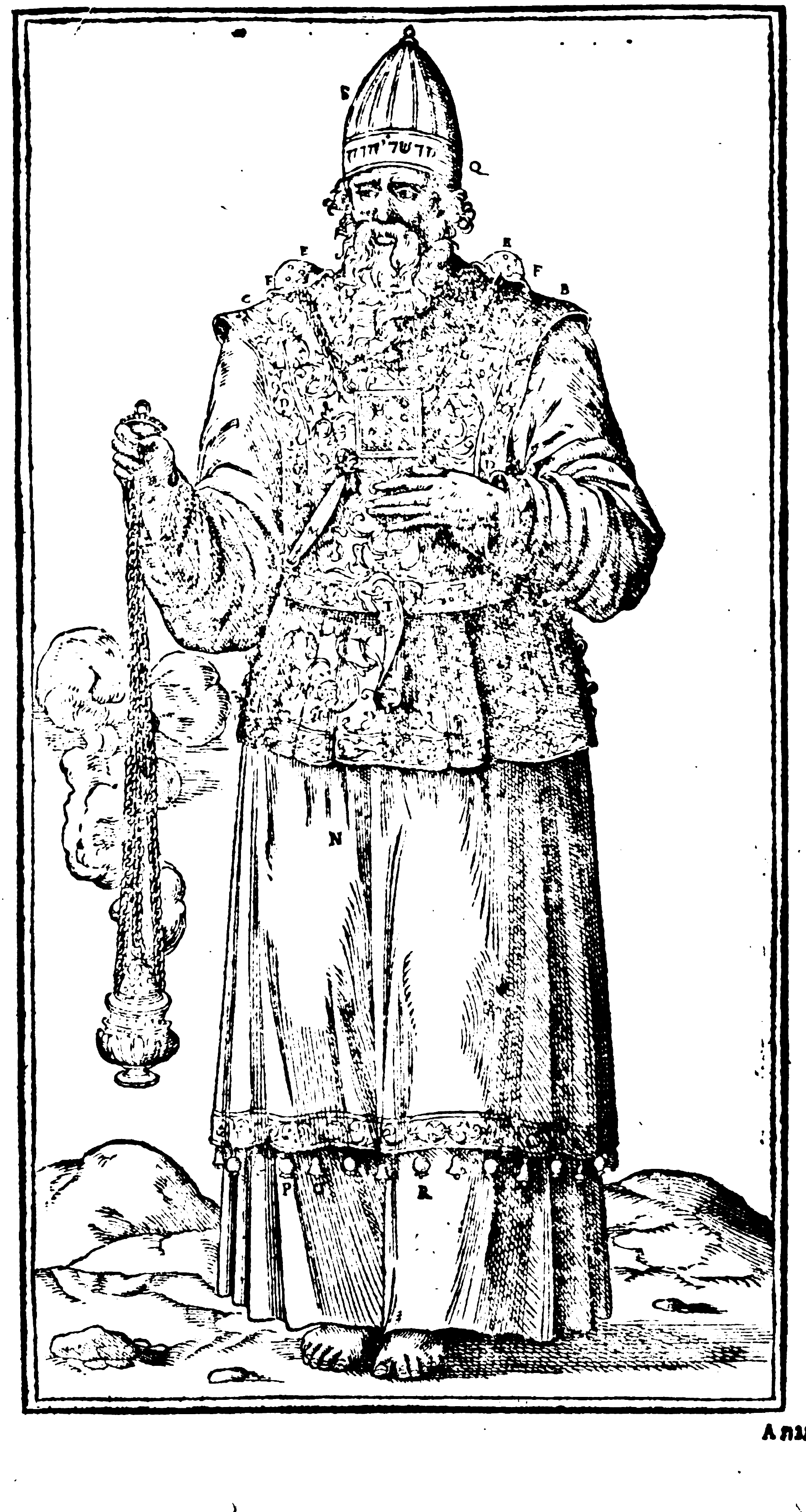
[The lettered declaration of the vestment continues → p182]
P. בכתנת Kethoneth — that is, the linen Tunic, or the inner Linen shift; in Greek ποδήρης [podērēs], that is, ankle-length. This clings to the body, and is so tight, with narrow sleeves, that there is scarcely any wrinkle in it, especially from the upper part; and it descends down to the legs and ankles.
R. מעיל Meil — a hyacinth-colored ankle-length tunic of the same color, with narrow sleeves; in the upper part, where it is drawn on around the neck, open as far as the middle of the breast; at its extreme and lowest hem — that is, at the feet — having a border distinguished, by wondrous art, with purple, scarlet, and golden flowers as well as gems; from which hang seventy-two golden bells and as many golden pomegranates, so arranged that between each pair of bells there is one pomegranate, and between two pomegranates one bell — so that, when the Pontiff enters into the Holy of Holies, he may go forth wholly vocal, sonorous, and most to be revered by the people.
C. אפד Ephod — which the Septuagint interpreter [renders] ἐπωμίδα [epōmida], Aquila ἐπίγραμμα [epigramma]; we may call it the Superhumerale (shoulder-piece), because it is laid over both shoulders. It is an elegant little sleeveless cloak, woven of hyacinth, scarlet, purple, and gold, after the manner of a monastic scapular without a cowl; it has two shoulder-pieces — that is, it consists of two equal parts, of which one covers the back, the other the breast down to the navel; in which, around the middle of the breast, a certain empty hollow (lacuna) is left for the reception of the Rational.
E. שהם Shoham — which the Septuagint translated “emeralds” (Smaragdos), Josephus “sardonyxes.” They are two gems enclosed in gold, of such magnitude that on each of them the names of six Patriarchs are contained, engraved; which, in place of clasps, join the shoulder-pieces on both sides around the neck.
T. אבנט Abnet, in Chaldaic המיינא Hemyana — is a girdle, or a broad belt (Zone) four fingers wide, empty within, so woven that it might seem the slough of a serpent putting off its old age, or the intestine of some oblong animal; consisting of a byssine (linen) thread, interwoven with flowers and gems of scarlet, purple, hyacinth, and gold; which, once and again around the breast, binds the ephod and the tunics, and flows down to the ankles. Wherefore Vatablus and Castalio err, 11 who in their scholiastic annotations painted this Zone in the likeness of a short and broad strap descending from the breast down to the navel, according to the measure of the Ephod; for the aforesaid description of Philo refutes them.
D. חשן Choshen, in Greek λόγιον [logion] — we may name it the Rationale (breastplate). It is a cloth of a palm’s breadth square, variegated with gold and the same colors as the Ephod, so that it fills up exactly the square hollow left before the breast; to which are inwoven and bound with gold twelve gems of diverse kinds, incomparable in magnitude, beauty, and price, distinguished into four rows, so that in each little row three stones are placed, and on each stone one of the names of the tribes is engraved.
M. טבעות זהב Tabbaoth Zahav — are four golden rings, one at each of the four corners of the Rational, having opposite to themselves — on the edge of the hinder shoulder-piece, under the armpits — four other rings, by which the Ephod is fastened with intervening hyacinthine ribbons.
G. שרשרת זהב Sharsheroth Zahav — are golden chains, which, fastened by golden rings to the two upper corners of the Ephod that look toward the neck, were coupled in the upper part with the settings of the sardonyxes, lest the magnitude and weight of the stones should break the hyacinthine ribbons.
Q. מצנפת Mitznepheth — which the Greeks [call] τιάραν [tiaran]; some call it a Cap (Galerum), others an Infula, having the figure of a linen half-sphere little cap, and having no peak at the top, common to all the priests. Upon it is set another, somewhat higher, hyacinthine little cap, which the author of the book of Ecclesiasticus, and Solomon in the book of Wisdom, call a Mitre and a Diadem. 12 A golden crown surrounds this with a triple row; in the hinder part of which little golden cups, very like the flowers of henbane, are seen; but in the front part, which overhangs the forehead, the holy Name of God — which by the Jews is reckoned ineffable — is incised with four Hebrew letters, namely י Iod, ה He, ו Vau, ה He.
Footnotes
-
What the Sciographic exposition is. ↩
-
In the Scriptures there are many things which cannot be conceived by thought, unless their images, expressed by shadows or pictures, are beheld by the gaze of the eyes. ↩
-
More distinctly is it apprehended by the mind, and more tenaciously retained in memory, what is beheld by the eyes than what is perceived by the ears alone. ↩
-
Ezekiel 4. ↩
-
Eusebius of Caesarea first depicted the topography of the Holy Land. ↩
-
Jerome depicted the habit of the pontifical vestment. ↩
-
Richard Victorinus designed the structure of Ezekiel’s temple in tables. ↩
-
Bede handed down the schemata of the Mosaic tabernacle and of Solomon’s temple. ↩
-
Albrecht Dürer [depicted] the form of the Tower of Babylon, and Johannes Buteo the form of Noah’s Ark. ↩
-
We exhibit an example in the picture of the Pontifical vestment. ↩
-
The error of Vatablus and Castalio, heretics. ↩
-
Wisdom 18:24; Ecclesiasticus 45:14. ↩