Works › The Book on the Sacrifice of the Mass
Volume 38 · pp. 129–131
Tractate III, Chapter XV
A marker with ≈ is an approximate page boundary, placed by measure of the text; the page photographs remain the authority. In the paired views, clicking a page marker brings that page into view.
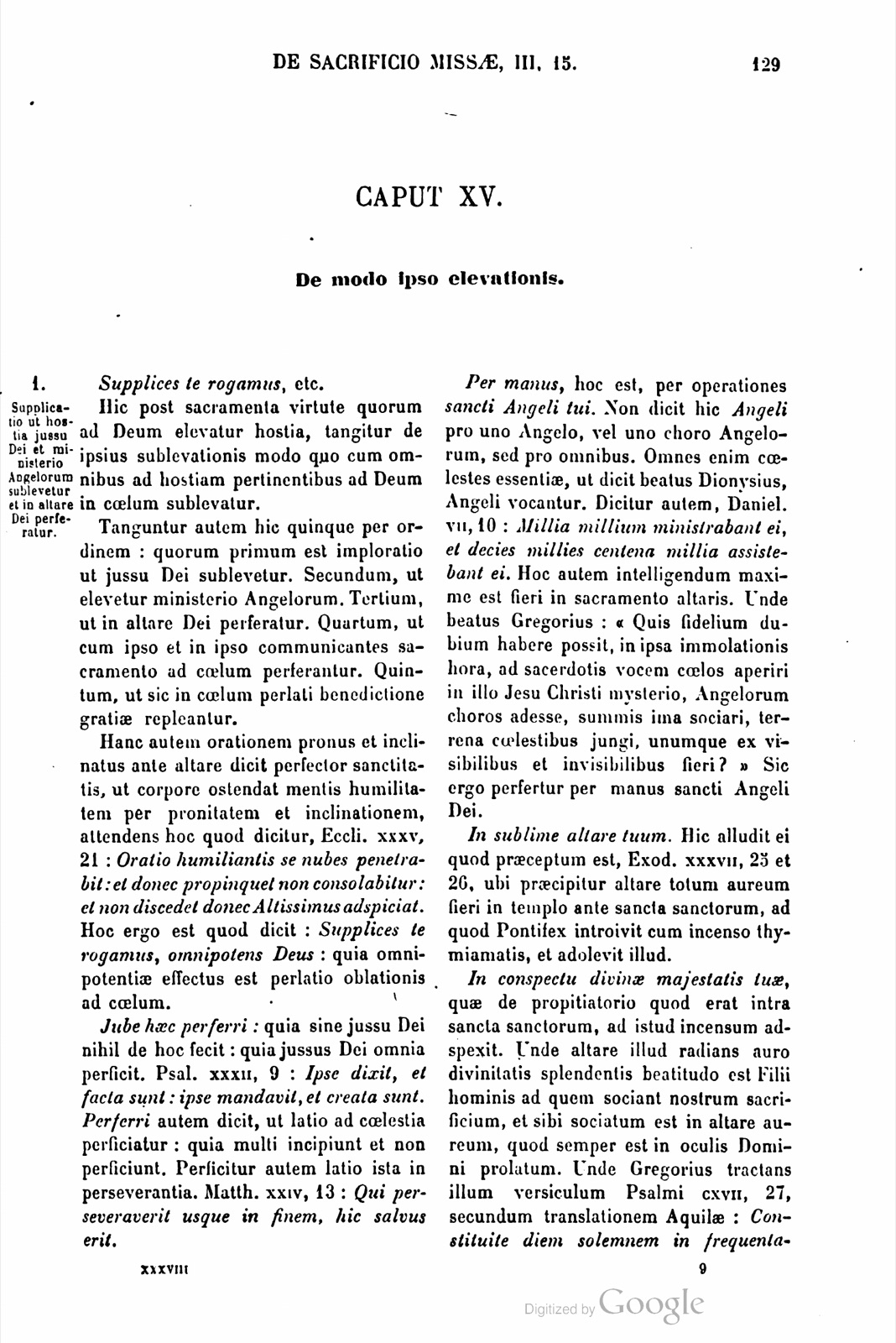
CAPUT XV.
De modo ipso elevationis.
[Marginal label: Supplicatio ut hostia jussu Dei et ministerio Angelorum sublevetur et in altare Dei perferatur.] 1. Supplices te rogamus, etc. Hic post sacramenta virtute quorum ad Deum elevatur hostia, tangitur de ipsius sublevationis modo quo cum omnibus ad hostiam pertinentibus ad Deum in coelum sublevatur.
Tanguntur autem hic quinque per ordinem: quorum primum est imploratio ut jussu Dei sublevetur. Secundum, ut elevetur ministerio Angelorum. Tertium, ut in altare Dei perferatur. Quartum, ut cum ipso et in ipso communicantes sacramento ad coelum perferantur. Quintum, ut sic in coelum perlati benedictione gratiae repleantur.
Hanc autem orationem pronus et inclinatus ante altare dicit perfector sanctitatis, ut corpore ostendat mentis humilitatem per pronitatem et inclinationem, attendens hoc quod dicitur, Eccli. XXXV, 21: Oratio humiliantis se nubes penetrabit: et donec propinquet non consolabitur: et non discedet donec Altissimus adspiciat. Hoc ergo est quod dicit: Supplices te rogamus, omnipotens Deus: quia omnipotentiae effectus est perlatio oblationis ad coelum.
Jube haec perferri: quia sine jussu Dei nihil de hoc fecit: quia jussus Dei omnia perficit. Psal. XXXI, 9: Ipse dixit, et facta sunt: ipse mandavit, et creata sunt. Perferri autem dicit, ut latio ad coelestia perficiatur: quia multi incipiunt et non perficiunt. Perficitur autem latio ista in perseverantia. Matth. XXIV, 13: Qui perseveraverit usque in finem, hic salvus erit.
Per manus, hoc est, per operationes sancti Angeli tui. Non dicit hic Angeli pro uno Angelo, vel uno choro Angelorum, sed pro omnibus. Omnes enim coelestes essentiae, ut dicit beatus Dionysius, Angeli vocantur. Dicitur autem, Daniel. VII, 10: Millia millium ministrabant ei, et decies millies centena millia assistebant ei. Hoc autem intelligendum maxime est fieri in sacramento altaris. Unde beatus Gregorius: "Quis fidelium dubium habere possit, in ipsa immolationis hora, ad sacerdotis vocem coelos aperiri in illo Jesu Christi mysterio, Angelorum choros adesse, summis ima sociari, terrena coelestibus jungi, unumque ex visibilibus et invisibilibus fieri?" Sic ergo perfertur per manus sancti Angeli Dei.
In sublime altare tuum. Hic alludit ei quod praeceptum est, Exod. XXXVII, 25 et 26, ubi praecipitur altare totum aureum fieri in templo ante sancta sanctorum, ad quod Pontifex introivit cum incenso thymiamatis, et adolevit illud.
In conspectu divinae majestatis tuae, quae de propitiatorio quod erat intra sancta sanctorum, ad istud incensum adspexit. Unde altare illud radians auro divinitatis splendentis beatitudo est Filii hominis ad quem sociant nostrum sacrificium, et sibi sociatum est in altare aureum, quod semper est in oculis Domini prolatum. Unde Gregorius tractans illum versiculum Psalmi CXVII, 27, secundum translationem Aquilae: Constituite diem solemnem in frequentationibus 1, usque ad cornu altaris, dicit sic: "Dies solemnis est Domino compunctio cordis nostri: sed tunc in frequentatione dies solemnis constituitur, cum in lacrymis pro amore ejus assidue mens movetur. Cui velut si diceremus: Tamdiu ista acturi sumus, quamdiu in tribulatione afficiemur? illico terminum quousque fieri debeat, subjungit dicens: Usque ad cornu altaris. Cornu quippe altaris est exaltatio sacrificii interioris, ubi cum venerimus, jam nulla necessitas est ut solemnem diem Domino de nostri lamentatione faciamus." Haec sunt verba Gregorii. Constat autem, quod sacrificium interius spiritus contribulati non exaltatur nisi incorporatum altaris sacrificio. De hoc Augustinus super eumdem Psalmum sic dicit: "Est quoddam altare invisibile, ad quod non accedet injustus. Ille solus accedit, qui ad illud securus accedit. Illic invenit vitam suam, qui in isto altari visibili discernit causam suam. Non igitur sufficit in terra dies iste solemnis, quo Agnus occisus est, sed constituite illum in condensis Scripturarum, alta et secreta rimantes quousque perveniatis, exaltatis a Deo mentibus, usque ad ejus divinitatem. Et quid ibi aliud nisi laudes cantabimus? Quid aliud dicemus, nisi, Deus meus es tu, et confitebor tibi: Deus meus es tu, et exaltabo te? non strepitu verborum ista dicemus, sed dilectio inhaerens illi per seipsam clamat istam vocem. Dilectio enim nostra vox est." Sic igitur perfertur in sublime altare Dei, quando omnes in sacrificio adhaerent deitati Christi in conspectu majestatis Patris existentis. Psal. XLII, 4: Introibo ad altare Dei, ad Deum qui laetificat juventutem meam 2.
CHAPTER XV.
On the very mode of elevation.
[Marginal label: Supplication that the host be lifted up by the command of God and by the ministry of the Angels and be carried into the altar of God.] 1. We humbly beseech thee, etc. Here, after the sacraments by whose power the host is elevated to God, there is touched upon the mode of its own lifting up, by which, with all things pertaining to the host, it is lifted up to God into heaven.
But five things are touched here in order: the first of which is the imploring that it be lifted up by the command of God; the second, that it be elevated by the ministry of the Angels; the third, that it be carried into the altar of God; the fourth, that those communicating with him and in him in the sacrament be carried to heaven; the fifth, that, thus carried into heaven, they be filled with the blessing of grace.
But the perfecter of sanctity says this prayer bent forward and inclined before the altar, so that by the body he may show the humility of the mind through bending forward and inclination, attending to what is said, Ecclesiasticus 35:21: The prayer of one humbling himself will pierce the clouds; and until it draws near he will not be consoled, and he will not depart until the Most High looks upon it. This, therefore, is what he says: We humbly beseech thee, almighty God, because the carrying of the oblation to heaven is the effect of omnipotence.
Command these things to be carried, because without the command of God nothing of this was done, because the command of God perfects all things. Psalm 31:9: He spoke, and they were made; he commanded, and they were created. But he says to be carried so that the bearing to heavenly things may be perfected, because many begin and do not perfect. But this bearing is perfected in perseverance. Matthew 24:13: He who perseveres unto the end, this one shall be saved.
By the hands, that is, by the operations of thy holy Angel. He does not here say Angel for one Angel or for one choir of Angels, but for all. For all heavenly essences, as blessed Dionysius says, are called Angels. And it is said, Daniel 7:10: Thousands of thousands ministered to him, and ten thousand times a hundred thousand stood by him. But this must be understood especially to be done in the sacrament of the altar. Hence blessed Gregory says: Who of the faithful could be in doubt that, in the very hour of immolation, at the voice of the priest the heavens are opened in that mystery of Jesus Christ, the choirs of Angels are present, the lowest things are joined to the highest, earthly things to heavenly things, and one thing is made from visible and invisible things? Thus, therefore, it is carried by the hands of the holy Angel of God.
Into thy sublime altar. Here he alludes to what was commanded, Exodus 37:25 and 26, where an altar wholly of gold is commanded to be made in the temple before the holy of holies, to which the Pontiff entered with the incense of fragrance and burned it.
In the sight of thy divine majesty, which looked from the propitiatory, which was within the holy of holies, toward that incense. Hence that altar, radiant with gold, is the beatitude of the Son of man shining with divinity, to whom they join our sacrifice; and, joined to him, it is in the golden altar, which is always brought forward in the eyes of the Lord. Hence Gregory, treating that verse of Psalm 117:27, according to the translation of Aquila: Establish a solemn day in gatherings 1, even to the horn of the altar, says thus: The solemn day for the Lord is the compunction of our heart; but then the solemn day is established in gathering, when the mind is moved continually in tears for love of him. As though if we were to say: How long shall we do these things, how long shall we be afflicted in tribulation? immediately he adds the limit to which it must be done, saying: To the horn of the altar. Indeed the horn of the altar is the exaltation of the interior sacrifice; when we have come there, there is now no necessity that we make a solemn day for the Lord from our lamentation. These are the words of Gregory. But it is certain that the interior sacrifice of a troubled spirit is not exalted unless incorporated into the sacrifice of the altar. Concerning this Augustine says thus upon the same Psalm: There is a certain invisible altar, to which the unjust person will not approach. He alone approaches who approaches securely to it. There he finds his life who at this visible altar discerns his cause. Therefore on earth this solemn day, on which the Lamb was slain, does not suffice; but establish it in the dense places of the Scriptures, searching lofty and secret things until you come, with minds exalted by God, all the way to his divinity. And what else shall we sing there except praises? What else shall we say except, Thou art my God, and I will confess to thee; thou art my God, and I will exalt thee? We shall not say those things with the noise of words, but love adhering to him cries out that voice by itself. For our love is our voice. Thus, therefore, it is carried into the sublime altar of God, when all who are in the sacrifice adhere to the deity of Christ existing in the sight of the majesty of the Father. Psalm 42:4: I will go in to the altar of God, to God who gives joy to my youth 2.
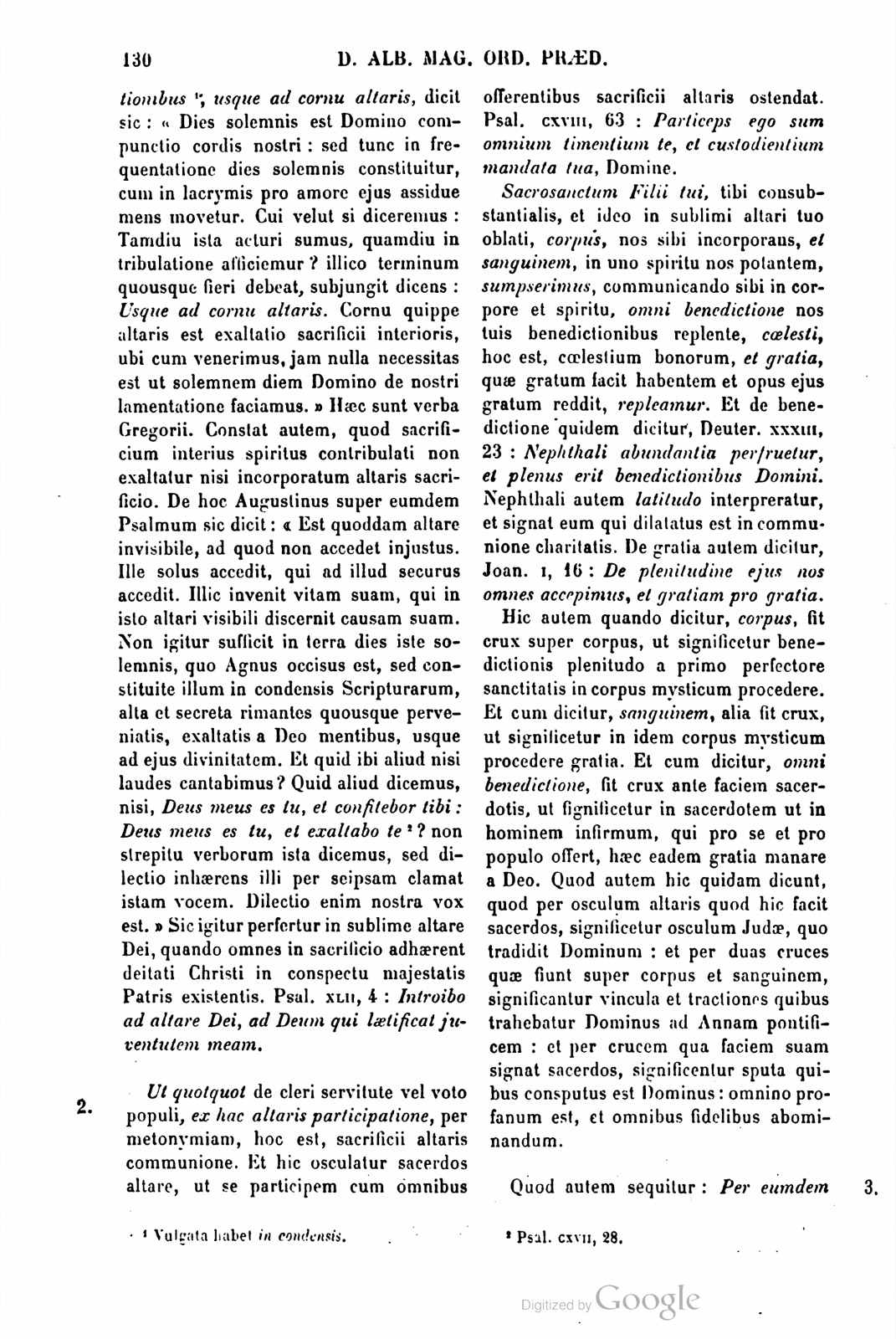
2. Ut quotquot de cleri servitute vel voto populi, ex hac altaris participatione, per metonymiam, hoc est, sacrificii altaris communione. Et hic osculatur sacerdos altare, ut se participem cum omnibus offerentibus sacrificii altaris ostendat. Psal. CXVIII, 63: Particeps ego sum omnium timentium te, et custodientium mandata tua, Domine.
Sacrosanctum Filii tui, tibi consubstantialis, et ideo in sublimi altari tuo oblati, corpus, nos sibi incorporans, et sanguinem, in uno spiritu nos potantem, sumpserimus, communicando sibi in corpore et spiritu, omni benedictione nos tuis benedictionibus replente, coelesti, hoc est, coelestium bonorum, et gratia, quae gratum facit habentem et opus ejus gratum reddit, repleamur. Et de benedictione quidem dicitur, Deuter. XXXIII, 23: Nephthali abundantia perfruetur, et plenus erit benedictionibus Domini. Nephthali autem latitudo interpretatur, et signat eum qui dilatatus est in communione charitatis. De gratia autem dicitur, Joan. I, 16: De plenitudine ejus nos omnes accepimus, et gratiam pro gratia.
Hic autem quando dicitur, corpus, fit crux super corpus, ut significetur benedictionis plenitudo a primo perfectore sanctitatis in corpus mysticum procedere. Et cum dicitur, sanguinem, alia fit crux, ut significetur in idem corpus mysticum procedere gratia. Et cum dicitur, omni benedictione, fit crux ante faciem sacerdotis, ut significetur in sacerdotem ut in hominem infirmum, qui pro se et pro populo offert, haec eadem gratia manare a Deo. Quod autem hic quidam dicunt, quod per osculum altaris quod hic facit sacerdos, significetur osculum Judae, quo tradidit Dominum: et per duas cruces quae fiunt super corpus et sanguinem, significantur vincula et tractiones quibus trahebatur Dominus ad Annam pontificem: et per crucem qua faciem suam signat sacerdos, significentur sputa quibus consputus est Dominus: omnino profanum est, et omnibus fidelibus abominandum.
2. That as many as, from the service of the clergy or the vow of the people, from this participation of the altar, by metonymy, that is, by communion in the sacrifice of the altar. And here the priest kisses the altar, so that he may show himself a participant with all those offering the sacrifice of the altar. Psalm 118:63: I am a participant of all who fear thee and who keep thy commandments, O Lord.
The sacrosanct body of thy Son, consubstantial with thee and therefore offered in thy sublime altar, incorporating us into himself, and the blood, giving us to drink in one spirit, we shall have received, by communicating with him in body and spirit; may we be filled with every blessing, he filling us with thy blessings, heavenly, that is, of heavenly goods, and with grace, which makes its possessor pleasing and renders his work pleasing. And concerning blessing indeed it is said, Deuteronomy 33:23: Nephthali shall enjoy abundance and will be full of the blessings of the Lord. But Nephthali is interpreted breadth, and signifies him who has been broadened in the communion of charity. But concerning grace it is said, John 1:16: From his fullness we all have received, and grace for grace.
But here, when body is said, a cross is made over the body, so that it may be signified that the fullness of blessing proceeds from the first perfecter of sanctity into the mystical body. And when blood is said, another cross is made, so that it may be signified that grace proceeds into the same mystical body. And when every blessing is said, a cross is made before the face of the priest, so that it may be signified that this same grace flows from God into the priest as into an infirm man who offers for himself and for the people. But what certain persons say here, that by the kiss of the altar which the priest here makes is signified the kiss of Judas by which he betrayed the Lord, and that by the two crosses which are made over the body and blood are signified the bonds and draggings by which the Lord was dragged to Annas the pontiff, and that by the cross by which the priest signs his face are signified the spits with which the Lord was spat upon, is wholly profane and abominable to all the faithful.
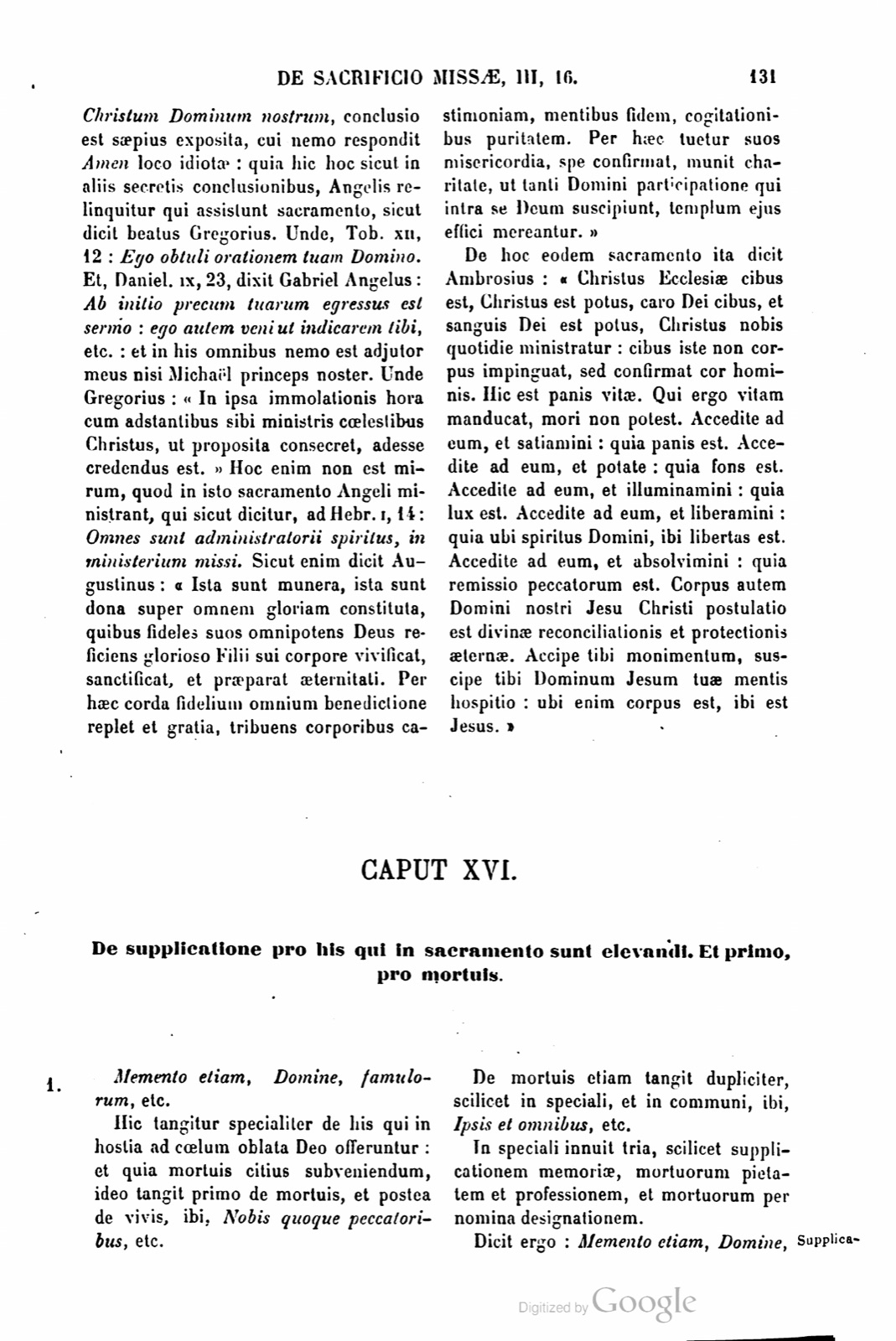
3. Quod autem sequitur: Per eumdem Christum Dominum nostrum, conclusio est saepius exposita, cui nemo respondit Amen loco idiotae: quia hic hoc sicut in aliis secretis conclusionibus, Angelis relinquitur qui assistunt sacramento, sicut dicit beatus Gregorius. Unde, Tob. XII, 12: Ego obtuli orationem tuam Domino. Et, Daniel. IX, 23, dixit Gabriel Angelus: Ab initio precum tuarum egressus est sermo: ego autem veni ut indicarem tibi, etc.: et in his omnibus nemo est adjutor meus nisi Michael princeps noster. Unde Gregorius: "In ipsa immolationis hora cum adstantibus sibi ministris coelestibus Christus, ut proposita consecret, adesse credendus est." Hoc enim non est mirum, quod in isto sacramento Angeli ministrant, qui sicut dicitur, ad Hebr. I, 14: Omnes sunt administratorii spiritus, in ministerium missi. Sicut enim dicit Augustinus: "Ista sunt munera, ista sunt dona super omnem gloriam constituta, quibus fideles suos omnipotens Deus reficiens glorioso Filii sui corpore vivificat, sanctificat, et praeparat aeternitati. Per haec corda fidelium omnium benedictione replet et gratia, tribuens corporibus castimoniam, mentibus fidem, cogitationibus puritatem. Per haec tuetur suos misericordia, spe confirmat, munit charitate, ut tanti Domini participatione qui intra se Deum suscipiunt, templum ejus effici mereantur."
De hoc eodem sacramento ita dicit Ambrosius: "Christus Ecclesiae cibus est, Christus est potus, caro Dei cibus, et sanguis Dei est potus, Christus nobis quotidie ministratur: cibus iste non corpus impinguat, sed confirmat cor hominis. Hic est panis vitae. Qui ergo vitam manducat, mori non potest. Accedite ad eum, et satiamini: quia panis est. Accedite ad eum, et potate: quia fons est. Accedite ad eum, et illuminamini: quia lux est. Accedite ad eum, et liberamini: quia ubi spiritus Domini, ibi libertas est. Accedite ad eum, et absolvimini: quia remissio peccatorum est. Corpus autem Domini nostri Jesu Christi postulatio est divinae reconciliationis et protectionis aeternae. Accipe tibi monimentum, suscipe tibi Dominum Jesum tuae mentis hospitio: ubi enim corpus est, ibi est Jesus."
3. But what follows: Through the same Christ our Lord, is the conclusion often expounded, to which no one responds Amen in place of the unlearned person, because here, as in other conclusions of the secrets, this is left to the Angels who attend the sacrament, as blessed Gregory says. Hence, Tobit 12:12: I offered thy prayer to the Lord. And Daniel 9:23, the Angel Gabriel said: From the beginning of thy prayers the word went forth; but I have come to show thee, etc.; and in all these things no one is my helper except Michael our prince. Hence Gregory says: In the very hour of immolation, when the heavenly ministers stand by, Christ, so that he may consecrate the things proposed, must be believed to be present. For it is not marvelous that Angels minister in this sacrament, who, as is said, Hebrews 1:14, are all ministering spirits sent for ministry. For as Augustine says: These are the presents, these are the gifts established above every glory, by which almighty God, refreshing his faithful with the glorious body of his Son, brings them to life, sanctifies them, and prepares them for eternity. Through these he fills the hearts of all the faithful with blessing and grace, granting chastity to bodies, faith to minds, purity to thoughts. Through these by mercy he guards his own, confirms them in hope, fortifies them with charity, so that by participation in so great a Lord they who receive God within themselves may deserve to be made his temple.
Concerning this same sacrament Ambrose says thus: Christ is the food of the Church, Christ is drink; the flesh of God is food, and the blood of God is drink; Christ is daily ministered to us. This food does not fatten the body, but strengthens the heart of man. This is the bread of life. Therefore he who eats life cannot die. Come to him and be satisfied, because he is bread. Come to him and drink, because he is a font. Come to him and be enlightened, because he is light. Come to him and be freed, because where the Spirit of the Lord is, there is liberty. Come to him and be absolved, because he is the remission of sins. But the body of our Lord Jesus Christ is the request of divine reconciliation and eternal protection. Take for thyself a memorial, receive for thyself the Lord Jesus into the lodging of thy mind; for where the body is, there is Jesus.
If a page does not appear, its photograph has not been uploaded yet.