Works › The Book on the Sacrifice of the Mass
Volume 38 · pp. 131–137
Tractate III, Chapter XVI opening
A marker with ≈ is an approximate page boundary, placed by measure of the text; the page photographs remain the authority. In the paired views, clicking a page marker brings that page into view.
CAPUT XVI.
De supplicatione pro his qui in sacramento sunt elevandi. Et primo, pro mortuis.
[Marginal label: Supplicatio pro defunctis.] 1. Memento etiam, Domine, famulorum, etc. Hic tangitur specialiter de his qui in hostia ad coelum oblata Deo offeruntur: et quia mortuis citius subveniendum, ideo tangit primo de mortuis, et postea de vivis, ibi, Nobis quoque peccatoribus, etc.
De mortuis etiam tangit dupliciter, scilicet in speciali, et in communi, ibi, Ipsis et omnibus, etc.
In speciali innuit tria, scilicet supplicationem memoriae, mortuorum pietatem et professionem, et mortuorum per nomina designationem.
Dicit ergo: Memento etiam, Domine, hoc est, non sicut de his de quibus nullam vis habere memoriam et nullam notitiam, de quibus dicit Psalmista, Psal. XV, 4: Nec memor ero nominum eorum per labia mea. Et, Matth. VII, 23: Et tunc confitebor illis: Quia numquam novi vos. Illi enim in Dei memoria non sunt, qui non sunt in libro vitae, de quibus dicitur: In civitate tua imaginem ipsorum ad nihilum rediges 1. Non sint ergo tales, sed sint in notitia tua, sicut dixit, Exod. XXXIII, 12: Novi te ex nomine: invenisti enim gratiam coram me. Qualis autem sit Dei memoria, in praemissis dictum est.
Famulorum famularumque tuarum, qui tibi in obedientia mandatorum famulati sunt: quia de ipsis qui numquam famulari voluerunt, nulla est apud Deum recordatio. II ad Timoth. II, 19: Cognovit Dominus qui sunt ejus. Joan. X, 14: Cognosco meas, et cognoscunt me meae.
Qui nos praecesserunt cum signo fidei. Tangit mortuorum pietatem et professionem. Praecesserunt autem nos decedendo cum signo. Cum signo autem fidei, hoc est, sacramenta fidei venerabiliter et reverenter suscipiendo. De illis etiam spes est apud Ecclesiam, et pro illis intercedit. II Machab. XII, 42 et seq.: Vir fortissimus Judas, facta collatione, duodecim millia drachmas argenti misit Jerosolymam, offerri pro peccatis mortuorum sacrificium, bene et religiose de resurrectione cogitans: (nisi enim eos, qui ceciderant, resurrecturos speraret, superfluum videretur et vanum orare pro mortuis). Haec est enim resurrectio prima, quod anima resurgat a peccatis in quibus detinetur. Et secunda resurrectio est corporum de sepulcris. Et de hac eadem fide suffragii mortuorum dicitur, Apocal. XX, 5 et 6: Haec est resurrectio prima. Beatus et sanctus, qui habet partem in resurrectione prima: in his secunda mors non habet potestatem: quia illi aeternaliter non damnabuntur.
CHAPTER XVI.
On the supplication for those who are to be elevated in the sacrament. And first, for the dead.
[Marginal label: Supplication for the departed.] 1. Remember also, O Lord, thy servants, etc. Here there is touched specially upon those who in the host offered to God are offered to heaven; and because the dead must be aided more quickly, therefore he first touches upon the dead, and afterward upon the living, there: To us also sinners, etc.
Concerning the dead also he touches in two ways, namely in special and in common, there: To these and to all, etc.
In special he indicates three things, namely the supplication of memory, the piety and profession of the dead, and the designation of the dead by names.
Therefore he says: Remember also, O Lord, that is, not as concerning those of whom thou dost will to have no memory and no knowledge, of whom the Psalmist says, Psalm 15:4: I will not remember their names through my lips. And Matthew 7:23: And then I will confess to them: Because I never knew you. For those are not in the memory of God who are not in the book of life, of whom it is said: In thy city thou shalt reduce their image to nothing 1. Therefore let them not be such, but let them be in thy knowledge, as he said, Exodus 33:12: I knew thee by name; for thou hast found grace before me. But what the memory of God is has been said in what came before.
Of thy servants and handmaids, who served thee in obedience to the commandments, because concerning those who never wished to serve, there is no remembrance before God. 2 Timothy 2:19: The Lord has known those who are his. John 10:14: I know mine, and mine know me.
Who have gone before us with the sign of faith. He touches the piety and profession of the dead. But they have gone before us by dying with the sign. But with the sign of faith means by receiving the sacraments of faith venerably and reverently. Concerning them there is also hope before the Church, and for them she intercedes. 2 Maccabees 12:42 and following: The most brave Judas, a collection having been made, sent twelve thousand drachmas of silver to Jerusalem, that sacrifice might be offered for the sins of the dead, thinking well and religiously about the resurrection; for unless he hoped that those who had fallen were going to rise, it would seem superfluous and vain to pray for the dead. For this is the first resurrection, that the soul rises from the sins in which it is detained. And the second resurrection is of bodies from tombs. And concerning this same faith of suffrage for the dead it is said, Apocalypse 20:5 and 6: This is the first resurrection. Blessed and holy is he who has part in the first resurrection: over these the second death has no power, because they will not be damned eternally.
Et dormiunt in somno pacis. Mors enim piorum somnus est: quia in dormiente magis quam in vigilante agit vita occulta, sed in eo tantum ligata est vita manifesta: et ita est in his qui mortui sunt cum signo fidei. In his agit plus vita gratiae quam in vivis: sed vita manifesta operans in corpore, ligata est in eis usque ad corporum resurrectionem. Unde, Joan. XI, 11: Lazarus amicus noster dormit. Luc. VIII, 52: Non est mortua puella, sed dormit. Psal. CXXVI, 2 et 3: Cum dederit dilectis suis somnum, ecce haereditas Domini, filii: merces, fructus ventris. Hi ergo dormiunt in somno pacis: quia si sunt in regno perfectionis, pacem acceperunt dicentes: In pace in idipsum dormiam, et requiescam 2. Apocal. XIV, 13: Amodo jam dicit Spiritus ut requiescant a laboribus suis. Si autem sunt in purgatorio, tunc certa exspectatione in pace cordis exspectant suae purgationis terminum, et liberationem a poenis et locis poenarum.
Et ex verbo isto videtur innui, quod animae in purgatorio non affliguntur ministerio daemonum: quia cum daemonibus somnum pacis non haberent: sed purgantur per seipsas sicut aurum purgatur et rutilat in igne. I ad Corinth. III, 13: Uniuscujusque opus quale sit, ignis probabit. Et infra, v. 15: Si cujus opus arserit, detrimentum patietur: ipse autem salvus erit, sic tamen quasi per ignem. Unde etiam non opinor, quod daemones animas purgandas deferant ad loca poenarum: quia sanctae sunt animae, et dicit David in Psalmo LXXIII, 19: Ne tradas bestiis animas confitentes tibi, hoc est, non trades eas potestati daemonum affligendas, qui sunt bestiae quasi vastiae dictae: et animas pauperum tuorum ne obliviscaris in finem, quia purgatas educes de locis poenarum: sed potius animae pondere venialium quae secum portant de corpore exeuntes, tendunt profundius et minus profunde ad loca
And they sleep in the sleep of peace. For the death of the pious is sleep, because hidden life acts more in the sleeping person than in the waking person, but manifest life alone is bound in him; and so it is in those who have died with the sign of faith. In these, the life of grace acts more than in the living, but manifest life operating in the body is bound in them until the resurrection of bodies. Hence, John 11:11: Lazarus our friend sleeps. Luke 8:52: The girl is not dead, but sleeps. Psalm 126:2 and 3: When he shall have given sleep to his beloved, behold the inheritance of the Lord, sons; the reward, the fruit of the womb. Therefore these sleep in the sleep of peace, because if they are in the kingdom of perfection, they have received peace, saying: In peace, into the same, I shall sleep and rest 2. Apocalypse 14:13: Now already the Spirit says that they should rest from their labors. But if they are in purgatory, then with certain expectation in the peace of the heart they await the end of their purgation and liberation from punishments and places of punishments.
And from this word it seems to be indicated that souls in purgatory are not afflicted by the ministry of demons, because with demons they would not have the sleep of peace; but they are purged through themselves just as gold is purged and glows red in fire. 1 Corinthians 3:13: Of what sort each one's work is, the fire will prove. And below, verse 15: If anyone's work shall burn, he shall suffer loss, but he himself shall be saved, yet so as through fire. Hence I also do not think that demons carry souls to be purged to places of punishments, because souls are holy; and David says in Psalm 73:19: Do not hand over to beasts the souls confessing to thee, that is, thou shalt not hand them over to the power of demons to be afflicted, who are beasts as if called ravagers; and do not forget unto the end the souls of thy poor, because when they have been purged thou shalt lead them out from the places of punishments; but rather, by the weight of venials which souls carry with them when leaving the body, they tend more deeply and less deeply to places
poenarum pro diversitate venialium quae secum deferunt, sicut diversi ponderis gravia tendunt deorsum. Et ideo, Zachar. V, 7, dicitur iniquitas sedere super talentum plumbi. Et in Psalmo XXXVI, 5, dicitur de peccatis: Et sicut onus grave gravatae sunt super me. Istis ergo valent suffragia.
N. et N. Et hic fit mentio specialis quorumdam defunctorum, et praecipue pro quibus oblationes factae sunt ad altare: quia vota eorum sunt in sacrificio, sicut diximus in ante habitis.
2. Et post mentionem specialium, quos sola cogitatione non verbo vocali recolit, stans ad aram perfector sanctitatis, prosequitur in communi dicens: Ipsis, Domine, quos in speciali designavimus recordatione, et omnibus in Christo, hoc est, in signis fidei Christi, quiescentibus, a laboribus vitae exterioris. Job, III, 17: Requieverunt fessi robore. Et ibidem, v. 13: Nunc enim dormiens silerem, et somno meo requiescerem.
Locum refrigerii: quia jam non sunt in locis refrigerii, in quo divina foveantur consolatione. Et alludit ei quod dicitur, Zachar. IX, 11: Tu in sanguine testamenti tui emisisti vinctos tuos de lacu in quo non est aqua. Hoc est refrigerium divinae consolationis, et hoc dictum est quoad ignis afflictionem. Non ergo sunt de illis quibus nullum subvenit refrigerium. Luc. XVI, 24: Pater Abraham, miserere mei, et mitte Lazarum, ut intingat extremum digiti sui in aquam, ut refrigeret linguam meam, quia crucior in hac flamma. Et respondit Abraham post aliqua, v. 26: Inter nos et vos chaos magnum firmatum est, ut hi qui volunt hanc transire ad vos, non possint, neque inde huc transmeare. Chaos enim illud profundissimum immobilitas est divinae sententiae, quae nullum sanctorum in patria per compassionis suffragium permittit transire ad subventionem in inferno damnatorum, nec aliquem damnatorum per adoptionem refrigerii permittit transire liberatum ad locum beatorum.
Hic est ergo locus refrigerii, hic locus lucis, contra illud, quod in tenebris sunt qui in purgatorio purgantur: quae lux maxime est in aperta Dei visione, de qua dicitur, I ad Timoth. VI, 16: Lucem inhabitat inaccessibilem. De tenebris autem dicitur, Sapient. XVII, 20: Ipsi sibi fuerunt graviores tenebris. Quia tamen interiorem habent candentem fidei lucem, merito illius lucis aliquando purgati ad fruitionem aeternae lucis exibunt. Mich. VII, 8 et 9: Consurgam cum sedero in tenebris, Dominus lux mea est. Iram Domini portabo, quoniam peccavi ei, donec causam meam judicet, et faciat judicium meum. Educet me in lucem, videbo justitiam ejus.
Hic etiam dicitur locus pacis: quia animae in locis poenarum pacem ab extrinsecus affligente non habent, sicut dicitur, Baruch, III, 3: Si in via Dei ambulasses, habitasses utique in pace sempiterna, hoc est, in loco beatorum, ubi, sicut dicitur ibidem, v. 17, est lumen oculorum, et pax, scilicet Christi, quam inveniunt illi qui perfecte custodiunt mandata: quia sicut dicit Psalmista, Psal. XVIII, 12: In custodiendis illis retributio multa. Psal. CXVIII, 165: Pax multa diligentibus legem tuam. Haec autem pax quae post turbationem purgationis oratur animabus omnibus, est pax Jerusalem coelestis, de qua dicit Augustinus in libro XIV de Civitate Dei: "Pax coelestis civitatis est concordia fruendi Deo, et invicem in Deo."
of punishments according to the diversity of the venials which they carry with them, just as heavy things of diverse weight tend downward. And therefore, Zechariah 5:7, iniquity is said to sit upon a talent of lead. And in Psalm 36:5 it is said of sins: And like a heavy burden they have been made heavy upon me. Therefore suffrages avail for these.
N. and N. And here special mention is made of certain departed persons, and especially of those for whom oblations have been made at the altar, because their vows are in the sacrifice, as we have said in what has gone before.
2. And after the mention of special persons, whom the perfecter of sanctity, standing at the altar, recalls by thought alone and not by vocal word, he proceeds in common, saying: To these, O Lord, whom we have designated in special remembrance, and to all who rest in Christ, that is, in the signs of the faith of Christ, from the labors of exterior life. Job 3:17: Those wearied in strength have rested. And in the same place, verse 13: For now, sleeping, I would be silent, and I would rest in my sleep.
A place of refreshment, because they are not already in places of refreshment, in which they may be cherished by divine consolation. And he alludes to what is said, Zechariah 9:11: Thou, in the blood of thy testament, hast sent forth thy bound ones from the pit in which there is no water. This is the refreshment of divine consolation, and this has been said with respect to the affliction of fire. Therefore they are not among those for whom no refreshment gives aid. Luke 16:24: Father Abraham, have mercy on me, and send Lazarus, that he may dip the tip of his finger in water, to cool my tongue, because I am tormented in this flame. And Abraham answered after some words, verse 26: Between us and you a great chaos has been fixed, so that those who wish to cross from here to you cannot, nor can they pass from there to here. For that most profound chaos is the immobility of the divine sentence, which permits none of the saints in the homeland to cross by a suffrage of compassion to bring help into the hell of the damned, nor permits any of the damned, by adoption of refreshment, to pass freed to the place of the blessed.
This, therefore, is the place of refreshment, this the place of light, against the fact that those who are purged in purgatory are in darkness. This light is chiefly in the open vision of God, of which it is said, 1 Timothy 6:16: He inhabits inaccessible light. But concerning the darkness it is said, Wisdom 17:20: They were heavier darkness to themselves. Yet because they have the inward glowing light of faith, by the merit of that light, having at some time been purged, they will go out to the fruition of eternal light. Micah 7:8 and 9: I shall rise when I sit in darkness; the Lord is my light. I shall bear the wrath of the Lord, because I have sinned against him, until he judges my cause and makes judgment for me. He will lead me into light; I shall see his justice.
This is also called a place of peace, because souls in places of punishments do not have peace from one afflicting them externally, as is said, Baruch 3:3: If thou hadst walked in the way of God, thou wouldest surely have dwelt in everlasting peace, that is, in the place of the blessed, where, as is said in the same place, verse 17, there is light of the eyes, and peace, namely of Christ, which they find who perfectly keep the commandments; because as the Psalmist says, Psalm 18:12: In keeping them there is much reward. Psalm 118:165: Much peace to those who love thy law. But this peace which after the disturbance of purgation is prayed for all souls is the peace of heavenly Jerusalem, concerning which Augustine says in book XIV of The City of God: The peace of the heavenly city is the concord of enjoying God, and one another in God.
Ut indulgeas, hoc est, ex bonitate tua indulgentiam tribuas, deprecamur, omnes qui tibi sacrificium offerimus, sive servitute, sive voto, dicentes cum Psalmista, Psal. CXLII, 2: Non intres in judicium cum servo tuo, Domine, quia non justificabitur in conspectu tuo omnis vivens. Et, Daniel. IX, 18: Non enim in justificationibus nostris prosternimus preces ante faciem tuam, sed in miserationibus tuis multis. Et ideo oramus, ut ex indulgentia dones locum refrigerii, lucis et pacis defunctis.
Per eumdem Christum Dominum nostrum, qui defunctos in fide sua liberavit a locis poenarum.
[Marginal label: Suffragia Ecclesiae quibus sint?] 3. Est autem hic annotandum quibus et ad quid prosint suffragia Ecclesiae, et quae sint suffragia, et qualiter sunt facienda.
Et circa primum quidem quatuor ordines defunctorum distinguit Augustinus, scilicet valde malos, et valde bonos, mediocriter bonos, et mediocriter malos.
Valde mali quidem sunt, qui in vita desperata vitam finierunt, dicentes dicto oris, vel perfidia cordis, vel facto operis illud Job, XXI, 14: Qui dixerunt Deo: Recede a nobis, et scientiarum viarum tuarum nolumus. Quia si etiam dicto oris vel fide cordis non dixerunt, tamen omni facto clamaverunt illud Apostoli, ad Titum, I, 16: Confitentur se nosse Deum, factis autem negant. Judaei ergo et pagani et haeretici dicunt illud perfidia cordis, blasphemi dicunt illud dicto oris, falsi Christiani dicunt illud facto operis. Illis ergo non prosunt suffragia Ecclesiae: quia ut dicit Augustinus: "Dum viverent, non se dignos, sed potius indignos fecerunt ut eis talia salutis adminicula prodesse possent."
Valde boni autem sunt statum puritatis tenentes, et nullis mundi sordibus inquinati, sicut sunt qui cum Apostolo dicunt, ad Philip. I, 21: Mihi vivere Christus est, et mori lucrum. Et post pauca, v. 23: Coarctor autem e duobus: desiderium habens dissolvi, et esse cum Christo, multo magis melius. Hoc autem dicere debent devotione cordis, et veritate oris et intentionis, et facto operis: quia si etiam illis aliquid adhaeret parvum ex terrena ista et contagiosa inhabitatione, dicit Augustinus, quod illud quod facit gutta in camino, hoc facit tale parvum veniale in tali viro justo. Consumitur enim calore ferventissimae charitatis. Hi ergo, ut dicit Augustinus, tam boni sunt, quod talibus remediis non indigent.
Mediocriter autem boni sunt, qui sine mortali aut sunt, sicut innocentes, aut mortalia sua per compunctionem et confessionem et satisfactionem venialia fecerunt, et bonis operibus inhaerendo, et obedientia mandatorum et decretorum Ecclesiae vixerunt, tamen perfectam consiliorum vitam non tenuerunt: et ideo multa de terrena contagione eis venialia adhaeserunt, quae tamen levia sunt et otiosa et neglecta, et non satis devota, bona, perfecta: et isti quidem in purgatorio cremabilia habent, sed magnam et notabilem ad ignem non habent resistentiam: et ideo lignum, foenum et stipula non vocantur 3.
Mediocriter autem mali sunt, qui mandatorum quidem habent custodiam et mortalia sua per poenitentiam in venialia commutaverunt, sed tamen more et sollicitudine curae saecularis pro domibus et uxoribus et filiis multa non mortalia, sed a servitio et sollicitudine Dei et fervore charitatis et devotionis multum retrahentia et fortiter ad imum tendentia et illaqueantia in concupiscentia carnis et cupiditate rerum, citra Deum tamen et divinum praeceptum commiserunt et committunt quotidie, qui notabilem ad ignem habent resistentiam antequam crementur: et ideo illi ligna, foenum, et stipulam superaedificant supra fidei fundamentum. Ligna in majoribus diutius ardentibus, foenum in mediocribus, et stipulam in minimis, tamen ad ignem ordinatis. Et illis duobus defunctorum generibus prosunt suffragia Ecclesiae. Et sic patet primum, scilicet quibus prosunt suffragia. Unde Augustinus dicit: "Si scirem patrem meum esse in inferno, non plus rogarem pro ipso quam pro diabolo." Illi enim, ut diximus, sunt ultra chaos divinae misericordiae, et eorum non erit recordatio ad bonum 4.
That thou wouldest pardon, that is, that from thy goodness thou wouldest grant indulgence, we pray, all of us who offer sacrifice to thee, whether by service or by vow, saying with the Psalmist, Psalm 142:2: Enter not into judgment with thy servant, O Lord, because no living person will be justified in thy sight. And Daniel 9:18: For not in our justifications do we prostrate prayers before thy face, but in thy many acts of mercy. And therefore we pray that from indulgence thou wouldest give to the departed a place of refreshment, light, and peace.
Through the same Christ our Lord, who freed the departed in his faith from the places of punishments.
[Marginal label: What the suffrages of the Church are for.] 3. But here it must be noted for whom and for what the suffrages of the Church are useful, and what the suffrages are, and how they are to be done.
And concerning the first Augustine distinguishes four orders of the dead, namely the very bad, the very good, the moderately good, and the moderately bad.
The very bad are those who ended life in a desperate life, saying by word of mouth, or by the perfidy of the heart, or by deed of work, that saying of Job 21:14: They said to God: Depart from us, and we do not want the knowledge of thy ways. For even if they did not say it by word of mouth or by faith of heart, nevertheless by every deed they cried aloud that saying of the Apostle, Titus 1:16: They confess that they know God, but by deeds they deny him. Therefore Jews and pagans and heretics say that by perfidy of heart; blasphemers say it by word of mouth; false Christians say it by deed of work. Therefore the suffrages of the Church do not profit those persons, because, as Augustine says: While they lived, they made themselves not worthy, but rather unworthy, that such aids of salvation could profit them.
But the very good are those holding the state of purity and stained by no filth of the world, such as those who say with the Apostle, Philippians 1:21: To me to live is Christ, and to die is gain. And after a few words, verse 23: I am constrained by the two, having a desire to be dissolved and to be with Christ, a much better thing. But they ought to say this by devotion of heart, and truth of mouth and intention, and deed of work, because if even some small thing adheres to them from this earthly and contagious inhabitation, Augustine says that what a drop does in a furnace, such a small venial thing does in such a just man. For it is consumed by the heat of most fervent charity. Therefore these, as Augustine says, are so good that they do not need such remedies.
But the moderately good are those who either are without mortal sin, like the innocent, or have made their mortal sins venial through compunction and confession and satisfaction, and have lived by adhering to good works and by obedience to the commandments and decrees of the Church, yet have not held the perfect life of the counsels. Therefore many venial things from earthly contagion have adhered to them, which nevertheless are light and idle and neglected, and not sufficiently devout, good, perfect things. And these indeed have things burnable in purgatory, but they do not have great and notable resistance to the fire; and therefore they are not called wood, hay, and stubble 3.
But the moderately bad are those who indeed have the keeping of the commandments and have changed their mortal sins into venial sins through penance, but nevertheless by custom and solicitude of secular care for houses and wives and children they have committed and daily commit many things that are not mortal, yet greatly draw back from the service and solicitude of God and from the fervor of charity and devotion, and strongly tend downward and ensnare in concupiscence of the flesh and cupidity of things, yet short of God and the divine precept; these have notable resistance to the fire before they are burned. And therefore those persons build wood, hay, and stubble upon the foundation of faith: wood in greater things burning longer, hay in middling things, and stubble in the least, yet ordered to fire. And the suffrages of the Church profit those two genera of the dead. And thus the first point is clear, namely for whom suffrages profit. Hence Augustine says: If I knew my father were in hell, I would pray no more for him than for the devil. For those, as we have said, are beyond the chaos of divine mercy, and there will be no remembrance of them unto good 4.
[Marginal label: Ad quid prosint?] 4. Ad quid autem prosunt, iterum dicit Augustinus, dicens quod quibus prosunt vel ad hoc prosunt, ut velocior sit eorum liberatio, vel ut tolerabilior sit eorum damnatio. Mediocriter autem bonis et mediocriter malis prosunt, ut velocior sit eorum liberatio: et ideo tot possunt fieri suffragia pro uno aliquo, quod statim in momento liberatur: et ideo in hoc solo casu melior est conditio divitis quam pauperis: quia habet unde suffragia fiant pro ipso. Unde, Proverb. XIII, 8, dicitur: Redemptio animae viri divitiae suae. Quod autem dicit Augustinus, quod ad hoc prosunt ut tolerabilior sit eorum damnatio, diversimode intelligitur a Doctoribus magnis. Praepositivus enim dicit, quod propter hoc verbum suffragia prosunt valde malis in inferno damnatis, sed non ad liberationem: dicebat enim, primum quidem quod fit pro tali aliquo, tantum tollit poenam vel partem poenae a damnatis, sequens autem suffragium non tollit tantam ut primum in mensura quantitatis, sed tollit tantam in proportione: et quia poena eorum extensive accepta secundum modum continui divisibilis est in infinitum, ideo illa poena numquam finitur per suffragium et tamen per omne suffragium tolerabilior efficitur. Hujus autem exemplum dabat in continua linea, quae si dividatur per aequalia in quantitate mensurae, sicut per duo aequa, vel tria, vel quinque, et sic deinceps aequa in mensura, tunc procul dubio stabit divisio et finietur linea: quia tales partes non infinitae sunt in ipso. Si autem sic dividatur, ut primo dividatur per duo, vel per tria, et sic deinceps, et residuum iterum dividatur per duo, vel per tria quae sunt dimidia, vel tertia residui non aequalia primis nisi proportione residui, numquam stabit divisio, sed procedit in infinitum: quia definitio continui est in infinitum divisibile esse. Tali ergo divisione dicebat a damnatis poenarum divisionem per suffragium Ecclesiae fieri. Sed quaeratur a Praepositivo, quae sit causa quod secundum suffragium minus in quantitate poenae tollit quam primum, cum in omni natura duo aequaliter agentia, aequaliter tollant et abjiciant de passivo? et non poterit causam rationabilem assignare. Adhuc autem secundum plus debet tollere quam primum: quia poena illa diminuta per primum, minus potest resistere secundo quam primo.
[Marginal label: For what they are useful.] 4. But for what they profit, Augustine again speaks, saying that for those whom they profit, they profit either for this, that their liberation be swifter, or that their damnation be more tolerable. But for the moderately good and the moderately bad they profit so that their liberation be swifter; and therefore so many suffrages can be made for one person that immediately in a moment he is freed; and therefore in this case alone the condition of the rich person is better than that of the poor person, because he has the means by which suffrages may be made for him. Hence Proverbs 13:8 says: The redemption of a man's soul is his riches. But what Augustine says, that they profit for this, that their damnation be more tolerable, is understood in diverse ways by great Doctors. For Praepositivus says that because of this word suffrages profit the very bad damned in hell, but not for liberation; for he said that the first thing which is done for such a person takes away so much punishment, or a part of punishment, from the damned, but the following suffrage does not take away as much as the first in the measure of quantity, but takes away as much in proportion; and because their punishment, taken extensively according to the mode of a divisible continuum, is divisible to infinity, that punishment is never ended by suffrage, and yet by every suffrage it is made more tolerable. He gave the example of this in a continuous line: if it is divided by equal things in quantity of measure, as by two equal parts, or three, or five, and so afterward by equal parts in measure, then without doubt the division will stand and the line will be ended, because such parts are not infinite in it. But if it is so divided that first it is divided by two or by three, and so afterward the remainder is again divided by two or by three, which are halves or thirds of the remainder, not equal to the first except in the proportion of the remainder, the division will never stand but proceeds to infinity, because the definition of a continuum is to be divisible to infinity. Therefore he said that by such a division a division of punishments is made from the damned through the suffrage of the Church. But let Praepositivus be asked what the cause is that the second suffrage takes away less in the quantity of punishment than the first, since in every nature two things acting equally equally take away and cast out from the passive subject; and he will not be able to assign a rational cause. Moreover, the second ought to take away more than the first, because that punishment, diminished by the first, can resist the second less than the first.
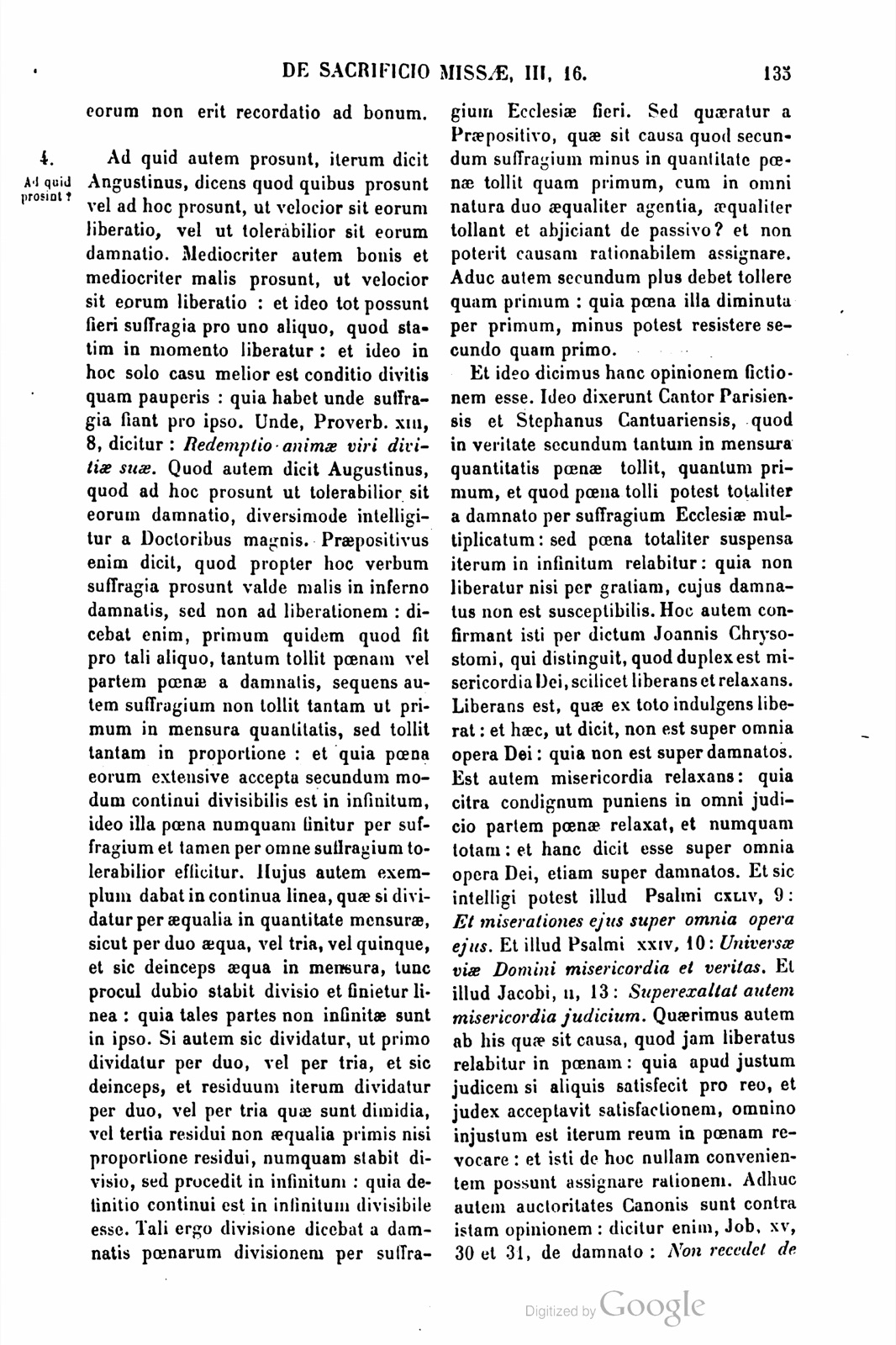
Et ideo dicimus hanc opinionem fictionem esse. Ideo dixerunt Cantor Parisiensis et Stephanus Cantuariensis, quod in veritate secundum tantum in mensura quantitatis poenae tollit, quantum primum, et quod poena tolli potest totaliter a damnato per suffragium Ecclesiae multiplicatum: sed poena totaliter suspensa iterum in infinitum relabitur: quia non liberatur nisi per gratiam, cujus damnatus non est susceptibilis. Hoc autem confirmant isti per dictum Joannis Chrysostomi, qui distinguit, quod duplex est misericordia Dei, scilicet liberans et relaxans. Liberans est, quae ex toto indulgens liberat: et haec, ut dicit, non est super omnia opera Dei: quia non est super damnatos. Est autem misericordia relaxans: quia citra condignum puniens in omni judicio partem poenae relaxat, et numquam totam: et hanc dicit esse super omnia opera Dei, etiam super damnatos. Et sic intelligi potest illud Psalmi CXLIV, 9: Et miserationes ejus super omnia opera ejus. Et illud Psalmi XXIV, 10: Universae viae Domini misericordia et veritas. Et illud Jacobi, II, 13: Superexaltat autem misericordia judicium. Quaerimus autem ab his quae sit causa, quod jam liberatus relabitur in poenam: quia apud justum judicem si aliquis satisfecit pro reo, et judex acceptavit satisfactionem, omnino injustum est iterum reum in poenam revocare: et isti de hoc nullam convenientem possunt assignare rationem. Adhuc autem auctoritates Canonis sunt contra istam opinionem: dicitur enim, Job, XV, 30 et 31, de damnato: Non recedet de tenebris: ramos ejus arefaciet flamma, et auferetur spiritu oris sui. Non credet frustra errore deceptus, quod aliquo pretio redimendus sit. Proverb. VI, 34 et 35: Quia zelus et furor viri non parcet in die vindictae: nec acquiescet cujusquam precibus, nec suscipiet pro redemptione dona plurima.
Ideo post istos venit magnus doctor Gulielmus Altisiodorensis, et dixit, quod pro certo poena ignis non diminuitur, nec suspenditur a damnatis per Ecclesiae suffragium, tamen prodest ut tolerabilior sit eorum damnatio: quia confortat patientem, ut confortato vigore levius ferat ignis incendium. Hujus autem dedit exemplum, sicut quando aliquis pondere magno gravatus, lassitudine debilitatur: si quis in faciem ejus fundit aquam frigidam, in nullo quidem pondus alleviat, et tamen illum ad levius sustinendum confortat et refrigerat: et in hoc sensu dixit divitem suffragium guttae aquae petere ut refrigeretur. Sed hoc valde mirabile est, qualiter etiam fingi possit hoc quod dicit iste: cum Abraham dicat tantum esse chaos 5, quod etiam minimum compassionis suffragium a sanctis ad damnatos non poterit derivari. Adhuc constat, quod nihil potest relevare poenam damnati nisi peccati diminutio vel dimissio: quia nihil facit animam ab igne passibilem nisi peccatum: peccatum autem nec dimittitur nec diminuitur nisi per gratiam. Gratia autem secundum fidem Catholicam non sunt susceptibiles damnati: quia dicit Damascenus, quod oportet scire, quia quod in Angelis est casus, hoc est in hominibus mors: et sicut Angeli post casum non sunt reparabiles vel gratiae susceptibiles, ita nec homines post mortem.
And therefore we say that this opinion is a fiction. Therefore the Parisian Cantor and Stephen of Canterbury said that in truth the second takes away as much in the measure of the quantity of punishment as the first, and that punishment can be taken away totally from a damned person through a multiplied suffrage of the Church, but that the totally suspended punishment slips back again without end, because he is not freed except by grace, of which a damned person is not susceptible. But these confirm this by the saying of John Chrysostom, who distinguishes that there is a twofold mercy of God, namely liberating and relaxing. The liberating is that which, pardoning entirely, liberates; and this, as he says, is not over all the works of God, because it is not over the damned. But there is a relaxing mercy, because, punishing short of what is deserved, it relaxes part of the punishment in every judgment and never the whole; and he says this is over all the works of God, even over the damned. And thus that saying of Psalm 144:9 can be understood: And his mercies are over all his works. And that saying of Psalm 24:10: All the ways of the Lord are mercy and truth. And that saying of James 2:13: Mercy exalts itself above judgment. But we ask these what the cause is that someone already freed slips back into punishment, because before a just judge, if someone has satisfied for a guilty person and the judge has accepted the satisfaction, it is altogether unjust to call the guilty person back again into punishment; and they can assign no fitting reason for this. Moreover, the authorities of the Canon are against that opinion; for it is said, Job 15:30 and 31, concerning the damned person: He shall not depart from darkness; flame shall dry up his branches, and he shall be taken away by the spirit of his mouth. Deceived by empty error, he will not believe that he must be redeemed by any price. Proverbs 6:34 and 35: Because the jealousy and fury of a man will not spare in the day of vengeance; nor will he yield to anyone's prayers, nor accept many gifts for redemption.
Therefore after these came the great doctor William of Auxerre, and he said that certainly the punishment of fire is not diminished nor suspended from the damned by the suffrage of the Church, yet it profits so that their damnation be more tolerable, because it strengthens the sufferer so that, with strength strengthened, he may bear the burning of the fire more lightly. Of this he gave an example: as when someone burdened by a great weight is weakened by weariness; if someone pours cold water on his face, he does not lessen the weight at all, and nevertheless strengthens and refreshes him for sustaining it more lightly. And in this sense he said that the rich man sought the suffrage of a drop of water so that he might be refreshed. But it is very marvelous how what he says can even be imagined, since Abraham says that the chaos is so great 5 that even the least suffrage of compassion cannot be derived from the saints to the damned. Moreover, it is certain that nothing can relieve the punishment of a damned person except the diminution or remission of sin, because nothing makes the soul passible by fire except sin; but sin is neither remitted nor diminished except through grace. But according to the Catholic faith the damned are not susceptible of grace, because Damascene says that it must be known that what fall is in Angels, death is in human beings; and just as Angels after the fall are not reparable or susceptible of grace, so neither are human beings after death.
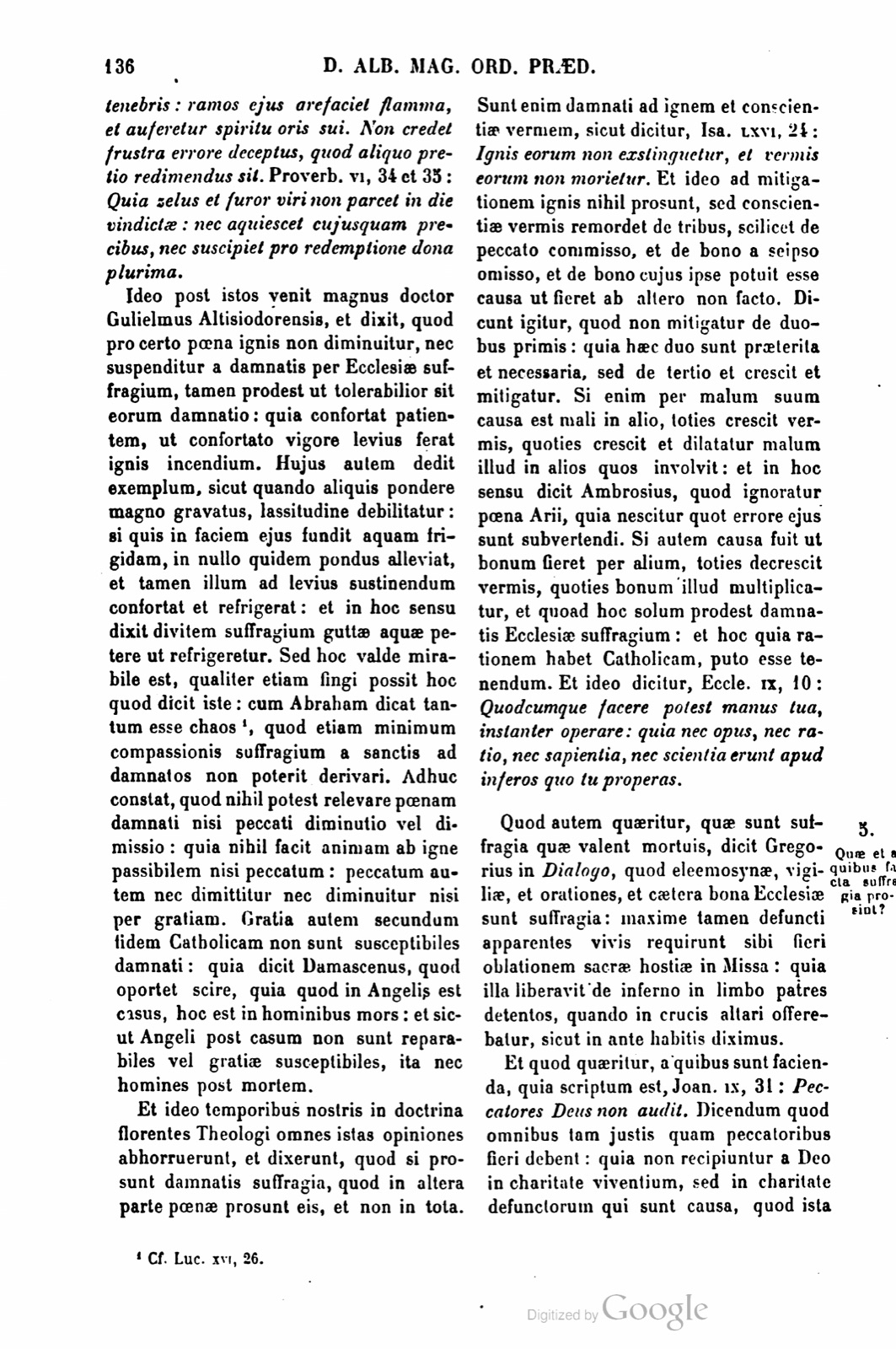
Et ideo temporibus nostris in doctrina florentes Theologi omnes istas opiniones abhorruerunt, et dixerunt, quod si prosunt damnatis suffragia, quod in altera parte poenae prosunt eis, et non in tota. Sunt enim damnati ad ignem et conscientiae vermem, sicut dicitur, Isa. LXVI, 24: Ignis eorum non exstinguetur, et vermis eorum non morietur. Et ideo ad mitigationem ignis nihil prosunt, sed conscientiae vermis remordet de tribus, scilicet de peccato commisso, et de bono a seipso omisso, et de bono cujus ipse potuit esse causa ut fieret ab altero non facto. Dicunt igitur, quod non mitigatur de duobus primis: quia haec duo sunt praeterita et necessaria, sed de tertio et crescit et mitigatur. Si enim per malum suum causa est mali in alio, toties crescit vermis, quoties crescit et dilatatur malum illud in alios quos involvit: et in hoc sensu dicit Ambrosius, quod ignoratur poena Arii, quia nescitur quot errore ejus sunt subvertendi. Si autem causa fuit ut bonum fieret per alium, toties decrescit vermis, quoties bonum illud multiplicatur, et quoad hoc solum prodest damnatis Ecclesiae suffragium: et hoc quia rationem habet Catholicam, puto esse tenendum. Et ideo dicitur, Eccle. IX, 10: Quodcumque facere potest manus tua, instanter operare: quia nec opus, nec ratio, nec sapientia, nec scientia erunt apud inferos quo tu properas.
[Marginal label: Quae et a quibus facta suffragia prosint?] 5. Quod autem quaeritur, quae sunt suffragia quae valent mortuis, dicit Gregorius in Dialogo, quod eleemosynae, vigiliae, et orationes, et caetera bona Ecclesiae sunt suffragia: maxime tamen defuncti apparentes vivis requirunt sibi fieri oblationem sacrae hostiae in Missa: quia illa liberavit de inferno in limbo patres detentos, quando in crucis altari offerebatur, sicut in ante habitis diximus.
Et quod quaeritur, a quibus sunt facienda, quia scriptum est, Joan. IX, 31: Peccatores Deus non audit. Dicendum quod omnibus tam justis quam peccatoribus fieri debent: quia non recipiuntur a Deo in charitate viventium, sed in charitate defunctorum qui sunt causa, quod ista fiunt a vivis. Si enim quaereretur justus qui faceret, cum nemo sciat utrum odio vel amore dignus sit 6, revocaretur in dubium totum quod facit Ecclesia de suffragiis defunctorum.
Sic igitur Ecclesia Catholica tali fide offert pro defunctis omnibus: quia de quolibet praesumit, quod sit in loco purgandorum, cum sibi constare non possit de impoenitentia finali alicujus, quia solus Deus novit corda decedentium. Scit ergo Ecclesia illud dictum Domini, Ezechiel. XVIII, 21 et 22: Si impius egerit poenitentiam ab omnibus peccatis suis, ... omnium iniquitatum ejus, quas operatus est, non recordabor. Et pie credit Ecclesia, quod multi etiam post positionem loquelae de peccatis suis ingemiscunt in poenitentiam salutarem. Pro excommunicatis tamen et publice damnatis non nisi silenter in corde et non publice orare consuevit Ecclesia.
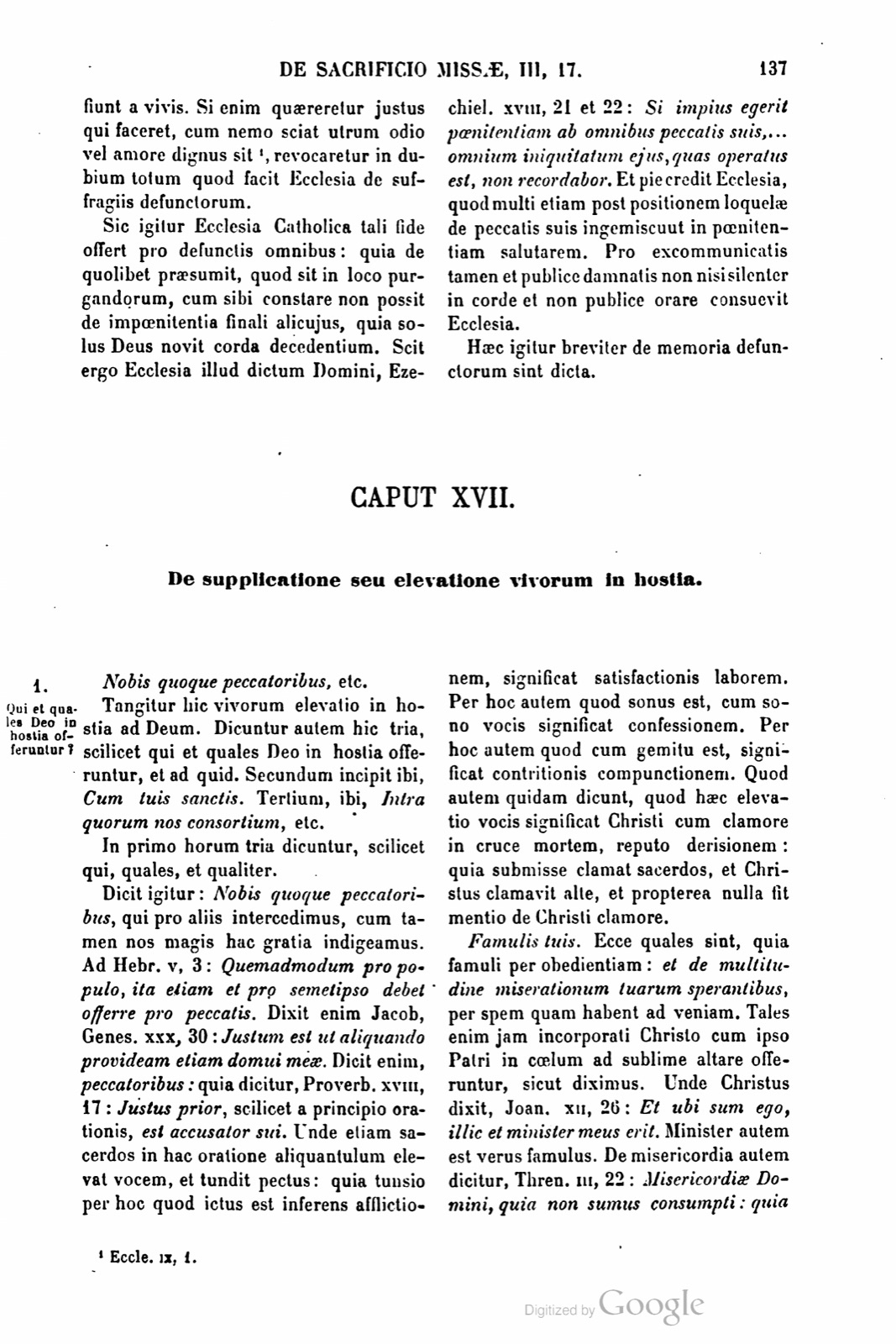
Haec igitur breviter de memoria defunctorum sint dicta.
And therefore in our times all theologians flourishing in doctrine abhorred these opinions and said that if suffrages profit the damned, they profit them in the other part of punishment, and not in the whole. For the damned are assigned to fire and the worm of conscience, as is said, Isaiah 66:24: Their fire shall not be extinguished and their worm shall not die. And therefore they profit nothing for the mitigation of the fire, but the worm of conscience gnaws concerning three things, namely concerning sin committed, and concerning the good omitted by oneself, and concerning the good of which one could have been the cause so that it would be done by another and was not done. Therefore they say that it is not mitigated concerning the first two, because these two are past and necessary, but concerning the third it both grows and is mitigated. For if by his evil he is a cause of evil in another, the worm grows as often as that evil grows and is spread into others whom it involves; and in this sense Ambrose says that the punishment of Arius is unknown, because it is not known how many are to be subverted by his error. But if he was a cause that good be done through another, the worm decreases as often as that good is multiplied; and with respect to this alone the suffrage of the Church profits the damned. And because this has a Catholic reason, I think it is to be held. And therefore it is said, Ecclesiastes 9:10: Whatever thy hand can do, work urgently, because neither work, nor reason, nor wisdom, nor knowledge will be in the lower regions to which thou hastenest.
[Marginal label: What suffrages, and by whom done, are useful.] 5. But as to the question what suffrages avail for the dead, Gregory says in the Dialogues that alms, vigils, and prayers, and the other good things of the Church are suffrages; yet the departed, appearing to the living, most of all ask that the oblation of the sacred host in Mass be made for them, because it freed from hell the fathers detained in limbo when it was offered on the altar of the cross, as we have said in what has gone before.
And as to the question by whom they are to be done, because it is written, John 9:31: God does not hear sinners. It must be said that they ought to be done by all, both just persons and sinners, because they are not received by God in the charity of the living, but in the charity of the departed, who are the cause that these things are done by the living. For if the just person who would perform them were sought, since no one knows whether he is worthy of hatred or love 6, the whole thing which the Church does concerning suffrages of the departed would be called into doubt.
Thus, therefore, with such faith the Catholic Church offers for all the departed, because concerning each one it presumes that he is in the place of those to be purged, since it cannot be certain to her concerning anyone's final impenitence, because God alone knows the hearts of those dying. Therefore the Church knows that saying of the Lord, Ezekiel 18:21 and 22: If the impious man shall do penance for all his sins, ... I will not remember all his iniquities which he has worked. And the Church piously believes that many, even after the setting down of speech, groan over their sins unto saving penance. Nevertheless for the excommunicated and publicly condemned the Church is accustomed to pray only silently in the heart and not publicly.
Therefore let these things have been said briefly concerning the memory of the departed.
If a page does not appear, its photograph has not been uploaded yet.