Works › The Book on the Sacrifice of the Mass
Volume 38 · pp. 75–77
Tractate III, Chapter I
A marker with ≈ is an approximate page boundary, placed by measure of the text; the page photographs remain the authority. In the paired views, clicking a page marker brings that page into view.
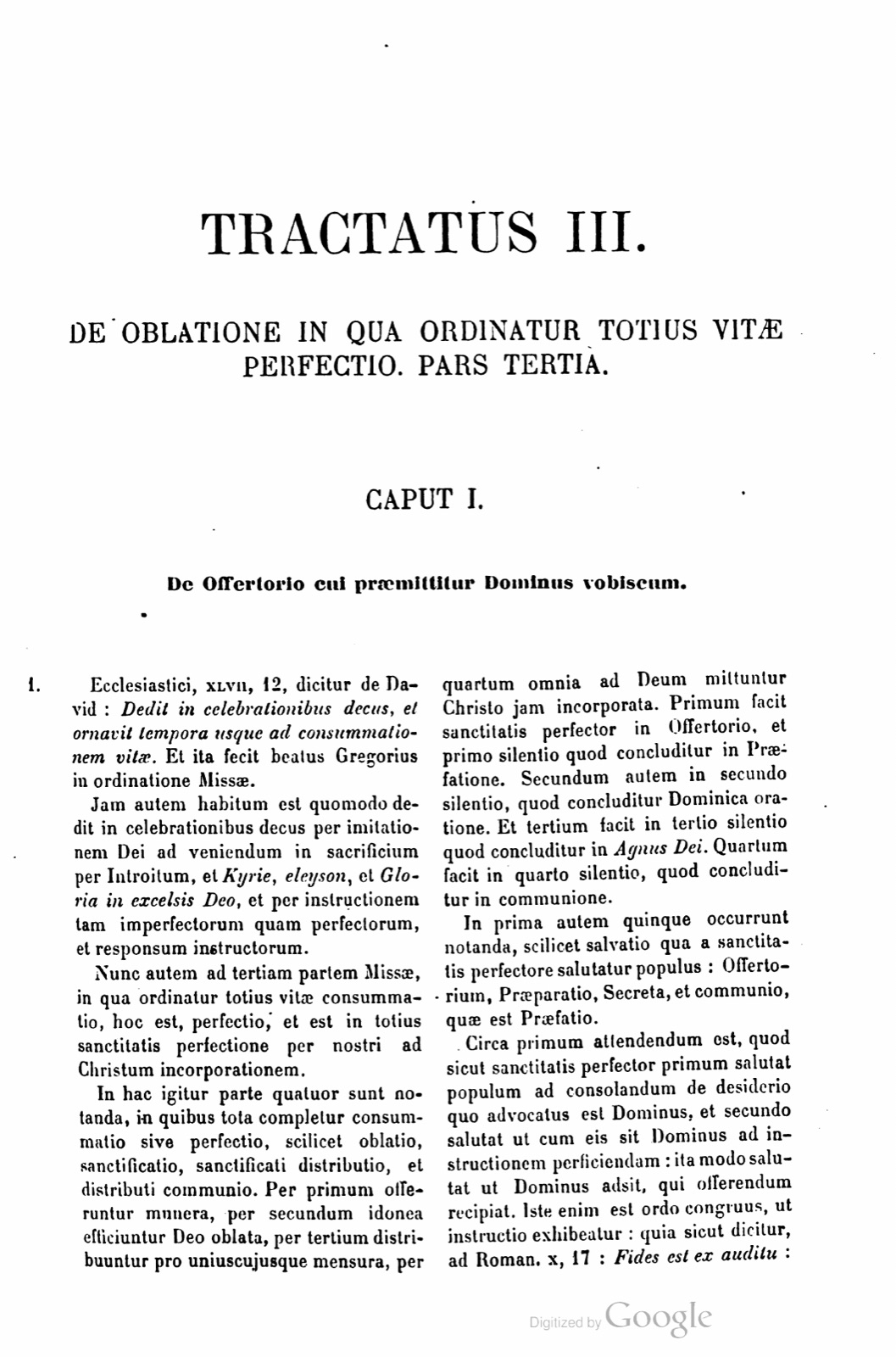
TRACTATUS III.
DE OBLATIONE IN QUA ORDINATUR TOTIUS VITAE PERFECTIO. PARS TERTIA.
CAPUT I.
De Offertorio cui praemittitur Dominus vobiscum.
1. Ecclesiastici, XLVI, 12, dicitur de David: Dedit in celebrationibus decus, et ornavit tempora usque ad consummationem vitae. Et ita fecit beatus Gregorius in ordinatione Missae.
Jam autem habitum est quomodo dedit in celebrationibus decus per imitationem Dei ad veniendum in sacrificium per Introitum, et Kyrie, eleyson, et Gloria in excelsis Deo, et per instructionem tam imperfectorum quam perfectorum, et responsum instructorum.
Nunc autem ad tertiam partem Missae, in qua ordinatur totius vitae consummatio, hoc est, perfectio, et est in totius sanctitatis perfectione per nostri ad Christum incorporationem.
In hac igitur parte quatuor sunt notanda, in quibus tota completur consummatio sive perfectio, scilicet oblatio, sanctificatio, sanctificati distributio, et distributi communio. Per primum offeruntur munera, per secundum idonea efficiuntur Deo oblata, per tertium distribuuntur pro uniuscujusque mensura, per quartum omnia ad Deum mittuntur Christo jam incorporata. Primum facit sanctitatis perfector in Offertorio, et primo silentio quod concluditur in Praefatione. Secundum autem in secundo silentio, quod concluditur Dominica oratione. Et tertium facit in tertio silentio quod concluditur in Agnus Dei. Quartum facit in quarto silentio, quod concluditur in communione.
In prima autem quinque occurrunt notanda, scilicet salvatio qua a sanctitatis perfectore salutatur populus: Offertorium, Praeparatio, Secreta, et communio, quae est Praefatio.
Circa primum attendendum est, quod sicut sanctitatis perfector primum salutat populum ad consolandum de desiderio quo advocatus est Dominus, et secundo salutat ut cum eis sit Dominus ad instructionem perficiendam: ita modo salutat ut Dominus adsit, qui offerendum recipiat. Iste enim est ordo congruus, ut instructio exhibeatur: quia sicut dicitur, ad Roman. X, 17: Fides est ex auditu: auditus autem per verbum Christi. Et quod post hoc quisque fidem perceptam ore confiteatur: quia, sicut dicitur ibidem, ad Roman. X, 10: Corde creditur ad justitiam, ore autem confessio fit ad salutem. Psal. CXV, 10: Credidi, propter quod locutus sum. Et tertio, fructus totus est, ut credens populus Domino offeratur. Ad Hebr. XIII, 15: Per ipsum ergo offeramus sacrificium laudis semper Deo, id est, fructum labiorum nostrorum confitentium nomini ejus.
Hac igitur ratione sanctitatis perfector dicit: Dominus vobiscum, convertens se ad populum. Dominus, inquam, vobiscum, ut in sacrificium Deo offeramini. Dominus vobiscum, ut circa saporem oblationis afficiamini. Dominus vobiscum, ut oblato sacrificio incorporemini. Dominus enim vobiscum est, quando sibi vos oblatos suscipit, quando vos circa suum sacrificium affici facit, quando vos sibi unum facit et unit. De primo dicitur, II Paralip. XX, 17: Cras egrediemini contra eos, et Dominus erit vobiscum. Jam enim confessione fidei fuistis cum Domino, et ideo Dominus vobiscum est. De secundo dicitur, Genes. XXVIII, 20: Si fuerit Deus mecum, et custodierit me in via, per quam ego ambulo, et dederit mihi panem ad vescendum, hoc est, ad gustum sui in specie panis, erit mihi Dominus in Deum. Psal. XXXIII, 9: Gustate, et videte quoniam suavis est Dominus. I Petri, II, 3: Si tamen gustastis, quoniam dulcis est Dominus. De tertio dicitur, Numer. XIV, 7 et seq.: Terra, quam circuivimus, valde bona est. Si propitius fuerit Dominus, inducet nos in eam. Et post pauca, v. 9: Dominus nobiscum est, nolite metuere. Haec enim terra est terrae nostrae benedictus fructus, qui est corpus Domini, in quod nos inducit per unionem sui: et ad hoc optatur esse nobiscum. Igitur dicit hoc loco: Dominus vobiscum. Respondetur autem ex parte offerentium: Et cum spiritu tuo: quia hoc sacrificium quod in spiritu offertur, acceptatur a Domino. Daniel. II, 59: In animo contrito et spiritu humilitatis suscipiamur. Psal. L, 19: Sacrificium Deo spiritus contribulatus, cor contritum, etc. Hac igitur de causa hic dicit: Et cum spiritu tuo.
TRACTATE III.
ON THE OBLATION IN WHICH THE PERFECTION OF THE WHOLE LIFE IS ORDERED. THIRD PART.
CHAPTER I.
On the Offertory, before which The Lord be with you is put.
1. In Ecclesiasticus 46:12 it is said of David: He gave beauty in the celebrations, and adorned the times even to the consummation of life. And blessed Gregory did so in the ordering of the Mass.
But now it has been had how he gave beauty in the celebrations by imitation of God for coming into the sacrifice through the Introit, and Kyrie eleison, and Glory to God in the highest, and through the instruction both of the imperfect and of the perfect, and the response of those instructed.
But now to the third part of the Mass, in which the consummation of the whole life, that is, perfection, is ordered, and it consists in the perfection of all sanctity through our incorporation into Christ.
Therefore in this part four things are to be noted, in which the whole consummation or perfection is completed, namely oblation, sanctification, distribution of what has been sanctified, and communion of what has been distributed. Through the first, gifts are offered; through the second, the things offered are made fit for God; through the third, they are distributed according to the measure of each one; through the fourth, all things, now incorporated in Christ, are sent to God. The perfecter of sanctity does the first in the Offertory and in the first silence, which is concluded in the Preface. But the second he does in the second silence, which is concluded by the Lord's prayer. And he does the third in the third silence, which is concluded in the Agnus Dei. He does the fourth in the fourth silence, which is concluded in communion.
But in the first, five things occur to be noted: namely the salutation by which the people are greeted by the perfecter of sanctity, the Offertory, the Preparation, the Secret, and the communion, which is the Preface.
Concerning the first one must attend that just as the perfecter of sanctity first greets the people for consoling them concerning the desire by which the Lord has been called, and secondly greets them so that the Lord may be with them for completing the instruction, so now he greets them so that the Lord may be present, who receives what is to be offered. For this is the fitting order, that instruction be exhibited, because, as is said, Romans 10:17: Faith is from hearing, and hearing through the word of Christ. And after this each one should confess by mouth the faith he has received, because, as is said in the same place, Romans 10:10: With the heart one believes unto justice, but with the mouth confession is made unto salvation. Psalm 115:10: I believed, on account of which I spoke. And thirdly, the whole fruit is that the believing people be offered to the Lord. Hebrews 13:15: Through him therefore let us always offer a sacrifice of praise to God, that is, the fruit of our lips confessing his name.
Therefore for this reason the perfecter of sanctity says: The Lord be with you, turning himself to the people. The Lord, I say, be with you, so that you may be offered to God as sacrifice. The Lord be with you, so that you may be affected concerning the savor of the oblation. The Lord be with you, so that, when the sacrifice has been offered, you may be incorporated. For the Lord is with you when he receives you offered to himself, when he makes you be affected concerning his sacrifice, when he makes and unites you as one to himself. Concerning the first it is said, 2 Paralipomenon 20:17: Tomorrow you shall go out against them, and the Lord will be with you. For now by confession of faith you have been with the Lord, and therefore the Lord is with you. Concerning the second it is said, Genesis 28:20: If God will be with me, and keep me on the way by which I walk, and will give me bread to eat, that is, for tasting him under the species of bread, he will be the Lord to me for God. Psalm 33:9: Taste and see that the Lord is sweet. 1 Peter 2:3: If nevertheless you have tasted that the Lord is sweet. Concerning the third it is said, Numbers 14:7 and following: The land which we have gone around is very good. If the Lord is favorable, he will lead us into it. And a little after, verse 9: The Lord is with us; do not fear. For this land is the blessed fruit of our land, which is the body of the Lord, into which he leads us through union with himself; and for this he is desired to be with us. Therefore he says in this place: The Lord be with you. But from the part of those offering, the response is: And with thy spirit, because this sacrifice which is offered in spirit is accepted by the Lord. Daniel 2:59: In a contrite soul and spirit of humility may we be received. Psalm 50:19: A sacrifice to God is a troubled spirit, a contrite heart, etc. Therefore for this reason he says here: And with thy spirit.
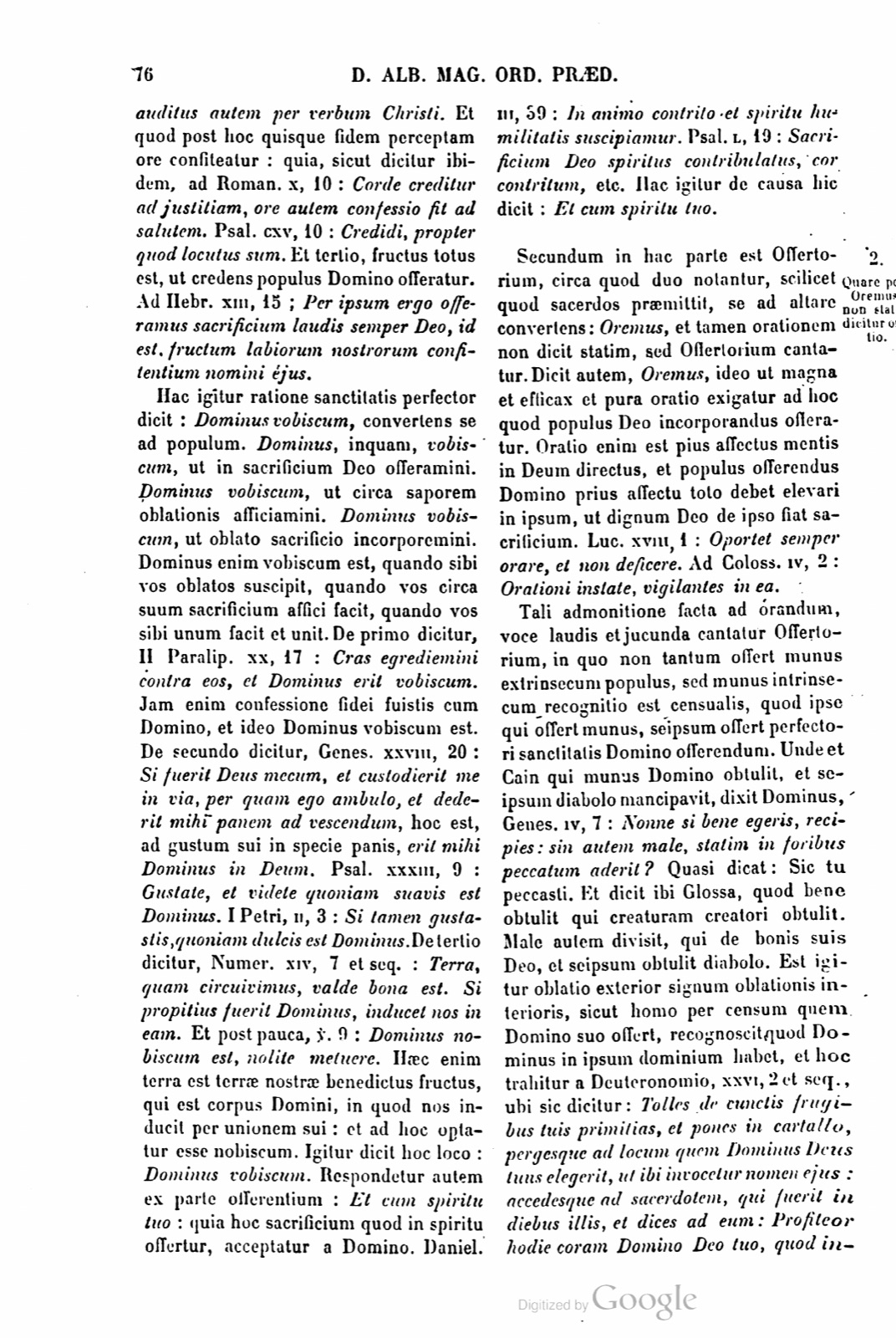
2. Secundum in hac parte est Offertorium, circa quod duo notantur, scilicet quod sacerdos praemittit, se ad altare convertens: Oremus, et tamen orationem non dicit statim, sed Offertorium cantatur. Dicit autem, Oremus, ideo ut magna et efficax et pura oratio exigatur ad hoc quod populus Deo incorporandus offeratur. Oratio enim est pius affectus mentis in Deum directus, et populus offerendus Domino prius affectu toto debet elevari in ipsum, ut dignum Deo de ipso fiat sacrificium. Luc. XVIII, 1: Oportet semper orare, et non deficere. Ad Coloss. IV, 2: Orationi instate, vigilantes in ea.
Tali admonitione facta ad orandum, voce laudis et jucunda cantatur Offertorium, in quo non tantum offert munus extrinsecum populus, sed munus intrinsecum recognitio est censualis, quod ipse qui offert munus, seipsum offert perfectori sanctitatis Domino offerendum. Unde et Cain qui munus Domino obtulit, et seipsum diabolo mancipavit, dixit Dominus, Genes. IV, 7: Nonne si bene egeris, recipies: sin autem male, statim in foribus peccatum aderit? Quasi dicat: Sic tu peccasti. Et dicit ibi Glossa, quod bene obtulit qui creaturam creatori obtulit. Male autem divisit, qui de bonis suis Deo, et seipsum obtulit diabolo. Est igitur oblatio exterior signum oblationis interioris, sicut homo per censum quem Domino suo offert, recognoscit quod Dominus in ipsum dominium habet, et hoc trahitur a Deuteronomio, XXVI, 2 et seq., ubi sic dicitur: Tolles de cunctis frugibus tuis primitias, et pones in cartallo, pergesque ad locum quem Dominus Deus tuus elegerit, ut ibi invocetur nomen ejus: accedesque ad sacerdotem, qui fuerit in diebus illis, et dices ad eum: Profiteor hodie coram Domino Deo tuo, quod ingressus sum in terram pro qua juravit patribus nostris ut daret eam nobis. Suscipiensque sacerdos cartallum de manu tua, ponet ante altare Domini Dei tui. Et aliquibus interpositis, v. 10 et 11, dicit sic ille qui munus obtulit: Idcirco nunc offero primitias frugum terrae, quam Dominus dedit mihi. Et dimittes eas in conspectu Domini Dei tui, et adorato Domino Deo tuo. Et epulaberis in omnibus bonis quae Dominus Deus tuus dederit tibi. Sic enim per oblationem recognoscit se pertinere ad Dominum, et oblatus illi secum epulabitur in convivio corporis et sanguinis Domini.
2. The second thing in this part is the Offertory, concerning which two things are noted, namely that the priest puts before, turning himself to the altar: Let us pray, and nevertheless he does not immediately say a prayer, but the Offertory is sung. But he says, Let us pray, so that a great and efficacious and pure prayer may be required for this, that the people to be incorporated into God may be offered. For prayer is a pious affection of the mind directed into God, and the people to be offered to the Lord must first be raised up into him by their whole affection, so that a sacrifice worthy of God may be made from the people. Luke 18:1: It is necessary always to pray, and not to fail. Colossians 4:2: Be instant in prayer, watching in it.
When such an admonition to pray has been made, the Offertory is sung with a voice of praise and a joyful one. In it the people offer not only an extrinsic gift, but the recognition of an intrinsic gift is a censual recognition, because the one who offers the gift offers himself to be offered to the Lord, the perfecter of sanctity. Hence also Cain, who offered a gift to the Lord and enslaved himself to the devil, to him the Lord said, Genesis 4:7: If you have done well, will you not receive? But if badly, sin will immediately be at the doors. As if he were saying: Thus you have sinned. And the Gloss says there that he offered well who offered the creature to the creator. But he divided badly who offered to God from his goods, and offered himself to the devil. Therefore exterior oblation is a sign of interior oblation, as a human being through the census that he offers to his lord recognizes that the lord has dominion over him; and this is drawn from Deuteronomy 26:2 and following, where it is said thus: You shall take from all your crops the firstfruits, and you shall place them in a basket, and you shall go to the place which the Lord your God has chosen, so that his name may be invoked there; and you shall approach the priest who will be in those days, and you shall say to him: I profess today before the Lord your God that I have entered into the land concerning which he swore to our fathers that he would give it to us. And the priest, receiving the basket from your hand, will set it before the altar of the Lord your God. And with some things interposed, verses 10 and 11, he who offered the gift says thus: For this reason I now offer the firstfruits of the crops of the land which the Lord gave me. And you shall leave them in the sight of the Lord your God, and when the Lord your God has been adored. And you shall feast in all the goods which the Lord your God has given you. For thus through oblation he recognizes that he belongs to the Lord, and having been offered to him, he will feast with him in the banquet of the body and blood of the Lord.
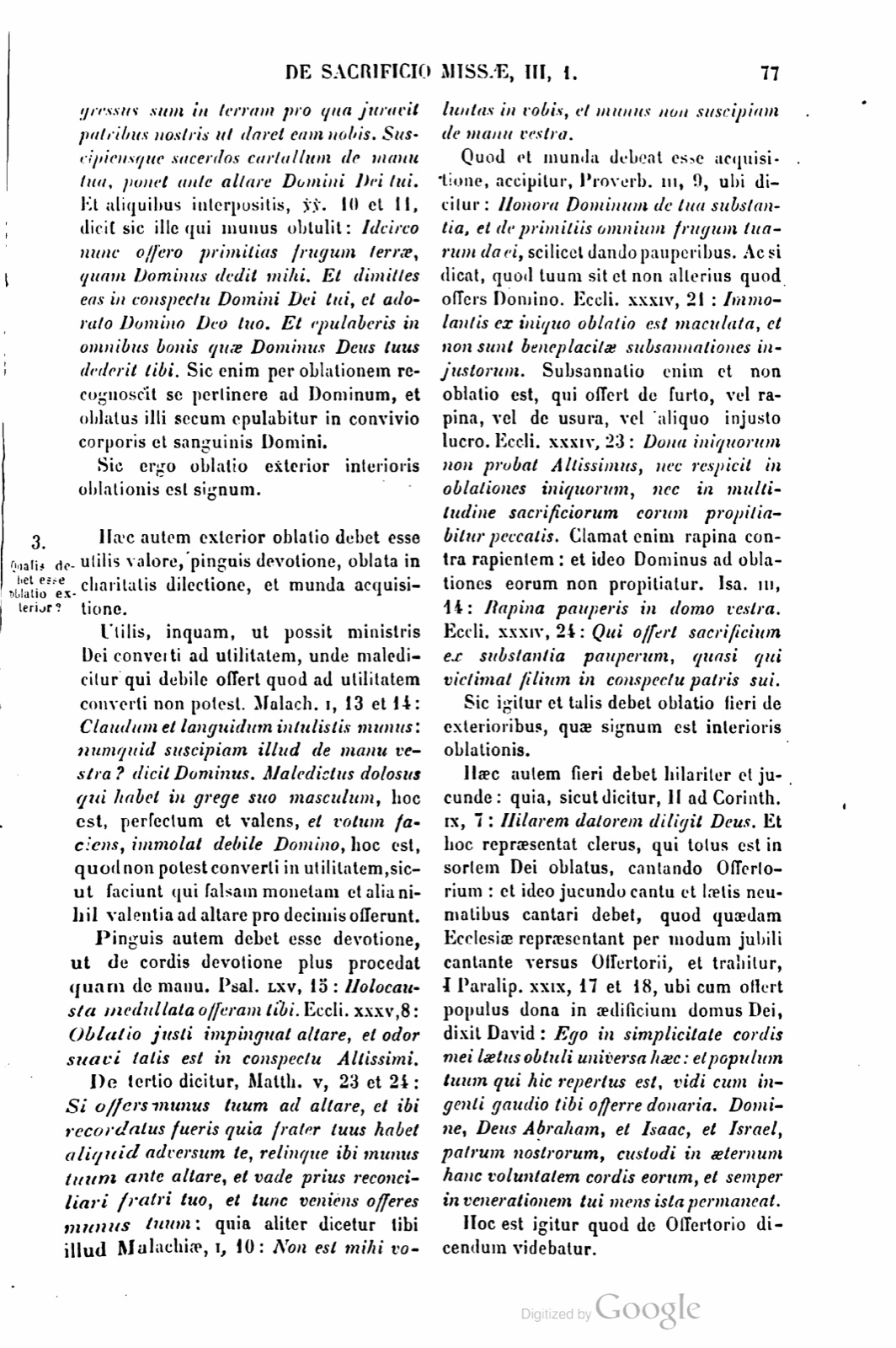
Sic ergo oblatio exterior interioris oblationis est signum.
[Marginal label: Qualis debet esse oblatio exterior?] 3. Haec autem exterior oblatio debet esse utilis valore, pinguis devotione, oblata in charitatis dilectione, et munda acquisitione.
Utilis, inquam, ut possit ministris Dei converti ad utilitatem, unde maledicitur qui debile offert quod ad utilitatem converti non potest. Malach. I, 13 et 14: Claudum et languidum intulistis munus: numquid suscipiam illud de manu vestra? dicit Dominus. Maledictus dolosus qui habet in grege suo masculum, hoc est, perfectum et valens, et votum faciens, immolat debile Domino, hoc est, quod non potest converti in utilitatem, sicut faciunt qui falsam monetam et alia nihil valentia ad altare pro decimis offerunt.
Pinguis autem debet esse devotione, ut de cordis devotione plus procedat quam de manu. Psal. LXV, 15: Holocausta medullata offeram tibi. Eccli. XXXV, 8: Oblatio justi impinguat altare, et odor suavitatis est in conspectu Altissimi.
De tertio dicitur, Matth. V, 23 et 24: Si offers munus tuum ad altare, et ibi recordatus fueris quia frater tuus habet aliquid adversum te, relinque ibi munus tuum ante altare, et vade prius reconciliari fratri tuo, et tunc veniens offeres munus tuum: quia aliter dicetur tibi illud Malachiae, I, 10: Non est mihi voluntas in vobis, et munus non suscipiam de manu vestra.
Quod et munda debeat esse acquisitione, accipitur, Proverb. III, 9, ubi dicitur: Honora Dominum de tua substantia, et de primitiis omnium frugum tuarum da ei, scilicet dando pauperibus. Ac si dicat, quod tuum sit et non alterius quod offers Domino. Eccli. XXXIV, 21: Immolantis ex iniquo oblatio est maculata, et non sunt beneplacitae subsannationes injustorum. Subsannatio enim et non oblatio est, qui offert de furto, vel rapina, vel de usura, vel aliquo injusto lucro. Eccli. XXXIV, 23: Dona iniquorum non probat Altissimus, nec respicit in oblationes iniquorum, nec in multitudine sacrificiorum eorum propitiabitur peccatis. Clamat enim rapina contra rapientem: et ideo Dominus ad oblationes eorum non propitiatur. Isa. III, 14: Rapina pauperis in domo vestra. Eccli. XXXIV, 24: Qui offert sacrificium ex substantia pauperum, quasi qui victimat filium in conspectu patris sui.
Sic igitur et talis debet oblatio fieri de exterioribus, quae signum est interioris oblationis.
Haec autem fieri debet hilariter et jucunde: quia, sicut dicitur, II ad Corinth. IX, 7: Hilarem datorem diligit Deus. Et hoc repraesentat clerus, qui totus est in sortem Dei oblatus, cantando Offertorium: et ideo jucundo cantu et laetis neumatibus cantari debet, quod quaedam Ecclesiae repraesentant per modum jubili cantante versus Offertorii, et trahitur, I Paralip. XXIX, 17 et 18, ubi cum offert populus dona in aedificium domus Dei, dixit David: Ego in simplicitate cordis mei laetus obtuli universa haec: et populum tuum qui hic repertus est, vidi cum ingenti gaudio tibi offerre donaria. Domine, Deus Abraham, et Isaac, et Israel, patrum nostrorum, custodi in aeternum hanc voluntatem cordis eorum, et semper in venerationem tui mens ista permaneat.
Hoc est igitur quod de Offertorio dicendum videbatur.
Thus therefore exterior oblation is the sign of interior oblation.
[Marginal label: What sort of exterior oblation ought there to be?] 3. But this exterior oblation ought to be useful in value, fat in devotion, offered in the love of charity, and clean in acquisition.
Useful, I say, so that it can be converted to usefulness for the ministers of God. Hence one who offers a feeble thing which cannot be converted to usefulness is cursed. Malachi 1:13 and 14: You have brought in a lame and sick gift. Shall I receive it from your hand? says the Lord. Cursed is the deceitful man who has in his flock a male, that is, something perfect and strong, and, making a vow, sacrifices a feeble thing to the Lord, that is, what cannot be converted to usefulness, as those do who offer false money and other worthless things at the altar for tithes.
But it ought to be fat in devotion, so that it proceeds more from devotion of the heart than from the hand. Psalm 65:15: I will offer to thee marrowy holocausts. Ecclesiasticus 35:8: The oblation of the just fattens the altar, and the odor of sweetness is in the sight of the Most High.
Concerning the third it is said, Matthew 5:23 and 24: If you offer your gift at the altar, and there remember that your brother has something against you, leave your gift there before the altar, and first go to be reconciled to your brother, and then coming you shall offer your gift, because otherwise that word of Malachi 1:10 will be said to you: There is no will for me in you, and I will not receive a gift from your hand.
That it also ought to be clean in acquisition is taken from Proverbs 3:9, where it is said: Honor the Lord from your substance, and from the firstfruits of all your crops give to him, namely by giving to the poor. As if he were saying that what you offer to the Lord should be yours and not another's. Ecclesiasticus 34:21: The oblation of one sacrificing from injustice is stained, and the mockeries of the unjust are not well-pleasing. For it is mockery and not oblation when someone offers from theft, or robbery, or usury, or some unjust gain. Ecclesiasticus 34:23: The Most High does not approve the gifts of the wicked, nor does he look upon the oblations of the wicked, nor will he be propitiated for sins in the multitude of their sacrifices. For robbery cries out against the robber; and therefore the Lord is not propitiated toward their oblations. Isaiah 3:14: The robbery of the poor is in your house. Ecclesiasticus 34:24: He who offers sacrifice from the substance of the poor is like one who sacrifices a son in the sight of his father.
Thus therefore such an oblation also ought to be made from exterior things, which is a sign of interior oblation.
But these things ought to be done cheerfully and joyfully, because, as is said, 2 Corinthians 9:7: God loves a cheerful giver. And this the clergy, who have wholly been offered into the lot of God, represent by singing the Offertory. And therefore it ought to be sung with joyful song and glad neumes, which certain Churches represent after the mode of jubilation by singing the verses of the Offertory. And it is drawn from 1 Paralipomenon 29:17 and 18, where, when the people offered gifts for the building of the house of God, David said: In the simplicity of my heart I joyfully offered all these things; and I saw your people who are found here offering gifts to you with great joy. O Lord, God of Abraham and Isaac and Israel, our fathers, keep forever this will of their heart, and may this mind always remain for the veneration of you.
This therefore is what seemed to need saying about the Offertory.
If a page does not appear, its photograph has not been uploaded yet.