Works › The Book on the Sacrifice of the Mass
Volume 38 · pp. 69–72
Chapter X, Articles III-IX
A marker with ≈ is an approximate page boundary, placed by measure of the text; the page photographs remain the authority. In the paired views, clicking a page marker brings that page into view.
ARTICULUS III.
De tertio autem articulo dixerunt: Qui propter nos homines, et propter nostram salutem, descendit de caelis: et incarnatus est de Spiritu sancto ex Maria Virgine, et homo factus est. [Marginal label: Contra Manichaeum.] Et ista expressio articuli incarnationis facta est contra Manichaeum. Ille enim dixit, quod non propter homines nec propter salutem hominum descendit, sed potius descendit a Lucifero expulsus, et quod adhuc Lucifer reascensurus sit in caelum ad sedem, unde in ascensione Christi expulsus est. Fingit enim, quod praelium magnum factum sit in caelo, sicut dicitur, Apocal. XII, 7. Et quod in primo proelio expulsus est Christus, et in secundo expulsus sit Lucifer. Et hoc proelium dicit fuisse inter duos deos, Deum scilicet lucis, et Deum tenebrarum, sive Deum bonum et Deum malum.
Hoc igitur excludentes Patres, dicunt quod nulla necessitate et nulla violentia detrusus, sed charitate hominum et amore salutis eorum descendit de caelis, non caelos relinquendo secundum divinitatem, sed in nostris quae assumpsit, visibilis in hoc mundo apparendo. Ad Ephes. IV, 10: Qui descendit, ipse est et qui ascendit super omnes caelos, ut impleret omnia. Joan. III, 13: Nemo ascendit in caelum, nisi qui descendit de caelo. Joan. III, 16: Sic Deus dilexit mundum, ut Filium suum unigenitum daret.
Quia autem idem Manes dicit non esse veram carnem Christi, sed phantasma fuisse, eo quod sicut asserit, malus Deus istam carnem vitiosam fecerit, et hanc carnem non posse esse de bono Deo, ideo addiderunt: Et incarnatus est de Spiritu sancto, qui non nisi bonus Deus esse poterit. Et praepositio de quando dicitur de Spiritu sancto, notat potestatem et operationem, et non notat materiam: quia si de materia substantiae Spiritus sancti factus esset Christus, tunc sequeretur quod Spiritus sanctus esset Pater Filii secundum humanam generationem: et hoc est impium, quia Christus non habet Patrem, nisi secundum aeternam generationem, ut dicit Augustinus, quod in terris est sine patre et in caelis sine matre.
Ex Maria autem additur, ut vera caro connaturalis matri esse credatur, et non phantastica, sicut dixit Manichaeus.
Virgine autem additur propter Ebionitas, qui non Mariam virginem in partu dixerunt, et post partum: quia dixerunt, quod tantum Christum hominem ex maternis visceribus protulit, et non Deum. Et quia homo purus de utero virginali non exit, nisi apertis claustris pudoris, ideo dixerunt Mariam in partu Christi esse devirginatam. Hi etiam dixerunt, quod Maria esset Χριστότοκος, hoc est, Christi hominis mater, et non esset Θεότοκος, hoc est, veri Dei mater. Ideo eadem synodus statuit, quod Virgo Θεότοκος, et non Χριστότοκος deinceps diceretur. [Marginal label: Maria theotocos.]
Et quia Manes dixit, quod Christus humanatus sicut habitu aliquis dicitur tunicatus, vel cappatus, vel palliatus, et non esset homo verus, eo quod non sibi naturaliter et essentialiter univisset hominis naturam, sed extrinsecus tantum, et extrinsecus habitualiter assumpsisset sibi hominis naturam. Et ideo ad excludendum hunc errorem, addidit sancta synodus: Et homo factus est: factum enim erat. Joan. I, 14: Verbum caro factum est, etc. Et, ad Galat. IV, 4 et 5: Misit Deus Filium suum, factum ex muliere, factum sub lege, ut omnes qui sub lege erant redimeret, ut adoptionem filiorum reciperemus.
ARTICULUS IV.
ARTICLE III.
But concerning the third article they said: Who for us human beings, and for our salvation, descended from the heavens; and was incarnate by the Holy Spirit from the Virgin Mary, and was made man. [Marginal label: Against Manichaeus.] And this expression of the article of the incarnation was made against Manichaeus. For he said that he descended neither on account of human beings nor on account of the salvation of human beings, but rather that he descended driven out by Lucifer, and that Lucifer is still to re-ascend into heaven to the seat from which he was driven out in the ascension of Christ. For he invents that a great battle was made in heaven, as is said, Apocalypse 12:7. And that in the first battle Christ was driven out, and in the second Lucifer was driven out. And he says that this battle was between two gods, namely the God of light and the God of darkness, or the good God and the evil God.
Therefore the Fathers, excluding this, say that he descended from the heavens driven down by no necessity and no violence, but by charity for human beings and love of their salvation, not leaving the heavens according to divinity, but appearing visible in this world in the things of ours which he assumed. Ephesians 4:10: He who descended is himself also the one who ascended above all the heavens, that he might fill all things. John 3:13: No one has ascended into heaven except the one who descended from heaven. John 3:16: God so loved the world that he gave his only-begotten Son.
But because the same Manes says that Christ's flesh is not true flesh, but was a phantom, because, as he asserts, an evil God made that vicious flesh, and this flesh cannot be from the good God, therefore they added: And he was incarnate by the Holy Spirit, who cannot be anything but the good God. And the preposition by, when it is said of the Holy Spirit, marks power and operation, and does not mark matter; because if Christ had been made from the matter of the substance of the Holy Spirit, then it would follow that the Holy Spirit was the Father of the Son according to human generation; and this is impious, because Christ does not have a Father except according to eternal generation, as Augustine says, that on earth he is without father and in heaven without mother.
But from Mary is added so that the flesh may be believed true and connatural to the mother, and not phantastic, as Manichaeus said.
But Virgin is added on account of the Ebionites, who said that Mary was not a virgin in childbirth and after childbirth, because they said that she brought forth from her maternal womb only Christ the man, and not God. And because a mere man does not come out from a virginal womb except when the barriers of modesty have been opened, therefore they said that Mary in the birth of Christ was devirginated. They also said that Mary was Christotokos, that is, mother of Christ the man, and was not Theotokos, that is, mother of the true God. Therefore the same synod decreed that the Virgin would henceforth be called Theotokos, and not Christotokos. [Marginal label: Mary theotocos.]
And because Manes said that Christ was humanated in the way that by a garment someone is said to be tunicked, or cloaked with a cope, or mantled, and that he was not a true man, because he had not united to himself naturally and essentially the nature of a human being, but had assumed to himself the nature of a human being only externally and externally in the manner of a habit. And therefore, to exclude this error, the holy synod added: And he was made man. For he had been made. John 1:14: The Word was made flesh, etc. And Galatians 4:4 and 5: God sent his Son, made from a woman, made under the law, that he might redeem all who were under the law, that we might receive the adoption of sons.
ARTICLE IV.
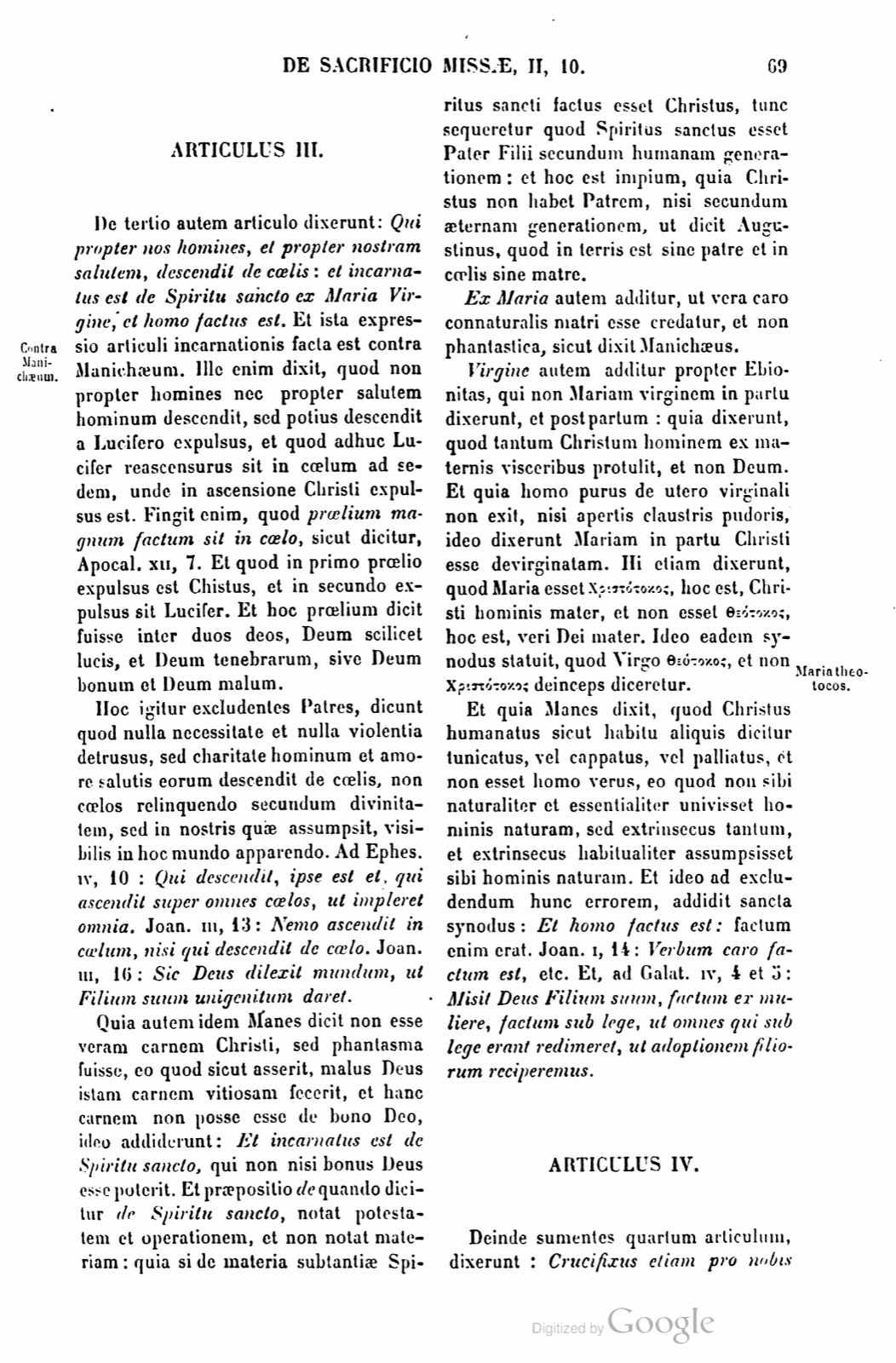
Deinde sumentes quartum articulum, dixerunt: Crucifixus etiam pro nobis sub Pontio Pilato, passus, et sepultus est. Et huic non addiderunt ad explanationem et expressionem, nisi quod dicunt: Crucifixus etiam pro nobis. Quod etiam propter Manichaeos est additum, qui dixerunt non pro nobis esse crucifixum, sed totum phantastice fuisse actum, quod dicitur de Christi passione. [Marginal label: Contra Sabellium.] Additum est etiam propter Sabellianos haereticos, qui dixerunt nos in nullo indigere Christo: quia etiam nos filii Dei esse possumus, quando volumus, eo quod non dixerunt Christum sanctum, sed purum hominem fuisse: et ideo synodus posuit: Pro nobis, ut sciamus nos nihil posse nisi per Christi sanguinem. Unde, Joan. XVII, 19, dicit: Ego pro eis sanctifico meipsum, hoc est, in sanctum sacrificium me offero, sine quo redimi non poteramus. Ex quo hunc modum redemptionis per mortem Christi summa sapientia ordinavit et elegit alia hic dicenda, quae in symbolo Apostolorum sunt dicta.
ARTICULUS V.
Post hunc sumpserunt quintum, et illum his verbis declaraverunt, dicentes: Et resurrexit tertia die secundum Scripturas. Et de descensu quidem ad inferos dimiserunt: quia circa illud error nullus erat: sed et erat contentio de resurrectione, quibusdam dicentibus, quod non tertia die Christus resurrexit: quia non tribus diebus in sepulcro jacuit, Parasceve enim in nocte sepultus, non jacuit nisi per sabbatum, et ante lucem Dominicae diei resurrexit: et ideo ut hanc determinarent contentionem, dixerunt quod resurrexit tertia die secundum Scripturas, hoc est, sicut illos tres dies Scriptura docet computare. Haec enim, ut dicit Augustinus, per synecdochen partem computavit pro toto, ita quod pars Parasceves quando sepultus est et mortuus, cum praecedente parte diei et tota praecedente nocte computatur pro uno die naturali: et nox quae est inter Parascevem et sabbatum, cum ipso sabbato pro uno die computatur: et vespere sabbati cum nocte sequenti pro una die Dominica computentur, quia semper vespera praecedens cum die sequenti ad unam partem pertinebant. Genes. I, 5: Factum est vespere et mane dies unus. Quare autem artificialibus duabus noctibus et uno die artificiali Christus in sepulcro jacuit, hanc causam assignat Augustinus: quia scilicet in Christo non sunt tenebrae, dies clara suam claram mortem signat. In nobis autem qui tenebrosi sumus, duae mortes, peccati scilicet et poenae, significantur per duas noctes, quas Christus sua lucidissima morte ad lucem gratiae reduxit. Psal. CXXXVIII, 11: Nox illuminatio mea in deliciis meis. Michaeae, VII, 8: Cum sedero in tenebris, Dominus lux mea est. Matth. XII, 39 et 40, dixit, hoc esse signum paenitentium, qui a duplici nocte vel morte per mortem Christi quaerunt liberari. Generatio mala et adultera signum quaerit, et signum non dabitur ei, nisi signum Jonae Prophetae. Sicut enim fuit Jonas in ventre ceti tribus diebus et tribus noctibus, sic erit Filius hominis in corde terrae tribus diebus et tribus noctibus.
ARTICULUS VI.
Deinde sumpserunt sextum sic dicentes sicut Apostolus dixerat: Et ascendit in caelum, sedet ad dexteram Patris. Hic articulus non habebat necessariam explanationem: quia propriam haeresim contra hunc articulum nullam audierant.
ARTICULUS VII.
Septimum autem tractantes dixerunt: Et iterum venturus est cum gloria judicare vivos et mortuos: cujus regni non erit finis. Huic autem articulo in parte anteriori ad exclusionem deliramenti Origenis addiderunt: Et iterum venturus est cum gloria: quia Origenes dixerat, quod adhuc venturus esset passibilis in aereo corpore, passurus pro daemonibus in aere, sicut passus fuerat pro hominibus in terra. [Marginal label: Contra Origenem.] Fulti autem sunt auctoritate Christi, Matth. XXVI, 64, dicentis: Amodo videbitis Filium hominis sedentem a dextris virtutis Dei, et venientem in nubibus caeli.
Then, taking the fourth article, they said: He was also crucified for us under Pontius Pilate, suffered, and was buried. And to this they added nothing for explanation and expression except what they say: He was also crucified for us. This also was added on account of the Manichaeans, who said that he was not crucified for us, but that the whole thing which is said about Christ's passion was enacted phantastically. [Marginal label: Against Sabellius.] It was also added on account of the Sabellian heretics, who said that we need Christ in nothing, because we too can be sons of God when we wish, since they did not say that Christ was holy, but that he was a mere human being; and therefore the synod set down: For us, so that we may know that we can do nothing except through the blood of Christ. Hence, John 17:19, he says: For them I sanctify myself, that is, I offer myself as a holy sacrifice, without which we could not be redeemed. From this, since the highest wisdom ordained and chose this mode of redemption through the death of Christ, other things to be said here are those which have been said in the Symbol of the Apostles.
ARTICLE V.
After this they took the fifth and declared it in these words, saying: And he rose again on the third day according to the Scriptures. And concerning the descent to the lower regions, indeed, they passed over it, because there was no error about that; but there was also a dispute about the resurrection, with some saying that Christ did not rise again on the third day, because he did not lie in the sepulcher for three days. For buried on Parasceve in the night, he lay only through the Sabbath, and rose again before the light of the Lord's day. And therefore, to determine this dispute, they said that he rose again on the third day according to the Scriptures, that is, as Scripture teaches those three days to be counted. For this, as Augustine says, counted the part for the whole by synecdoche, so that the part of Parasceve when he was buried and died, with the preceding part of the day and the whole preceding night, is counted for one natural day; and the night which is between Parasceve and the Sabbath, with the Sabbath itself, is counted for one day; and the evening of the Sabbath with the following night is counted for one Lord's day, because the preceding evening with the following day always belonged to one part. Genesis 1:5: Evening was made and morning, one day. But why Christ lay in the sepulcher through two artificial nights and one artificial day, Augustine assigns this cause: namely that, because there are no shadows in Christ, the clear day signifies his clear death. But in us, who are dark, the two deaths, namely of sin and of punishment, are signified by the two nights, which Christ by his most luminous death brought back to the light of grace. Psalm 138:11: The night is my illumination in my delights. Micah 7:8: When I sit in darkness, the Lord is my light. Matthew 12:39 and 40 said that this is the sign of penitents, who seek to be freed from a double night or death through the death of Christ. An evil and adulterous generation seeks a sign, and a sign will not be given to it except the sign of Jonah the prophet. For as Jonah was in the belly of the whale three days and three nights, so the Son of man will be in the heart of the earth three days and three nights.
ARTICLE VI.
Then they took the sixth, saying thus as the Apostle had said: And he ascended into heaven; he sits at the right hand of the Father. This article did not have a necessary explanation, because they had heard no heresy proper to this article.
ARTICLE VII.
But treating the seventh, they said: And again he will come with glory to judge the living and the dead; of whose kingdom there will be no end. To this article, in the former part, for the exclusion of Origen's delirium, they added: And again he will come with glory, because Origen had said that he would still come passible in an airy body, to suffer for the demons in the air, just as he had suffered for human beings on earth. [Marginal label: Against Origen.] But they were supported by the authority of Christ, Matthew 26:64, saying: From now on you will see the Son of man sitting at the right hand of the power of God, and coming in the clouds of heaven.
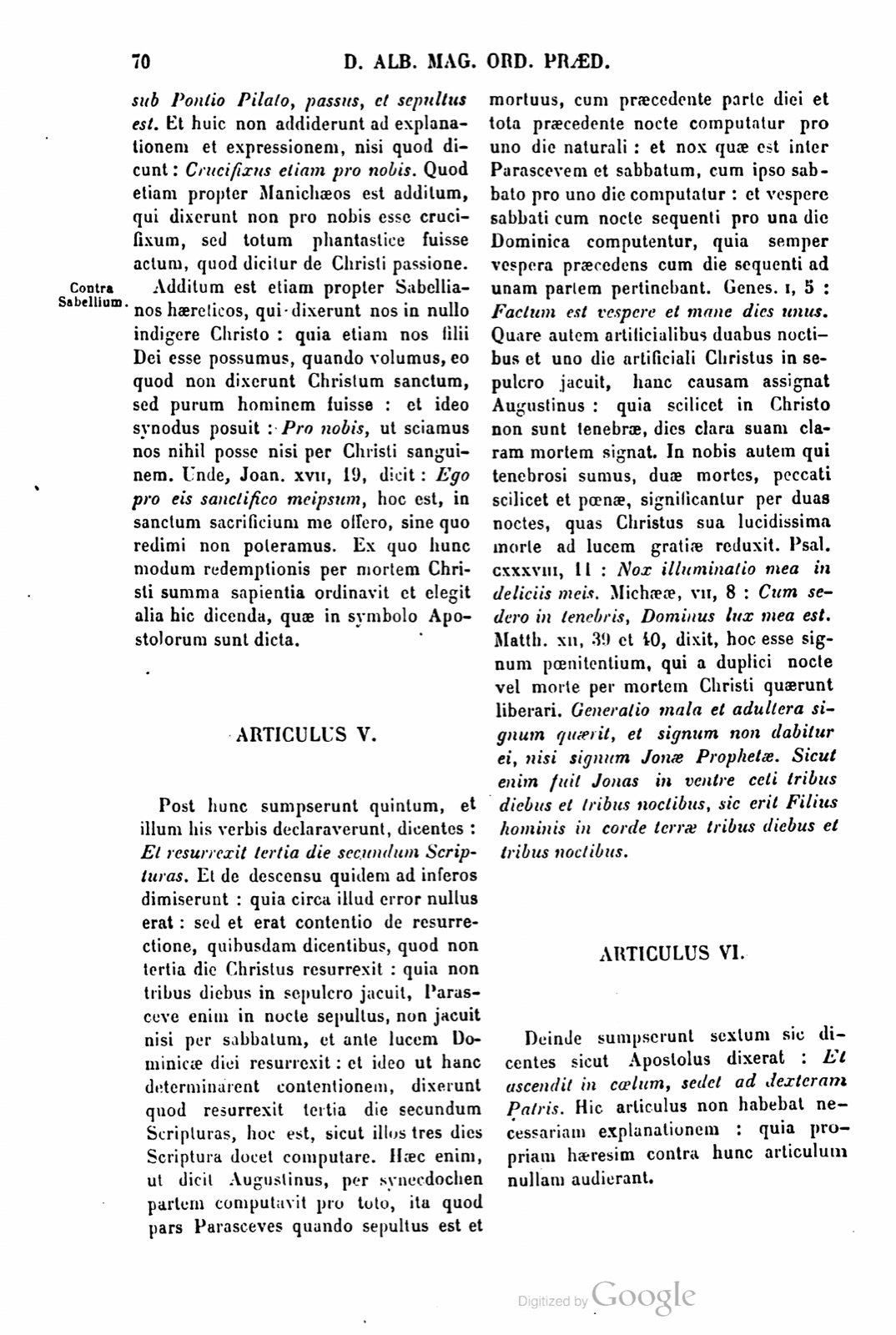
Ex parte autem posteriori addiderunt: Cujus regni non erit finis, contra judaizantes haereticos dicentes, quod Christus venturus sit et regnaturus annis mille in aurea Jerusalem, et tunc regnum illud finiturus et aliud incepturus. Fundaverunt autem dictum illud super hoc Danielis, VII, 14: Potestas ejus, potestas aeterna, quae non auferetur, et regnum ejus, quod non corrumpetur. Luc. I, 32 et 33: Dabit illi Dominus Deus sedem David, patris ejus: et regnabit in domo Jacob in aeternum, et regni ejus non erit finis.
ARTICULUS VIII.
Deinde tractantes articulum octavum dixerunt: Et in Spiritum sanctum, Dominum et vivificantem, qui ex Patre Filioque procedit: qui cum Patre et Filio simul adoratur, et conglorificatur: qui locutus est per Prophetas. Multae enim haereses jam surrexerunt de processione Spiritus sancti, quas in expressione processionis ejus necessarium fuit excludere.
Quod enim addunt: In Spiritum sanctum Dominum, contra Nestorium et Eutichetem, Constantinopolitanos Patriarchas, addiderunt, qui Spiritum sanctum dixerunt esse servum Patris et Filii. [Marginal label: Contra Nestorium et Eutichetem.] Et causa erroris fuit, quod spiritum in Deo sicut in homine acceperunt. In homine enim spiritus fumus est lucidus vel aereus, qui ex humido naturali resolvitur, et deservit animae in operationes animales et vitales et naturales, et movetur in omnem partem corporis, sicut radii solis et stellarum in mundo vehentes virtutes caelestes a stellis ad inferiora, ut ex illis generentur, et augeantur, et convalescant: et ita spiritus hominis in membra vehit virtutes animae et cordis. Et ad hanc similitudinem dixerunt Spiritum sanctum creatum a Patre procedere, et sic vehere et invehere virtutes potentiae Patris et sapientiae Filii et omnibus creatis, et ideo servire Patri et Filio et esse servum eorum, et non quidem per se vivificare, sed vehiculum esse vitae Patris et Filii: quia, sicut dicitur, Joan. V, 26: Sicut Pater habet vitam in semetipso, sic dedit et Filio habere vitam in semetipso. Et non dicitur hoc de Spiritu sancto.
Hunc ergo errorem exterminantes dicunt: Et vivificantem. [Marginal label: Error translationis.] Et ut hoc melius notarent ipsi Patres, dixerunt vivificatorem: sed cum transferretur symbolum, imperfecte translatum fuit, et translator dixit, vivificantem pro vivificatore: synodus enim intendit, quod ex natura vivifica esset vivificator, sicut et Pater et Filius. Fundaverunt autem se in hoc quod dicitur, Joan. VI, 64: Spiritus est qui vivificat. Ezechiel. I, 20: Spiritus vitae erat in rotis.
Quod autem additur: Qui ex Patre Filioque procedit, synodus non dicit nisi qui ex Patre procedit, et Latini suscipientes de Graeco in Latinum translatum auctoritate Leonis Papae addiderunt, Filioque: quia quod synodus non dixit, Filioque, non dimisit ideo quod a Filio non procedat Spiritus sanctus, sed ideo quia nullus error adhuc contra hoc surrexerat. Et quia in Evangelio, Joan. XV, 26, non ponitur plus nisi de Patre, ubi dixit Christus: Mittam vobis a Patre Spiritum veritatis, qui a Patre procedit. Et noluerunt addere aliquid Evangelio, cum adhuc non esset necesse. Latini autem attendentes quod dixit Apostolus Spiritum esse Filii, dicens, ad Roman. VIII, 9: Si quis Spiritum Christi non habet, hic non est ejus. Et, ad Galat. IV, 6: Misit Deus Spiritum Filii sui in corda vestra, clamantem: Abba, Pater. Et quia Christus dixit, Joan. XV, 26: Quem ego mittam vobis a Patre. Quae expresse signant Spiritum sanctum a Filio procedere sicut a Patre. Maxime cum Graeci contendere inciperent propter dictum synodi, Spiritum sanctum a Filio non procedere, addiderunt auctoritate Leonis Papae: Qui ex Patre Filioque procedit. Et hac de causa Athanasius, Graecorum doctor, illustrissimus Alexandriae Episcopus, in symbolo quod in Treveri edidit ad explanationem symboli quod in Quicumque vult salvus esse, continetur, Spiritus sanctus, dixit, a Patre et Filio: non factus, nec creatus, nec genitus, sed procedens. Dicunt tamen Graeci Latinos esse excommunicatos: quia sancta synodus dixit, quia non permittimus alicui cujuscumque potestatis neque nobismetipsis potestatem aliquid addendi vel diminuendi. Et, Qui addiderit vel minuerit, excommunicatus sit. Sed Latini ad hoc dicunt, quod qui explanat, non aliquid extrinsecus addit, sed quod intus latuit, ostendit. Aliter et ipsa synodus excommunicata fuisset: quia multa ad explanationem symbolo addiderunt Apostolorum. Necessitate ergo erroris Graecorum additum est, Filioque.
But in the later part they added: Of whose kingdom there will be no end, against Judaizing heretics who say that Christ will come and reign a thousand years in a golden Jerusalem, and then will end that kingdom and begin another. They founded that saying upon this passage of Daniel 7:14: His power is an eternal power, which will not be taken away, and his kingdom is one which will not be corrupted. Luke 1:32 and 33: The Lord God will give him the seat of David his father, and he will reign in the house of Jacob forever, and of his kingdom there will be no end.
ARTICLE VIII.
Then, treating the eighth article, they said: And in the Holy Spirit, the Lord and giver of life, who proceeds from the Father and the Son, who together with the Father and the Son is adored and conglorified, who spoke through the Prophets. For many heresies had already arisen concerning the procession of the Holy Spirit, which it was necessary to exclude in the expression of his procession.
For what they add, In the Holy Spirit the Lord, they added against Nestorius and Eutyches, patriarchs of Constantinople, who said that the Holy Spirit was servant of the Father and the Son. [Marginal label: Against Nestorius and Eutyches.] And the cause of the error was that they accepted spirit in God as in a human being. For in a human being spirit is a luminous or airy smoke, which is released from natural moisture and serves the soul in animal and vital and natural operations, and is moved into every part of the body, as the rays of the sun and stars in the world carry heavenly powers from the stars to lower things, so that from them they may be generated, and increased, and grow strong. And thus the spirit of a human being carries the powers of soul and heart into the members. And after this likeness they said that the Holy Spirit proceeded as created from the Father, and so carried and brought the powers of the potency of the Father and of the wisdom of the Son also to all created things, and therefore served the Father and the Son and was their servant, and did not indeed give life by himself, but was the vehicle of the life of the Father and the Son, because, as is said, John 5:26: As the Father has life in himself, so he gave also to the Son to have life in himself. And this is not said of the Holy Spirit.
Therefore exterminating this error they say: And giver of life. [Marginal label: Error of translation.] And in order that the Fathers themselves might mark this better, they said life-giver; but when the Symbol was being translated, it was translated imperfectly, and the translator said giving life in place of life-giver. For the synod intended that from life-giving nature he would be a life-giver, as also the Father and the Son are. But they founded themselves in this, that it is said, John 6:64: It is the Spirit who gives life. Ezekiel 1:20: The spirit of life was in the wheels.
But what is added, Who proceeds from the Father and the Son, the synod says only, who proceeds from the Father, and the Latins, receiving the translation from Greek into Latin, added, by the authority of Pope Leo, and the Son. For the synod, in not saying and the Son, did not omit it because the Holy Spirit does not proceed from the Son, but because no error against this had yet arisen. And because in the Gospel, John 15:26, no more is set down except concerning the Father, where Christ said: I will send to you from the Father the Spirit of truth, who proceeds from the Father. And they did not wish to add anything to the Gospel, since it was not yet necessary. But the Latins, attending to what the Apostle said, that the Spirit is of the Son, saying, Romans 8:9: If anyone does not have the Spirit of Christ, he is not his. And Galatians 4:6: God sent the Spirit of his Son into your hearts, crying: Abba, Father. And because Christ said, John 15:26: Whom I will send to you from the Father. These things expressly signify that the Holy Spirit proceeds from the Son as from the Father. Especially when the Greeks began to contend, on account of the saying of the synod, that the Holy Spirit does not proceed from the Son, they added by the authority of Pope Leo: Who proceeds from the Father and the Son. And for this cause Athanasius, teacher of the Greeks, most illustrious bishop of Alexandria, in the Symbol which he issued at Trier for the explanation of the Symbol which is contained in Whosoever wishes to be saved, said that the Holy Spirit is from the Father and the Son: not made, nor created, nor begotten, but proceeding. Yet the Greeks say that the Latins are excommunicated, because the holy synod said that we do not permit anyone of whatever power, nor ourselves, the power of adding or diminishing anything. And, Whoever adds or diminishes, let him be excommunicated. But the Latins say to this that one who explains does not add something extrinsic, but shows what lay hidden within. Otherwise even the synod itself would have been excommunicated, because it added many things to the Symbol of the Apostles for explanation. Therefore by necessity from the error of the Greeks, and the Son was added.
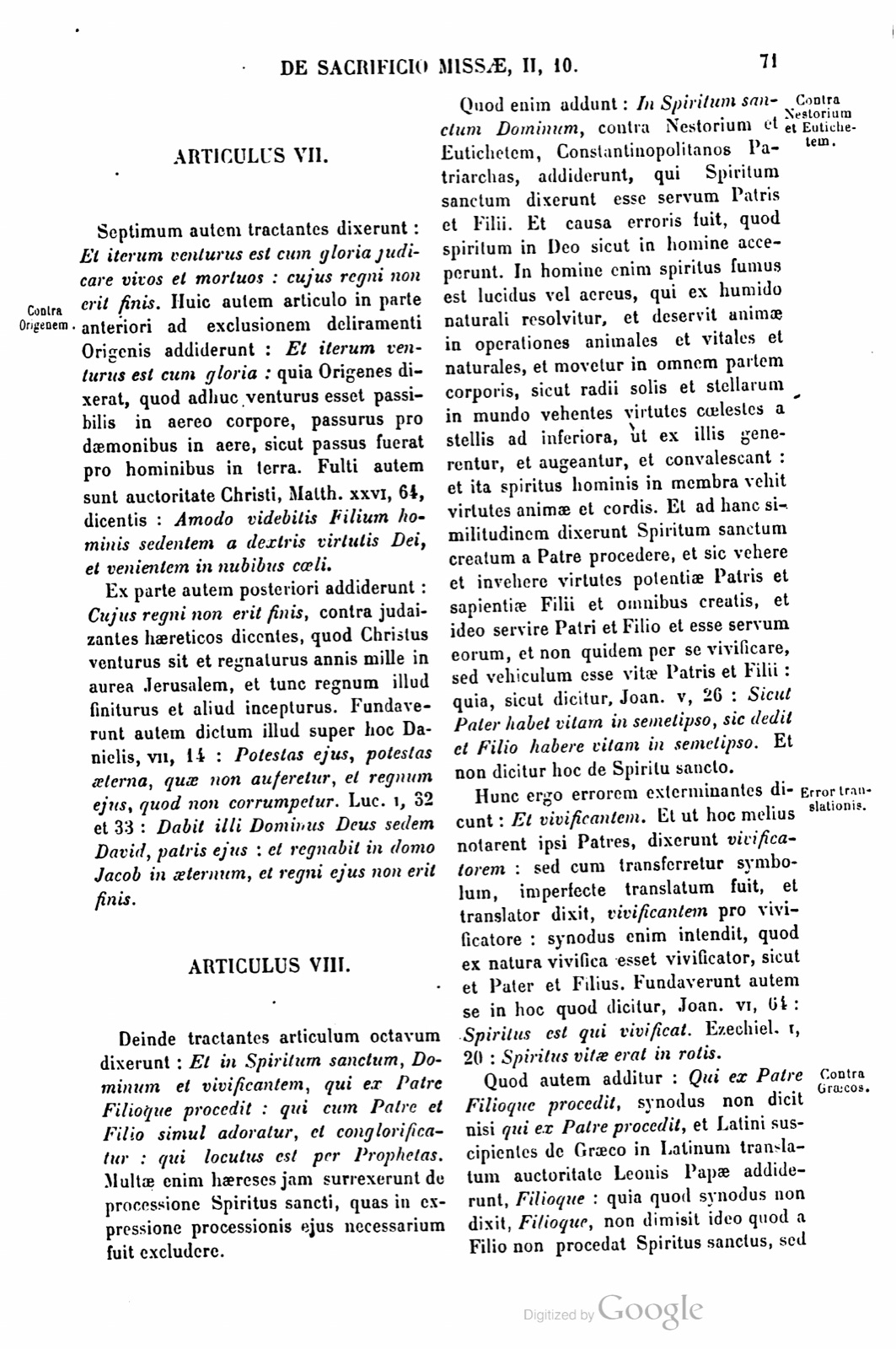
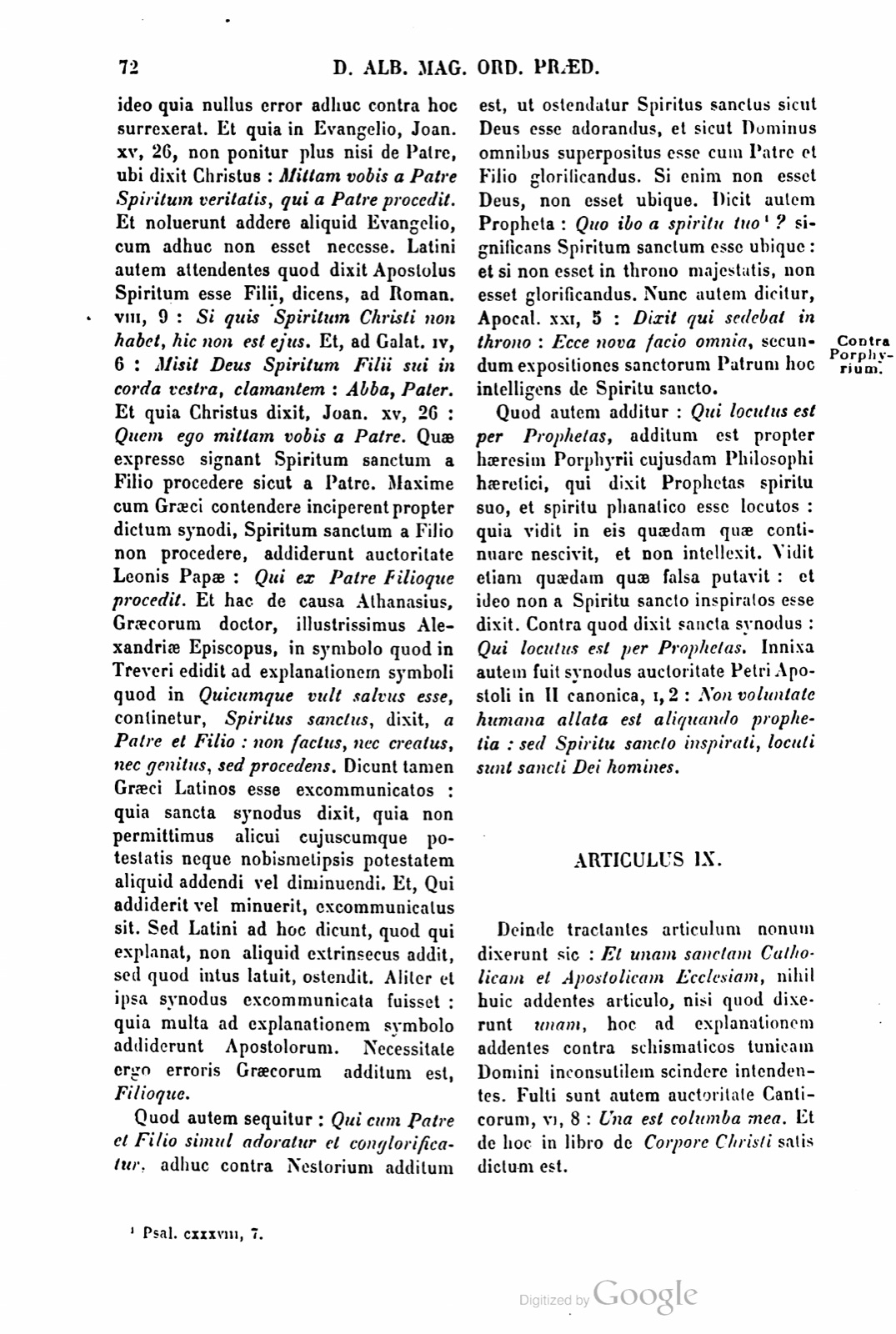
Quod autem sequitur: Qui cum Patre et Filio simul adoratur et conglorificatur, adhuc contra Nestorium additum est, ut ostendatur Spiritus sanctus sicut Deus esse adorandus, et sicut Dominus omnibus superpositus esse cum Patre et Filio glorificandus. Si enim non esset Deus, non esset ubique. Dicit autem Propheta: Quo ibo a spiritu tuo 1? significans Spiritum sanctum esse ubique: et si non esset in throno majestatis, non esset glorificandus. Nunc autem dicitur, Apocal. XXI, 5: Dixit qui sedebat in throno: Ecce nova facio omnia, secundum expositiones sanctorum Patrum hoc intelligens de Spiritu sancto.
Quod autem additur: Qui locutus est per Prophetas, additum est propter haeresim Porphyrii cujusdam Philosophi haeretici, qui dixit Prophetas spiritu suo, et spiritu phanatico esse locutos: quia vidit in eis quaedam quae continuare nescivit, et non intellexit. Vidit etiam quaedam quae falsa putavit: et ideo non a Spiritu sancto inspiratos esse dixit. [Marginal label: Contra Porphyrium.] Contra quod dixit sancta synodus: Qui locutus est per Prophetas. Innixa autem fuit synodus auctoritate Petri Apostoli in II canonica, I, 2: Non voluntate humana allata est aliquando prophetia: sed Spiritu sancto inspirati, locuti sunt sancti Dei homines.
ARTICULUS IX.
Deinde tractantes articulum nonum dixerunt sic: Et unam sanctam Catholicam et Apostolicam Ecclesiam, nihil huic addentes articulo, nisi quod dixerunt unam, hoc ad explanationem addentes contra schismaticos tunicam Domini inconsutilem scindere intendentes. Fulti sunt autem auctoritate Canticorum, VI, 8: Una est columba mea. Et de hoc in libro de Corpore Christi satis dictum est.
But what follows, Who together with the Father and the Son is adored and conglorified, was added still against Nestorius, so that the Holy Spirit may be shown to be adored as God, and to be glorified as Lord set over all, with the Father and the Son. For if he were not God, he would not be everywhere. But the Prophet says: Where shall I go from thy spirit 1? signifying that the Holy Spirit is everywhere; and if he were not on the throne of majesty, he would not be glorified. But now it is said, Apocalypse 21:5: He who sat on the throne said: Behold, I make all things new, according to the expositions of the holy Fathers understanding this of the Holy Spirit.
But what is added, Who spoke through the Prophets, was added on account of the heresy of a certain Porphyry, a heretical Philosopher, who said that the Prophets spoke by their own spirit and by a fanatical spirit, because he saw in them certain things which he did not know how to connect and did not understand. He also saw certain things which he thought false, and therefore said that they were not inspired by the Holy Spirit. [Marginal label: Against Porphyry.] Against this the holy synod said: Who spoke through the Prophets. But the synod relied upon the authority of the Apostle Peter in the second canonical epistle, 1:2: Prophecy was not at any time brought by human will, but inspired by the Holy Spirit, holy men of God spoke.
ARTICLE IX.
Then, treating the ninth article, they said thus: And one holy Catholic and Apostolic Church, adding nothing to this article except that they said one, adding this for explanation against schismatics intending to tear the seamless tunic of the Lord. But they were supported by the authority of the Song of Songs 6:8: One is my dove. And concerning this enough has been said in the book On the Body of Christ.
Notes
- Psalm 138:7. (Psal. CXXXVIII, 7.) ↩
If a page does not appear, its photograph has not been uploaded yet.