Works › The Book on the Sacrifice of the Mass
Volume 38 · pp. 66–68
Chapter X, Articles I-II
A marker with ≈ is an approximate page boundary, placed by measure of the text; the page photographs remain the authority. In the paired views, clicking a page marker brings that page into view.
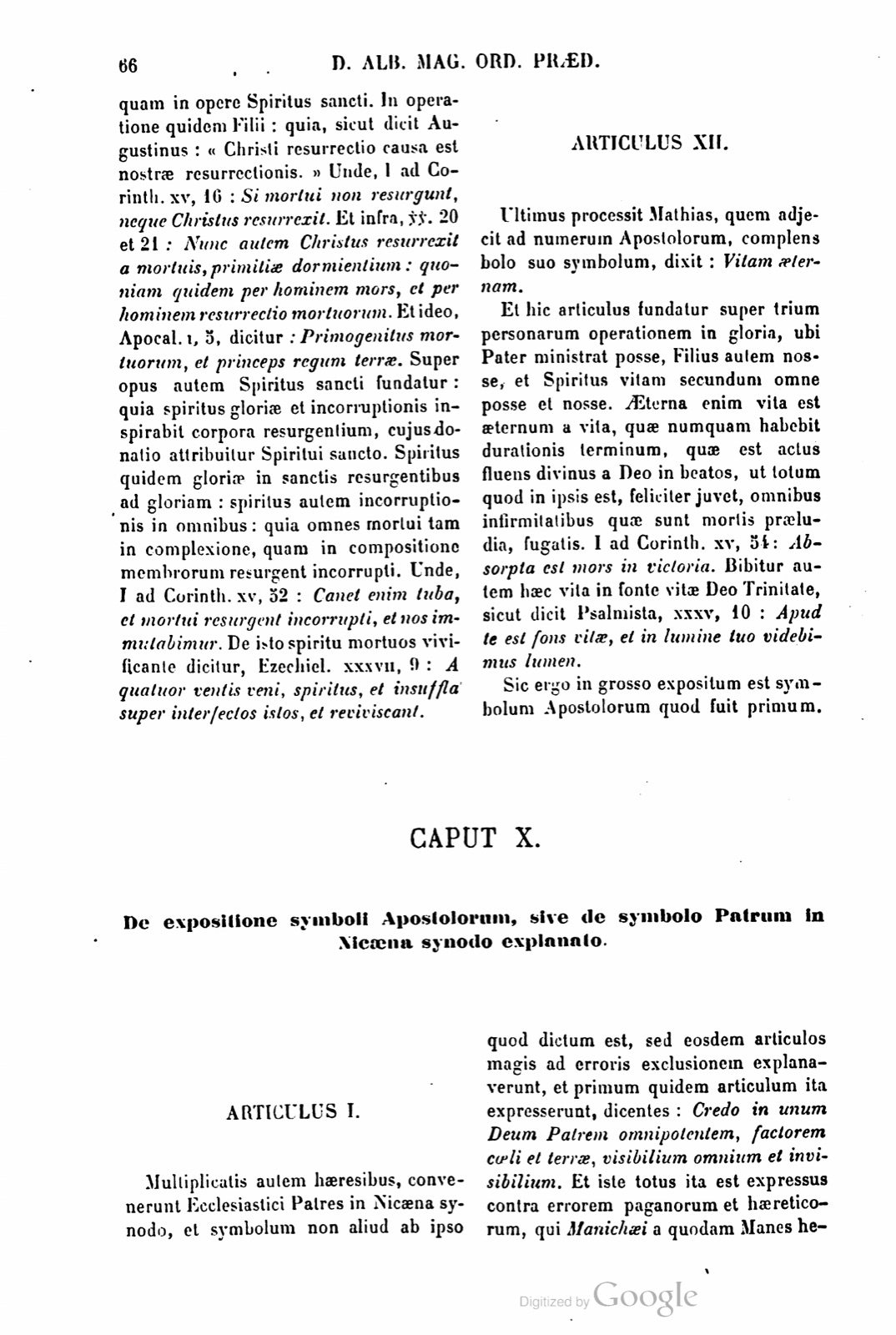
CAPUT X.
De expositione symboli Apostolorum, sive de symbolo Patrum in Nicaena synodo explanato.
ARTICULUS I.
Multiplicatis autem haeresibus, convenerunt Ecclesiastici Patres in Nicaena synodo, et symbolum non aliud ab ipso quod dictum est, sed eosdem articulos magis ad erroris exclusionem explanaverunt, et primum quidem articulum ita expresserunt, dicentes: Credo in unum Deum Patrem omnipotentem, factorem caeli et terrae, visibilium omnium et invisibilium. Et iste totus ita est expressus contra errorem paganorum et haereticorum, qui Manichaei a quodam Manes haeresiarcha eorum dicuntur. Pagani enim multos deos essentialem divinitatem habentes et ab invicem differentes esse dixerunt. [Marginal label: Contra Manichaeum.] Manes autem docuit duos deos, et duo esse principia, scilicet Deum lucis, et Deum tenebrarum: unum Deum bonorum principium, et alium principium malorum. Et hoc ideo quia errantes putaverunt malum esse essentiam, et ideo habere efficientem causam, quae cum non possit esse bonus Deus, dixerunt Deum malum esse principium malorum.
Contra quod dixerunt Patres: Credo in unum Deum, etc., quia, Deuter. VI, 4, dicitur: Dominus Deus noster, Dominus unus est. Exod. XX, 2: Non habebis deos alienos coram me. Psal. LXXX, 10 et 11: Non erit in te Deus recens, neque adorabis Deum alienum. Ego enim sum Dominus Deus tuus.
Cum autem dicitur unus Deus, non est haec unitas quae in aliquo cadat genere vel specie unitatis creatae. Omnis enim unitas creata multiplicatur in omnibus suis suppositis in quibus est. Petrus enim et Martinus non sunt unum animal, neque unus homo secundum esse animalis vel hominis. Haec autem unitas naturae vel essentiae divinae tanta est, quod in suis suppositis, quae sunt tres personae, non multiplicatur: quia Pater et Filius et Spiritus sanctus non sunt tres dii secundum esse divinitatis, sed unus Deus: et sic sunt una substantia, et una essentia, et una sapientia, et sic de omnibus aliis quae absolute et non relative dicuntur de personis. Et si alii sunt dii, non essentialiter, sed participative, sicut sancti: vel nuncupative, sicut idola dii dicuntur. Et quando tales dii plures sunt in suppositis, tunc multiplicatur eorum divinitas in ipsis. Et de participative quidem dictis diis dicitur in Psalmo LXXXI, 6: Ego dixi: Dii estis, et filii Excelsi omnes. De aliis autem dicitur in Psalmo XCV, 4: Omnes dii gentium daemonia, Dominus autem caelos fecit. De omnibus autem istis simul dicitur, I ad Corinth. VIII, 4 et seq.: Scimus quoniam idolum nihil est in mundo, et nullus est Deus, nisi unus. Nam etsi sunt qui dicantur dii, sive in caelo, sive in terra, siquidem sunt dii multi, et domini multi, nobis tamen unus est Deus, Pater, ex quo omnia, et nos in illum: et unus Dominus, Jesus Christus, per quem omnia, et nos per ipsum.
CHAPTER X.
On the exposition of the Symbol of the Apostles, or on the Symbol of the Fathers explained in the Nicene synod.
ARTICLE I.
But when heresies had multiplied, the ecclesiastical Fathers came together in the Nicene synod, and they explained, not another Symbol different from the very one which has been stated, but the same articles more for the exclusion of error, and indeed they expressed the first article in this way, saying: I believe in one God the Father almighty, maker of heaven and earth, of all things visible and invisible. And this whole article is thus expressed against the error of pagans and heretics, who are called Manichaeans from a certain Manes, their heresiarch. For pagans said that there are many gods having essential divinity and differing from one another. [Marginal label: Against Manichaeus.] But Manes taught that there are two gods and that there are two principles, namely the God of light and the God of darkness: one God the principle of good things, and another the principle of evils. And this because in erring they thought that evil is an essence, and therefore has an efficient cause; and since that cause cannot be the good God, they said that an evil God is the principle of evils.
Against this the Fathers said: I believe in one God, etc., because, Deuteronomy 6:4, it is said: The Lord our God, the Lord is one. Exodus 20:2: You shall not have strange gods before me. Psalm 80:10 and 11: There will not be in thee a recent god, nor will you adore a strange god. For I am the Lord thy God.
But when one God is said, this is not the unity which falls in some genus or species of created unity. For every created unity is multiplied in all its supposits in which it is. For Peter and Martin are not one animal, nor one human being according to the being of animal or human being. But this unity of divine nature or essence is so great that it is not multiplied in its supposits, which are the three persons; because the Father and the Son and the Holy Spirit are not three gods according to the being of divinity, but one God. And thus they are one substance, and one essence, and one wisdom, and so concerning all other things which are said of the persons absolutely and not relatively. And if there are other gods, they are not such essentially, but participatively, as the saints are, or nuncupatively, as idols are called gods. And when such gods are many in supposits, then their divinity is multiplied in them. And concerning gods said so participatively it is said in Psalm 81:6: I said: You are gods, and all sons of the Most High. But concerning the others it is said in Psalm 95:4: All the gods of the nations are demons, but the Lord made the heavens. But concerning all these at once it is said, 1 Corinthians 8:4 and following: We know that an idol is nothing in the world, and that there is no God except one. For although there are those who are called gods, whether in heaven or on earth, since indeed there are many gods and many lords, yet for us there is one God, the Father, from whom are all things, and we unto him; and one Lord, Jesus Christ, through whom are all things, and we through him.
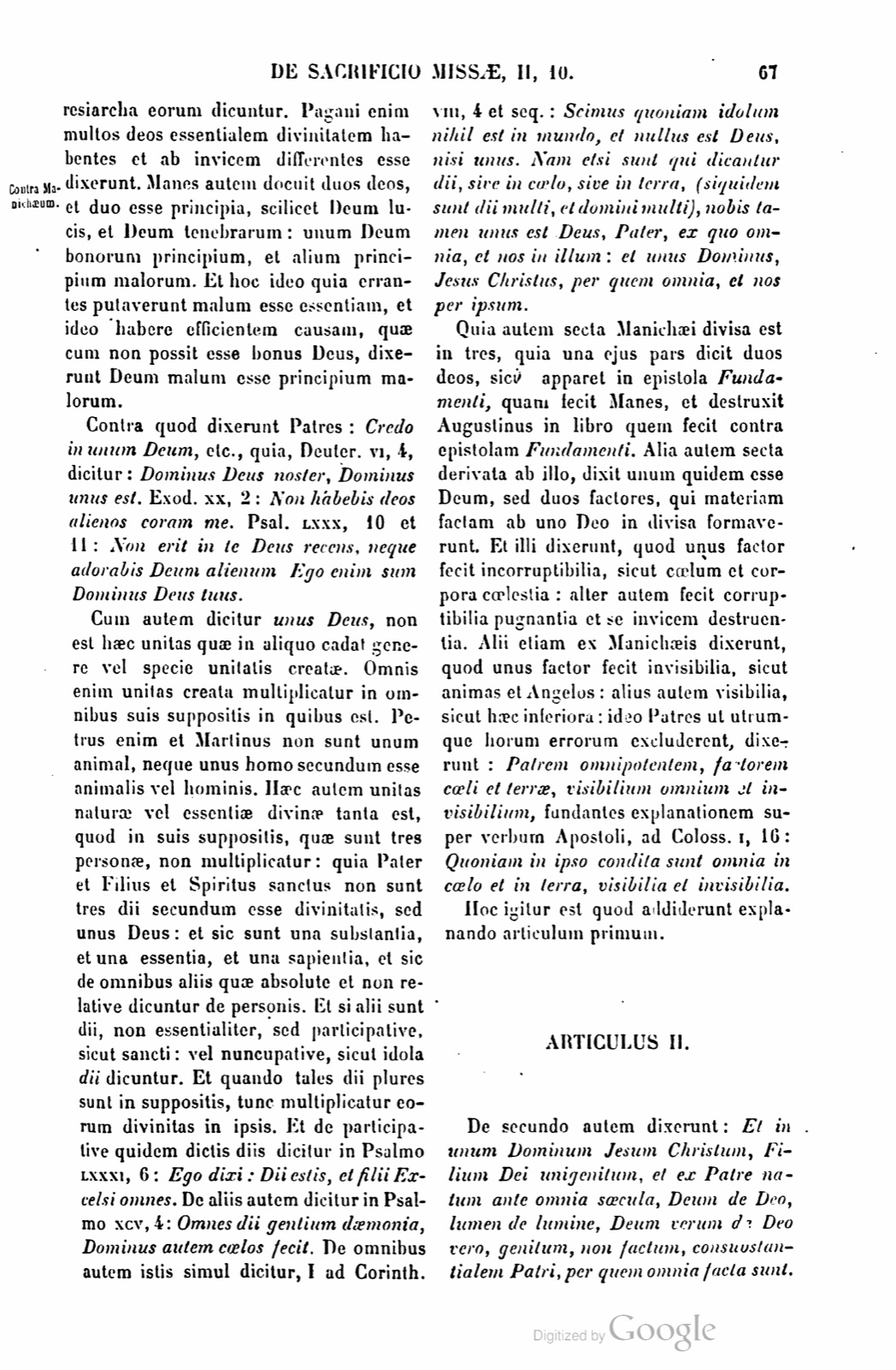
Quia autem secta Manichaei divisa est in tres, quia una ejus pars dicit duos deos, sicut apparet in epistola Fundamenti, quam fecit Manes, et destruxit Augustinus in libro quem fecit contra epistolam Fundamenti. Alia autem secta derivata ab illo, dixit unum quidem esse Deum, sed duos factores, qui materiam factam ab uno Deo in divisa formaverunt. Et illi dixerunt, quod unus factor fecit incorruptibilia, sicut caelum et corpora caelestia: alter autem fecit corruptibilia pugnantia et se invicem destruentia. Alii etiam ex Manichaeis dixerunt, quod unus factor fecit invisibilia, sicut animas et Angelos: alius autem visibilia, sicut haec inferiora: ideo Patres ut utrumque horum errorum excluderent, dixerunt: Patrem omnipotentem, factorem caeli et terrae, visibilium omnium et invisibilium, fundantes explanationem super verbum Apostoli, ad Coloss. I, 16: Quoniam in ipso condita sunt omnia in caelo et in terra, visibilia et invisibilia.
Hoc igitur est quod addiderunt explanando articulum primum.
ARTICULUS II.
De secundo autem dixerunt: Et in unum Dominum Jesum Christum, Filium Dei unigenitum, et ex Patre natum ante omnia saecula, Deum de Deo, lumen de lumine, Deum verum de Deo vero, genitum, non factum, consubstantialem Patri, per quem omnia facta sunt.
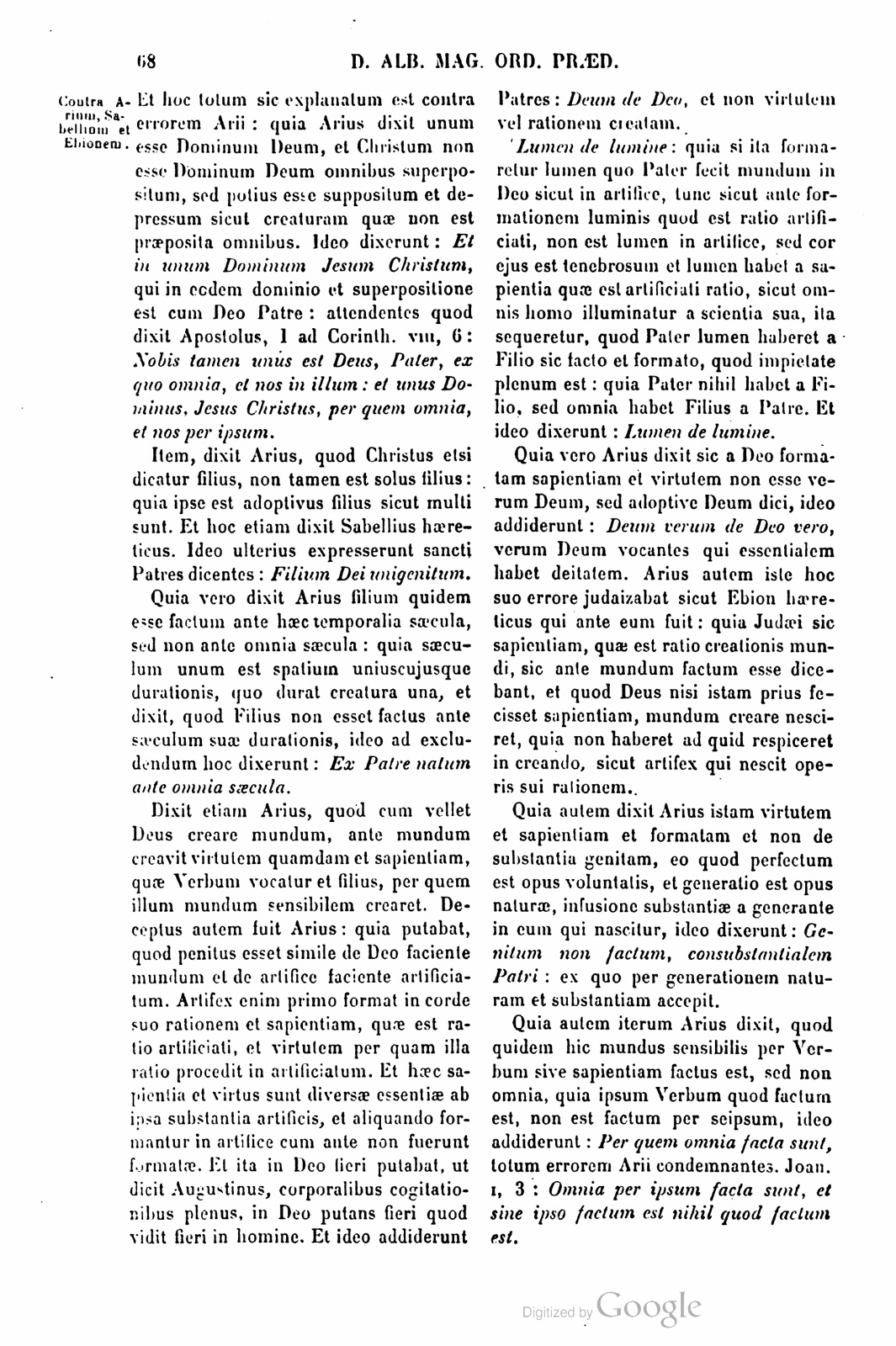
[Marginal label: Contra Arium, Sabellium et Ebionem.] Et hoc totum sic explanatum est contra errorem Arii: quia Arius dixit unum esse Dominum Deum, et Christum non esse Dominum Deum omnibus superpositum, sed potius esse suppositum et depressum sicut creaturam quae non est praeposita omnibus. Ideo dixerunt: Et in unum Dominum Jesum Christum, qui in eodem dominio et superpositione est cum Deo Patre: attendentes quod dixit Apostolus, I ad Corinth. VIII, 6: Nobis tamen unus est Deus, Pater, ex quo omnia, et nos in illum: et unus Dominus, Jesus Christus, per quem omnia, et nos per ipsum.
Item, dixit Arius, quod Christus etsi dicatur filius, non tamen est solus filius: quia ipse est adoptivus filius sicut multi sunt. Et hoc etiam dixit Sabellius haereticus. Ideo ulterius expresserunt sancti Patres dicentes: Filium Dei unigenitum.
Quia vero dixit Arius filium quidem esse factum ante haec temporalia saecula, sed non ante omnia saecula: quia saeculum unum est spatium uniuscujusque durationis, quo durat creatura una, et dixit, quod Filius non esset factus ante saeculum suae durationis, ideo ad excludendum hoc dixerunt: Ex Patre natum ante omnia saecula.
But because the sect of Manichaeus is divided into three, because one part of it says that there are two gods, as appears in the Letter of the Foundation, which Manes made, and which Augustine destroyed in the book that he made against the Letter of the Foundation. But another sect derived from him said that there is indeed one God, but two makers, who formed dividedly the matter made by the one God. And they said that one maker made incorruptible things, such as heaven and the heavenly bodies, but the other made corruptible things, things fighting and destroying one another. Yet others from the Manichaeans said that one maker made invisible things, such as souls and Angels, but another made visible things, such as these lower things. Therefore the Fathers, in order to exclude each of these errors, said: the Father almighty, maker of heaven and earth, of all things visible and invisible, founding the explanation upon the word of the Apostle, Colossians 1:16: For in him all things were created in heaven and on earth, visible and invisible.
This therefore is what they added by explaining the first article.
ARTICLE II.
But concerning the second they said: And in one Lord Jesus Christ, the only-begotten Son of God, and born of the Father before all ages, God from God, light from light, true God from true God, begotten, not made, consubstantial with the Father, through whom all things were made.
[Marginal label: Against Arius, Sabellius, and Ebion.] And this whole thing, explained thus, is against the error of Arius, because Arius said that there is one Lord God and that Christ is not the Lord God set over all, but rather is subject and depressed like a creature which has not been set over all. Therefore they said: And in one Lord Jesus Christ, who is in the same dominion and superposition with God the Father, attending to what the Apostle said, 1 Corinthians 8:6: Yet for us there is one God, the Father, from whom are all things, and we unto him; and one Lord, Jesus Christ, through whom are all things, and we through him.
Again, Arius said that although Christ is called son, nevertheless he is not the only son, because he is an adoptive son, just as many are. And Sabellius the heretic also said this. Therefore the holy Fathers expressed it further, saying: the only-begotten Son of God.
But because Arius said that the son indeed was made before these temporal ages, but not before all ages, because one age is the span of duration of each thing, by which one creature lasts, and he said that the Son had not been made before the age of his own duration, therefore to exclude this they said: Born of the Father before all ages.
Dixit etiam Arius, quod cum vellet Deus creare mundum, ante mundum creavit virtutem quamdam et sapientiam, quae Verbum vocatur et filius, per quem illum mundum sensibilem crearet. Deceptus autem fuit Arius: quia putabat, quod penitus esset simile de Deo faciente mundum et de artifice faciente artificiatum. Artifex enim primo format in corde suo rationem et sapientiam, quae est ratio artificiati, et virtutem per quam illa ratio procedit in artificiatum. Et haec sapientia et virtus sunt diversae essentiae ab ipsa substantia artificis, et aliquando formantur in artifice cum ante non fuerunt formatae. Et ita in Deo fieri putabat, ut dicit Augustinus, corporalibus cogitationibus plenus, in Deo putans fieri quod vidit fieri in homine. Et ideo addiderunt Patres: Deum de Deo, et non virtutem rationem creatam.
Lumen de lumine: quia si ita formaretur lumen quo Pater fecit mundum in Deo sicut in artifice, tunc sicut ante formationem luminis quod est ratio artificiati, non est lumen in artifice, sed cor ejus est tenebrosum et lumen habet a sapientia quae est artificiati ratio, sicut omnis homo illuminatur a scientia sua, ita sequeretur, quod Pater lumen haberet a Filio sic facto et formato, quod impietate plenum est: quia Pater nihil habet a Filio, sed omnia habet Filius a Patre. Et ideo dixerunt: Lumen de lumine.
Quia vero Arius dixit sic a Deo formatam sapientiam et virtutem non esse verum Deum, sed adoptive Deum dici, ideo addiderunt: Deum verum de Deo vero, verum Deum vocantes qui essentialem habet deitatem. Arius autem iste hoc suo errore judaizabat sicut Ebion haereticus qui ante eum fuit: quia Judaei sic sapientiam, quae est ratio creationis mundi, sic ante mundum factum esse dicebant, et quod Deus nisi istam prius fecisset sapientiam, mundum creare nesciret, quia non haberet ad quid respiceret in creando, sicut artifex qui nescit operis sui rationem.
Quia autem dixit Arius istam virtutem et sapientiam et formatam et non de substantia genitam, eo quod perfectum est opus voluntatis, et generatio est opus naturae, infusione substantiae a generante in eum qui nascitur, ideo dixerunt: Genitum non factum, consubstantialem Patri: ex quo per generationem naturam et substantiam accepit.
Quia autem iterum Arius dixit, quod illa quidem hic mundus sensibilis per Verbum sive sapientiam factus est, sed non omnia, quia ipsum Verbum quod factum est, non est factum per seipsum, ideo addiderunt: Per quem omnia facta sunt, ut totum errorem Arii condemnantes. Joan. I, 3: Omnia per ipsum facta sunt, et sine ipso factum est nihil quod factum est.
Arius also said that, when God wished to create the world, before the world he created a certain power and wisdom, which is called Word and son, through whom he would create that sensible world. But Arius was deceived, because he thought that the case of God making the world was entirely similar to that of an artisan making an artifact. For an artisan first forms in his heart the reason and wisdom which is the reason of the artifact, and the power through which that reason proceeds into the artifact. And this wisdom and power are diverse essences from the very substance of the artisan, and sometimes they are formed in the artisan when previously they had not been formed. And he thought that it happened so in God, as Augustine says, full of bodily thoughts, thinking that what he saw happen in a human being happened in God. And therefore the Fathers added: God from God, and not a created power or reason.
Light from light: because if the light by which the Father made the world were formed in God as in an artisan, then, just as before the formation of the light which is the reason of the artifact there is not light in the artisan, but his heart is dark and he has light from the wisdom which is the reason of the artifact, as every human being is illumined by his knowledge, so it would follow that the Father would have light from the Son thus made and formed, which is full of impiety; because the Father has nothing from the Son, but the Son has all things from the Father. And therefore they said: Light from light.
But because Arius said that wisdom and power thus formed by God are not true God, but are called God adoptively, therefore they added: true God from true God, calling true God the one who has essential deity. But this Arius in this error of his was Judaizing like Ebion the heretic who was before him; because the Jews used to say that wisdom, which is the reason of the creation of the world, was made before the world in this way, and that unless God had first made that wisdom, he would not know how to create the world, because he would not have something to which he could look in creating, as an artisan who does not know the reason of his work.
But because Arius said that this power and wisdom was both formed and not begotten from substance, on the ground that a completed thing is the work of will, and generation is a work of nature, by infusion of substance from the one generating into him who is born, therefore they said: Begotten, not made, consubstantial with the Father, from whom through generation he received nature and substance.
But because Arius again said that this sensible world indeed was made through the Word or wisdom, but not all things, because the Word itself which was made was not made through itself, therefore they added: Through whom all things were made, as condemning the whole error of Arius. John 1:3: All things were made through him, and without him nothing that was made was made.
If a page does not appear, its photograph has not been uploaded yet.