Works › The Book on the Sacrifice of the Mass
Volume 38 · pp. 49–50
Chapter V. On the Tract
A marker with ≈ is an approximate page boundary, placed by measure of the text; the page photographs remain the authority. In the paired views, clicking a page marker brings that page into view.
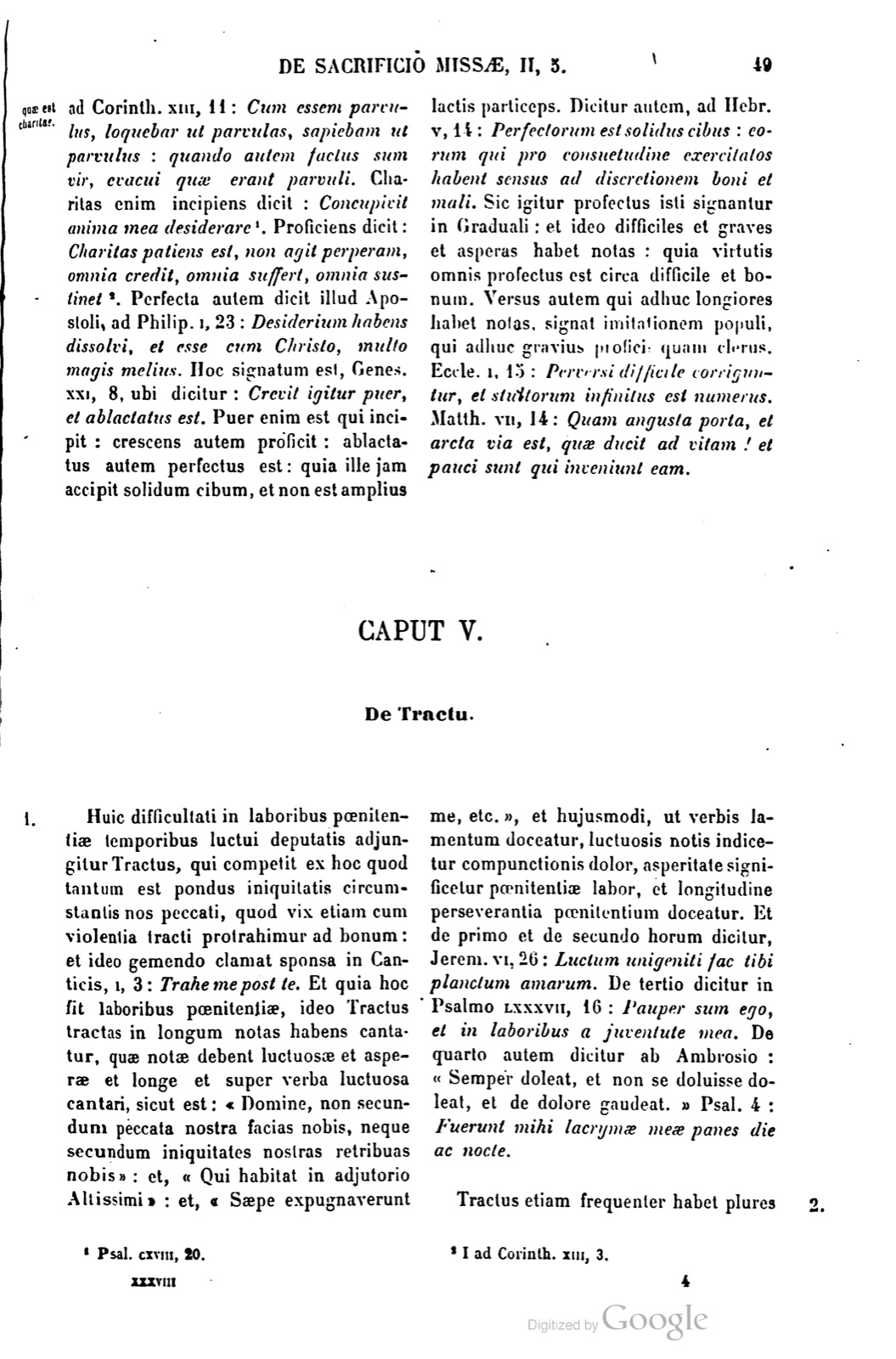
CAPUT V.
De Tractu.
1. Huic difficultati in laboribus poenitentiae temporibus luctui deputatis adjungitur Tractus, qui competit ex hoc quod tantum est pondus iniquitatis circumstantis nos peccati, quod vix etiam cum violentia tracti protrahimur ad bonum: et ideo gemendo clamat sponsa in Canticis, I, 3: Trahe me post te. Et quia hoc fit laboribus poenitentiae, ideo Tractus tractas in longum notas habens cantatur, quae notae debent luctuosae et asperae et longe et super verba luctuosa cantari, sicut est: "Domine, non secundum peccata nostra facias nobis, neque secundum iniquitates nostras retribuas nobis"; et, "Qui habitat in adjutorio Altissimi"; et, "Saepe expugnaverunt me, etc.", et hujusmodi, ut verbis lamentum doceatur, luctuosis notis indicetur compunctionis dolor, asperitate significetur poenitentiae labor, et longitudine perseverantia poenitentium doceatur. Et de primo et de secundo horum dicitur, Jerem. VI, 26: Luctum unigeniti fac tibi planctum amarum. De tertio dicitur in Psalmo LXXXVII, 16: Pauper sum ego, et in laboribus a juventute mea. De quarto autem dicitur ab Ambrosio: "Semper doleat, et non se doluisse doleat, et de dolore gaudeat." Psal. 4: Fuerunt mihi lacrymae meae panes die ac nocte.
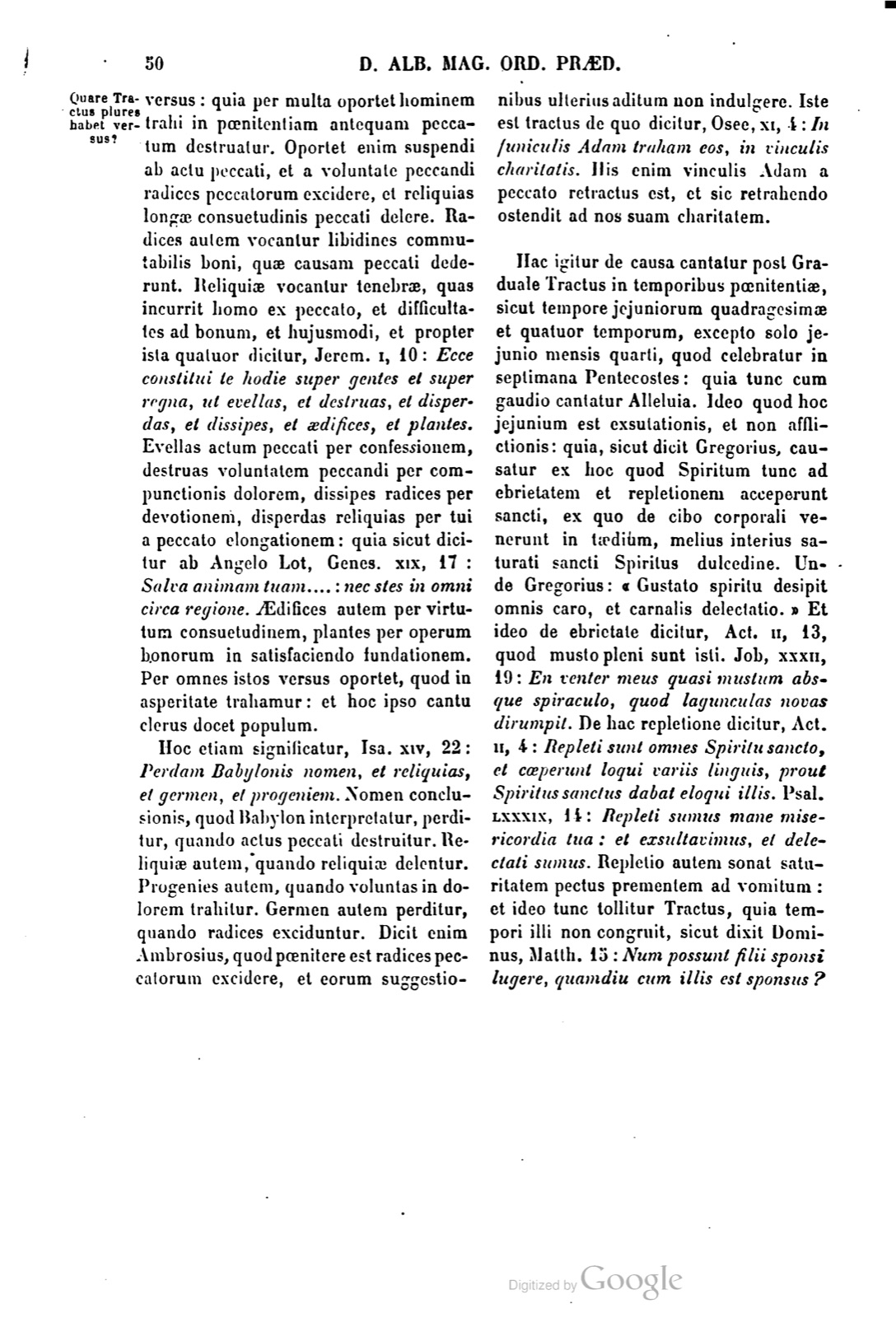
2. [Marginal label: Quare Tractus plures habet versus?] Tractus etiam frequenter habet plures versus: quia per multa oportet hominem trahi in poenitentiam antequam peccatum destruatur. Oportet enim suspendi ab actu peccati, et a voluntate peccandi radices peccatorum excidere, et reliquias longae consuetudinis peccati delere. Radices autem vocantur libidines commutabilis boni, quae causam peccati dederunt. Reliquiae vocantur tenebrae, quas incurrit homo ex peccato, et difficultates ad bonum, et hujusmodi, et propter ista quatuor dicitur, Jerem. I, 10: Ecce constitui te hodie super gentes et super regna, ut evellas, et destruas, et disperdas, et dissipes, et aedifices, et plantes. Evellas actum peccati per confessionem, destruas voluntatem peccandi per compunctionis dolorem, dissipes radices per devotionem, disperdas reliquias per tui a peccato elongationem: quia sicut dicitur ab Angelo Lot, Genes. XIX, 17: Salva animam tuam...: nec stes in omni circa regione. Aedifices autem per virtutum consuetudinem, plantes per operum bonorum in satisfaciendo fundationem. Per omnes istos versus oportet, quod in asperitate trahamur: et hoc ipso cantu clerus docet populum.
CHAPTER V.
On the Tract.
1. To this difficulty in the labors of penitence, at the times assigned to mourning, the Tract is joined, which is fitting from this, that so great is the weight of the iniquity of the sin surrounding us, that scarcely even when drawn with violence are we drawn forth to the good; and therefore the bride cries with groaning in Canticles 1:3: Draw me after you. And because this is done by the labors of penitence, therefore the Tract is sung as having notes drawn out at length, which notes ought to be sung mournful and rough and long and over mournful words, as it is: "Lord, do not do to us according to our sins, nor repay us according to our iniquities"; and, "He who dwells in the help of the Most High"; and, "Often they have fought against me, etc.," and things of this sort, so that lamentation may be taught by the words, the sorrow of compunction may be indicated by mournful notes, the labor of penitence may be signified by roughness, and the perseverance of penitents may be taught by length. And concerning the first and the second of these it is said, Jeremiah 6:26: Make mourning for an only-begotten one for yourself, bitter lamentation. Concerning the third it is said in Psalm 87:16: I am poor, and in labors from my youth. But concerning the fourth it is said by Ambrose: "Let him always grieve, and not grieve that he has grieved, and let him rejoice concerning grief." Psalm 4: My tears were my breads by day and by night.
2. [Marginal label: Why does the Tract have several verses?] The Tract also frequently has several verses, because a human being must be drawn through many things into penitence before sin is destroyed. For he must be suspended from the act of sin, and cut out the roots of sins from the will of sinning, and wipe away the remnants of a long habit of sin. But the roots are called the desires of changeable good, which gave the cause of sin. Remnants are called the darknesses that a human being incurs from sin, and difficulties toward the good, and things of this sort; and because of these four it is said, Jeremiah 1:10: Behold, today I have appointed you over nations and over kingdoms, that you may pluck up, and destroy, and scatter, and dissipate, and build, and plant. You pluck up the act of sin through confession; you destroy the will of sinning through the sorrow of compunction; you dissipate the roots through devotion; you scatter the remnants through your removal from sin, because as is said by the Angel to Lot, Genesis 19:17: Save your soul... and do not stand anywhere around the region. You build by the habit of virtues; you plant by the founding of good works in making satisfaction. Through all these verses it is necessary that we be drawn in roughness, and by this very chant the clergy teaches the people.
Hoc etiam significatur, Isa. XIV, 22: Perdam Babylonis nomen, et reliquias, et germen, et progeniem. Nomen confusionis, quod Babylon interpretatur, perditur, quando actus peccati destruitur. Reliquiae autem, quando reliquiae delentur. Progenies autem, quando voluntas in dolorem trahitur. Germen autem perditur, quando radices exciduntur. Dicit enim Ambrosius, quod poenitere est radices peccatorum excidere, et eorum suggestionibus ulterius aditum non indulgere. Iste est tractus de quo dicitur, Osee, XI, 4: In funiculis Adam traham eos, in vinculis charitatis. His enim vinculis Adam a peccato retractus est, et sic retrahendo ostendit ad nos suam charitatem.
Hac igitur de causa cantatur post Graduale Tractus in temporibus poenitentiae, sicut tempore jejuniorum quadragesimae et quatuor temporum, excepto solo jejunio mensis quarti, quod celebratur in septimana Pentecostes: quia tunc cum gaudio cantatur Alleluia. Ideo quod hoc jejunium est exsultationis, et non afflictionis: quia, sicut dicit Gregorius, causatur ex hoc quod Spiritum tunc ad ebrietatem et repletionem acceperunt sancti, ex quo de cibo corporali venerunt in taedium, melius interius saturati sancti Spiritus dulcedine. Unde Gregorius: "Gustato spiritu desipit omnis caro, et carnalis delectatio." Et ideo de ebrietate dicitur, Act. II, 13, quod musto pleni sunt isti. Job, XXXII, 19: En venter meus quasi mustum absque spiraculo, quod lagunculas novas dirumpit. De hac repletione dicitur, Act. II, 4: Repleti sunt omnes Spiritu sancto, et coeperunt loqui variis linguis, prout Spiritus sanctus dabat eloqui illis. Psal. LXXXIX, 14: Repleti sumus mane misericordia tua: et exsultavimus, et delectati sumus. Repletio autem sonat saturitatem pectus prementem ad vomitum: et ideo tunc tollitur Tractus, quia tempori illi non congruit, sicut dixit Dominus, Matth. IX, 15: Num possunt filii sponsi lugere, quamdiu cum illis est sponsus?
This is also signified in Isaiah 14:22: I will destroy Babylon's name, and remnants, and sprout, and offspring. The name of confusion, which Babylon is interpreted, is destroyed when the act of sin is destroyed. But remnants are destroyed when remnants are wiped away. Offspring is destroyed when the will is drawn into sorrow. But the sprout is destroyed when the roots are cut out. For Ambrose says that to do penance is to cut out the roots of sins and to grant no further entrance to their suggestions. This is the tract concerning which it is said, Hosea 11:4: With the cords of Adam I will draw them, with the bonds of charity. For by these bonds Adam was drawn back from sin, and thus by drawing back he showed his charity toward us.
Therefore for this cause the Tract is sung after the Gradual in times of penitence, as in the time of the fasts of Lent and of the Ember days, except only the fast of the fourth month, which is celebrated in the week of Pentecost, because then Alleluia is sung with joy. The reason is that this fast is one of exultation, and not of affliction, because, as Gregory says, it is caused from this, that the saints then received the Spirit unto drunkenness and fullness, from which they came into weariness of bodily food, being better filled inwardly with the sweetness of the Holy Spirit. Hence Gregory says: "When the spirit has been tasted, all flesh and carnal delight loses savor." And therefore concerning drunkenness it is said, Acts 2:13, that these are full of new wine. Job 32:19: Behold, my belly is like new wine without a vent, which bursts new bottles. Concerning this fullness it is said, Acts 2:4: All were filled with the Holy Spirit, and began to speak in various tongues, as the Holy Spirit gave them to speak. Psalm 89:14: We were filled in the morning with your mercy; and we exulted and were delighted. But fullness sounds like satiety pressing the breast toward vomiting; and therefore then the Tract is removed, because it is not fitting to that time, as the Lord said, Matthew 9:15: Can the sons of the bridegroom mourn as long as the bridegroom is with them?
If a page does not appear, its photograph has not been uploaded yet.