Works › The Book on the Sacrifice of the Mass
Volume 38 · pp. 46–49
Chapter IV. On the Gradual that is joined to the Epistle
A marker with ≈ is an approximate page boundary, placed by measure of the text; the page photographs remain the authority. In the paired views, clicking a page marker brings that page into view.
CAPUT IV.
De Graduali quod Epistolae adjungitur.
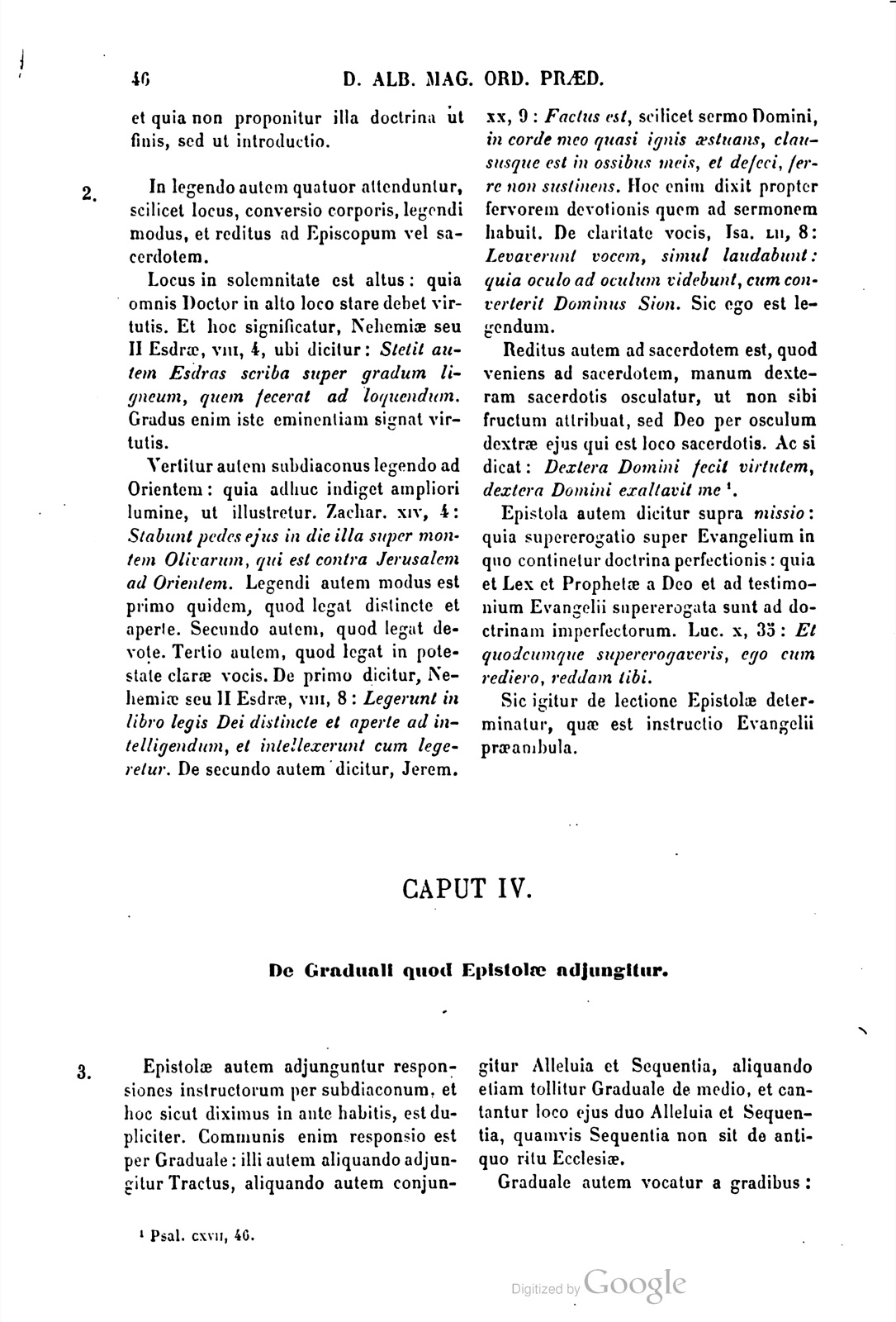
3. Epistolae autem adjunguntur responsiones instructorum per subdiaconum, et hoc sicut diximus in ante habitis, est dupliciter. Communis enim responsio est per Graduale: illi autem aliquando adjungitur Tractus, aliquando autem conjungitur Alleluia et Sequentia, aliquando etiam tollitur Graduale de medio, et cantantur loco ejus duo Alleluia et Sequentia, quamvis Sequentia non sit de antiquo ritu Ecclesiae.
Graduale autem vocatur a gradibus: quia sicut instruit subdiaconus, ita in eo per gradus virtutum proficit studium subditorum. Et hoc quidem respondendo profitetur chorus. Propter quod et ipsum Graduale antiquitus Responsorium vocabatur. Cum autem omnis virtus sit in qua proficimus circa difficile et bonum, et difficile sit cum labore, et bonum ferat dulcedinem in gustu et gaudium in corde, ideo in tempore poenitentiae profectui virtutis propter laborem adjungitur Tractus. In festis enim quando gustatur spiritus bonus, conjungitur vox laetitiae in Alleluia et Sequentia.
Graduale igitur dicitur a choro, ut significetur profectus de virtute in virtutem ab instructis a subdiacono. Versus autem gradualis, praecinente choro, significat profectum in populo, et ideo cantant versum minores. Dicitur autem Graduale ad litteram: quia in gradibus cantatur: qui cantus profectum virtutum per gradus significat, de quibus dicitur in Psalmo in translatione Aquilae: "Distribuite gradus ejus, ut enarretis in progenie altera 1." Et hoc significatur in cantico graduum, scilicet quod profitentur se ire de virtute in virtutem, ita quod videbunt in doctrina Evangelii Deum deorum in Sion.
2. [Marginal label: Profectus in causa virtutis.] Proficimus enim in causa virtutis, in virtute, in effectu virtutis, in adjunctis ad virtutem, et in forma virtutis ad merendum.
In causa quidem per tria: quia radicationis virtutis sunt tres gradus. Primus scire, et secundus velle, tertius autem in difficilibus operibus perseverare. Et de scire quidem dicitur de doctrina, Sapient. VIII, 7: Sobrietatem et prudentiam docet, et justitiam, et virtutem, hoc est, fortitudinem, quibus in vita nihil utilius hominibus. Et sic perhibetur scire. De velle autem dicitur, ad Philip. II, 13: Deus enim est, qui operatur in nobis velle et perficere pro bona voluntate. II ad Corinth. VIII, 12: Si enim voluntas prompta est, secundum id quod habet accepta est. II Machab. I, 3: Ut faciatis ejus voluntatem corde magno et animo volenti. Dicit enim Augustinus, quod nemo invitus bonum facit, etsi bonum est quod facit. De perseverantia autem dicitur, Matth. XXIV, 13: Qui perseveraverit usque in finem, hic salvus erit. Hic igitur est profectus in causa radicationis virtutis.
CHAPTER IV.
On the Gradual that is joined to the Epistle.
3. But to the Epistle are joined the responses of those instructed through the subdeacon, and this, as we said in what came before, is in two ways. For the common response is through the Gradual; but to it sometimes the Tract is joined, and sometimes Alleluia and the Sequence are joined, and sometimes also the Gradual is removed from the middle, and in place of it two Alleluias and Sequences are sung, although the Sequence is not from the ancient rite of the Church.
But Gradual is named from steps, because as the subdeacon instructs, so in it the zeal of subjects makes progress through the steps of the virtues. And the choir professes this by responding. On account of this the Gradual itself was anciently called Responsory. But since every virtue in which we make progress concerns the difficult and the good, and the difficult is with labor, and the good brings sweetness in taste and joy in the heart, therefore in the time of penitence the Tract is joined to the progress of virtue on account of labor. For on feasts, when the good spirit is tasted, the voice of joy is joined in the Alleluia and Sequence.
Therefore the Gradual is said by the choir so that progress from virtue into virtue may be signified by those instructed by the subdeacon. But the verse of the Gradual, with the choir singing beforehand, signifies progress in the people, and therefore lesser ones sing the verse. But it is called Gradual literally because it is sung on the steps; this song signifies the progress of virtues through steps, concerning which it is said in the Psalm in the translation of Aquila: "Distribute its steps, that you may narrate in another generation 1." And this is signified in the song of steps, namely that they profess themselves to go from virtue into virtue, so that they will see in the doctrine of the Gospel the God of gods in Zion.
2. [Marginal label: Progress in the cause of virtue.] For we make progress in the cause of virtue, in virtue, in the effect of virtue, in things joined to virtue, and in the form of virtue for meriting.
Indeed in the cause there are three, because there are three steps of the rooting of virtue. The first is to know, the second to will, but the third to persevere in difficult works. And concerning knowing, it is said about doctrine in Wisdom 8:7: She teaches sobriety and prudence, and justice, and virtue, that is, fortitude, than which nothing is more useful to human beings in life. And thus knowing is borne witness to. But concerning willing it is said in Philippians 2:13: For God is the one who works in us to will and to accomplish for good will. 2 Corinthians 8:12: For if the will is prompt, it is accepted according to that which it has. 2 Maccabees 1:3: That you may do his will with a great heart and a willing soul. For Augustine says that no one unwillingly does a good thing, even if what he does is good. But concerning perseverance it is said in Matthew 24:13: He who perseveres unto the end, he will be saved. This therefore is progress in the cause of the rooting of virtue.
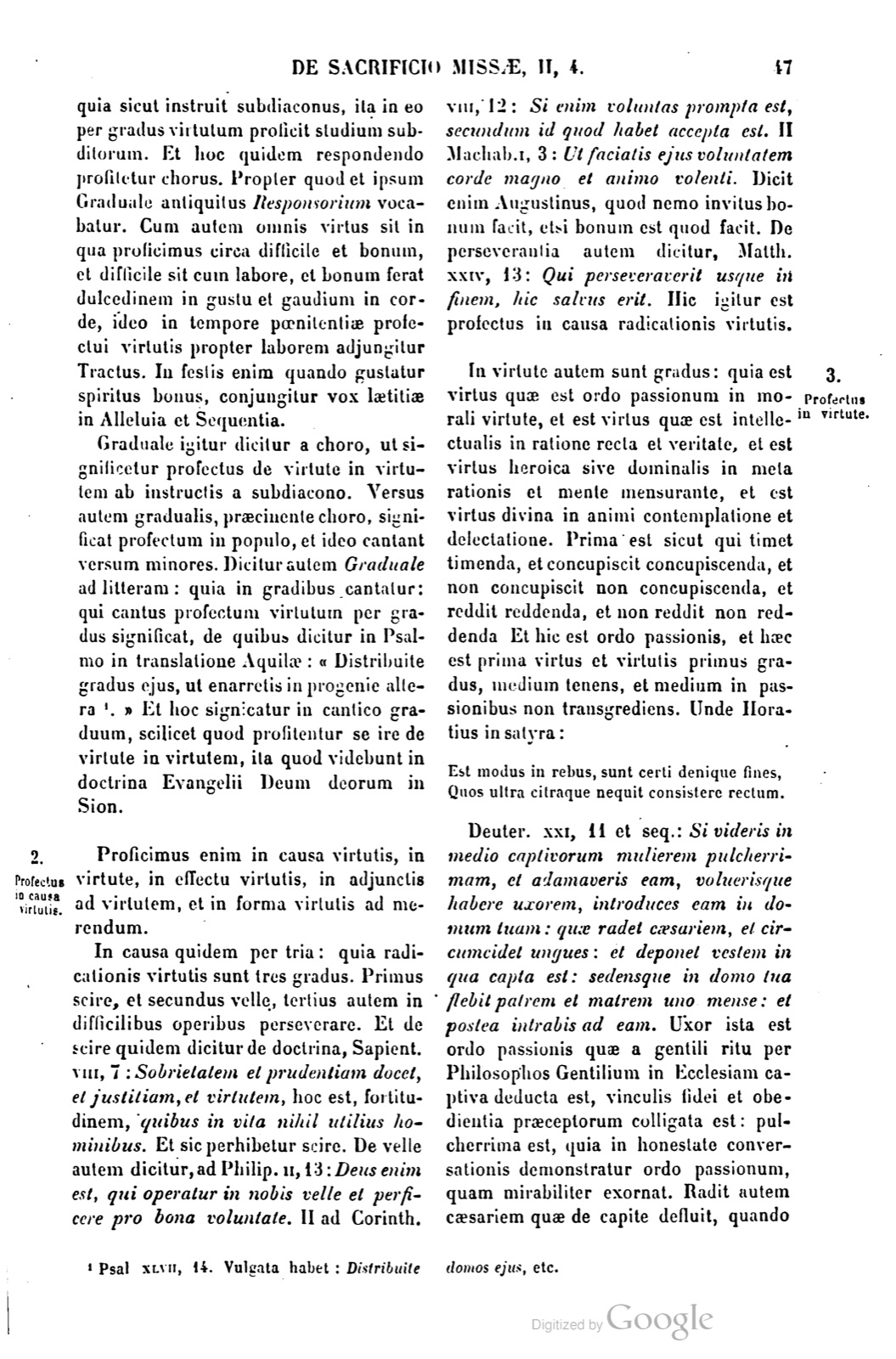
3. [Marginal label: Profectus in virtute.] In virtute autem sunt gradus: quia est virtus quae est ordo passionum in morali virtute, et est virtus quae est intellectualis in ratione recta et veritate, et est virtus heroica sive dominalis in meta rationis et mente mensurante, et est virtus divina in animi contemplatione et delectatione. Prima est sicut qui timet timenda, et concupiscit concupiscenda, et non concupiscit non concupiscenda, et reddit reddenda, et non reddit non reddenda. Et hic est ordo passionis, et haec est prima virtus et virtutis primus gradus, medium tenens, et medium in passionibus non transgrediens. Unde Horatius in satyra:
Est modus in rebus, sunt certi denique fines, quos ultra citraque nequit consistere rectum.
Deuter. XXI, 11 et seq.: Si videris in medio captivorum mulierem pulcherrimam, et adamaveris eam, voluerisque habere uxorem, introduces eam in domum tuam: quae radet caesariem, et circumcidet ungues: et deponet vestem in qua capta est: sedensque in domo tua flebit patrem et matrem uno mense: et postea intrabis ad eam. Uxor ista est ordo passionis quae a gentili ritu per Philosophos Gentilium in Ecclesiam captiva deducta est, vinculis fidei et obedientia praeceptorum colligata est: pulcherrima est, quia in honestate conversationis demonstratur ordo passionum, quam mirabiliter exornat. Radit autem caesariem quae de capite defluit, quando superfluas concupiscentias de capite cordis deponit. Ungues autem circumcidit, quia superfluam abscidit iram et audaciam. Vestem deponit, quando compositionem saecularem mutat in Ecclesiasticam pulchritudinem. Sedet autem, quando a tumultu cogitationum saecularium quiescit. In domo est, quando omni honore virtutis domum intrat et familiam Ecclesiae. Patrem plangit et matrem, quando tristatur de absentia amicorum quod non in eamdem transeant virtutis regulam. Et sic efficitur uxor boni viri multa ferens genimina bonorum operum.
Secundus gradus est virtutum intellectualium, quando homo omnia sua mensurat recta ratione, et divina quidem sapientia lecta et audita, intellecta vera per scientiam, facienda per artem, agenda in his quae fuerunt homini per prudentiam. Ad hunc profectum virtutis invitat Dominus, Joan. IV, 16, dicens: Voca virum tuum, et veni huc. Vir enim recta est ratio, ad quam omnia perficienda sunt, ut sic ad Dominum veniamus. Sic dicitur, Isa. XLVI, 8: Redite, praevaricatores, ad cor, hoc est, ad rectam rationem: et bis dicit, redite 2, quia redeundum est ad rectam rationem in divinis sicut in sapientia et intellectu divinorum, et redeundum est ad rectam rationem in humanis sicut in scientia verorum et arte faciendorum et prudentia agendorum.
3. [Marginal label: Progress in virtue.] But in virtue there are steps, because there is virtue that is the order of passions in moral virtue, and there is virtue that is intellectual in right reason and truth, and there is heroic or dominative virtue in the boundary of reason and the measuring mind, and there is divine virtue in the contemplation and delight of the soul. The first is as one who fears things to be feared, and desires things to be desired, and does not desire things not to be desired, and renders things to be rendered, and does not render things not to be rendered. And this is the order of passion, and this is the first virtue and the first step of virtue, holding the mean, and not transgressing the mean in the passions. Hence Horace in a satire:
There is a measure in things; there are, finally, certain limits, beyond and short of which the right cannot stand.
Deuteronomy 21:11 and following: If you see among the captives a very beautiful woman, and have loved her, and wish to have her as wife, you shall lead her into your house; she will shave her hair and cut around her nails; and she will put aside the garment in which she was captured; and sitting in your house she will weep for her father and mother for one month; and afterward you will enter to her. That wife is the order of passion which, from a gentile rite, was led captive into the Church through the Philosophers of the Gentiles, and was bound by the bonds of faith and obedience to the precepts. She is very beautiful because in honorableness of conduct the order of passions is demonstrated, which wondrously adorns her. But she shaves the hair that flows down from the head when she puts aside superfluous concupiscences from the head of the heart. But she cuts around the nails because she cuts off superfluous anger and boldness. She puts aside the garment when she changes secular arrangement into ecclesiastical beauty. But she sits when she rests from the tumult of secular thoughts. She is in the house when she enters the house and family of the Church with every honor of virtue. She weeps for father and mother when she is saddened by the absence of friends, because they do not pass over into the same rule of virtue. And thus she becomes the wife of a good man, bearing many offspring of good works.
The second step is of intellectual virtues, when a human being measures all his things by right reason: divine wisdom indeed, read and heard; true things understood through science; things to be made through art; things to be done in those things that belong to a human being through prudence. To this progress of virtue the Lord invites in John 4:16, saying: Call your husband, and come here. For the husband is right reason, according to which all things are to be perfected, so that we may thus come to the Lord. Thus it is said in Isaiah 46:8: Return, transgressors, to the heart, that is, to right reason; and he says return twice 2, because one must return to right reason in divine things, as in wisdom and understanding of divine things, and one must return to right reason in human things, as in the science of true things and the art of things to be made and prudence of things to be done.
Tertius gradus est in virtute, ut de morali et intellectuali ad heroicam sive dominalem virtutem proficiamus. Hoc autem est, quod omnia quae animalia et brutalia et feralia et vaga sunt in nobis, sub meta mentis constringamus, ut extra mensuram illius nihil evagetur: sic enim homo sui heros et dominus efficitur. Et hoc signatur, Genes. XVI, 9, ubi ancillae Agar, quae animalitatem brutalem et feralem et vagam signat, dicitur: Agar, ancilla Sarae, revertere ad dominam tuam, et humiliare sub manu illius. Haec est virtus heroica, quae fortis mulier est, quae considerat semitas domus suae, hoc est, cordis sui vias, sicut dicitur, Proverb. XXXI, 27, nec permittit, quod sensualitas vaga, garrula, quietis impatiens umquam evagetur.
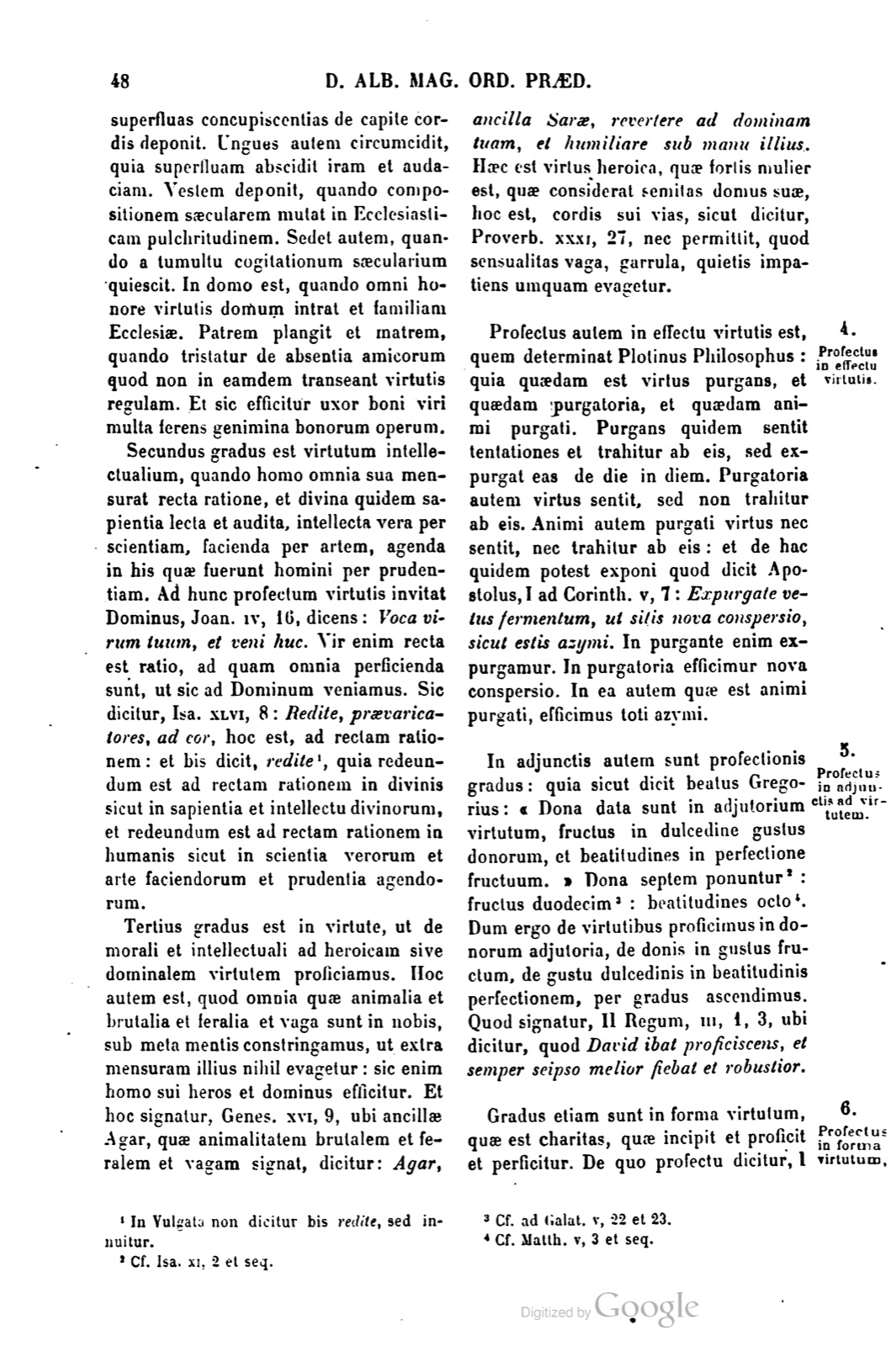
4. [Marginal label: Profectus in effectu virtutis.] Profectus autem in effectu virtutis est, quem determinat Plotinus Philosophus: quia quaedam est virtus purgans, et quaedam purgatoria, et quaedam animi purgati. Purgans quidem sentit tentationes et trahitur ab eis, sed expurgat eas de die in diem. Purgatoria autem virtus sentit, sed non trahitur ab eis. Animi autem purgati virtus nec sentit, nec trahitur ab eis: et de hac quidem potest exponi quod dicit Apostolus, I ad Corinth. V, 7: Expurgate vetus fermentum, ut sitis nova conspersio, sicut estis azymi. In purgante enim expurgamur. In purgatoria efficimur nova conspersio. In ea autem quae est animi purgati, efficimus toti azymi.
5. [Marginal label: Profectus in adjunctis ad virtutem.] In adjunctis autem sunt profectionis gradus: quia sicut dicit beatus Gregorius: "Dona data sunt in adjutorium virtutum, fructus in dulcedine gustus donorum, et beatitudines in perfectione fructuum." Dona septem ponuntur 3: fructus duodecim 4: beatitudines octo 5. Dum ergo de virtutibus proficimus in donorum adjutoria, de donis in gustus fructum, de gustu dulcedinis in beatitudinis perfectionem, per gradus ascendimus. Quod signatur, II Regum, III, 1, 3, ubi dicitur, quod David ibat proficiscens, et semper seipso melior fiebat et robustior.
6. [Marginal label: Profectus in forma virtutum, quae est charitas.] Gradus etiam sunt in forma virtutum, quae est charitas, quae incipit et proficit et perficitur. De quo profectu dicitur, I
The third step is in virtue, so that from moral and intellectual virtue we may make progress to heroic or dominative virtue. But this is that we bind under the boundary of the mind all things that are animal and brutish and beastlike and wandering in us, so that nothing may wander outside its measure. For thus a human being is made hero and lord of himself. And this is signified in Genesis 16:9, where to the maidservant Hagar, who signifies animality that is brutish and beastlike and wandering, it is said: Hagar, maidservant of Sarah, return to your mistress and be humbled under her hand. This is heroic virtue, which is the strong woman, who considers the paths of her house, that is, the ways of her heart, as is said in Proverbs 31:27, and does not permit wandering sensuality, chattering, impatient of rest, ever to wander away.
4. [Marginal label: Progress in the effect of virtue.] But progress in the effect of virtue is what the Philosopher Plotinus determines, because one virtue is purging, and another purgatorial, and another of a purged soul. Purging virtue indeed senses temptations and is drawn by them, but expurges them from day to day. Purgatorial virtue, however, senses them, but is not drawn by them. But the virtue of a purged soul neither senses them nor is drawn by them; and concerning this indeed what the Apostle says in 1 Corinthians 5:7 can be expounded: Expurge the old leaven, that you may be a new sprinkling, as you are unleavened. For in purging virtue we are expurged. In purgatorial virtue we are made a new sprinkling. But in that which is of a purged soul, we are made wholly unleavened.
5. [Marginal label: Progress in things joined to virtue.] But in things joined there are steps of progression, because as blessed Gregory says: "Gifts were given for the aid of virtues, fruits in the sweetness of the taste of gifts, and beatitudes in the perfection of fruits." Seven gifts are placed 3; twelve fruits 4; eight beatitudes 5. Therefore when from virtues we make progress into the aids of gifts, from gifts into the fruit of taste, from the taste of sweetness into the perfection of beatitude, we ascend by steps. This is signified in 2 Kings 3:1, 3, where it is said that David went making progress, and he was always becoming better and stronger than himself.
6. [Marginal label: Progress in the form of virtues, which is charity.] There are also steps in the form of virtues, which is charity, which begins and makes progress and is perfected. Concerning this progress it is said in 1
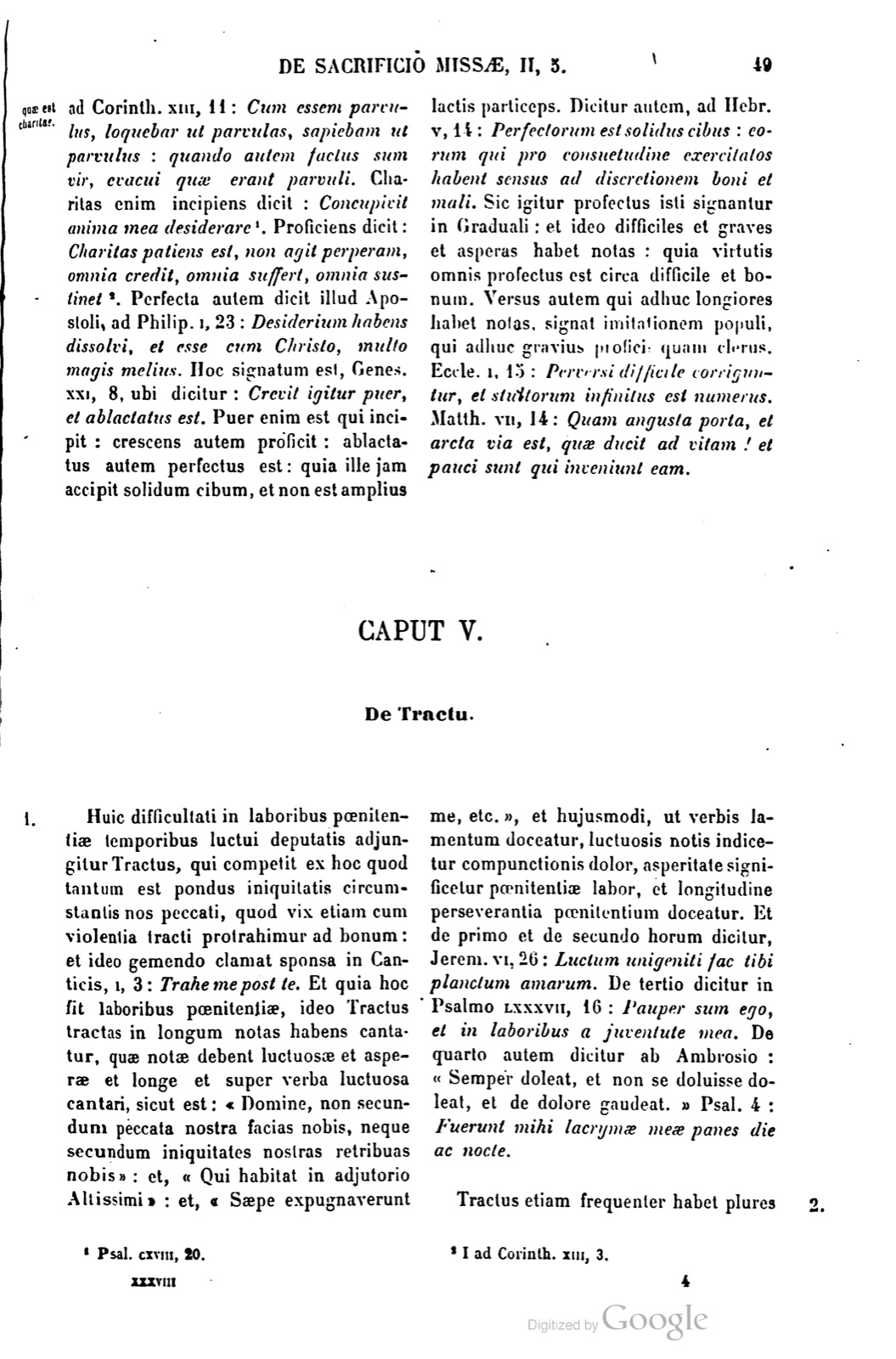
[Marginal label: quae est charitas.] ad Corinth. XIII, 11: Cum essem parvulus, loquebar ut parvulus, sapiebam ut parvulus: quando autem factus sum vir, evacuavi quae erant parvuli. Charitas enim incipiens dicit: Concupivit anima mea desiderare 6. Proficiens dicit: Charitas patiens est, non agit perperam, omnia credit, omnia suffert, omnia sustinet 7. Perfecta autem dicit illud Apostoli, ad Philip. I, 23: Desiderium habens dissolvi, et esse cum Christo, multo magis melius. Hoc signatum est, Genes. XXI, 8, ubi dicitur: Crevit igitur puer, et ablactatus est. Puer enim est qui incipit: crescens autem proficit: ablactatus autem perfectus est: quia ille jam accipit solidum cibum, et non est amplius lactis particeps. Dicitur autem, ad Hebr. V, 14: Perfectorum est solidus cibus: eorum qui pro consuetudine exercitatos habent sensus ad discretionem boni et mali. Sic igitur profectus isti signantur in Graduali: et ideo difficiles et graves et asperas habet notas: quia virtutis omnis profectus est circa difficile et bonum. Versus autem qui adhuc longiores habet notas, signat imitationem populi, qui adhuc gravius proficit quam clerus. Eccle. I, 15: Perversi difficile corriguntur, et stultorum infinitus est numerus. Matth. VII, 14: Quam angusta porta, et arcta via est, quae ducit ad vitam! et pauci sunt qui inveniunt eam.
[Marginal label: which is charity.] to Corinthians 13:11: When I was a little child, I spoke as a little child, I understood as a little child; but when I was made a man, I emptied out the things that belonged to a little child. For charity beginning says: My soul has desired to desire 6. Charity making progress says: Charity is patient, does not act perversely, believes all things, suffers all things, sustains all things 7. But perfected charity says that word of the Apostle, Philippians 1:23: Having a desire to be dissolved and to be with Christ, by far the better thing. This was signified in Genesis 21:8, where it is said: Therefore the boy grew and was weaned. For the boy is one who begins; growing, however, he makes progress; but weaned, he is perfect, because he now receives solid food and is no longer a partaker of milk. It is said, however, in Hebrews 5:14: Solid food belongs to the perfect, to those who by custom have their senses exercised for the discretion of good and evil. Thus therefore those progresses are signified in the Gradual; and therefore it has difficult and heavy and rough notes, because every progress of virtue concerns the difficult and the good. But the verse that has still longer notes signifies the imitation of the people, which still makes progress more laboriously than the clergy. Ecclesiastes 1:15: Perverse persons are corrected with difficulty, and the number of fools is infinite. Matthew 7:14: How narrow is the gate, and strait is the way, which leads to life! and few are those who find it.
Notes
- Psalm 47:14. The Vulgate has: Distribute its houses, etc. (Psal. XLVII, 14. Vulgata habet: Distribuite domos ejus, etc.) ↩
- In the Vulgate, return is not said twice, but is implied. (In Vulgata non dicitur bis redite, sed innuitur.) ↩
- Compare Isaiah 11:2 and following. (Cf. Isa. XI, 2 et seq.) ↩
- Compare Galatians 5:22 and 23. (Cf. ad Galat. V, 22 et 23.) ↩
- Compare Matthew 5:3 and following. (Cf. Matth. V, 3 et seq.) ↩
- Psalm 118:20. (Psal. CXVIII, 20.) ↩
- 1 Corinthians 13:3. (I ad Corinth. XIII, 3.) ↩
If a page does not appear, its photograph has not been uploaded yet.