Works › The Book on the Sacrifice of the Mass
Volume 38 · pp. 45–46
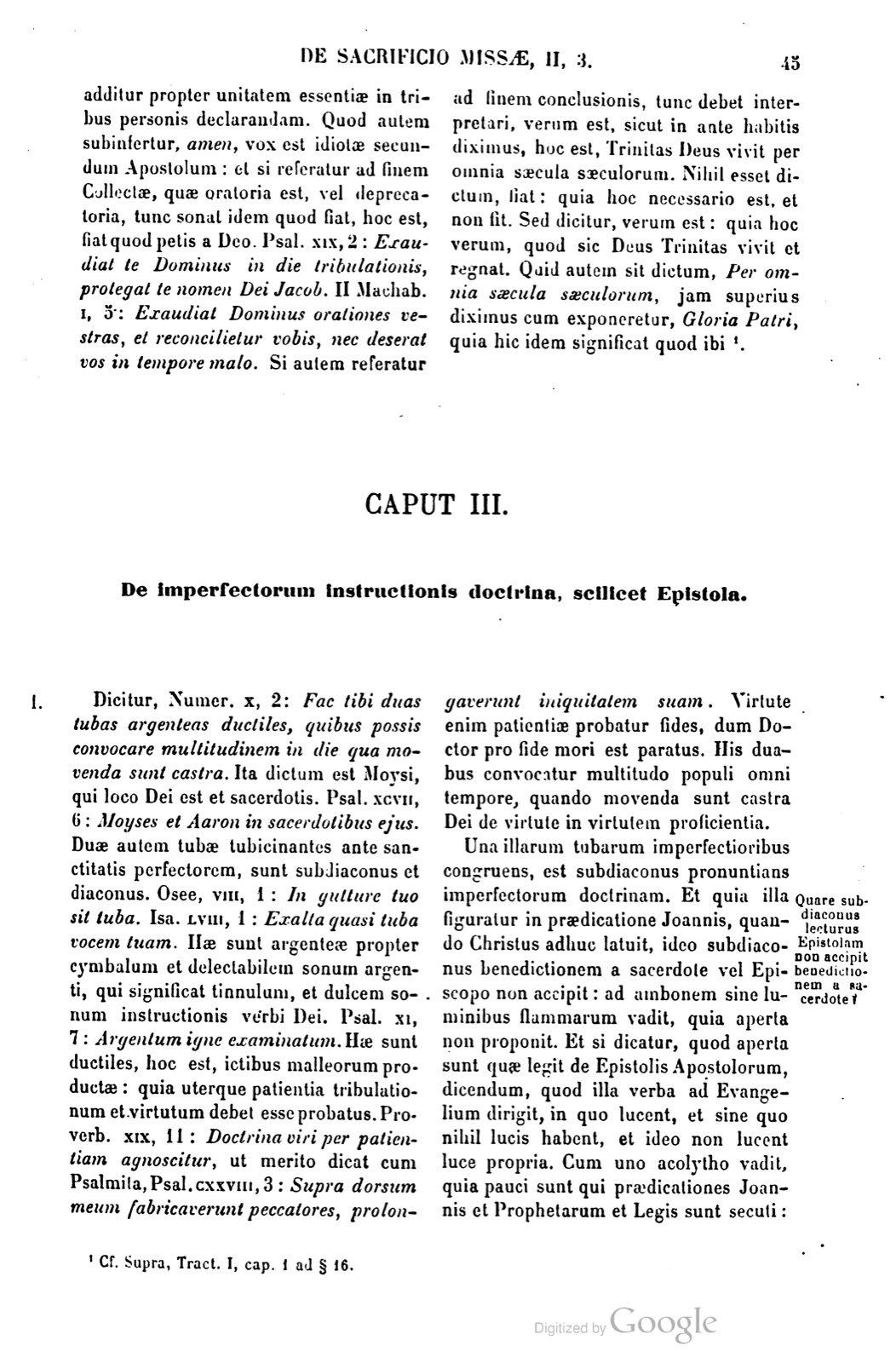
Chapter III. On the doctrine of the instruction of the imperfect, namely the Epistle
A marker with ≈ is an approximate page boundary, placed by measure of the text; the page photographs remain the authority. In the paired views, clicking a page marker brings that page into view.
CAPUT III.
De imperfectorum instructionis doctrina, scilicet Epistola.
1. Dicitur, Numer. X, 2: Fac tibi duas tubas argenteas ductiles, quibus possis convocare multitudinem in die qua movenda sunt castra. Ita dictum est Moysi, qui loco Dei est et sacerdotis. Psal. XCVIII, 6: Moyses et Aaron in sacerdotibus ejus. Duae autem tubae tubicinantes ante sanctitatis perfectorem, sunt subdiaconus et diaconus. Osee, VIII, 1: In gutture tuo sit tuba. Isa. LVIII, 1: Exalta quasi tuba vocem tuam. Hae sunt argenteae propter cymbalum et delectabilem sonum argenti, qui significat tinnulum, et dulcem sonum instructionis verbi Dei. Psal. XI, 7: Argentum igne examinatum. Hae sunt ductiles, hoc est, ictibus malleorum productae: quia uterque patientia tribulationum et virtutum debet esse probatus. Proverb. XIX, 11: Doctrina viri per patientiam agnoscitur, ut merito dicat cum Psalmista, Psal. CXXVIII, 3: Supra dorsum meum fabricaverunt peccatores, prolongaverunt iniquitatem suam. Virtute enim patientiae probatur fides, dum Doctor pro fide mori est paratus. His duabus convocatur multitudo populi omni tempore, quando movenda sunt castra Dei de virtute in virtutem proficientia.
[Marginal label: Quare subdiaconus lecturus Epistolam non accipit benedictionem a sacerdote.] Una illarum tubarum imperfectioribus congruens, est subdiaconus pronuntians imperfectorum doctrinam. Et quia illa figuratur in praedicatione Joannis, quando Christus adhuc latuit, ideo subdiaconus benedictionem a sacerdote vel Episcopo non accipit: ad ambonem sine luminibus flammarum vadit, quia aperta non proponit. Et si dicatur, quod aperta sunt quae legit de Epistolis Apostolorum, dicendum, quod illa verba ad Evangelium dirigit, in quo lucent, et sine quo nihil lucis habent, et ideo non lucent luce propria. Cum uno acolytho vadit, quia pauci sunt qui praedicationes Joannis et Prophetarum et Legis sunt secuti: et quia non proponitur illa doctrina ut finis, sed ut introductio.
2. In legendo autem quatuor attenduntur, scilicet locus, conversio corporis, legendi modus, et reditus ad Episcopum vel sacerdotem.
CHAPTER III.
On the doctrine of the instruction of the imperfect, namely the Epistle.
1. It is said in Numbers 10:2: Make for yourself two silver ductile trumpets, with which you may be able to call together the multitude on the day on which the camps are to be moved. Thus it was said to Moses, who is in the place of God and of the priest. Psalm 98:6: Moses and Aaron among his priests. But the two trumpets trumpeting before the perfecter of holiness are the subdeacon and deacon. Hosea 8:1: Let the trumpet be in your throat. Isaiah 58:1: Lift up your voice like a trumpet. These are silver on account of the cymbal and delightful sound of silver, which signifies the ringing and sweet sound of the instruction of the word of God. Psalm 11:7: Silver tried by fire. These are ductile, that is, brought forth by blows of hammers, because each ought to be proved by patience of tribulations and virtues. Proverbs 19:11: The learning of a man is known through patience, so that he fittingly says with the Psalmist, Psalm 128:3: Sinners have built upon my back; they have prolonged their iniquity. For faith is proved by the virtue of patience, while the Teacher is prepared to die for the faith. By these two the multitude of the people is called together at every time when the camps of God, making progress from virtue into virtue, are to be moved.
[Marginal label: Why the subdeacon about to read the Epistle does not receive a blessing from the priest.] One of those trumpets, congruent with the more imperfect, is the subdeacon pronouncing the doctrine of the imperfect. And because that is figured in the preaching of John, when Christ was still hidden, therefore the subdeacon does not receive a blessing from the priest or bishop; he goes to the ambo without lights of flames, because he does not set forth open things. And if it is said that the things that he reads from the Epistles of the Apostles are open, one must say that those words direct toward the Gospel, in which they shine, and without which they have no light; and therefore they do not shine with their own light. He goes with one acolyte, because few are those who followed the preachings of John and of the Prophets and of the Law, and because that doctrine is not set forth as the end, but as an introduction.
2. But in reading four things are attended to, namely the place, the turning of the body, the mode of reading, and the return to the bishop or priest.
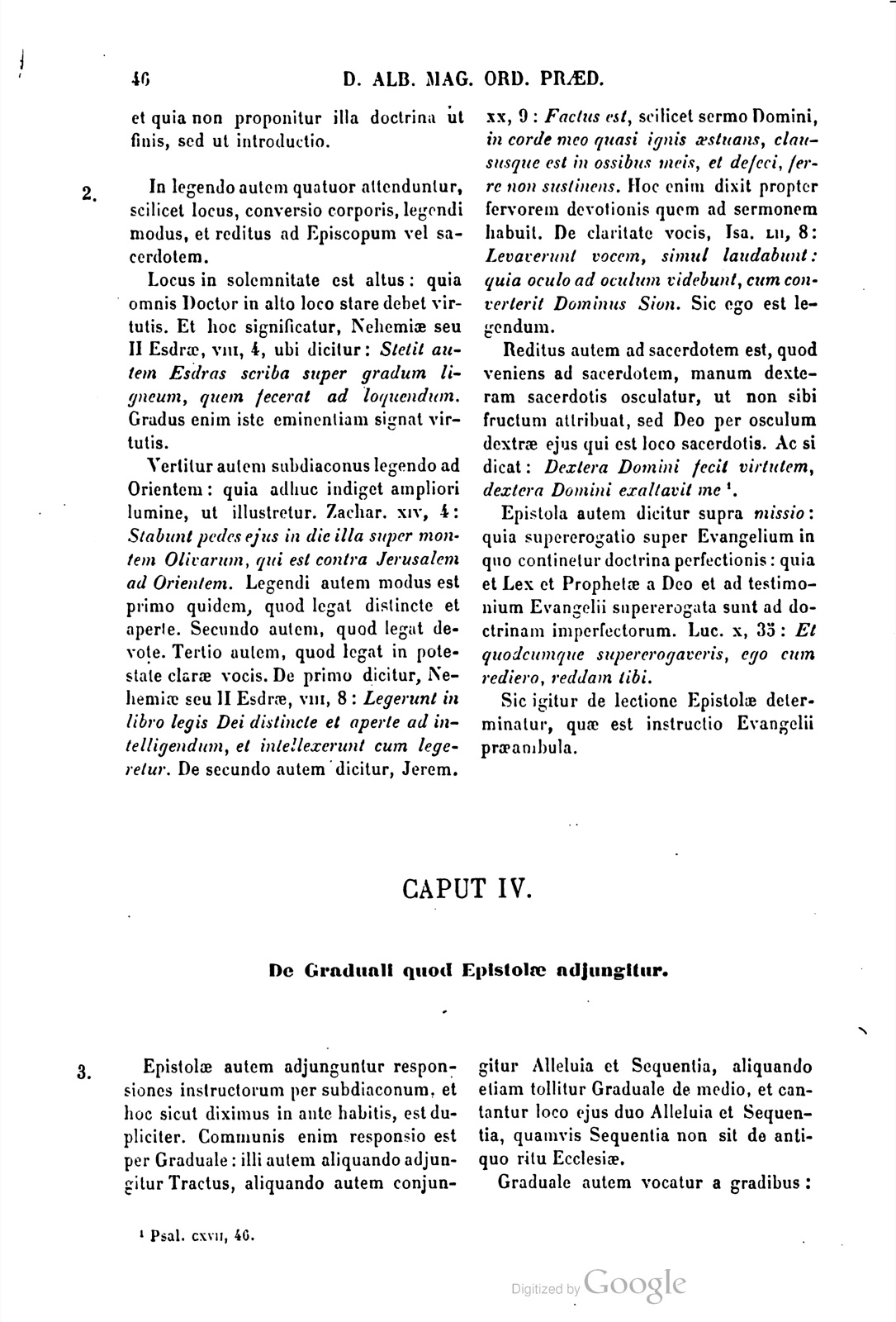
Locus in solemnitate est altus: quia omnis Doctor in alto loco stare debet virtutis. Et hoc significatur, Nehemiae seu II Esdrae, VIII, 4, ubi dicitur: Stetit autem Esdras scriba super gradum ligneum, quem fecerat ad loquendum. Gradus enim iste eminentiam signat virtutis.
Vertitur autem subdiaconus legendo ad Orientem: quia adhuc indiget ampliori lumine, ut illustretur. Zachar. XIV, 4: Stabunt pedes ejus in die illa super montem Olivarum, qui est contra Jerusalem ad Orientem. Legendi autem modus est primo quidem, quod legat distincte et aperte. Secundo autem, quod legat devote. Tertio autem, quod legat in potestate clarae vocis. De primo dicitur, Nehemiae seu II Esdrae, VIII, 8: Legerunt in libro legis Dei distincte et aperte ad intelligendum, et intellexerunt cum legeretur. De secundo autem dicitur, Jerem. XX, 9: Factus est, scilicet sermo Domini, in corde meo quasi ignis aestuans, claususque est in ossibus meis, et defeci, ferre non sustinens. Hoc enim dixit propter fervorem devotionis quem ad sermonem habuit. De claritate vocis, Isa. LII, 8: Levaverunt vocem, simul laudabunt: quia oculo ad oculum videbunt, cum converterit Dominus Sion. Sic ergo est legendum.
Reditus autem ad sacerdotem est, quod veniens ad sacerdotem, manum dexteram sacerdotis osculatur, ut non sibi fructum attribuat, sed Deo per osculum dextrae ejus qui est loco sacerdotis. Ac si dicat: Dextera Domini fecit virtutem, dextera Domini exaltavit me 1.
Epistola autem dicitur supra missio: quia supererogatio super Evangelium in quo continetur doctrina perfectionis: quia et Lex et Prophetae a Deo et ad testimonium Evangelii supererogata sunt ad doctrinam imperfectorum. Luc. X, 35: Et quodcumque supererogaveris, ego cum rediero, reddam tibi.
Sic igitur de lectione Epistolae determinatur, quae est instructio Evangelii praeambula.
The place in solemnity is high, because every Teacher ought to stand in the high place of virtue. And this is signified in Nehemiah or 2 Esdras 8:4, where it is said: But Ezra the scribe stood upon a wooden step, which he had made for speaking. For that step signifies the eminence of virtue.
But the subdeacon, in reading, is turned toward the East, because he still needs a fuller light so that he may be illumined. Zechariah 14:4: His feet will stand on that day upon the mount of Olives, which is opposite Jerusalem toward the East. But the mode of reading is, first indeed, that he read distinctly and openly; second, that he read devoutly; third, that he read with the power of a clear voice. Concerning the first it is said in Nehemiah or 2 Esdras 8:8: They read in the book of the law of God distinctly and openly for understanding, and they understood when it was read. But concerning the second it is said in Jeremiah 20:9: It was made, namely the word of the Lord, in my heart like a burning fire, and it was shut up in my bones, and I fainted, not sustaining to bear it. For he said this on account of the fervor of devotion that he had toward the word. Concerning clarity of voice, Isaiah 52:8: They lifted up their voice; together they will praise, because eye to eye they will see when the Lord converts Zion. Thus therefore one must read.
But the return to the priest is that, coming to the priest, he kisses the right hand of the priest, so that he may not attribute the fruit to himself, but to God through the kiss of the right hand of him who is in the place of the priest. As if he were saying: The right hand of the Lord has wrought virtue, the right hand of the Lord has exalted me 1.
But Epistle is said as supra missio, because it is a supererogation over the Gospel, in which the doctrine of perfection is contained, because both the Law and the Prophets have been supererogated by God and for the testimony of the Gospel unto the doctrine of the imperfect. Luke 10:35: And whatever you supererogate, when I return, I will repay you.
Thus therefore it is determined concerning the reading of the Epistle, which is the preliminary instruction of the Gospel.
Notes
- Psalm 117:16. (Psal. CXVII, 16.) ↩
If a page does not appear, its photograph has not been uploaded yet.