Works › The Book on the Sacrifice of the Mass
Volume 38 · pp. 41–45
Chapter II. The prayer that is said first in the Mass is called the Collect
A marker with ≈ is an approximate page boundary, placed by measure of the text; the page photographs remain the authority. In the paired views, clicking a page marker brings that page into view.
CAPUT II.
Oratio quae primo dicitur in Missa, dicitur Collecta.
1. Sequitur autem post salutationem Oratio, ut Dominus aperiat corda audientium ad instructionem percipiendam, et ad digne suscipiendam oblationem sacramenti secundum dictum Apostoli, II ad Thessal. III, 1: Orate pro nobis, ut sermo Dei currat.
[Marginal label: Tria in oratione notanda, scilicet nomen, ritus, et conclusio. Quare oratio dicitur Collecta.] Circa hanc orationem tria sunt notanda, scilicet nomen, ritus, et conclusio.
Nomen dicitur Collecta. Ratio autem nominis est, vel quia colligit petita populi, quae sacerdos conscius secretorum colligit et offert Domino: vel quia tales fiebant pro populo, dum colligeretur ad communionem Domini celebrandam. De prima autem ratione dicitur, Tob. XII, 12: Quando orabas cum lacrymis, et sepeliebas mortuos,... ego obtuli orationem tuam Domino. Hoc dicit Angelus. Jam autem ante ostendimus, quod sacerdos Angelus Domini exercituum est 1.
Secundo autem modo dicitur Collecta: quia populus colligitur, cum dicitur. Notandum est, quod tribus modis populus colligi habet ad orandum, scilicet quando partita in unum colligit, hoc est, in Deum corda colligit, quae in multum sunt divisa. Unde Augustinus in libro IV Confessionum: "In omnibus quae mente percurro, non invenio tutum locum animae meae praeter te, Domine, in quo colliguntur sparsa mea." Matth. XII, 30: Qui non congregat mecum, spargit. Opus enim Dei semper in colligendo est, et opus diaboli in dispergendo. Secunda collecta est: quia populus ibi colligitur in unum cor et in animam unam. Psal. CI, 23: In conveniendo populos in unum, et reges ut serviant Domino. Psal. XLIX, 5: Congregate illi sanctos ejus, qui ordinant testamentum ejus. Testamentum enim est promissio Dei suo sanguine confirmata. Dicitur iterum collecta corporis mystici, quae sic in unum commiscetur sicut corpus Christi ex multis granis, et sanguis Christi de multis uvis. Psal. CX, 1 et 2: Confitebor tibi, Domine, in toto corde meo, in consilio justorum, et congregatione. Magna opera Domini, exquisita in omnes voluntates ejus. Nulla enim sunt majora opera Domini quam incorporari sanguini Christi et corpori, et ipsi Christo. Hoc signatum est, Nehemiae seu II Esdrae, VIII, 1, ubi dicitur, quod congregatus est omnis populus quasi vir unus ad audiendam legem. Genes. XLIX, 2: Congregamini, et audite, filii Jacob, audite Israel patrem vestrum. His igitur de causis vocatur Collecta oratio quae primo dicitur in Missa.
2. [Marginal label: Ritus Collectarum.] Ritus autem harum Collectarum est, quod primo erant Collectae confusae, et quilibet sacerdos vel Episcopus faciebat et dicebat Collectas quas volebat. Sed postea in concilio Africano, cui beatus Augustinus interfuit, statutum est, quod nulla in Missa diceretur oratio, nisi quae sacro esset approbata concilio. Postmodum autem Gelasius Papa videns, quod multimodae erant et differentes Collectae, etiam quae eadem die in diversis Ecclesiis dicerentur, resecavit superfluas, et quasdam immutavit in alias, et ordinavit, ut in Missis ubique esset conformitas. Postmodum veniens beatus Gregorius, videns quod in numero Collectarum sacerdotes modum excederent, ordinavit officium, multa resecans, mutans, et apponens, statuit ut impares dicerentur numero, una, vel tres, vel quinque, vel septem, et ultra septenarium nulla diceretur: cujus causam ipse assignans Gregorius dicit, quod divisio est causa multitudinis in omnibus: par autem numerus in duo aequa est divisibilis, et sic multitudinis est causa: et ideo binarius est causa multiplicationis et divisionis: quia omnia quae in multa vadunt, primo per duo dividuntur: quia binarius ab unitate, quae causa est indivisionis, primus recedit: et ideo etiam, ut dicit Augustinus, Deus operi secundae diei, cum mundum crearet, non benedixit, cum omnium aliorum benediceret operibus dierum. Quia igitur Dominus dixit, Matth. VI, 7: Orantes autem nolite multum loqui, sicut ethnici: putant enim quod in multiloquio suo exaudiantur: ideo par numerus Collectarum esse non debet. Plurimus etiam esse non debet: quia, Marc. XI, 40, de Scribis et Pharisaeis dicitur, quod devorant domos viduarum sub obtentu prolixae orationis. Et ideo praecipit beatus Benedictus in regula, quod omnis oratio in conventu brevis sit, ne taedium audientibus generetur, et devotio impediatur. Impar autem numerus, ut dicit Pythagoras, est qui in duo aequalia dividi non potest: stat enim prima ejus divisio in unitate, quae fieri divisionem non permittit: et ideo dicitur, quod "numero Deus impare gaudet" 2: quia divisionem Deus in omnibus detestatur. Osee, X, 2: Divisum est cor eorum, nunc interibunt. Et ideo ad praedictos numeros Collectas beatus Gregorius restrinxit.
CHAPTER II.
The prayer that is said first in the Mass is called the Collect.
1. But after the greeting follows the Prayer, so that the Lord may open the hearts of those hearing for receiving instruction, and for receiving worthily the oblation of the sacrament according to the saying of the Apostle, 2 Thessalonians 3:1: Pray for us, that the word of God may run.
[Marginal label: Three things to be noted in prayer, namely name, rite, and conclusion. Why is the prayer called Collect?] Concerning this prayer three things must be noted, namely name, rite, and conclusion.
The name is called Collect. But the reason for the name is either because it gathers the petitions of the people, which the priest, conscious of secrets, gathers and offers to the Lord, or because such prayers used to be made for the people while it was being gathered for celebrating the communion of the Lord. Concerning the first reason it is said in Tobit 12:12: When you were praying with tears and burying the dead,... I offered your prayer to the Lord. The Angel says this. But now we have shown before that the priest is the Angel of the Lord of hosts 1.
But in the second mode it is called Collect because the people is gathered when it is said. It must be noted that in three ways the people has to be gathered for praying, namely when it gathers divided things into one, that is, gathers hearts into God, which are divided into many things. Hence Augustine in book IV of the Confessions: "In all things that I run through with the mind, I do not find a safe place for my soul except you, Lord, in whom my scattered things are gathered." Matthew 12:30: He who does not gather with me scatters. For the work of God is always in gathering, and the work of the devil in scattering. The second collect is because there the people is gathered into one heart and into one soul. Psalm 101:23: In peoples convening into one, and kings, that they may serve the Lord. Psalm 49:5: Gather to him his saints, who order his testament. For a testament is the promise of God confirmed by his blood. Again it is called the collect of the mystical body, which is mixed into one in the way that the body of Christ is from many grains, and the blood of Christ from many grapes. Psalm 110:1 and 2: I will confess to you, Lord, with my whole heart, in the counsel of the just, and in the congregation. Great are the works of the Lord, sought out into all his wills. For there are no works of the Lord greater than to be incorporated into the blood of Christ and the body, and into Christ himself. This was signified in Nehemiah or 2 Esdras 8:1, where it is said that the whole people was gathered as one man to hear the law. Genesis 49:2: Be gathered, and hear, sons of Jacob; hear Israel your father. Therefore for these causes the prayer that is first said in the Mass is called Collect.
2. [Marginal label: The rite of the Collects.] But the rite of these Collects is that at first the Collects were confused, and any priest or bishop made and said the Collects that he wished. But afterward in the African council, at which blessed Augustine was present, it was established that no prayer should be said in the Mass unless it had been approved by a sacred council. But afterward Pope Gelasius, seeing that the Collects were manifold and different, even those that were said on the same day in different Churches, cut away superfluous ones, changed certain ones into others, and ordered that in Masses there should everywhere be conformity. Afterward blessed Gregory came, seeing that in the number of Collects priests exceeded measure, ordered the office, cutting away, changing, and adding many things, and established that they should be said in an odd number, one, or three, or five, or seven, and that none should be said beyond the septenary. Assigning the cause of this, Gregory himself says that division is the cause of multitude in all things; but an even number is divisible into two equal things, and thus is the cause of multitude; and therefore the binary is the cause of multiplication and division, because all things that go into many things are first divided through two, because the binary first withdraws from unity, which is the cause of indivision. And therefore also, as Augustine says, God did not bless the work of the second day when he created the world, although he blessed the works of all the other days. Therefore because the Lord said in Matthew 6:7: But when praying, do not speak much, like the heathen, for they think that in their much speaking they are heard, therefore there ought not to be an even number of Collects. Nor ought there to be a very great number, because in Mark 11:40 it is said of the Scribes and Pharisees that they devour the houses of widows under the pretext of lengthy prayer. And therefore blessed Benedict commands in the rule that every prayer in the assembly should be short, lest weariness be generated in the hearers and devotion impeded. But an odd number, as Pythagoras says, is one that cannot be divided into two equal things; for its first division stands in unity, which does not permit division to be made; and therefore it is said that "God rejoices in an odd number" 2, because God detests division in all things. Hosea 10:2: Their heart is divided; now they will perish. And therefore blessed Gregory restricted the Collects to the aforesaid numbers.
3. [Marginal label: Quare una, vel tres, vel quinque, vel septem Collectae cantantur.] Quare autem statutum sit, quod una, vel tres, vel quinque, vel septem, multi multas assignaverunt inutiles rationes. Dicunt enim quidam, quod una est propter fidem unitatis substantiae divinae in tribus personis, tres autem propter fidem Trinitatis, quinque vero propter quinque vulnera Jesu Christi, septem autem propter septem dona Spiritus sancti. Haec autem ratio nulla est: quia sic etiam novem esse deberent propter novem ordines Angelorum, et undecim quia undecim discipuli abierunt in Galilaeam, et tredecim propter Christum cum Apostolis, et quindecim propter quindecim gradus in quibus describitur profectus virtutum, in quo proficimus in oratione. Unde tales rationes penitus nullae sunt et derisibiles.
3. [Marginal label: Why are one, or three, or five, or seven Collects sung?] But as to why it was established that there should be one, or three, or five, or seven, many have assigned many useless reasons. For certain persons say that one is on account of faith in the unity of the divine substance in three persons; three, however, on account of faith in the Trinity; five, truly, on account of the five wounds of Jesus Christ; and seven, on account of the seven gifts of the Holy Spirit. But this reason is nothing, because then there also ought to be nine on account of the nine orders of Angels, and eleven because eleven disciples went away into Galilee, and thirteen on account of Christ with the Apostles, and fifteen on account of the fifteen steps in which the progress of the virtues is described, in which we make progress in prayer. Hence such reasons are entirely nothing and laughable.
Vera autem ratio hujus institutionis est, quod tria attenduntur in oratione, scilicet intentio orantis, et res in oratione petita, et modus petitionis. Respiciendo autem ad intentionem orantium quae una est, ut aeternum bonum habeatur, institutio dicit unam sufficere Collectam. Luc. X, 42: Porro unum est necessarium. Psal. XXVI, 4: Unam petii a Domino, hanc requiram. Respiciendo autem ad petita quae tria sunt, institutio statuit tres dici Collectas. Secundum ordinem enim petimus a malo liberari impediente nos ad meritum: secundum ordinem autem ad bonum petimus bonum gratiae et bonum gloriae. Matth. VI, 33: Quaerite primum regnum Dei et justitiam ejus. Justitia autem regni Dei duas habet partes, scilicet declinare a malo, et facere bonum.
Considerando autem modos petendi, duo modi considerantur, implicitus et explicitus. Considerando modum implicitum, statuit constitutio quinque, quas petitiones ponit Dominus, Luc. XI, 2 et seq., ubi dicit sic: Pater, sanctificetur nomen tuum. Adveniat regnum tuum. Panem nostrum quotidianum da nobis hodie. Et dimitte nobis peccata nostra, siquidem et ipsi dimittimus omni debenti nobis. Et ne nos inducas in tentationem. Et non ponit plures petitiones: quia in illa qua dicitur, Adveniat, etc., implicite continetur illa, Fiat voluntas tua: quia si voluntas Dei perficitur, regnum justitiae Christi jam adveniet. Et illa qua dicitur: Libera nos a malo, implicite continetur in illa: Et ne nos inducas in tentationem: ab omni enim malo liberatus est, qui in tentationem non inducitur: sicut etiam dicit Glossa ibidem. Si autem consideratur modus explicitus petitionum, tunc statuit constitutio septem fieri Collectas: quia Christus, Matth. VI, 9 et seq., septem docuit petitiones, explicite omnia quae necessaria sunt petentes, dicens: Pater noster, qui es in caelis, in quo nulla petitio continetur, sed potius ostenditur ad quem oratio est dirigenda. Sanctificetur nomen tuum, ecce prima. Adveniat regnum tuum, ecce secunda. Fiat voluntas tua sicut in caelo et in terra, ecce tertia. Panem nostrum supersubstantialem da nobis hodie, ecce quarta. Et dimitte nobis debita nostra, sicut et nos dimittimus debitoribus nostris, ecce quinta. Et ne nos inducas in tentationem, ecce sexta. Sed libera nos a malo, ecce septima. Ultra istas non est procedendum: quia vergit ad multiloquium, et generat taedium, et minuit devotionem.
Quod autem quidam plures volunt dicere sub una conclusione, nihil est: quia Collectae non numerantur a conclusione: quia in secundo loco aliquando duae, et aliquando quatuor, et aliquando sex sub una terminantur conclusione: et ideo hoc non est faciendum, sed tenenda Ecclesiae institutio: quia hoc est apostolicum. Unde, I ad Corinth. XI, 2: Laudo autem vos, fratres, quod per omnia mei memores estis, et sicut tradidi vobis, praecepta mea tenetis. Et post pauca, v. 16, dicit de illis qui statuta Patrum contemnunt, et sua esse meliora quam constitutiones Patrum contendunt, sic dicens: Si quis autem videtur contentiosus esse, nos talem consuetudinem non habemus, neque Ecclesia Dei. Si autem aliqua necessitas temporis illud exposcit et non contemptus constitutionis, possunt tunc dici pares, sicut in festo S. Stephani duae dicuntur, et in die Innocentium quatuor propter commemorationem Octavarum.
But the true reason for this institution is that three things are attended to in prayer, namely the intention of the one praying, the thing petitioned in prayer, and the mode of petition. Looking to the intention of those praying, which is one, that the eternal good may be had, the institution says that one Collect suffices. Luke 10:42: But one thing is necessary. Psalm 26:4: One thing I have asked of the Lord; this I will seek. But looking to the things petitioned, which are three, the institution established that three Collects be said. For in order we ask to be freed from the evil impeding us with respect to merit; but in order with respect to good we ask the good of grace and the good of glory. Matthew 6:33: Seek first the kingdom of God and his justice. But the justice of the kingdom of God has two parts, namely to decline from evil and to do good.
But considering the modes of petitioning, two modes are considered, implicit and explicit. Considering the implicit mode, the constitution established five, which petitions the Lord places in Luke 11:2 and following, where he says thus: Father, may your name be sanctified. May your kingdom come. Give us today our daily bread. And forgive us our sins, since we ourselves also forgive everyone owing to us. And do not lead us into temptation. And he does not place more petitions, because in that one in which it is said, May it come, etc., that one, Your will be done, is implicitly contained, because if the will of God is perfected, the kingdom of Christ's justice will now come. And that one in which it is said: Free us from evil, is implicitly contained in that one: And do not lead us into temptation; for he is freed from every evil who is not led into temptation, as the Gloss also says in the same place. But if the explicit mode of petitions is considered, then the constitution established that seven Collects be made, because Christ in Matthew 6:9 and following taught seven petitions, explicitly asking all things that are necessary, saying: Our Father, who are in heaven, in which no petition is contained, but rather it is shown to whom the prayer is to be directed. May your name be sanctified, behold the first. May your kingdom come, behold the second. May your will be done as in heaven and on earth, behold the third. Give us today our supersubstantial bread, behold the fourth. And forgive us our debts, as we also forgive our debtors, behold the fifth. And do not lead us into temptation, behold the sixth. But free us from evil, behold the seventh. Beyond these one must not proceed, because it turns toward much speaking, and generates weariness, and lessens devotion.
But that certain persons wish to say more under one conclusion is nothing, because the Collects are not numbered from the conclusion; because in the second place sometimes two, and sometimes four, and sometimes six are ended under one conclusion. And therefore this must not be done, but the institution of the Church must be held, because this is apostolic. Hence, 1 Corinthians 11:2: But I praise you, brothers, because through all things you are mindful of me, and as I handed them on to you, you hold my precepts. And a little later, verse 16, concerning those who despise the statutes of the Fathers and contend that their own things are better than the constitutions of the Fathers, he says thus: But if anyone seems to be contentious, we have no such custom, nor does the Church of God. But if some necessity of time requires it and not contempt of the constitution, even numbers can then be said, as on the feast of St. Stephen two are said, and on the day of the Innocents four on account of the commemoration of the Octaves.
4. [Marginal label: Tria notanda in conclusione Collectarum. Unde sit conclusio?] Conclusio autem fere in omnibus, exceptis valde paucis, est per Dominum nostrum. In qua conclusione tria sunt notanda, quorum unum est, unde addita sit haec conclusio. Secundo, qualiter sit facienda. Tertio, quid in ea contineatur.
Inventa est igitur conclusio et derivata ab Apostolis, considerando dictum Christi, Joan. XIV, 13: Et quodcumque petieritis Patrem in nomine meo, hoc faciam. Oportet enim nos in nomine ejus petere in cujus merito exaudimur: non enim in nostro, sed in merito Christi audimur, et ideo nomine Christi oportet concludere orationem. Psal. CXIII, 9: Non nobis, Domine, non nobis, sed nomini tuo da gloriam. Et hoc signatum est, Job, XLII, 8: Job autem servus meus orabit pro vobis, faciem ejus suscipiam. Job enim qui dolens interpretatur, significat Christum dolentem, pro nobis in cruce orantem.
Nomen autem quod ponimus, nomen est Jesu Christi: quia illa sunt nomina mediatoris. Deum humanatum dicit Jesus: hominem autem deificatum dicit Christus. Et unum nomen est mediatoris, qui ponit manum in ambobus, in Deo scilicet et homine: sicut enim a sole qui est longe, ignem mutuare non possumus, nisi medio berillo vel crystallo vel aliquo tali utamur: ita a Patre caelesti, a quo nos per peccatum elongavimus, haurire gratiam non possumus, nisi per mediatorem qui nobis et Patri est propinquus. I ad Timoth. II, 5: Unus mediator Dei et hominum, homo Christus Jesus. Igitur patet quare tali conclusione, non omnibus Collectis, est necesse.
5. [Marginal label: Qualiter facienda conclusio?] Facienda autem est in omnibus orationibus quae ad Patrem diriguntur: si ad Filium dirigitur, tunc aliquantulum fit alio modo sicut dicitur: "Qui crucem sanctam ascendisti et mundi tenebras illuminasti, tu corda nostra et corpora nostra illuminare dignare." Haec enim oratio non nisi ad Filium dirigitur: quia ille solus crucem ascendit, et ideo dicere non possumus: Per Dominum nostrum Jesum Christum Filium tuum: quia tunc Filius sui ipsius Filius esse significaretur, quod est haereticum: et ideo tunc dicimus concludentes orationem: "Qui cum Patre et Spiritu sancto vivis et regnas Deus." Si autem oratio fit ad Spiritum sanctum, tunc oportet quod sic concludatur: "Qui cum Patre et Filio vivis, etc." Similiter etiam quando in oratione directa ad Patrem fit mentio de Filio, oportet quod tunc in conclusione dicatur: Per eumdem Dominum nostrum. Si autem in Collecta ad Patrem directa, fit mentio de Spiritu sancto, tunc sic concluditur: Per Dominum nostrum Jesum Christum, qui tecum vivit et regnat in eodem Spiritu sancto.
4. [Marginal label: Three things to be noted in the conclusion of the Collects. Whence is the conclusion?] But the conclusion in almost all, except very few, is through our Lord. In this conclusion there are three things to be noted: one is whence this conclusion was added; second, how it is to be made; third, what is contained in it.
Therefore the conclusion was found and derived from the Apostles by considering the saying of Christ in John 14:13: And whatever you ask the Father in my name, this I will do. For we ought to ask in the name of him in whose merit we are heard; for we are not heard in our own merit, but in the merit of Christ, and therefore it is necessary to conclude prayer by the name of Christ. Psalm 113:9: Not to us, Lord, not to us, but to your name give glory. And this was signified in Job 42:8: But my servant Job will pray for you; I will receive his face. For Job, who is interpreted grieving, signifies Christ grieving, praying for us on the cross.
But the name that we place is the name of Jesus Christ, because those are the names of the mediator. Jesus says God made human; but Christ says a human being deified. And there is one name of the mediator, who places his hand upon both, namely upon God and human being. For just as from the sun, which is far away, we cannot borrow fire unless we use a beryl or crystal or something of this sort as intermediary, so from the heavenly Father, from whom we have been distanced through sin, we cannot draw grace except through a mediator who is near both to us and to the Father. 1 Timothy 2:5: One mediator of God and human beings, the man Christ Jesus. Therefore it is clear why such a conclusion, though not for all Collects, is necessary.
5. [Marginal label: How is the conclusion to be made?] It is to be made in all prayers that are directed to the Father. If it is directed to the Son, then it is made in a somewhat different way, as it is said: "You who ascended the holy cross and illumined the darknesses of the world, deign to illumine our hearts and our bodies." For this prayer is directed only to the Son, because he alone ascended the cross, and therefore we cannot say: Through our Lord Jesus Christ your Son, because then the Son would be signified as the Son of himself, which is heretical. And therefore then we say, concluding the prayer: "Who with the Father and the Holy Spirit live and reign as God." But if the prayer is made to the Holy Spirit, then it must be concluded thus: "Who with the Father and the Son live, etc." Similarly also, when in a prayer directed to the Father mention is made of the Son, then it is necessary that in the conclusion it be said: Through the same our Lord. But if in a Collect directed to the Father, mention is made of the Holy Spirit, then it is concluded thus: Through our Lord Jesus Christ, who with you lives and reigns in the same Holy Spirit.
6. [Marginal label: Quae in conclusione continentur?] Ea autem quae in hac conclusione posita sunt, intelligibilia sunt per ea quae jam ante fere dicta sunt. Quod enim dicitur: Per Dominum, dicitur propter facultatis divitias quae derivatur in orantes per Dominum Christum: quia talium facultatum copiam sonat hoc nomen, Dominus. Ad Roman. X, 12: Dominus dives in omnes qui invocant illum. Quod autem dicitur: Nostrum, dicitur, quia in se suscepit nostrum debitum. Quod, Jesum Christum, dicitur propter mediationem, ex qua potest et debet debito congrui subvenire. Quod autem dicitur, Filium tuum, notatur quod facultatem habet subveniendi per naturae divinae haereditatem. Per hoc quod dicitur, vivit, notatur, quod non morte prohibetur, sed sempiternum suum sacerdotium, quo offert et orat pro nobis, semper vivens ad interpellandum pro nobis 3. Per hoc quod dicitur, regnat, notatur confirmata potestas ad subveniendum. Cum autem dicitur, in unitate Spiritus sancti, duplex, ut dicit Hilarius, notatur unitas, essentiae scilicet et consensionis: et haec secunda attribuitur Spiritui sancto. Prima autem est essentiae trium personarum. Spiritus enim sanctus eo quod amor est, appropriatam sibi habet unionem consensionis. II ad Corinth. XIII, 13: Gratia Domini nostri Jesu Christi, et charitas Dei, et communicatio Spiritus sancti sit cum omnibus vobis. Amen. Quod autem additur, vivit et regnat Deus, additur propter unitatem essentiae in tribus personis declarandam. Quod autem subinfertur, amen, vox est idiotae secundum Apostolum: et si referatur ad finem Collectae, quae oratoria est, vel deprecatoria, tunc sonat idem quod fiat, hoc est, fiat quod petis a Deo. Psal. XIX, 2: Exaudiat te Dominus in die tribulationis, protegat te nomen Dei Jacob. II Machab. I, 3: Exaudiat Dominus orationes vestras, et reconcilietur vobis, nec deserat vos in tempore malo. Si autem referatur ad finem conclusionis, tunc debet interpretari, verum est, sicut in ante habitis diximus, hoc est, Trinitas Deus vivit per omnia saecula saeculorum. Nihil esset dictum, fiat: quia hoc necessario est, et non fit. Sed dicitur, verum est: quia hoc verum, quod sic Deus Trinitas vivit et regnat. Quid autem sit dictum, Per omnia saecula saeculorum, jam superius diximus cum exponeretur, Gloria Patri, quia hic idem significat quod ibi 4.
6. [Marginal label: What things are contained in the conclusion?] But the things that have been placed in this conclusion are intelligible through those things that have almost already been said. For what is said, Through the Lord, is said on account of the riches of capacity that are derived into those praying through the Lord Christ, because this name Lord sounds the abundance of such capacities. Romans 10:12: The Lord is rich toward all who invoke him. But what is said, our, is said because he took up our debt into himself. What is said, Jesus Christ, is said on account of mediation, from which he can and ought to come to the aid of the suitable debt. But what is said, your Son, notes that he has the capacity of coming to aid through the inheritance of divine nature. Through this that it is said, lives, it is noted that he is not hindered by death, but, by his everlasting priesthood by which he offers and prays for us, he is always living to intercede for us 3. Through this that it is said, reigns, confirmed power for coming to aid is noted. But when it is said, in the unity of the Holy Spirit, a twofold unity is noted, as Hilary says, namely of essence and of agreement; and this second is attributed to the Holy Spirit. But the first is the unity of essence of the three persons. For the Holy Spirit, in that he is love, has appropriated to himself the union of agreement. 2 Corinthians 13:13: The grace of our Lord Jesus Christ, and the charity of God, and the communication of the Holy Spirit be with you all. Amen. But what is added, lives and reigns as God, is added for declaring the unity of essence in the three persons. But what is added after, amen, is the voice of the unlearned person according to the Apostle; and if it is referred to the end of the Collect, which is prayerlike or deprecatory, then it sounds the same as let it be, that is, let what you ask from God be done. Psalm 19:2: May the Lord hear you in the day of tribulation; may the name of the God of Jacob protect you. 2 Maccabees 1:3: May the Lord hear your prayers, and be reconciled to you, and not desert you in the evil time. But if it is referred to the end of the conclusion, then it ought to be interpreted, it is true, as we said in what came before, that is, the Trinity God lives through all ages of ages. Let it be would have said nothing, because this necessarily is and is not made. But it is said, it is true, because this is true, that God the Trinity thus lives and reigns. But what is said by Through all ages of ages, we already said above when the Glory be to the Father was explained, because here it signifies the same thing as there 4.
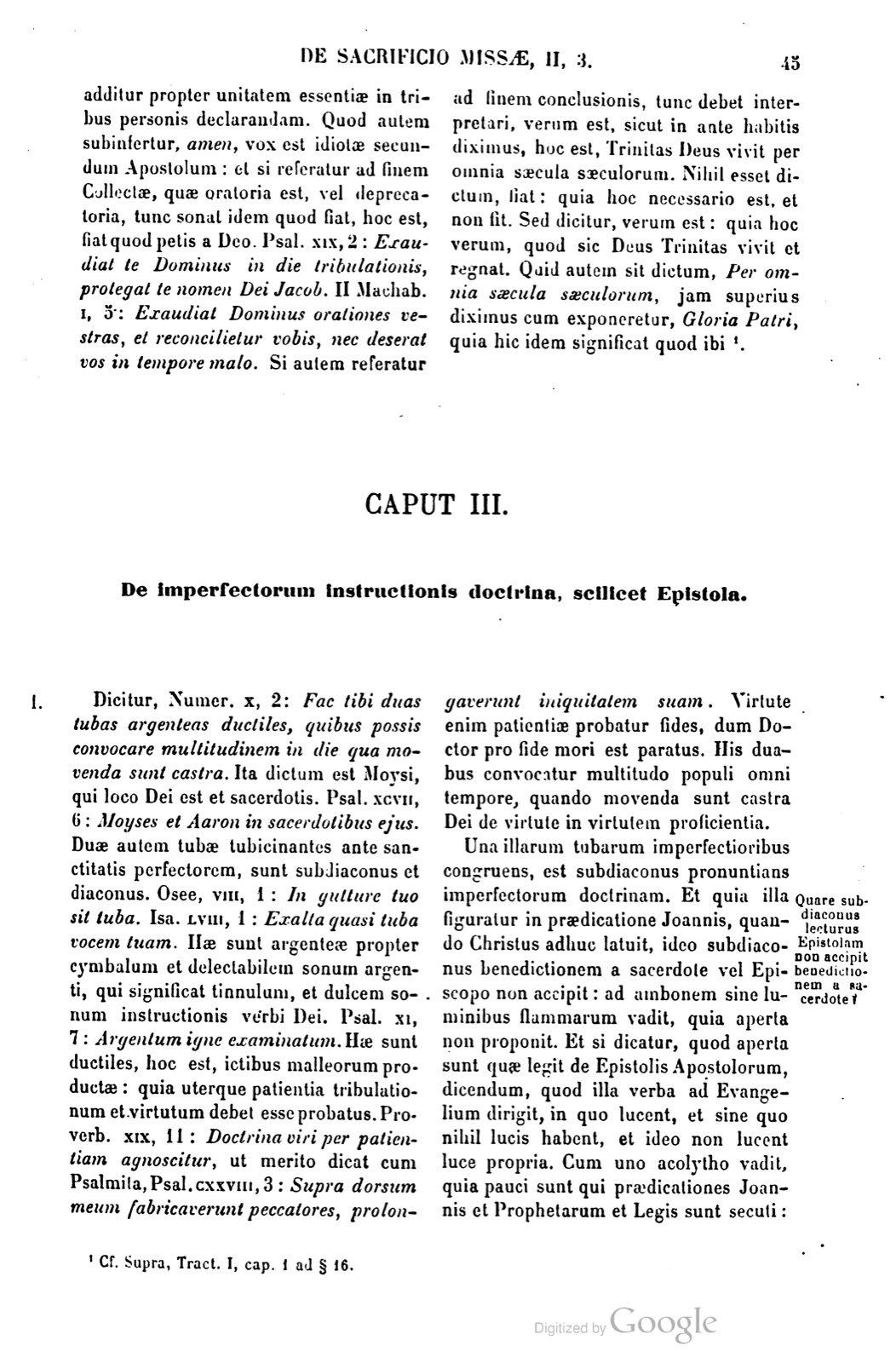
If a page does not appear, its photograph has not been uploaded yet.