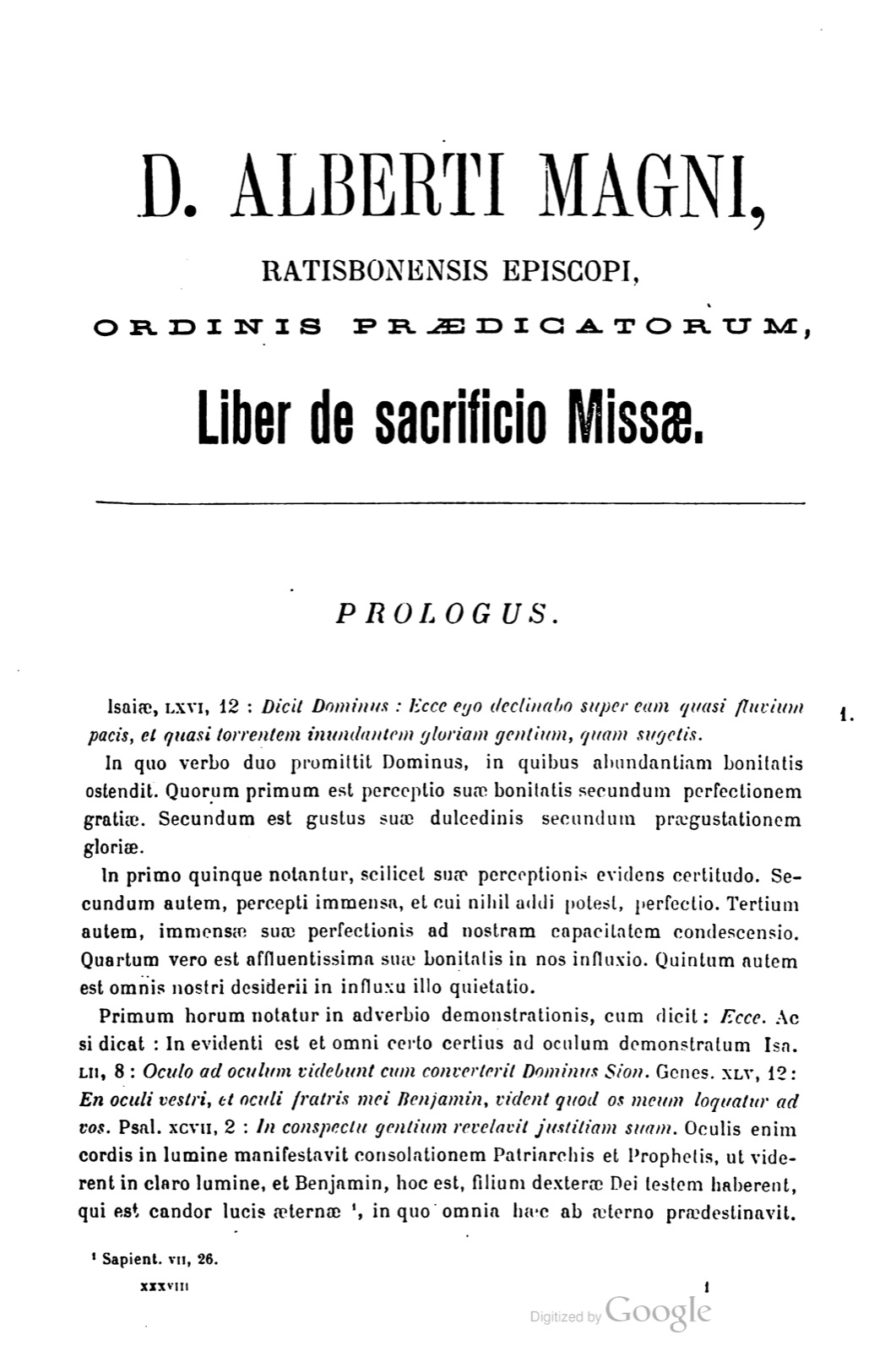
Works › The Book on the Sacrifice of the Mass
Volume 38 · pp. 1–6
Book on the Sacrifice of the Mass. Prologue
A marker with ≈ is an approximate page boundary, placed by measure of the text; the page photographs remain the authority. In the paired views, clicking a page marker brings that page into view.
D. Alberti Magni, Ratisbonensis episcopi, Ordinis Praedicatorum, Liber de sacrificio Missae.
Prologus.
Isaiae, LXVI, 12: Dicit Dominus: Ecce ego declinabo super eam quasi fluvium pacis, et quasi torrentem inundantem gloriam gentium, quam sugetis.
In quo verbo duo promittit Dominus, in quibus abundantiam bonitatis ostendit. Quorum primum est perceptio suae bonitatis secundum perfectionem gratiae. Secundum est gustus suae dulcedinis secundum praegustationem gloriae.
In primo quinque notantur, scilicet suae perceptionis evidens certitudo. Secundum autem, percepti immensa, et cui nihil addi potest, perfectio. Tertium autem, immensae suae perfectionis ad nostram capacitatem condescensio. Quartum vero est affluentissima suae bonitatis in nos influxio. Quintum autem est omnis nostri desiderii in influxu illo quietatio.
1. Primum horum notatur in adverbio demonstrationis, cum dicit: Ecce. Ac si dicat: In evidenti est et omni certo certius ad oculum demonstratum Isa. LII, 8: Oculo ad oculum videbunt cum converterit Dominus Sion. Genes. XLV, 12: En oculi vestri, et oculi fratris mei Benjamin, vident quod os meum loquatur ad vos. Psal. XCVII, 2: In conspectu gentium revelavit justitiam suam. Oculis enim cordis in lumine manifestavit consolationem Patriarchis et Prophetis, ut viderent in claro lumine, et Benjamin, hoc est, filium dexterae Dei testem haberent, qui est candor lucis aeternae 1, in quo omnia haec ab aeterno praedestinavit.
Unde etiam eos qui hanc certitudinem suae consolationis videre meruerunt, beatos habere oculos dicit, Luc. X, 23 et 24: Beati oculi, qui vident quae vos videtis. Dico enim vobis, quod multi reges et prophetae voluerunt videre quae vos videtis, et non viderunt: et audire quae auditis, et non audierunt. Vidit tamen ista in spiritu senex, et jam corpore non spiritu caecutiens Simeon, Luc. II, 30: Viderunt oculi mei salutare tuum.
In adverbio ergo demonstrationis notatur suae participationis certitudo fidelibus oculis demonstrata.
2. In hoc autem quod dicit: Ego, quod significantiam et discretionem notat, notatur illius participationis immensa, et cui nihil addi potest, perfectio. Ac si dicat: De caetero non minus aliquid quam bonum, quod ego ipse sum, influam vobis, quod et est omne bonum, et est omnis boni bonum. Unde dixit Dominus Moysi, Exod. XXXIII, 19: Ego ostendam omne bonum tibi. Isa. LII, 6: Propter hoc sciet populus meus nomen meum in die illa: quia ego ipse qui loquebar, ecce adsum. Ac si dicat: Jam de caetero non loquar multifariam, sicut locutus sum patribus in Prophetis 2: quia forte imperfecta sunt quae homo dicere potest, sed potius ego ipse adero in vobis. Propter quod unus eorum in seipso sentiens Christum, dixit: Audiam quid loquatur in me Dominus Deus 3. Et alter, II ad Corinth. XIII, 3: An experimentum quaeritis ejus qui in me loquitur Christus? Et, Isa. LXVI, 13 et 14: Quomodo si cui mater blandiatur, ita ego consolabor vos, et in Jerusalem consolabimini. Videbitis, et gaudebit cor vestrum.
Of D. Albert the Great, bishop of Regensburg, of the Order of Preachers, Book on the Sacrifice of the Mass.
Prologue.
Isaiah 66:12: The Lord says: Behold, I will turn down upon her as it were a river of peace, and as it were an overflowing torrent, the glory of the nations, which you shall suck.
In this word the Lord promises two things, in which he shows the abundance of goodness. The first of these is the reception of his goodness according to the perfection of grace. The second is the taste of his sweetness according to the foretaste of glory.
In the first, five things are noted, namely the evident certainty of its reception. Second, however, the immense perfection of the thing received, to which nothing can be added. Third, the condescension of his immense perfection to our capacity. Fourth is the most abundant inflow of his goodness into us. Fifth is the quieting of all our desire in that inflow.
1. The first of these is noted in the adverb of demonstration, when he says: Behold. As if he were saying: It is in evidence, and more certain than every certain thing, demonstrated to the eye. Isaiah 52:8: Eye to eye they shall see when the Lord converts Zion. Genesis 45:12: Behold, your eyes, and the eyes of my brother Benjamin, see that my mouth speaks to you. Psalm 97:2: In the sight of the nations he has revealed his justice. For he made consolation manifest in the light to the eyes of the heart for the Patriarchs and Prophets, so that they might see in clear light, and might have Benjamin, that is, the Son of the right hand of God, as witness, who is the brightness of eternal light 1, in whom he predestined all these things from eternity.
Hence also he says that those who merited to see this certainty of his consolation have blessed eyes, Luke 10:23 and 24: Blessed are the eyes that see the things that you see. For I say to you, that many kings and prophets wished to see the things that you see, and did not see them, and to hear the things that you hear, and did not hear them. Yet the old man Simeon, already growing blind in body, not in spirit, saw these things in spirit, Luke 2:30: My eyes have seen your salvation.
Therefore in the adverb of demonstration there is noted the certainty of his participation, demonstrated to faithful eyes.
2. But in this that he says, I, which notes significance and distinction, there is noted the immense perfection of that participation, to which nothing can be added. As if he were saying: From now on I will pour into you nothing less than the good that I myself am, which both is every good and is the good of every good. Hence the Lord said to Moses, Exodus 33:19: I will show you every good. Isaiah 52:6: For this reason my people shall know my name on that day, because I myself who was speaking, behold, I am present. As if he were saying: From now on I will not speak in many ways, as I spoke to the fathers in the Prophets 2, because perhaps the things that a human being can say are imperfect, but rather I myself will be present in you. On account of this, one of them, sensing Christ in himself, said: I will hear what the Lord God may speak in me 3. And another, 2 Corinthians 13:3: Do you seek an experiment of him who speaks in me, Christ? And Isaiah 66:13 and 14: As if a mother should caress someone, so I will console you, and in Jerusalem you shall be consoled. You shall see, and your heart shall rejoice.
In hoc ergo quod dicit: Ego, signanter et discrete immensam suae bonitatis perfectam copiam nobis instuendam promittit.
3. Tertium autem est immensae suae perfectionis ad nostram capacitatem condescensio, sive commensuratio: et hoc notatur in hoc quod dicit: Declinabo in vos. Ac si dicat: Altitudinem meae divinitatis quam caeli caelorum capere non poterant, in nullo deponens, assumam inferiorem naturam, in qua ad vos declinabo, ut mei possitis esse participes sicut petit Psalmista, Psal. CXLIII, 5: Domine, inclina caelos tuos, et descende. Et, Isa. LXIV, 1: Utinam dirumperes caelos, et descenderes. Sic enim nobis condescenderes, et nos tui faceres participes. Sic enim sui participationem dedit unicuique servorum suorum fidelium et prudentium secundum propriam virtutem. Matth. XXV, 15: Et uni dedit quinque talenta, alii autem duo, alii vero unum: unicuique secundum propriam virtutem. Sic declinavit ad nos misericors et miserator Dominus complens illud quod dicitur, ad Roman. IX, 28: Verbum abbreviatum faciet Dominus super terram 4. Quae consummatio abbreviata nobis inundavit gratiam et justitiam, qua nos justificavit, et gratificavit Christus Deus noster, et plus quam brevis factus est in sacramento, in quo totus in parvo percipitur ad justitiae et gratiae complementum.
Sic ergo in nos declinans coaptat et commensurat se Dominus immensus in seipso.
4. Quartum vero est affluentissima suae bonitatis in nos influxio. Et hoc notatur in hoc quod dicit: Quasi fluvium, quod a fluendo jugiter derivatur, et flumen dicitur: sicut enim dicit Psalmista, Psal. LXIV, 10: Flumen Dei repletum est aquis, scilicet gratiarum: et non est factus fons arens sine aqua, sicut sunt fluxus creaturarum, sed ipse omni fluxu gratiae, ut dicit Chrysostomus, non deficit, sed proficit, et continue in nos fluit, et ad Patris copiam refluit. Hic est fluvius de quo dicitur, Psal. XLV, 5: Fluminis impetus laetificat civitatem Dei, hoc est, sanctam Ecclesiam Catholicam. Psal. LXIV, 11: Rivos ejus inebria, multiplica genimina ejus: in stillicidiis ejus laetabitur germinans. Omnes enim sancti rivi sunt hujus fluminis, qui omnes ab ipso inebriantur, in quorum stillicidiis tota laetabitur germinans mater Ecclesia. Eccli. XXIV, 12: Dixi: Rigabo hortum meum plantationum, et inebriabo prati mei fructum: et ecce factus est mihi trames abundans, et fluvius meus ad mare appropinquavit. Abundans igitur et semper affluens, in hoc notatur copia suae gratiosae bonitatis.
Therefore in this that he says, I, he signally and distinctly promises that the immense and perfect abundance of his goodness is to be poured into us [printed: instuendam].
3. But the third is the condescension, or commensuration, of his immense perfection to our capacity; and this is noted in this that he says: I will decline into you. As if he were saying: In no way putting off the height of my divinity, which the heavens of heavens could not contain, I will assume a lower nature, in which I will decline toward you, so that you can be participants in me, as the Psalmist asks, Psalm 143:5: Lord, incline your heavens and descend. And Isaiah 64:1: Would that you would break open the heavens and descend. For thus you would condescend to us and make us participants in you. For thus he gave participation in himself to each of his faithful and prudent servants according to his own power. Matthew 25:15: And to one he gave five talents, but to another two, and to another one: to each according to his own power. Thus the merciful and compassionate Lord declined to us, fulfilling that which is said in Romans 9:28: The Lord will make a shortened word upon the earth 4. This shortened consummation overflowed grace and justice for us, by which Christ our God justified us and graced us, and he was made more than brief in the sacrament, in which the whole is perceived in a small thing for the complement of justice and grace.
Thus, therefore, declining into us, the immeasurable Lord adapts and commensurates himself, immeasurable in himself.
4. The fourth, however, is the most abundant inflow of his goodness into us. And this is noted in this that he says: As it were a river, which is derived from flowing continually, and is called a stream. For as the Psalmist says, Psalm 64:10: The river of God is filled with waters, namely of graces, and he has not been made a dry spring without water, as the flows of creatures are; but by every flow of grace, as Chrysostom says, he does not fail, but advances, and he continually flows into us, and flows back to the abundance of the Father. This is the river of which it is said, Psalm 45:5: The rush of the river makes glad the city of God, that is, the holy Catholic Church. Psalm 64:11: Make its streams drunk, multiply its offspring; in its drops the thing germinating shall rejoice. For all the saints are streams of this river, all of whom are made drunk by it, and in their drops the whole germinating mother Church shall rejoice. Ecclesiasticus 24:12: I said: I will water my garden of plantations, and I will make drunk the fruit of my meadow; and behold, an abundant path was made for me, and my river drew near to the sea. Therefore abundant and always flowing, in this the abundance of his gracious goodness is noted.
5. Quintum tandem est omnis nostri desiderii in influxu illo quietatio. Et hoc notatur per hoc quod dicit: Pacis: pacificati enim erimus percepto illo bono perfecto, nihil amplius extra ipsum requirentes: et haec tranquilla desiderii pax nobis influxa notatur: quia sicut dicit Augustinus: "Pax cordis non nisi in summo bono reperitur." Et haec est pax de qua dicitur, ad Philip. IV, 7: Et pax Dei quae exsuperat omnem sensum: quia de illo bono dicit Apostolus, I ad Corinth. II, 9, quod oculus non vidit, nec auris audivit, nec in cor hominis ascendit quae praeparavit Deus iis qui diligunt illum. Et quia tam altum et magnum est illud nostrum desiderium quietans bonum, ideo nulla est pax cordis, nisi cor ad ipsum deveniat et percipiat bonum illud. Unde Augustinus in libro I Confessionum: "Fecisti nos, Domine, ad te, et inquietum est cor nostrum, donec requiescat in te 5." Unde, Psal. LXXV, 3: In pace factus est locus ejus. Isa. XXVI, 12: Domine, dabis pacem nobis, omnia enim opera nostra operatus es nobis. Et de hoc bono quod sic influitur nobis ad pacis illius tranquillitatem, dicit Augustinus in libro X Confessionum: "In omnibus quae mente percurro, non invenio tutum et quietum locum animae meae, praeter te in quo colliguntur sparsa mea: quia quidquid bonorum in creaturis est sparsum, invenitur in aeterno bono collectum."
5. Finally, the fifth is the quieting of all our desire in that inflow. And this is noted by this that he says: Of peace. For we shall be pacified when that perfect good has been received, requiring nothing further outside it; and this tranquil peace of desire, poured into us, is noted, because as Augustine says, "Peace of heart is found only in the highest good." And this is the peace of which it is said, Philippians 4:7: And the peace of God, which surpasses every sense, because concerning that good the Apostle says, 1 Corinthians 2:9, that eye has not seen, nor ear heard, nor has it ascended into the heart of man what things God has prepared for those who love him. And because that good which quiets our desire is so high and great, therefore there is no peace of heart unless the heart comes to it and receives that good. Hence Augustine in book I of the Confessions: "You made us, Lord, for yourself, and our heart is restless until it rests in you 5." Hence Psalm 75:3: His place was made in peace. Isaiah 26:12: Lord, you will give us peace, for you have wrought all our works for us. And concerning this good, which is thus poured into us unto the tranquility of that peace, Augustine says in book X of the Confessions: "In all things that I run through in my mind, I do not find a safe and quiet place for my soul except you, in whom my scattered things are gathered together; because whatever of goods is scattered in creatures is found gathered together in the eternal good."
In his ergo quinque percipitur bonum divinum in gratia.
6. Horum autem primum excitat fidem, quae sicut dicit Augustinus, certitudo est invisibilium. Secundum accendit desiderium: quia semper desideratur id quod in bonitate est perfectum. Tertium sublevat ad spem: quia id speratur quod nobis est commensuratum et proportionatum: quia spes, ut dicit Augustinus, est certa exspectatio boni ex meritis et gratia proveniens. Quartum adampliat mentem, et totius intentionis expandit sinum. Quintum autem incitat ad clamandum et invocandum.
De primo horum dicitur, ad Hebr. XI, 1: Est autem fides sperandarum substantia rerum: argumentum non apparentium. Argumentum enim ex certitudine arguit mentem, et convincit de fidei veritate et certitudine.
De secundo autem dicitur in Psalmo XXXVIII, 4: Concaluit cor meum intra me, et in meditatione mea exardescet ignis. Et hoc facit fervens desiderium.
De tertio dicitur, I Petri, I, 3: Regeneravit nos in spem vivam. Ad Hebr. VI, 18 et 19: Confugimus ad tenendam propositam spem: quam sicut anchoram habemus animae tutam et firmam. Et haec spes in exspectando ex taedio affligitur. Proverb. XIII, 12: Spes quae differtur, affligit animam: lignum vitae desiderium veniens.
De quarto dicitur, II ad Corinth. VI, 11 et 12: Cor nostrum dilatatum est. Non angustiamini in vobis. Psal. CXVIII, 32: Viam mandatorum tuorum cucurri, cum dilatasti cor meum. Isa. LX, 5: Tunc videbis, et afflues, et mirabitur, et dilatabitur cor tuum.
De quinto dicitur, Jerem. XXXIII, 3: Clama ad me, et exaudiam te, et annuntiabo tibi grandia et firma quae nescis. Sic igitur et talibus stimulis incitata Ecclesia clamat magnis clamoribus, ut bonum illud in gratia percipiat.
7. Amplius autem incitatur ex praegustatione dulcedinis et beatitudinis gloriae divinae, quae sequenti parte auctoritatis denotatur, cum dicit: Quasi torrentem inundantem gloriam gentium, quam sugetis. In his enim verbis tria notantur, scilicet firmitas boni divini, et admirabilitas, et puritas: quia enim firmum et potens est in afficiendo, ideo irrumpit in affectum penetrando et afficiendo per delectationem. Quia autem admirabile est in altitudine, ideo est illud quod est gloria omnium gentium, et in quo gloriantur omnes gentes, et sine ipso nihil est gloriosum. Quia vero purum est, ideo sugitur, ut nihil a masticato vel digesto quasi impurum abjiciatur. Quod enim dentibus dividitur et atteritur, ut undique id quod purissimum est, ab eo sugatur: quod etiam in stomacho digeritur, et in hepate separatur, vel in venis eliquatur, ut ad puritatem omnimodam deducatur. Quod autem ultimo a membris sugitur, ita est purum, quod nihil abjicitur. Est igitur firmitate bonum divinum penetrans et afficiendo devincens affectum: admiratione et altitudine in se tenens intellectum: puritate autem totum delectans hominem.
Therefore in these five things the divine good is received in grace.
6. Now the first of these stirs up faith, which, as Augustine says, is certainty of invisible things. The second enkindles desire, because that which is perfect in goodness is always desired. The third raises up to hope, because that is hoped for which is commensurated and proportioned to us; for hope, as Augustine says, is a certain expectation of good arising from merits and grace. The fourth enlarges the mind and expands the bosom of the whole intention. But the fifth incites to crying out and invoking.
Concerning the first of these it is said in Hebrews 11:1: Now faith is the substance of things to be hoped for, the argument of things not appearing. For argument, from certainty, argues the mind and convinces it concerning the truth and certainty of faith.
Concerning the second, however, it is said in Psalm 38:4: My heart grew hot within me, and in my meditation fire will blaze forth. And fervent desire does this.
Concerning the third it is said, 1 Peter 1:3: He has regenerated us unto a living hope. Hebrews 6:18 and 19: We have fled for refuge to hold the hope set before us, which we have as an anchor of the soul, safe and firm. And this hope, in waiting, is afflicted by weariness. Proverbs 13:12: Hope that is deferred afflicts the soul; desire coming is a tree of life.
Concerning the fourth it is said, 2 Corinthians 6:11 and 12: Our heart has been enlarged. Do not be straitened in yourselves. Psalm 118:32: I ran the way of your commandments, when you enlarged my heart. Isaiah 60:5: Then you shall see and shall overflow, and your heart shall marvel and shall be enlarged.
Concerning the fifth it is said, Jeremiah 33:3: Cry to me, and I will hear you, and I will announce to you great and firm things that you do not know. Thus therefore, stirred by such goads also, the Church cries out with great cries, so that it may receive that good in grace.
7. Moreover it is stirred from the foretaste of the sweetness and blessedness of divine glory, which is denoted in the following part of the authority, when he says: As it were an overflowing torrent, the glory of the nations, which you shall suck. For in these words three things are noted, namely the firmness of the divine good, and its wonderfulness, and its purity. For because it is firm and powerful in affecting, therefore it breaks into the affection by penetrating and affecting through delight. But because it is wonderful in height, therefore it is that which is the glory of all nations, and in which all nations glory, and without which nothing is glorious. But because it is pure, therefore it is sucked, so that nothing as though impure may be cast away from what has been chewed or digested. For what is divided and worn down by the teeth is so dealt with that from every side that which is purest may be sucked from it; what is also digested in the stomach and separated in the liver, or refined in the veins, is brought to complete purity. But what is finally sucked by the members is so pure that nothing is cast away. Therefore by firmness the divine good penetrates and, by affecting, conquers the affection; by wonder and height it holds the intellect in itself; but by purity it delights the whole human being.
De primo horum dicitur in Psalmo XXXV, 9: Inebriabuntur ab ubertate domus tuae, et torrente voluptatis tuae potabis eos. Torrens enim fortissime irrumpit et affluit.
De admiratione et gloriositate dicit Psalmista, Psal. LXVII, 36: Mirabilis Deus in sanctis suis, etc.
De puritate delectante dicitur, Isa. LXVI, 11: Ut sugatis et repleamini ab ubere consolationis ejus, ut mulgeatis et deliciis affluatis ab omnimoda gloria ejus. Et ideo dicit Psalmista, Psal. XV, 11: Adimplebis me laetitia cum vultu tuo: delectationes in dextera tua usque in finem. Delectatio enim sicut dicit Philosophus in libro X Ethicorum, est operatio proprii et connaturalis habitus non impedita: quia delectatio est non sicut somnus, sed sicut vigilia: et quando potentia vel virtus est in operatione secundum naturalem habitum, tota natura in hanc operationem diffunditur: et quando est secundum proprium habitum, tunc natura illa singulariter in eam diffunditur, et nihil habet commune cum ea natura communis in genere vel specie sua sive aliena: quando autem non impedita est, tunc diffunditur non retracta ab aliquo, et tunc tota floret, et diffunditur sicut oculus in videndo, et intellectus intelligendo et delectando in bono divino. Hoc autem sentientes aliqui Patres et Prophetae tam in gratia quam in gloria, hoc est, gloriae praegustatione, totum cor elevantes in perceptionem boni divini fide vera, desiderio accenso, spe alta, corde dilatato, clamores magnos extulerunt ad vocandum in se illud bonum divinum, quod sic perfecte percipitur in gratia, et sic dulciter et firmiter et mirabiliter praegustatur in gloriae praegustatione, et clamabant omnes affici dulcedine boni illius.
Concerning the first of these it is said in Psalm 35:9: They shall be made drunk from the abundance of your house, and you shall give them drink from the torrent of your pleasure. For a torrent breaks in and flows most strongly.
Concerning wonder and gloriousness the Psalmist says, Psalm 67:36: God is wonderful in his saints, etc.
Concerning delighting purity it is said, Isaiah 66:11: That you may suck and be filled from the breast of its consolation, that you may milk and overflow with delights from its glory in every way. And therefore the Psalmist says, Psalm 15:11: You will fill me with joy with your countenance; delights are at your right hand even to the end. For delight, as the Philosopher says in book X of the Ethics, is the operation of a proper and connatural habit not impeded; because delight is not like sleep, but like waking; and when a power or virtue is in operation according to a natural habit, the whole nature is poured into this operation; and when it is according to a proper habit, then that nature is singularly poured into it, and it has nothing in common with that nature which is common in its own or in another genus or species; but when it is not impeded, then it is poured out, not drawn back by anything, and then it wholly flowers and is poured out, as the eye in seeing, and the intellect in understanding and delighting in the divine good. Now some Fathers and Prophets, sensing this both in grace and in glory, that is, in the foretaste of glory, lifting up the whole heart into the reception of the divine good by true faith, with desire kindled, with high hope, with heart enlarged, raised great cries to call into themselves that divine good, which is thus perfectly received in grace, and thus sweetly and firmly and wonderfully foretasted in the foretaste of glory, and they all cried out to be affected by the sweetness of that good.
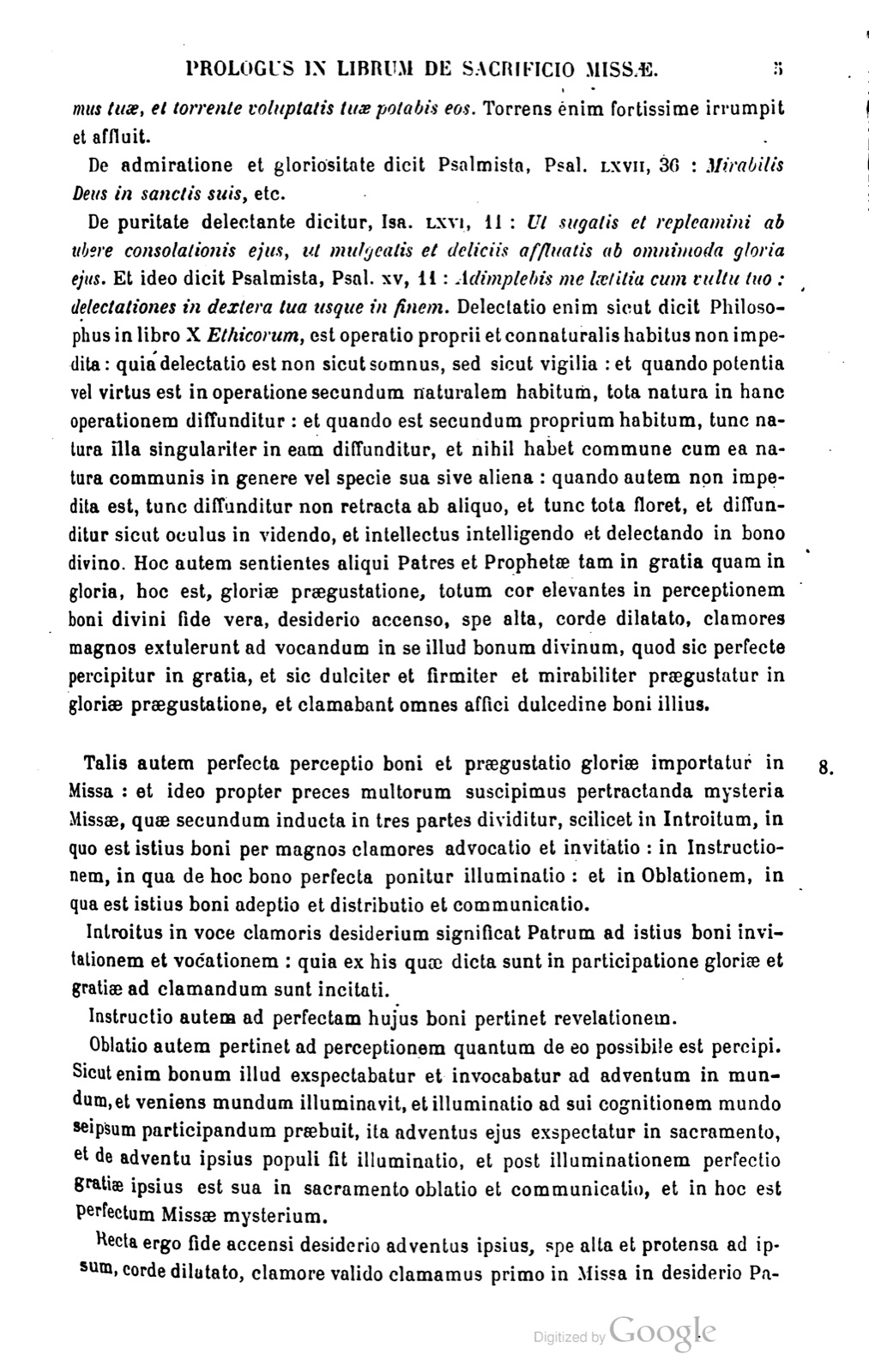
8. Talis autem perfecta perceptio boni et praegustatio gloriae importatur in Missa: et ideo propter preces multorum suscipimus pertractanda mysteria Missae, quae secundum inducta in tres partes dividitur, scilicet in Introitum, in quo est istius boni per magnos clamores advocatio et invitatio: in Instructionem, in qua de hoc bono perfecta ponitur illuminatio: et in Oblationem, in qua est istius boni adeptio et distributio et communicatio.
Introitus in voce clamoris desiderium significat Patrum ad istius boni invitationem et vocationem: quia ex his quae dicta sunt in participatione gloriae et gratiae ad clamandum sunt incitati.
Instructio autem ad perfectam hujus boni pertinet revelationem.
Oblatio autem pertinet ad perceptionem quantum de eo possibile est percipi. Sicut enim bonum illud exspectabatur et invocabatur ad adventum in mundum, et veniens mundum illuminavit, et illuminatio ad sui cognitionem mundo seipsum participandum praebuit, ita adventus ejus exspectatur in sacramento, et de adventu ipsius populi fit illuminatio, et post illuminationem perfectio gratiae ipsius est sua in sacramento oblatio et communicatio, et in hoc est perfectum Missae mysterium.
Recta ergo fide accensi desiderio adventus ipsius, spe alta et protensa ad ipsum, corde dilatato, clamore valido clamamus primo in Missa in desiderio Patrum. Secundo repraesentamus illuminationem populorum. Et tertio, oblationem et communicationem omnium suarum gratiarum.
Et haec sunt quae in Missa Ecclesia repraesentat: Deus igitur quem vocamus ut veniat, cujus illuminationibus perfruimur, ut sciamus quid secundum veritatem quilibet in ipso inveniat, et in cujus oblatione percepimus quantum in ipso fidelis populus habeat, sic excitat ad clamandum corde et ore, quod in ipso mens nostra experiatur omne quod desiderat, ipso praestante Domino nostro Jesu Christo, qui cum Patre et Spiritu sancto vivit et regnat in saecula saeculorum. Amen.
8. Now such perfect reception of the good and foretaste of glory is brought in the Mass; and therefore, on account of the prayers of many, we undertake the mysteries of the Mass to be treated, which according to what has been introduced is divided into three parts, namely into the Introit, in which there is the advocacy and invitation of this good through great cries; into the Instruction, in which perfect illumination concerning this good is set forth; and into the Oblation, in which there is the obtaining and distribution and communication of this good.
The Introit, in the voice of a cry, signifies the desire of the Fathers toward the inviting and calling of this good, because from those things that have been said in the participation of glory and grace they were incited to crying out.
But the Instruction pertains to the perfect revelation of this good.
The Oblation pertains to reception, insofar as it is possible for something to be received from it. For just as that good was awaited and invoked for its coming into the world, and by coming it illuminated the world, and the illumination offered itself to the world to be participated for knowledge of itself, so its coming is awaited in the sacrament; and from its coming the illumination of the people is made; and after the illumination the perfection of its grace is its oblation and communication in the sacrament; and in this is the perfect mystery of the Mass.
Therefore, inflamed with right faith by desire for his coming, with hope high and stretched toward him, with heart enlarged, with strong cry we first cry out in the Mass in the desire of the Fathers. Second, we represent the illumination of the peoples. And third, the oblation and communication of all his graces.
And these are the things that the Church represents in the Mass. Therefore God, whom we call that he may come, whose illuminations we enjoy, so that we may know what each person according to truth finds in him, and in whose oblation we receive how much the faithful people has in him, so stirs us to crying out with heart and mouth that in him our mind may experience everything that it desires, our Lord Jesus Christ himself granting it, who with the Father and the Holy Spirit lives and reigns forever and ever. Amen.

If a page does not appear, its photograph has not been uploaded yet.