Works › The Book on the Sacrament of the Eucharist
Volume 38 · pp. 427–428
Chapter II, 13-14
A marker with ≈ is an approximate page boundary, placed by measure of the text; the page photographs remain the authority. In the paired views, clicking a page marker brings that page into view.
Marginal label (printed p. 427): Casus qui in ritu confectionis accidere possunt.
Marginal label (printed p. 427): Responsiones ad objecta ultima.
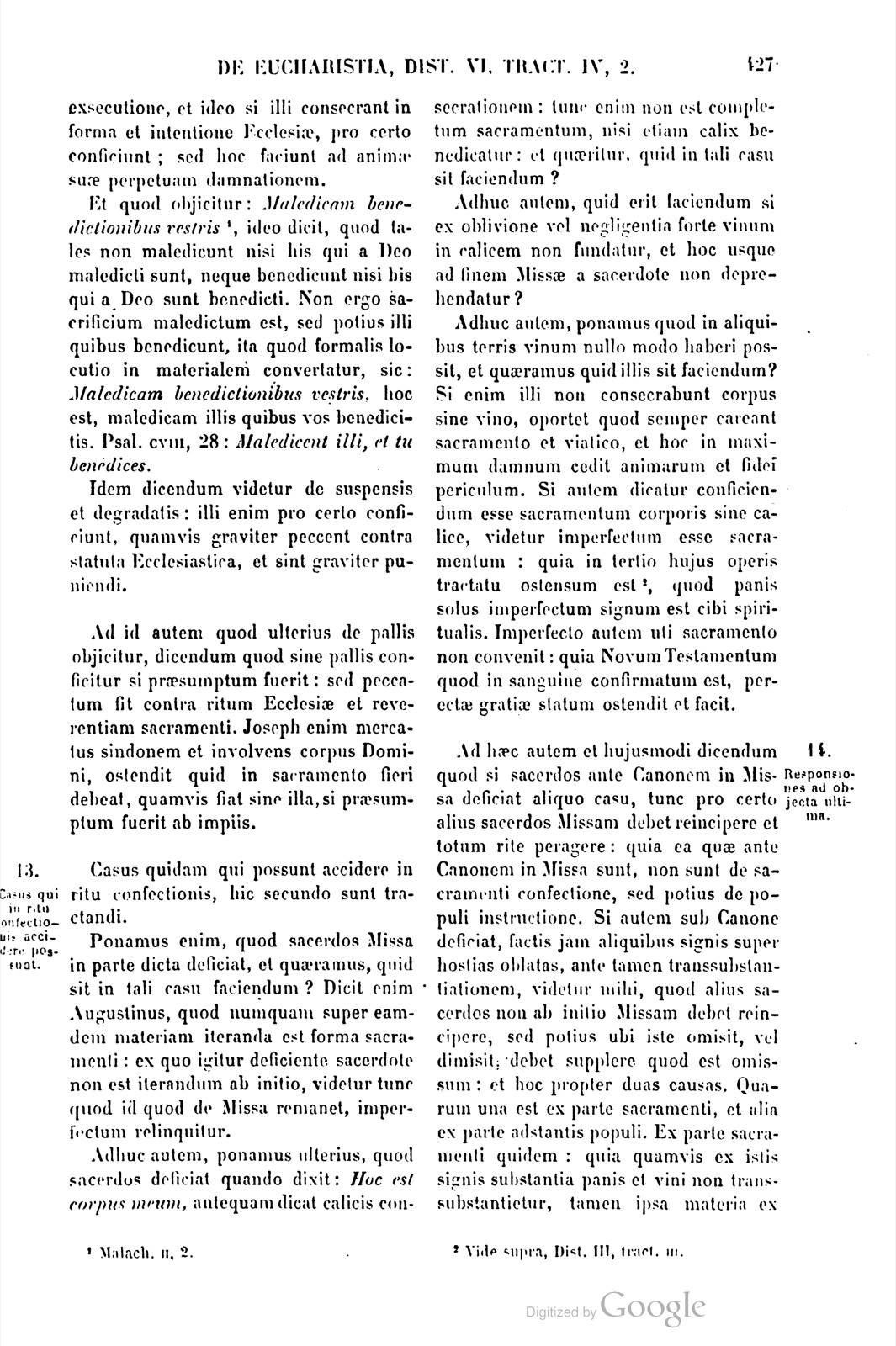
13. Casus quidam qui possunt accidere in ritu confectionis, hic secundo sunt tractandi.
Ponamus enim, quod sacerdos Missa in parte dicta deficiat, et quaeramus, quid sit in tali casu faciendum? Dicit enim Augustinus, quod numquam super eamdem materiam iteranda est forma sacramenti: ex quo igitur deficiente sacerdote non est iterandum ab initio, videtur tunc quod id quod de Missa remanet, imperfectum relinquitur.
Adhuc autem, ponamus ulterius, quod sacerdos deficiat quando dixit: Hoc est corpus meum, antequam dicat calicis consecrationem: tunc enim non est completum sacramentum, nisi etiam calix benedicatur: et quaeritur, quid in tali casu sit faciendum?
Adhuc autem, quid erit faciendum si ex oblivione vel negligentia forte vinum in calicem non fundatur, et hoc usque ad finem Missae a sacerdote non deprehendatur?
Adhuc autem, ponamus quod in aliquibus terris vinum nullo modo haberi possit, et quaeramus quid illis sit faciendum? Si enim illi non consecrabunt corpus sine vino, oportet quod semper careant sacramento et viatico, et hoc in maximum damnum cedit animarum et fidei periculum. Si autem dicatur conficiendum esse sacramentum corporis sine calice, videtur imperfectum esse sacramentum: quia in tertio hujus operis tractatu ostensum est 1, quod panis solus imperfectum signum est cibi spiritualis. Imperfecto autem uti sacramento non convenit: quia Novum Testamentum quod in sanguine confirmatum est, perfectae gratiae statum ostendit et facit.
14. Ad haec autem et hujusmodi dicendum quod si sacerdos ante Canonem in Missa deficiat aliquo casu, tunc pro certo alius sacerdos Missam debet reincipere et totum rite peragere: quia ea quae ante Canonem in Missa sunt, non sunt de sacramenti confectione, sed potius de populi instructione. Si autem sub Canone deficiat, factis jam aliquibus signis super hostias oblatas, ante tamen transsubstantiationem, videtur mihi, quod alius sacerdos non ab initio Missam debet reincipere, sed potius ubi iste omisit, vel dimisit; debet supplere quod est omissum: et hoc propter duas causas. Quarum una est ex parte sacramenti, et alia ex parte adstantis populi. Ex parte sacramenti quidem: quia quamvis ex istis signis substantia panis et vini non transsubstantietur, tamen ipsa materia ex verbis et signis recipit sanctitatem, ex qua efficitur magis idonea ad hoc quod in corpus Christi transsubstantietur. Propter hoc non est repetendum super illam hostiam, ne injuria fiat virtuti verborum, quae tamquam nihil habetur, quando iterum verba super eamdem hostiam iterantur, tamquam priora verba a priore sacerdote dicta nullam virtutem habuissent. Causa autem ex parte populi est, quia populus ex hoc minus verba et signa Canonis appretiaretur, si videret ea tam facile repeti: quia prius dicta videntur esse annihilata. Signa autem illa licet non transsubstantient, tamen passionem Christi in mysterio repraesentant, et passio Christi numquam irrita debet reputari.
Marginal label (printed p. 427): Cases which can happen in the rite of confection.
Marginal label (printed p. 427): Responses to the last objections.
13. Certain cases which can happen in the rite of confection must here be treated secondly.
For let us posit that a priest fails in the Mass when the part has been said, and let us ask what must be done in such a case. For Augustine says that the form of the sacrament must never be repeated over the same matter. Therefore, from this, when the priest fails, it must not be repeated from the beginning; it seems then that what remains of the Mass is left imperfect.
Moreover, let us posit further that the priest fails when he has said, This is my body, before he says the consecration of the chalice; for then the sacrament is not complete unless the chalice also is blessed; and it is asked what must be done in such a case.
Moreover, what will have to be done if through forgetfulness or negligence perhaps wine is not poured into the chalice, and this is not detected by the priest up to the end of the Mass?
Moreover, let us posit that in some lands wine can in no way be had, and let us ask what must be done for them. For if they will not consecrate the body without wine, they must always lack the sacrament and viaticum, and this falls into the greatest harm of souls and danger of faith. But if it is said that the sacrament of the body must be confected without the chalice, it seems to be an imperfect sacrament, because in the third tractate of this work it has been shown 1 that bread alone is an imperfect sign of spiritual food. But to use an imperfect sacrament is not fitting, because the New Testament which has been confirmed in blood shows and makes the state of perfect grace.
14. But to these and things of this kind it must be said that if a priest fails before the Canon in the Mass by some case, then certainly another priest ought to begin the Mass again and perform the whole rite, because those things which are before the Canon in the Mass are not of the confection of the sacrament, but rather of the instruction of the people. But if he fails under the Canon, when some signs have already been made over the hosts offered, yet before transubstantiation, it seems to me that another priest ought not to begin the Mass again from the beginning, but rather where that one omitted or left off; he ought to supply what was omitted. And this is because of two causes. One of these is on the part of the sacrament, and the other on the part of the people standing by. On the part of the sacrament indeed, because although from those signs the substance of bread and wine is not transubstantiated, nevertheless the matter itself receives sanctity from the words and signs, from which it is made more suitable for this, that it be transubstantiated into the body of Christ. Because of this it must not be repeated over that host, lest injury be done to the power of the words, which is held as nothing when the words are repeated again over the same host, as though the prior words said by the prior priest had had no power. But the cause on the part of the people is that from this the people would appreciate the words and signs of the Canon less, if they saw them repeated so easily, because the things said before seem to have been annihilated. But those signs, although they do not transubstantiate, nevertheless represent the passion of Christ in mystery, and the passion of Christ must never be reckoned void.
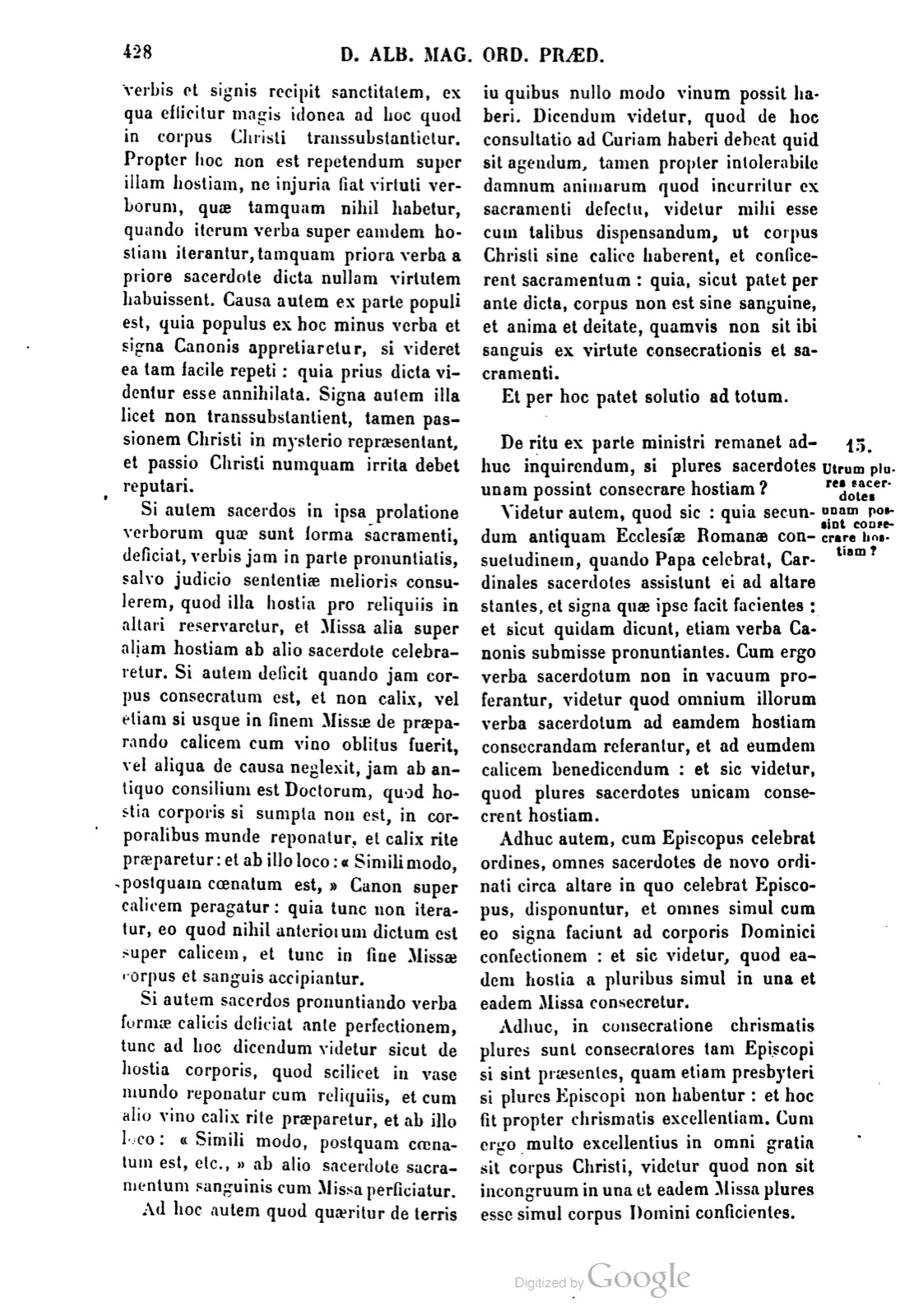
Si autem sacerdos in ipsa prolatione verborum quae sunt forma sacramenti, deficiat, verbis jam in parte pronuntiatis, salvo judicio sententiae melioris consulerem, quod illa hostia pro reliquiis in altari reservaretur, et Missa alia super aliam hostiam ab alio sacerdote celebraretur. Si autem deficit quando jam corpus consecratum est, et non calix, vel etiam si usque in finem Missae de praeparando calicem cum vino oblitus fuerit, vel aliqua de causa neglexit, jam ab antiquo consilium est Doctorum, quod hostia corporis si sumpta non est, in corporalibus munde reponatur, et calix rite praeparetur: et ab illo loco: « Simili modo, postquam coenatum est, » Canon super calicem peragatur: quia tunc non iteratur, eo quod nihil anteriorum dictum est super calicem, et tunc in fine Missae corpus et sanguis accipiantur.
Si autem sacerdos pronuntiando verba formae calicis deficiat ante perfectionem, tunc ad hoc dicendum videtur sicut de hostia corporis, quod scilicet in vase mundo reponatur cum reliquiis, et cum alio vino calix rite praeparetur, et ab illo loco: « Simili modo, postquam coenatum est, etc., » ab alio sacerdote sacramentum sanguinis cum Missa perficiatur.
Ad hoc autem quod quaeritur de terris in quibus nullo modo vinum possit haberi. Dicendum videtur, quod de hoc consultatio ad Curiam haberi debeat quid sit agendum, tamen propter intolerabile damnum animarum quod incurritur ex sacramenti defectu, videtur mihi esse cum talibus dispensandum, ut corpus Christi sine calice haberent, et conficerent sacramentum: quia, sicut patet per ante dicta, corpus non est sine sanguine, et anima et deitate, quamvis non sit ibi sanguis ex virtute consecrationis et sacramenti.
Et per hoc patet solutio ad totum.
But if the priest fails in the very utterance of the words which are the form of the sacrament, when the words have now been pronounced in part, saving the judgment of a better opinion, I would advise that that host be reserved on the altar for relics, and another Mass be celebrated over another host by another priest. But if he fails when the body has already been consecrated and not the chalice, or even if up to the end of the Mass he has forgotten about preparing the chalice with wine, or has neglected it for some cause, the counsel of the Doctors has already from of old been that the host of the body, if it has not been taken, be laid cleanly in the corporals, and the chalice be prepared duly; and from that place, "In a similar way, after supper was done," the Canon over the chalice should be carried through, because then it is not repeated, since none of the preceding things has been said over the chalice, and then at the end of the Mass the body and blood are received.
But if the priest fails in pronouncing the words of the form of the chalice before the perfection, then it seems that one must say to this as concerning the host of the body, namely that it be laid in a clean vessel with the relics, and the chalice be duly prepared with other wine, and from that place, "In a similar way, after supper was done, etc.," the sacrament of the blood be completed with the Mass by another priest.
But to this which is asked concerning lands in which wine can in no way be had. It seems one must say that consultation ought to be had with the Curia about what must be done in this, yet because of the intolerable harm of souls which is incurred from the defect of the sacrament, it seems to me that there must be dispensation with such persons, so that they may have the body of Christ without the chalice and may confect the sacrament; because, as is clear through the things said before, the body is not without blood and soul and deity, although blood is not there from the power of consecration and of sacrament.
And through this the solution to the whole is clear.
Notes
- See above, Distinction III, tractate III. (Vide supra, Dist. III, tract. III.) ↩
If a page does not appear, its photograph has not been uploaded yet.