Works › The Book on the Sacrament of the Eucharist
Volume 38 · pp. 425–427
Chapter II, Response to the Objections, 8-12
A marker with ≈ is an approximate page boundary, placed by measure of the text; the page photographs remain the authority. In the paired views, clicking a page marker brings that page into view.
Marginal label (printed p. 425): De vestibus sacris.
Marginal label (printed p. 425): De his qui ordinati sunt ab haereticis, vel schismaticis.
Marginal label (printed p. 425): De altari non cooperto pallis lineis.
Marginal label (printed p. 425): Responsio ad objectiones.
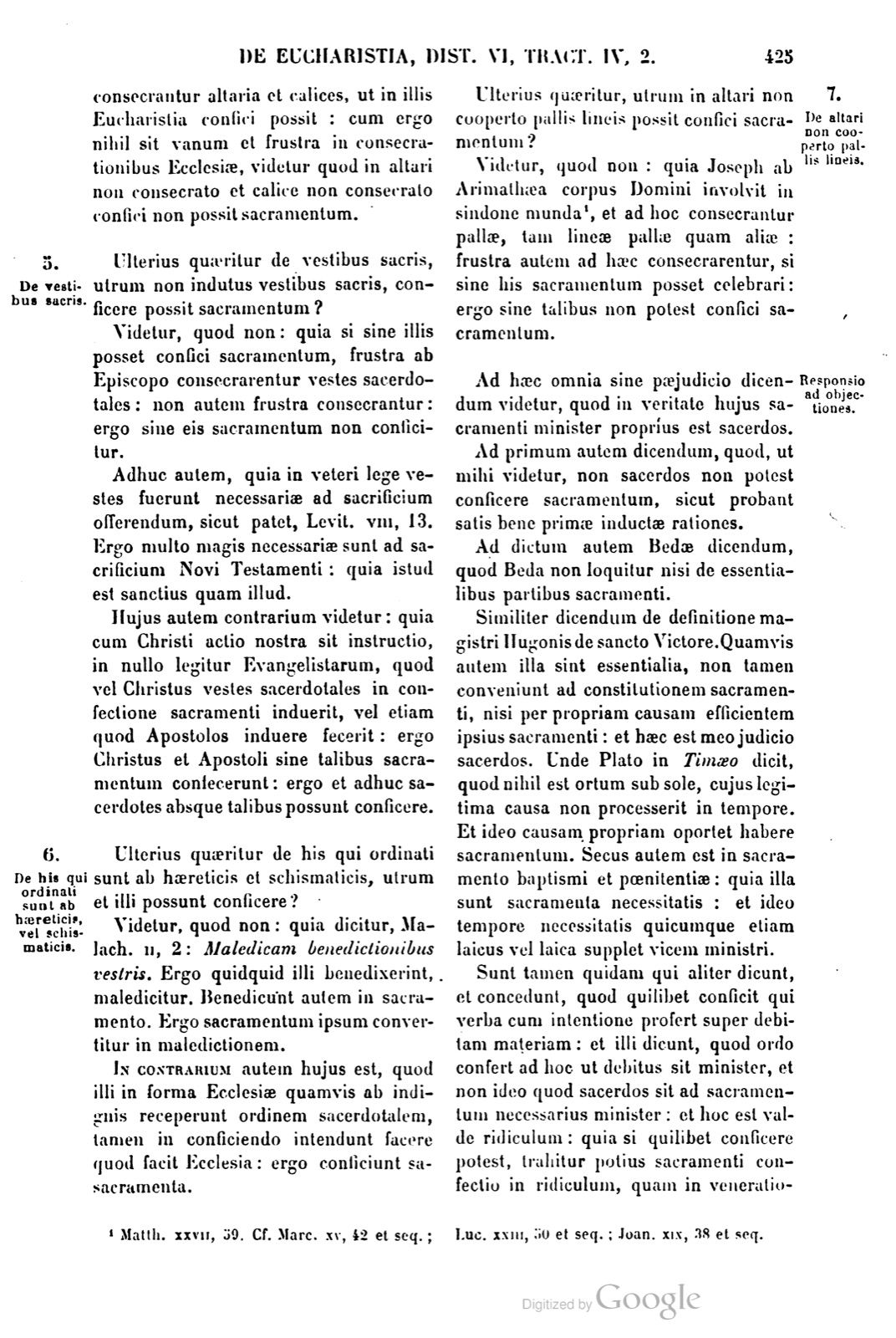
Ad haec omnia sine praejudicio dicendum videtur, quod in veritate hujus sacramenti minister proprius est sacerdos.
Ad primum autem dicendum, quod, ut mihi videtur, non sacerdos non potest conficere sacramentum, sicut probant satis bene primae inductae rationes.
Ad dictum autem Bedae dicendum, quod Beda non loquitur nisi de essentialibus partibus sacramenti.
Similiter dicendum de definitione magistri Hugonis de sancto Victore. Quamvis autem illa sint essentialia, non tamen conveniunt ad constitutionem sacramenti, nisi per propriam causam efficientem ipsius sacramenti: et haec est meo judicio sacerdos. Unde Plato in Timaeo dicit, quod nihil est ortum sub sole, cujus legitima causa non processerit in tempore. Et ideo causam propriam oportet habere sacramentum. Secus autem est in sacramento baptismi et poenitentiae: quia illa sunt sacramenta necessitatis: et ideo tempore necessitatis quicumque etiam laicus vel laica supplet vicem ministri. Sunt tamen quidam qui aliter dicunt, et concedunt, quod quilibet conficit qui verba cum intentione profert super debitam materiam: et illi dicunt, quod ordo confert ad hoc ut debitus sit minister, et non ideo quod sacerdos sit ad sacramentum necessarius minister: et hoc est valde ridiculum: quia si quilibet conficere potest, trahitur potius sacramenti confectio in ridiculum, quam in venerationem: et ideo dictum illorum reputo absurdum.
8. Ad id quod ulterius quaeritur de altari et templo, dicendum videtur, quod altare consecratum est de idoneitate sacrificii, sed non de necessitate: et ideo qui celebraret in loco communi, deponendus et degradandus est: sed tamen ipse conficit sacramentum.
Ad id quod contra objicitur, dicendum quod sanctiora sunt sacrificia Novi Testamenti quam Veteris: sed tamen etiam sacrificia Veteris Testamenti alibi quam in templo vel in altari frequenter a prioribus sunt oblata: sed postquam elegit Dominus locum in quo offerri deberent, peccavit quidem contra mandatum Domini, qui alibi obtulit: sed tamen id quod obtulit, oblatio fuit: et sic est etiam in isto sacrificio.
Marginal label (printed p. 425): On sacred vestments.
Marginal label (printed p. 425): On those who have been ordained by heretics or schismatics.
Marginal label (printed p. 425): On an altar not covered with linen cloths.
Marginal label (printed p. 425): Response to the objections.
To all these things it seems, without prejudice, that one must say that in truth the proper minister of this sacrament is a priest.
But to the first it must be said that, as it seems to me, one who is not a priest cannot confect the sacrament, as the first reasons brought forward prove well enough.
But to the saying of Bede it must be said that Bede speaks only of the essential parts of the sacrament.
Similarly one must speak about the definition of Master Hugh of Saint Victor. For although those things are essential, nevertheless they do not come together for the constitution of the sacrament except through the proper efficient cause of the sacrament itself; and this, in my judgment, is a priest. Hence Plato in the Timaeus says that nothing has arisen under the sun whose legitimate cause did not proceed in time. And therefore a sacrament must have its proper cause. But it is otherwise in the sacrament of baptism and of penance, because those are sacraments of necessity; and therefore in a time of necessity anyone, even a layman or laywoman, supplies the place of the minister. Yet there are some who say otherwise, and concede that anyone confects who utters the words with intention over the due matter; and they say that order confers for this, that he be the due minister, and not because a priest is a necessary minister for the sacrament. And this is very ridiculous, because if anyone can confect, the confection of the sacrament is drawn rather into ridicule than into veneration; and therefore I reckon their saying absurd.
8. To that which is further asked concerning altar and temple, it seems that one must say that a consecrated altar belongs to the fittingness of the sacrifice, but not to necessity; and therefore he who would celebrate in a common place must be deposed and degraded, but nevertheless he himself confects the sacrament.
To that which is objected against this, it must be said that the sacrifices of the New Testament are holier than those of the Old; but nevertheless even the sacrifices of the Old Testament were frequently offered by earlier men elsewhere than in the temple or on the altar. But after the Lord chose the place in which they ought to be offered, he indeed sinned against the commandment of the Lord who offered elsewhere; but nevertheless that which he offered was an oblation; and so it is also in this sacrifice.
Ad id quod dicunt, quod passer invenit sibi domum 1, etc., dicendum quod locus debitus sacrificio est altare: sed non est necessarius, ita quod si alibi offeratur, non conficiatur: et ideo oblatio accepta in altari fit: extra autem altare et templum si praesumatur offerri, tunc quidem oblatum factum est et bonum et divinum corpus Domini, sed oblatio quae est actio offerentis, non est accepta, sed potius maledicta.
9. Ad id quod ulterius quaeritur de hostiis ex ignorantia in altari remanentibus ex oblivione, vel guttis vini pedi vel lateri calicis adhaerentibus, dicendum videtur, quod illae non consecrantur: quia de eis nihil intenditur, sicut probat in contrarium adducta objectio.
Ad id autem quod objicitur, dicendum quod ignorata et non intenta non subjiciuntur benedictioni et actioni formae sacramentalis: quia confectio actus est utentis ratione: et ideo non fertur nisi super intentum.
10. Ad id quod ulterius de altari non consecrato quaeritur, dicendum videtur, quod non debet confici super altare non consecratum: si autem praesumptum fuerit, tunc videtur, quod ille conficiat: sed si hoc facit in contemptum ritus Ecclesiae, deponendus est et degradandus.
Ad hoc autem quod de Domino objicitur, dicendum quod in veritate per solum tactum Domini mensa in qua benedixit, consecrabatur.
Quod autem in contrarium objicitur, dicendum quod propter hoc consecratio altaris non est frustra, quia sine ea confici potest sacramentum: sed consecratio confertur altari, ut sit idonea mensa tanto sacramento.
Idem etiam intelligendum est de calicis consecratione.
11. Ad id quod ulterius quaeritur de vestibus, similiter videtur, quod vestes sunt de bene esse, ut ostendant munditiam et virtutes quae in ministerio tanti sacramenti esse debent, et ad hoc etiam fuerunt in Veteri Testamento, et quoad hoc benedictio vestium non est superflua: si tamen sacerdos sine his celebraret, sacramentum pro certo ipse conficit, sed graviter peccat contra Ecclesiasticam institutionem et sacramenti reverentiam, et ideo deponendus est et graviter puniendus.
To that which they say, that the sparrow has found for itself a house 1, etc., it must be said that the due place for sacrifice is an altar, but it is not necessary so that, if it is offered elsewhere, it is not confected. And therefore an accepted oblation occurs on an altar; but outside altar and temple, if it is presumed to be offered, then indeed the thing offered has been made the good and divine body of the Lord, but the oblation which is the action of the one offering is not accepted, but rather cursed.
9. To that which is further asked concerning hosts remaining on the altar through ignorance from forgetfulness, or drops of wine adhering to the foot or side of the chalice, it seems that one must say that those are not consecrated, because nothing is intended concerning them, as the objection brought forward to the contrary proves.
But to that which is objected, it must be said that things unknown and not intended are not subjected to the blessing and action of the sacramental form, because confection is an act of one using reason; and therefore it is borne only upon what is intended.
10. To that which is further asked concerning an unconsecrated altar, it seems that one must say that it ought not to be confected upon an unconsecrated altar; but if it has been presumed, then it seems that he confects; but if he does this in contempt of the rite of the Church, he must be deposed and degraded.
But to this which is objected concerning the Lord, it must be said that in truth by the Lord's touch alone the table on which he blessed was consecrated.
But as to what is objected to the contrary, it must be said that for this reason the consecration of an altar is not to no purpose, because without it the sacrament can be confected; but consecration is conferred upon an altar so that it may be a fitting table for so great a sacrament.
The same also must be understood concerning the consecration of the chalice.
11. To that which is further asked concerning vestments, similarly it seems that vestments belong to well-being, so that they may show the cleanness and virtues which ought to be in the ministry of so great a sacrament; and they also existed for this in the Old Testament, and with regard to this the blessing of vestments is not superfluous. Yet if a priest were to celebrate without these, he himself certainly confects the sacrament, but he sins gravely against the ecclesiastical institution and the reverence of the sacrament, and therefore he must be deposed and gravely punished.
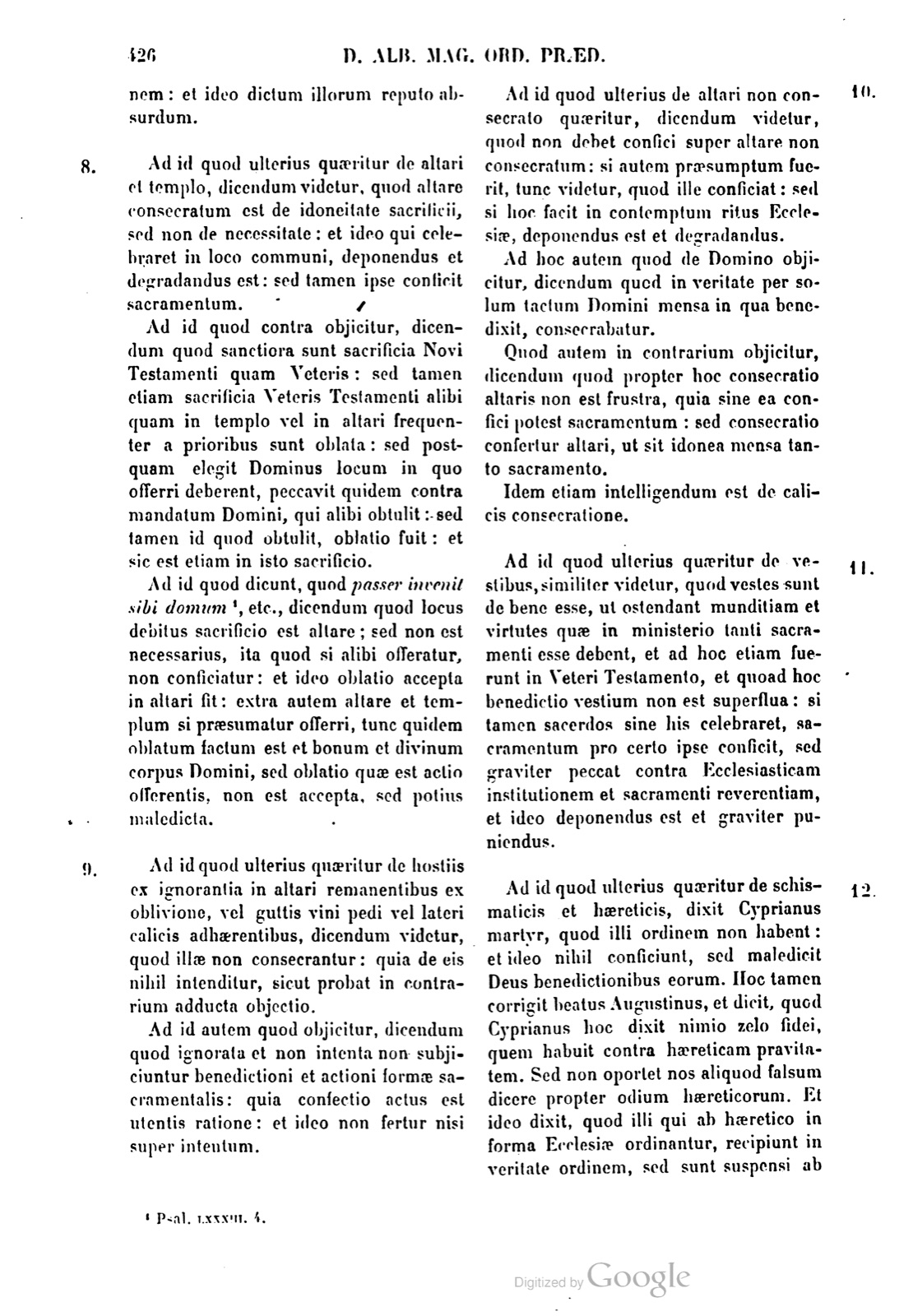
12. Ad id quod ulterius quaeritur de schismaticis et haereticis, dixit Cyprianus martyr, quod illi ordinem non habent: et ideo nihil conficiunt, sed maledicit Deus benedictionibus eorum. Hoc tamen corrigit beatus Augustinus, et dicit, quod Cyprianus hoc dixit nimio zelo fidei, quem habuit contra haereticam pravitatem. Sed non oportet nos aliquod falsum dicere propter odium haereticorum. Et ideo dixit, quod illi qui ab haeretico in forma Ecclesiae ordinantur, recipiunt in veritate ordinem, sed sunt suspensi ab exsecutione, et ideo si illi consecrant in forma et intentione Ecclesiae, pro certo conficiunt; sed hoc faciunt ad animae suae perpetuam damnationem.
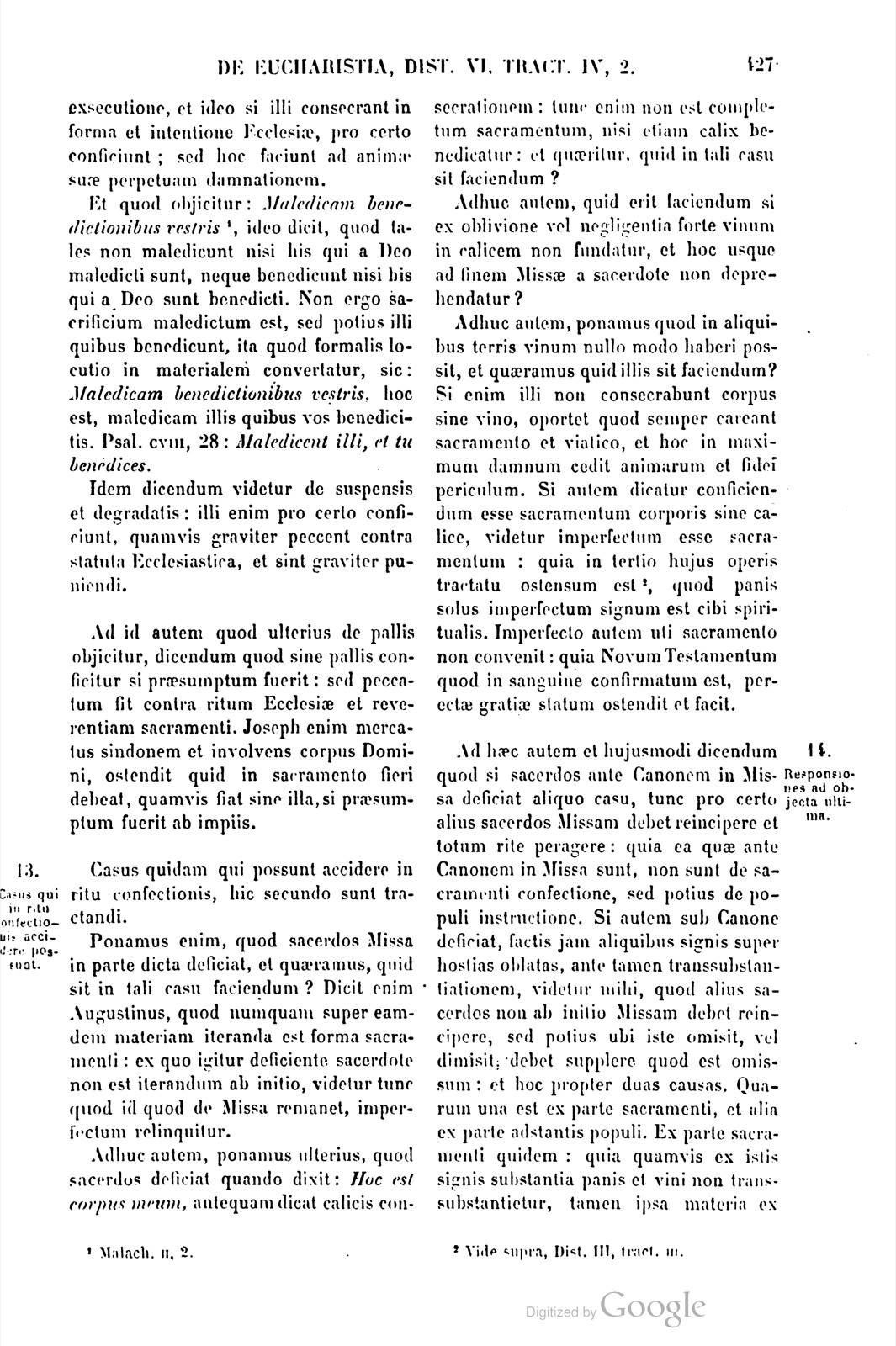
Et quod objicitur: Maledicam benedictionibus vestris 2, ideo dicit, quod tales non maledicunt nisi his qui a Deo maledicti sunt, neque benedicunt nisi his qui a Deo sunt benedicti. Non ergo sacrificium maledictum est, sed potius illi quibus benedicunt, ita quod formalis locutio in materialem convertatur, sic: Maledicam benedictionibus vestris, hoc est, maledicam illis quibus vos benedicitis. Psal. CVIII, 28: Maledicent illi, et tu benedices.
Idem dicendum videtur de suspensis et degradatis: illi enim pro certo conficiunt, quamvis graviter peccent contra statuta Ecclesiastica, et sint graviter puniendi.
Ad id autem quod ulterius de pallis objicitur, dicendum quod sine pallis conficitur si praesumptum fuerit: sed peccatum fit contra ritum Ecclesiae et reverentiam sacramenti. Joseph enim mercatus sindonem et involvens corpus Domini, ostendit quid in sacramento fieri debeat, quamvis fiat sine illa, si praesumptum fuerit ab impiis.
12. To that which is further asked concerning schismatics and heretics, Cyprian the martyr said that they do not have order, and therefore they confect nothing, but God curses their blessings. Yet blessed Augustine corrects this and says that Cyprian said this from excessive zeal for the faith, which he had against heretical depravity. But we ought not to say anything false because of hatred of heretics. And therefore he said that those who are ordained by a heretic in the form of the Church receive order in truth, but are suspended from execution; and therefore if they consecrate in the form and intention of the Church, they certainly confect, but they do this to the perpetual damnation of their soul.
And as to what is objected, I shall curse your blessings 2, he therefore says that such persons do not curse except those who are cursed by God, nor do they bless except those who are blessed by God. Therefore the sacrifice is not cursed, but rather those whom they bless, so that formal speech is converted into material speech, thus: I shall curse your blessings, that is, I shall curse those whom you bless. Psalm 108:28: They shall curse, and you will bless.
The same seems to have to be said concerning the suspended and degraded: for they certainly confect, although they sin gravely against ecclesiastical statutes and are to be punished gravely.
But to that which is further objected concerning palls, it must be said that it is confected without palls if it has been presumed; but sin is committed against the rite of the Church and the reverence of the sacrament. For Joseph, buying a linen cloth and wrapping the body of the Lord, showed what ought to be done in the sacrament, although it happens without that cloth if it has been presumed by impious persons.
If a page does not appear, its photograph has not been uploaded yet.