Works › The Book on the Sacrament of the Eucharist
Volume 38 · pp. 413–415
Tractate III. Single Chapter, 2-3
A marker with ≈ is an approximate page boundary, placed by measure of the text; the page photographs remain the authority. In the paired views, clicking a page marker brings that page into view.
Marginal label (printed p. 413): Dubia ex praemissis orta.
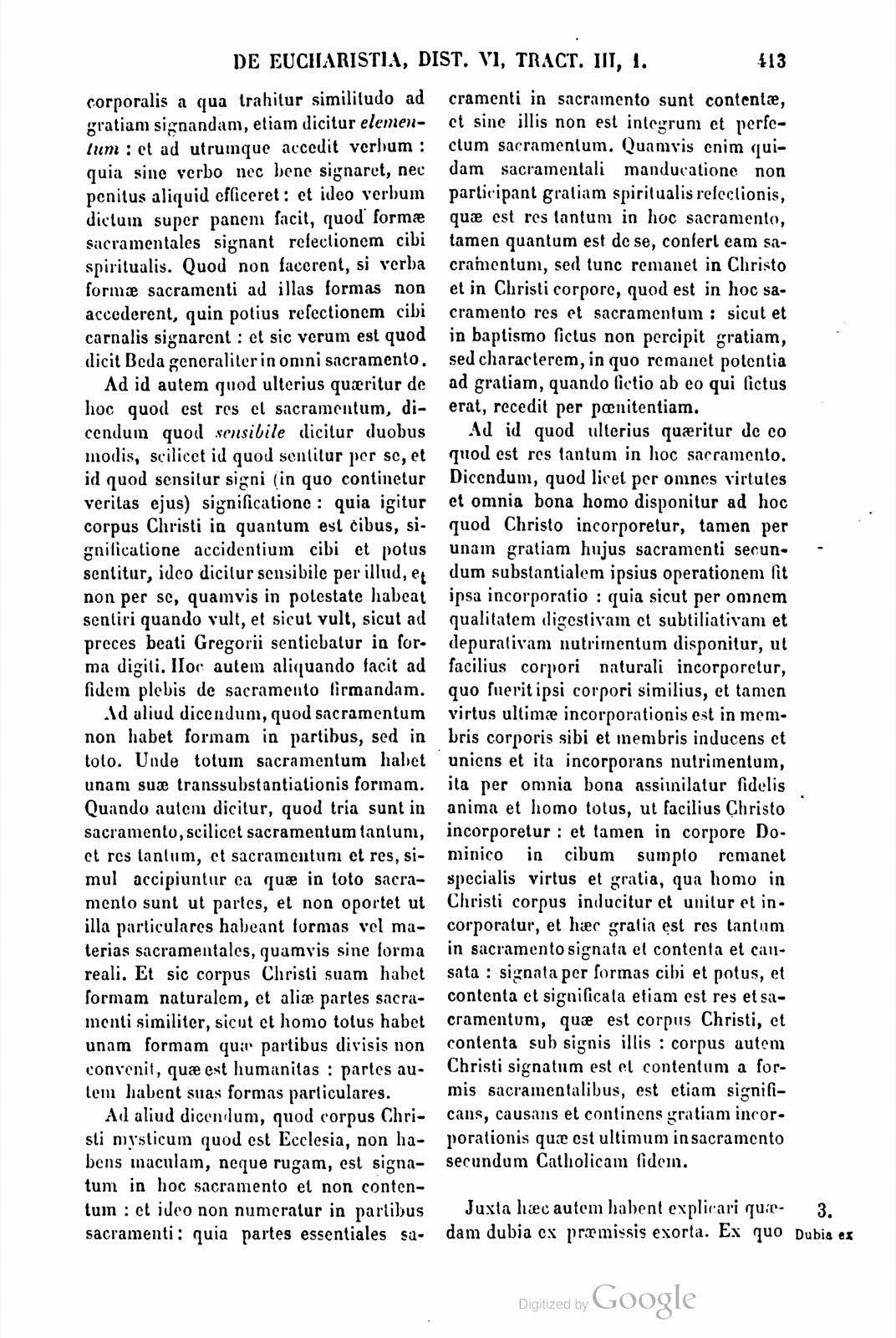
Ad id autem quod ulterius quaeritur de hoc quod est res et sacramentum, dicendum quod sensibile dicitur duobus modis, scilicet id quod sentitur per se, et id quod sentitur signi (in quo continetur veritas ejus) significatione: quia igitur corpus Christi in quantum est cibus, significatione accidentium cibi et potus sentitur, ideo dicitur sensibile per illud, et non per se, quamvis in potestate habeat sentiri quando vult, et sicut vult, sicut ad preces beati Gregorii sentiebatur in forma digiti. Hoc autem aliquando facit ad fidem plebis de sacramento firmandam.
Ad aliud dicendum, quod sacramentum non habet formam in partibus, sed in toto. Unde totum sacramentum habet unam suae transsubstantiationis formam. Quando autem dicitur, quod tria sunt in sacramento, scilicet sacramentum tantum, et res tantum, et sacramentum et res, simul accipiuntur ea quae in toto sacramento sunt ut partes, et non oportet ut illa particulares habeant formas vel materias sacramentales, quamvis sine forma reali. Et sic corpus Christi suam habet formam naturalem, et aliae partes sacramenti similiter, sicut et homo totus habet unam formam quae partibus divisis non convenit, quae est humanitas: partes autem habent suas formas particulares.
Ad aliud dicendum, quod corpus Christi mysticum quod est Ecclesia, non habens maculam, neque rugam, est signatum in hoc sacramento et non contentum: et ideo non numeratur in partibus sacramenti: quia partes essentiales sacramenti in sacramento sunt contentae, et sine illis non est integrum et perfectum sacramentum. Quamvis enim quidam sacramentali manducatione non participant gratiam spiritualis refectionis, quae est res tantum in hoc sacramento, tamen quantum est de se, confert eam sacramentum, sed tunc remanet in Christo et in Christi corpore, quod est in hoc sacramento res et sacramentum: sicut et in baptismo fictus non percipit gratiam, sed characterem, in quo remanet potentia ad gratiam, quando fictio ab eo qui fictus erat, recedit per paenitentiam.
Ad id quod ulterius quaeritur de eo quod est res tantum in hoc sacramento. Dicendum, quod licet per omnes virtutes et omnia bona homo disponitur ad hoc quod Christo incorporetur, tamen per unam gratiam hujus sacramenti secundum substantialem ipsius operationem fit ipsa incorporatio: quia sicut per omnem qualitatem digestivam et subtiliativam et depurativam nutrimentum disponitur, ut facilius corpori naturali incorporetur, quo fuerit ipsi corpori similius, et tamen virtus ultimae incorporationis est in membris corporis sibi et membris inducens et uniens et ita incorporans nutrimentum, ita per omnia bona assimilatur fidelis anima et homo totus, ut facilius Christo incorporetur: et tamen in corpore Dominico in cibum sumpto remanet specialis virtus et gratia, qua homo in Christi corpus inducitur et unitur et incorporatur, et haec gratia est res tantum in sacramento signata et contenta et causata: signata per formas cibi et potus, et contenta et significata etiam est res et sacramentum, quae est corpus Christi, et contenta sub signis illis: corpus autem Christi signatum est et contentum a formis sacramentalibus, est etiam significans, causans et continens gratiam incorporationis quae est ultimum in sacramento secundum Catholicam fidem.
Marginal label (printed p. 413): Doubts arisen from the preceding things.
But to that which is further asked concerning that which is thing and sacrament, it must be said that sensible is said in two ways, namely that which is sensed through itself, and that which is sensed by the signification of the sign, in which its truth is contained. Therefore, because the body of Christ insofar as it is food is sensed by the signification of the accidents of food and drink, for this reason it is called sensible through that and not through itself, although it has in its power to be sensed when it wills and as it wills, as at the prayers of blessed Gregory it was sensed in the form of a finger. But he sometimes does this to strengthen the faith of the people concerning the sacrament.
To the other it must be said that the sacrament does not have form in the parts, but in the whole. Hence the whole sacrament has one form of its transubstantiation. But when it is said that three things are in the sacrament, namely sacrament only, and thing only, and sacrament and thing, those things which are in the whole sacrament as parts are taken together; and those particular things need not have sacramental forms or matters, although not without real form. And thus the body of Christ has its natural form, and the other parts of the sacrament similarly, just as the whole man has one form which does not belong to the divided parts, which is humanity; but the parts have their own particular forms.
To the other it must be said that the mystical body of Christ, which is the Church, having no stain nor wrinkle, is signified in this sacrament and not contained; and therefore it is not numbered among the parts of the sacrament, because the essential parts of the sacrament are contained in the sacrament, and without them there is not an integral and perfect sacrament. For although some by sacramental eating do not share in the grace of spiritual refreshment, which is the thing only in this sacrament, nevertheless, as far as it is of itself, the sacrament confers it; but then it remains in Christ and in the body of Christ, which in this sacrament is thing and sacrament, just as in baptism the feigned person does not receive grace, but the character, in which there remains potency toward grace when the feigning recedes through penance from him who was feigned.
To that which is further asked concerning that which is thing only in this sacrament, it must be said that although through all virtues and all goods a man is disposed to this, that he be incorporated into Christ, nevertheless through one grace of this sacrament, according to its substantial operation, the incorporation itself is made. For just as through every digestive and refining and cleansing quality nourishment is disposed so that it may be more easily incorporated into the natural body, the more similar it has become to that body, and nevertheless the power of final incorporation is in the members of the body, bringing nourishment into themselves and the members, and uniting it, and thus incorporating nourishment, so through all goods the faithful soul and the whole man are assimilated so that he may be more easily incorporated into Christ; and nevertheless in the Lord's body taken as food there remains a special power and grace by which man is brought into the body of Christ and united and incorporated, and this grace is the thing only in the sacrament, signified and contained and caused: signified by the forms of food and drink, and contained and signified also by the thing and sacrament, which is the body of Christ, and contained under those signs. But the body of Christ is signified and contained by the sacramental forms; it is also signifying, causing, and containing the grace of incorporation, which is the ultimate thing in the sacrament according to Catholic faith.
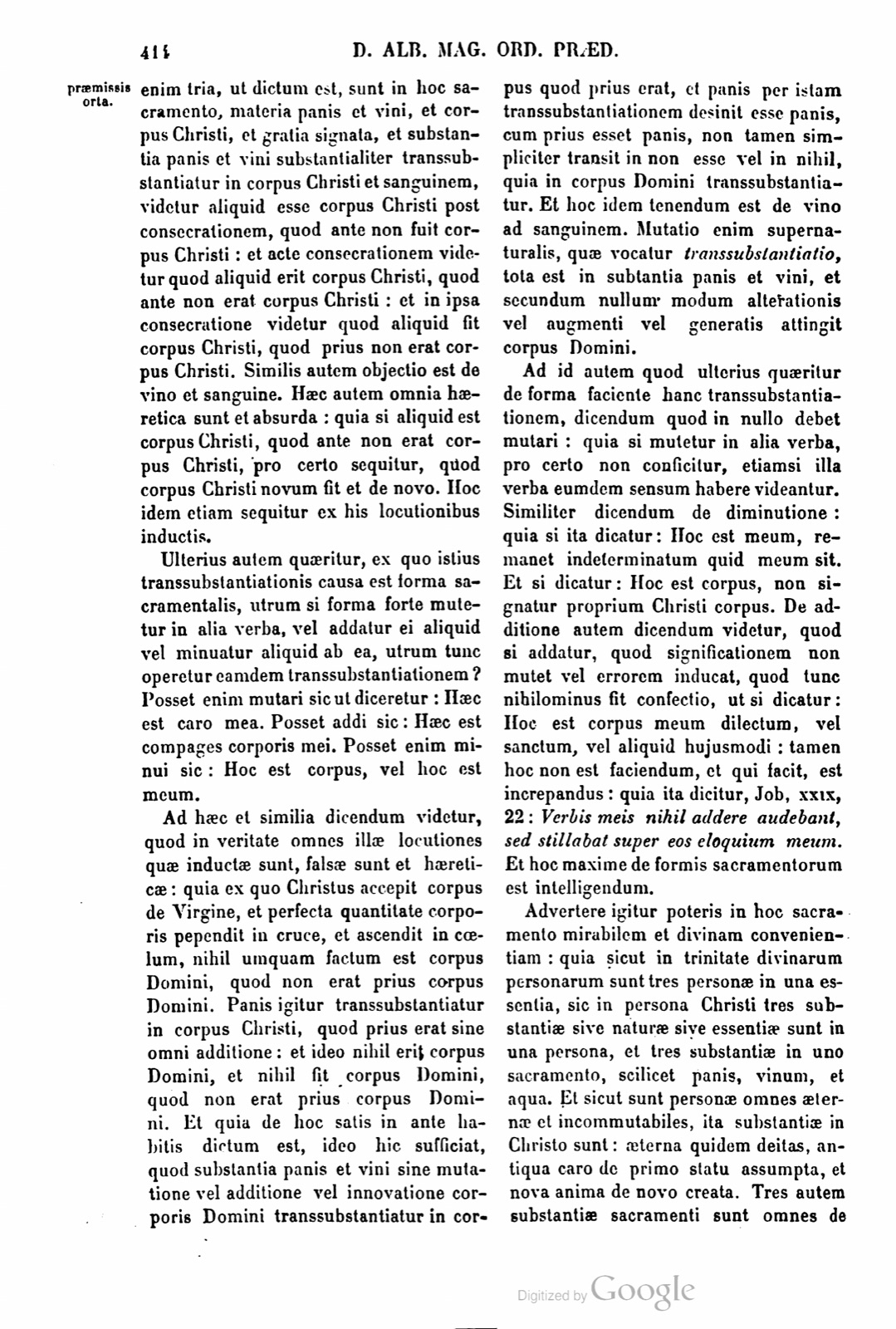
3. Juxta haec autem habent explicari quaedam dubia ex praemissis exorta. Ex quo enim tria, ut dictum est, sunt in hoc sacramento, materia panis et vini, et corpus Christi, et gratia signata, et substantia panis et vini substantialiter transsubstantiatur in corpus Christi et sanguinem, videtur aliquid esse corpus Christi post consecrationem, quod ante non fuit corpus Christi: et ante consecrationem videtur quod aliquid erit corpus Christi, quod ante non erat corpus Christi: et in ipsa consecratione videtur quod aliquid fit corpus Christi, quod prius non erat corpus Christi. Similis autem objectio est de vino et sanguine. Haec autem omnia haeretica sunt et absurda: quia si aliquid est corpus Christi, quod ante non erat corpus Christi, pro certo sequitur, quod corpus Christi novum fit et de novo. Hoc idem etiam sequitur ex his locutionibus inductis.
Ulterius autem quaeritur, ex quo istius transsubstantiationis causa est forma sacramentalis, utrum si forma forte mutetur in alia verba, vel addatur ei aliquid vel minuatur aliquid ab ea, utrum tunc operetur eamdem transsubstantiationem? Posset enim mutari sicut diceretur: Haec est caro mea. Posset addi sic: Haec est compages corporis mei. Posset enim minui sic: Hoc est corpus, vel hoc est meum.
Ad haec et similia dicendum videtur, quod in veritate omnes illae locutiones quae inductae sunt, falsae sunt et haereticae: quia ex quo Christus accepit corpus de Virgine, et perfecta quantitate corporis pependit in cruce, et ascendit in caelum, nihil umquam factum est corpus Domini, quod non erat prius corpus Domini. Panis igitur transsubstantiatur in corpus Christi, quod prius erat sine omni additione: et ideo nihil erit corpus Domini, et nihil fit corpus Domini, quod non erat prius corpus Domini. Et quia de hoc satis in ante habitis dictum est, ideo hic sufficiat, quod substantia panis et vini sine mutatione vel additione vel innovatione corporis Domini transsubstantiatur in corpus quod prius erat, et panis per istam transsubstantiationem desinit esse panis, cum prius esset panis, non tamen simpliciter transit in non esse vel in nihil, quia in corpus Domini transsubstantiatur. Et hoc idem tenendum est de vino ad sanguinem. Mutatio enim supernaturalis, quae vocatur transsubstantiatio, tota est in substantia panis et vini, et secundum nullum modum alterationis vel augmenti vel generationis attingit corpus Domini.
3. But next to these things certain doubts arising from the preceding matters must be explained. For since three things, as was said, are in this sacrament: the matter of bread and wine, and the body of Christ, and the grace signified; and the substance of bread and wine is substantially transubstantiated into the body and blood of Christ, it seems that something is the body of Christ after consecration which before was not the body of Christ; and before consecration it seems that something will be the body of Christ which before was not the body of Christ; and in the consecration itself it seems that something becomes the body of Christ which before was not the body of Christ. But a similar objection concerns wine and blood. But all these things are heretical and absurd, because if something is the body of Christ which before was not the body of Christ, certainly it follows that the body of Christ is made new and anew. This same thing also follows from these utterances introduced.
Further, it is asked, since the cause of this transubstantiation is the sacramental form, whether, if perhaps the form is changed into other words, or something is added to it or something is diminished from it, then it operates the same transubstantiation. For it could be changed as if it were said: This is my flesh. It could be added thus: This is the structure of my body. It could be diminished thus: This is body, or this is mine.
To these and similar things it seems that it must be said that in truth all those utterances which have been introduced are false and heretical; because from the time Christ received a body from the Virgin, and with the perfect quantity of a body hung on the cross, and ascended into heaven, nothing was ever made the body of the Lord which was not before the body of the Lord. Therefore bread is transubstantiated into the body of Christ, which existed before without any addition; and therefore nothing will be the body of the Lord, and nothing becomes the body of the Lord, which was not before the body of the Lord. And because enough has been said about this in the preceding matters, here let this suffice: that the substance of bread and wine, without change or addition or innovation of the Lord's body, is transubstantiated into the body which existed before; and through that transubstantiation bread ceases to be bread, since before it was bread, yet it does not pass simply into non-being or into nothing, because it is transubstantiated into the body of the Lord. And this same thing must be held concerning wine to blood. For the supernatural change which is called transubstantiation is wholly in the substance of bread and wine, and according to no mode of alteration or increase or generation does it touch the body of the Lord.
Ad id autem quod ulterius quaeritur de forma faciente hanc transsubstantiationem, dicendum quod in nullo debet mutari: quia si mutetur in alia verba, pro certo non conficitur, etiamsi illa verba eumdem sensum habere videantur. Similiter dicendum de diminutione: quia si ita dicatur: Hoc est meum, remanet indeterminatum quid meum sit. Et si dicatur: Hoc est corpus, non signatur proprium Christi corpus. De additione autem dicendum videtur, quod si addatur, quod significationem non mutet vel errorem inducat, quod tunc nihilominus fit confectio, ut si dicatur: Hoc est corpus meum dilectum, vel sanctum, vel aliquid hujusmodi: tamen hoc non est faciendum, et qui facit, est increpandus: quia ita dicitur, Job, XXIX, 22: Verbis meis nihil addere audebant, sed stillabat super eos eloquium meum. Et hoc maxime de formis sacramentorum est intelligendum.
Advertere igitur poteris in hoc sacramento mirabilem et divinam convenientiam: quia sicut in trinitate divinarum personarum sunt tres personae in una essentia, sic in persona Christi tres substantiae sive naturae sive essentiae sunt in una persona, et tres substantiae in uno sacramento, scilicet panis, vinum, et aqua. Et sicut sunt personae omnes aeternae et incommutabiles, ita substantiae in Christo sunt: aeterna quidem deitas, antiqua caro de primo statu assumpta, et nova anima de novo creata. Tres autem substantiae sacramenti sunt omnes de antiquo significatae, panis in corpore, et sanguis et aqua quae fluxerunt de Christi latere: et sic Christus est ubique in loco secundum deitatem: localiter autem in loco contentus in caelo. Ita secundum continentiam cibi non localiter, sed tamen vere secundum corporis et animae et deitatis praesentiam est simul in multis locis in sacramento, sicut de sacramento Catholice determinatur.
But to that which is further asked concerning the form making this transubstantiation, it must be said that it ought to be changed in nothing, because if it is changed into other words, certainly it is not confected, even if those words seem to have the same sense. Similarly, it must be said concerning diminution, because if it is said thus, This is mine, it remains indeterminate what mine is. And if it is said, This is body, Christ's own body is not signified. But concerning addition it seems that it must be said that if something is added which does not change the signification or introduce error, then the confection nonetheless occurs, as if it is said: This is my beloved body, or holy body, or something of this kind. Nevertheless this must not be done, and he who does it must be rebuked, because thus it is said in Job 29:22: They did not dare to add anything to my words, but my speech dropped upon them. And this is especially to be understood concerning the forms of the sacraments.
Therefore you will be able to notice in this sacrament a marvelous and divine fittingness, because just as in the Trinity of divine persons there are three persons in one essence, so in the person of Christ there are three substances or natures or essences in one person, and three substances in one sacrament, namely bread, wine, and water. And just as all the persons are eternal and unchangeable, so are the substances in Christ: namely eternal deity, ancient flesh assumed from the first state, and a new soul newly created. But the three substances of the sacrament are all signified of old: bread in the body, and blood and water which flowed from Christ's side. And thus Christ is everywhere in place according to deity, but locally contained in place in heaven. So according to the containment of food, not locally but nevertheless truly according to the presence of body and soul and deity, he is at the same time in many places in the sacrament, as is determined Catholicly concerning the sacrament.
If a page does not appear, its photograph has not been uploaded yet.