Works › The Book on the Sacrament of the Eucharist
Volume 38 · pp. 402–403
Chapter III, 5
A marker with ≈ is an approximate page boundary, placed by measure of the text; the page photographs remain the authority. In the paired views, clicking a page marker brings that page into view.
Marginal label (printed p. 402): Utrum forma consecrationis vini agat divisim vel conjunctim transsubstantiationem cum forma consecrationis panis?
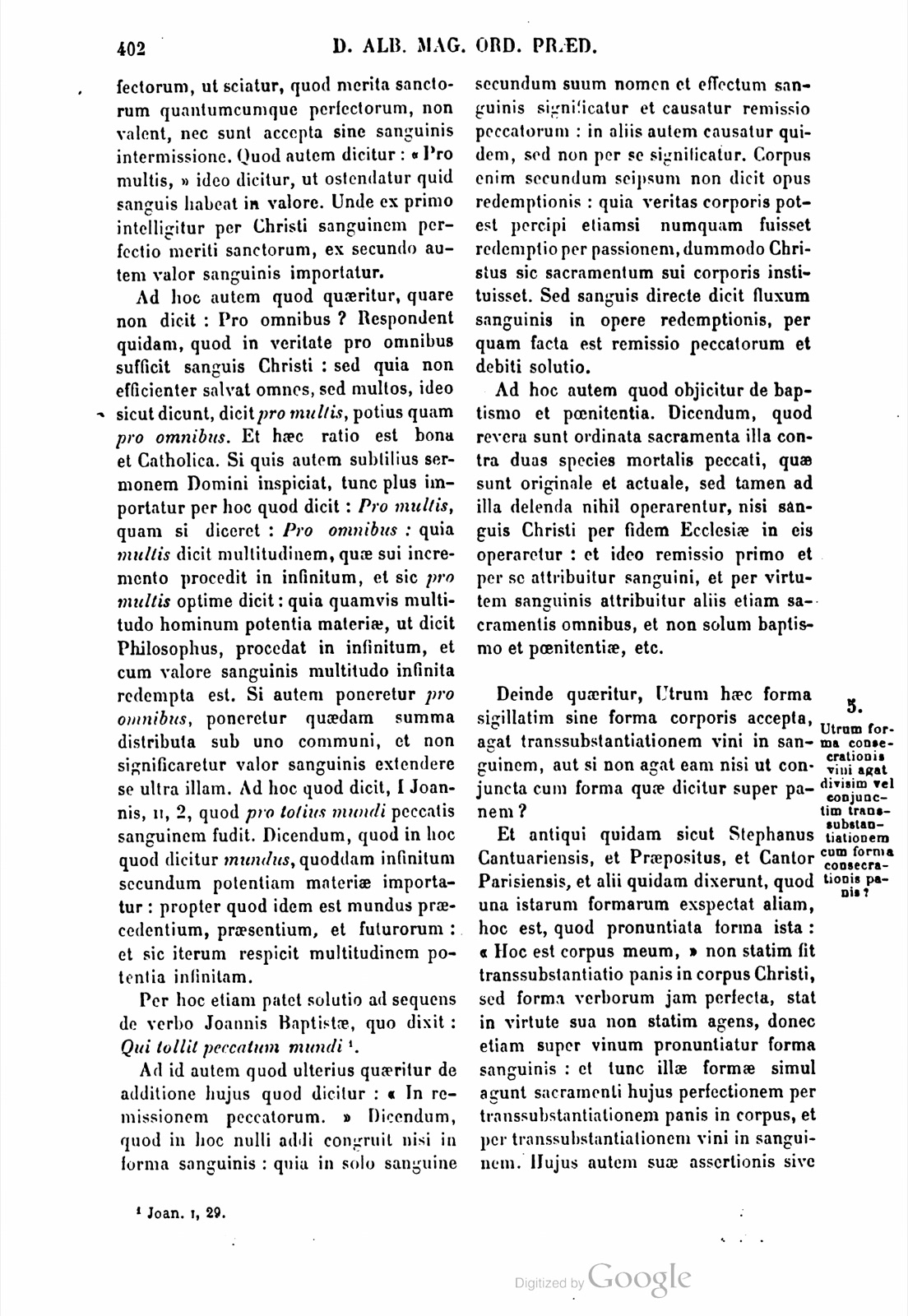
5. Deinde quaeritur, Utrum haec forma sigillatim sine forma corporis accepta, agat transsubstantiationem vini in sanguinem, aut si non agat eam nisi ut conjuncta cum forma quae dicitur super panem?
Et antiqui quidam sicut Stephanus Cantuariensis, et Praepositus, et Cantor Parisiensis, et alii quidam dixerunt, quod una istarum formarum exspectat aliam, hoc est, quod pronuntiata forma ista: « Hoc est corpus meum, » non statim fit transsubstantiatio panis in corpus Christi, sed forma verborum jam perfecta, stat in virtute sua non statim agens, donec etiam super vinum pronuntiatur forma sanguinis: et tunc illae formae simul agunt sacramenti hujus perfectionem per transsubstantiationem panis in corpus, et per transsubstantiationem vini in sanguinem. Hujus autem suae assertionis sive opinionis quatuor assignant rationes: quarum prima sumitur ex unitate sacramenti, quae jam in ante habitis probata est. Unius autem sacramenti una vel congregata ad unum est actio. Et ideo dicunt, quod simul congregatae sunt istae actiones formarum.
Secunda ratio sumitur ab unitate ejus quod semper in hoc sacramento continetur, sive bonus sit sacerdos conficiens, sive malus. Haec autem res est totus et perfectus Christus. Unius enim rei sacramentalis unica vel ad minus simul unita est actio convertens et constituens.
Tertia ratio sumpta est ab inconvenienti quod istis sequi videbatur, si contrarium hujus diceretur: et hoc est, quia si diceretur, quod non sunt simul actiones formarum, esset sub forma panis corpus sine sanguine, et sub forma vini sanguis sine corpore, quod esset magna sacramenti imperfectio: quia sic aliquando in altari esset Christus secundum aliquid sui, et non esset ibi secundum aliquid sui, quod valde inconveniens est.
Quarta autem ratio sumitur a simili: quia dicunt, quod sicut Spiritus sanctus simul corpus et sanguinem formavit in utero, ita conveniens est simul et non successive corpus et sanguinem supernaturali mutatione formari in sacramento, ut una actio divina et supernaturalis alii divinae et supernaturali respondeat secundum similitudinem et congruentiam.
Marginal label (printed p. 402): Whether the form of the consecration of wine acts separately or jointly with the form of consecration of bread in transubstantiation?
5. Then it is asked whether this form, taken separately without the form of the body, effects the transubstantiation of wine into blood, or whether it does not effect it except as joined with the form which is said over the bread.
And certain ancients, such as Stephen of Canterbury, the Praepositus, and the Cantor of Paris, and certain others, said that one of these forms waits for the other; that is, that when this form has been pronounced, "This is my body," the transubstantiation of bread into the body of Christ does not immediately occur, but the form of words, already perfected, stands in its own power, not immediately acting, until the form of the blood is also pronounced over the wine; and then those forms act together the perfection of this sacrament through the transubstantiation of bread into the body and through the transubstantiation of wine into blood. But they assign four reasons for this assertion or opinion of theirs. The first of these is taken from the unity of the sacrament, which has already been proved in the preceding matters. But of one sacrament there is one action or an action gathered to one. And therefore they say that those actions of the forms are gathered together at the same time.
The second reason is taken from the unity of that which is always contained in this sacrament, whether the priest confecting is good or bad. But this thing is the whole and perfect Christ. For of one sacramental thing there is one converting and constituting action, or at least an action united at the same time.
The third reason is taken from the unfitting result which seemed to them to follow if the contrary of this were said; and this is because, if it were said that the actions of the forms are not simultaneous, under the form of bread there would be body without blood, and under the form of wine blood without body, which would be a great imperfection of the sacrament, because thus at some time Christ would be on the altar according to something of himself, and would not be there according to something of himself, which is very unfitting.
But the fourth reason is taken from a likeness, because they say that just as the Holy Spirit formed body and blood together in the womb, so it is fitting that body and blood be formed together and not successively in the sacrament by a supernatural change, so that one divine and supernatural action may correspond to another divine and supernatural action according to likeness and congruence.
Haec igitur sunt propter quae dixerunt hoc quod dixerunt, et magnae fuerunt isti viri temporibus suis auctoritatis inter Doctores.
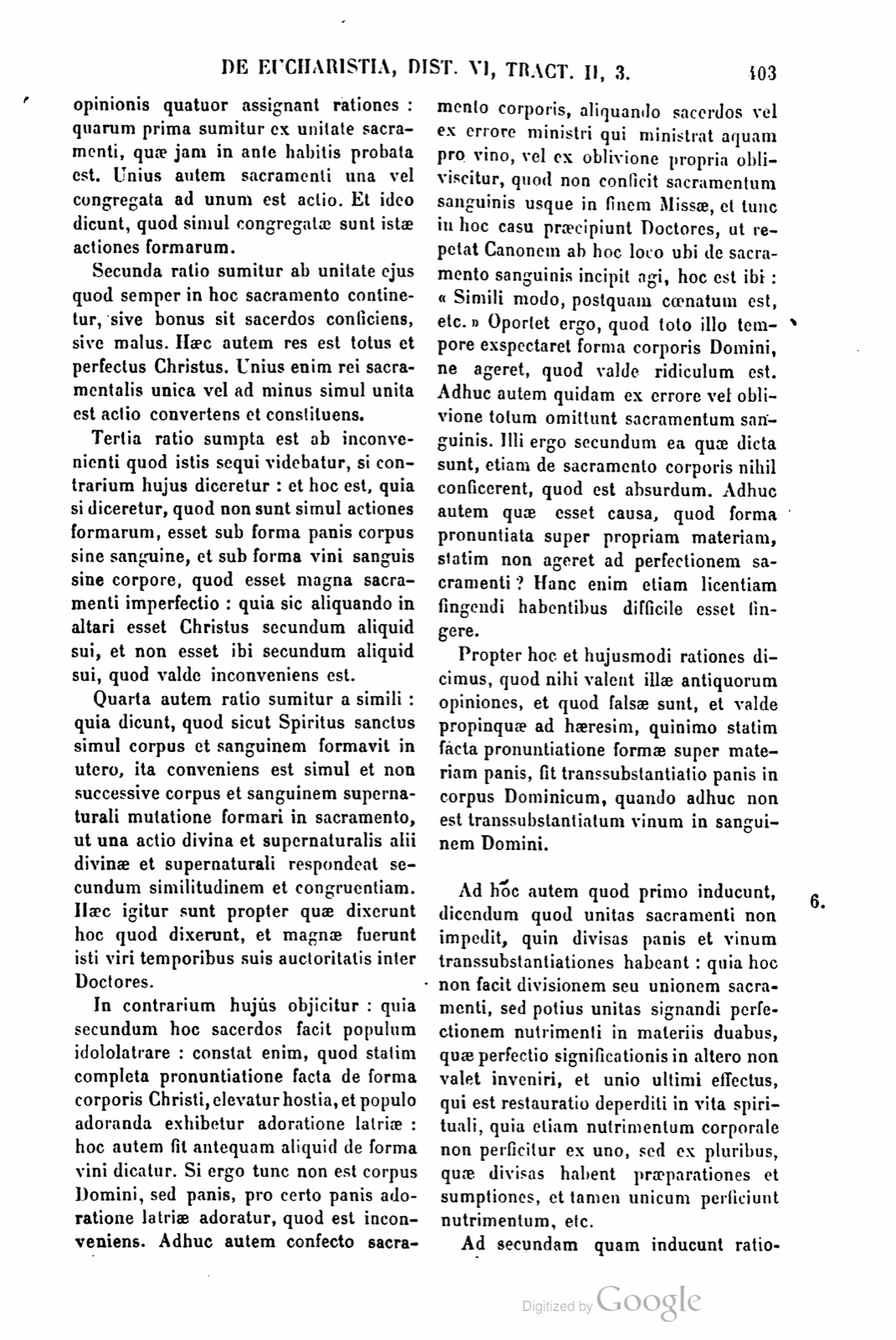
In contrarium hujus objicitur: quia secundum hoc sacerdos facit populum idololatrare: constat enim, quod statim completa pronuntiatione facta de forma corporis Christi, elevatur hostia, et populo adoranda exhibetur adoratione latriae: hoc autem fit antequam aliquid de forma vini dicatur. Si ergo tunc non est corpus Domini, sed panis, pro certo panis adoratione latriae adoratur, quod est inconveniens. Adhuc autem confecto sacramento corporis, aliquando sacerdos vel ex errore ministri qui ministrat aquam pro vino, vel ex oblivione propria obliviscitur, quod non conficit sacramentum sanguinis usque in finem Missae, et tunc in hoc casu praecipiunt Doctores, ut repetat Canonem ab hoc loco ubi de sacramento sanguinis incipit agi, hoc est ibi: « Simili modo, postquam coenatum est, etc. » Oportet ergo, quod toto illo tempore exspectaret forma corporis Domini, ne ageret, quod valde ridiculum est. Adhuc autem quidam ex errore vel oblivione totum omittunt sacramentum sanguinis. Illi ergo secundum ea quae dicta sunt, etiam de sacramento corporis nihil conficerent, quod est absurdum. Adhuc autem quae esset causa, quod forma pronuntiata super propriam materiam, statim non ageret ad perfectionem sacramenti? Hanc enim etiam licentiam fingendi habentibus difficile esset fingere.
Propter hoc et hujusmodi rationes dicimus, quod nihil valent illae antiquorum opiniones, et quod falsae sunt, et valde propinquae ad haeresim, quinimo statim facta pronuntiatione formae super materiam panis, fit transsubstantiatio panis in corpus Dominicum, quando adhuc non est transsubstantiatum vinum in sanguinem Domini.
These, therefore, are the reasons because of which they said what they said, and these men were of great authority among the Doctors in their own times.
Against this it is objected that according to this the priest makes the people commit idolatry; for it is agreed that as soon as the pronouncing made concerning the form of the body of Christ has been completed, the host is elevated and shown to the people to be adored with the adoration of latria; but this happens before anything is said concerning the form of wine. Therefore, if then it is not the body of the Lord, but bread, certainly bread is adored with the adoration of latria, which is unfitting. Moreover, after the sacrament of the body has been confected, sometimes the priest, either through error of the minister who supplies water for wine, or through his own forgetfulness, forgets, so that he does not confect the sacrament of blood until the end of Mass; and then in this case the Doctors prescribe that he repeat the Canon from that place where action concerning the sacrament of blood begins, that is, there: "In like manner, after supper had been taken, etc." Therefore it would be necessary that through that whole time the form of the Lord's body was waiting lest it act, which is very ridiculous. Moreover, certain persons through error or forgetfulness omit the whole sacrament of blood. Therefore those, according to the things that have been said, would also confect nothing of the sacrament of the body, which is absurd. Moreover, what would be the cause that the form pronounced over its proper matter would not immediately act toward the perfection of the sacrament? For even to those having this license of inventing, it would be difficult to invent this.
For this reason and reasons of this kind we say that those opinions of the ancients have no force, and that they are false and very near to heresy; indeed, as soon as the pronouncing of the form over the matter of bread has been made, the transubstantiation of bread into the Lord's body occurs, when the wine has not yet been transubstantiated into the blood of the Lord.
If a page does not appear, its photograph has not been uploaded yet.