Works › The Book on the Sacrament of the Eucharist
Volume 38 · pp. 403–405
Chapter III, 6-7
A marker with ≈ is an approximate page boundary, placed by measure of the text; the page photographs remain the authority. In the paired views, clicking a page marker brings that page into view.
Marginal label (printed p. 404): Quare utraque forma non eodem modo traditur?
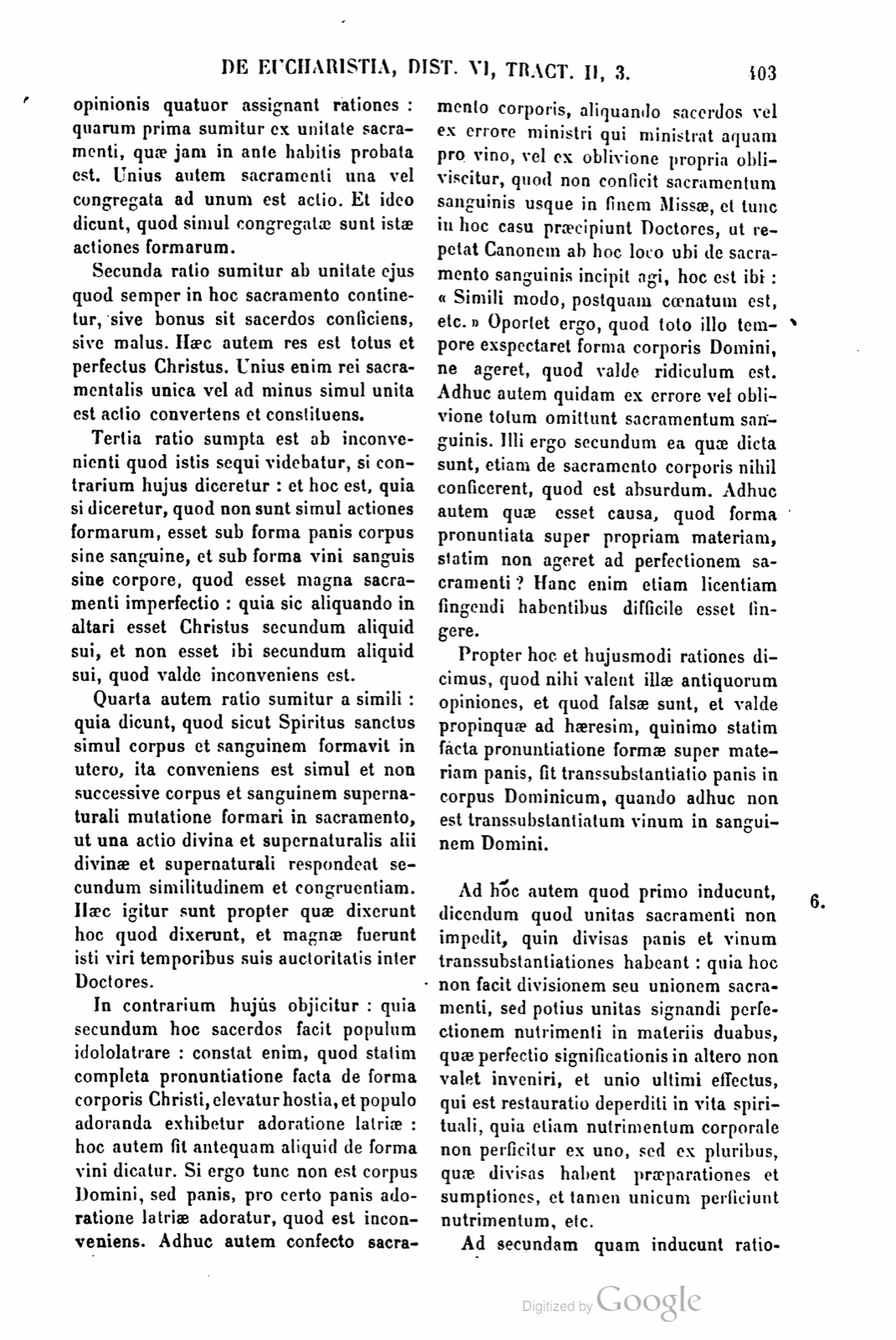
6. Ad hoc autem quod primo inducunt, dicendum quod unitas sacramenti non impedit, quin divisas panis et vinum transsubstantiationes habeant: quia hoc non facit divisionem seu unionem sacramenti, sed potius unitas signandi perfectionem nutrimenti in materiis duabus, quae perfectio significationis in altero non valet inveniri, et unio ultimi effectus, qui est restauratio deperditi in vita spirituali, quia etiam nutrimentum corporale non perficitur ex uno, sed ex pluribus, quae divisas habent praeparationes et sumptiones, et tamen unicum perficiunt nutrimentum, etc.
Ad secundam quam inducunt rationem, dicendum quod verum est, quod unus Christus integer et perfectus sub utraque est forma sacramentali, et quamvis unius rei unica sit actio, vel ad unum congregata, hoc verum est, quando unum et idem habetur uno modo et secundum eamdem et indivisam operationem. Hoc autem non est hic: quia ad aliud in nutrimento consecratur sanguis, et ad aliud corpus, quamvis illa postea conjuncta unam perficiant nutrimenti operationem, sicut diversa fercula vel diversi potus ordinati secundum naturam, quamvis diversas habeant praeparationes et sumptiones, unam tamen habent nutriendi perfectionem: et ideo propter hoc quod dicunt, non oportet quod una forma exspectet aliam in agendo.
Ad tertiam dicendum, quod ille error qui istis videbatur, non sequitur: quia licet sub forma panis ex virtute sacramenti non sit nisi corpus, tamen hoc non est sine sanguine: quia ex perfectione corporis naturalis habet venas plenas sanguine, et ex organisatione habet perfectionem animae, et ex gratia unionis habet perfectionem deitatis: sed sicut jam ante diximus, Ecclesia intendit habere sanguinem, non ex perfectione naturalis corporis, sed potius ex vi sacramentali ad nutrimenti spiritualis perfectionem. Et ideo non contingit inconveniens quod isti timebant, accidere. Numquam enim Christus secundum aliquid sui est in altari, et secundum aliquid sui semper est in altari, sicut jam saepius dictum est.
Marginal label (printed p. 404): Why is each form not handed down in the same mode?
6. But to what they introduce first, it must be said that the unity of the sacrament does not prevent the bread and wine from having divided transubstantiations, because this does not make division or union of the sacrament, but rather the unity of signifying the perfection of nourishment in two matters, which perfection of signification cannot be found in either one, and the union of the final effect, which is the restoration of what was lost in spiritual life; because even bodily nourishment is not perfected from one thing, but from many things, which have divided preparations and receptions and nevertheless perfect one nourishment, etc.
To the second reason which they introduce, it must be said that it is true that one Christ, entire and perfect, is under each sacramental form, and although of one thing there is one action, or an action gathered to one, this is true when one and the same thing is had in one mode and according to the same and undivided operation. But this is not so here, because the blood is consecrated for one thing in nourishment and the body for another, although those afterward joined perfect one operation of nourishment; just as diverse dishes or diverse drinks ordered according to nature, although they have diverse preparations and receptions, nevertheless have one perfection of nourishing. And therefore, because of what they say, it is not necessary that one form wait for the other in acting.
To the third it must be said that the error which seemed to them does not follow, because although under the form of bread by the power of the sacrament there is nothing except the body, nevertheless this is not without blood; because from the perfection of the natural body it has veins full of blood, and from organization it has the perfection of soul, and from the grace of union it has the perfection of deity. But as we have already said before, the Church intends to have the blood, not from the perfection of the natural body, but rather from sacramental force for the perfection of spiritual nourishment. And therefore the unfitting thing which those men feared does not happen. For Christ is never on the altar according to one part of himself while according to another part of himself he is always on the altar, as has now often been said.
Ad quartam autem rationem dicendum, quod transsubstantiationes supernaturales et divinae non sibi respondent, nisi secundum summae sapientiae ordinem. Et ideo cum summa sapientia ad unius perfectionem nutrimenti ordinaverit duas transsubstantiationes divisim faciendas et sumendas, duae divisae sunt in sacramento transsubstantiationes. Nec est simile quod pro simili inducitur: quia in formando corpus, necesse fuit quod sanguis esset materia corporis: et ideo oportuit, quod simul cum corpore sumeretur ad opus incarnationis. In sacramento autem potus sumitur ad nutrimentum, ut vehat et subtiliet cibum, et venarum vias aperiat, et membris continuet et adhaerere faciat: et ideo secundum consequentiae rationem in sacramento sanguis conficitur et sumitur post sacramenti corporis confectionem.
Haec ergo opinio stare non poterit, etc.
7. Nunc dicere restat quare non eodem modo traditur sicut forma quae dicitur super panem, ut sic plane diceretur: Hic est sanguis meus. Videtur enim, quod similis similium esse deberet traditio. Simile autem penitus in traditione sacramentali videtur esse de sacramento panis sive corporis, sive de sacramento vini sive sanguinis.
But to the fourth reason it must be said that supernatural and divine transubstantiations do not correspond to one another except according to the order of highest wisdom. And therefore, since highest wisdom has ordered for the perfection of one nourishment that two transubstantiations be made and received separately, there are two divided transubstantiations in the sacrament. Nor is the thing which is introduced as similar similar, because in forming the body it was necessary that blood be the matter of the body; and therefore it was necessary that it be taken together with the body for the work of incarnation. But in the sacrament drink is taken for nourishment, so that it may carry and refine the food, and open the ways of the veins, and join it to the members and make it adhere; and therefore, according to the account of consequence, in the sacrament the blood is confected and received after the confection of the sacrament of the body.
Therefore this opinion will not be able to stand, etc.
7. Now it remains to say why it is not handed down in the same mode as the form which is said over the bread, so that it would plainly be said thus: This is my blood. For it seems that the handing down of similar things ought to be similar. But in sacramental handing down, the case of the sacrament of bread or the body seems wholly similar to the case of the sacrament of wine or blood.
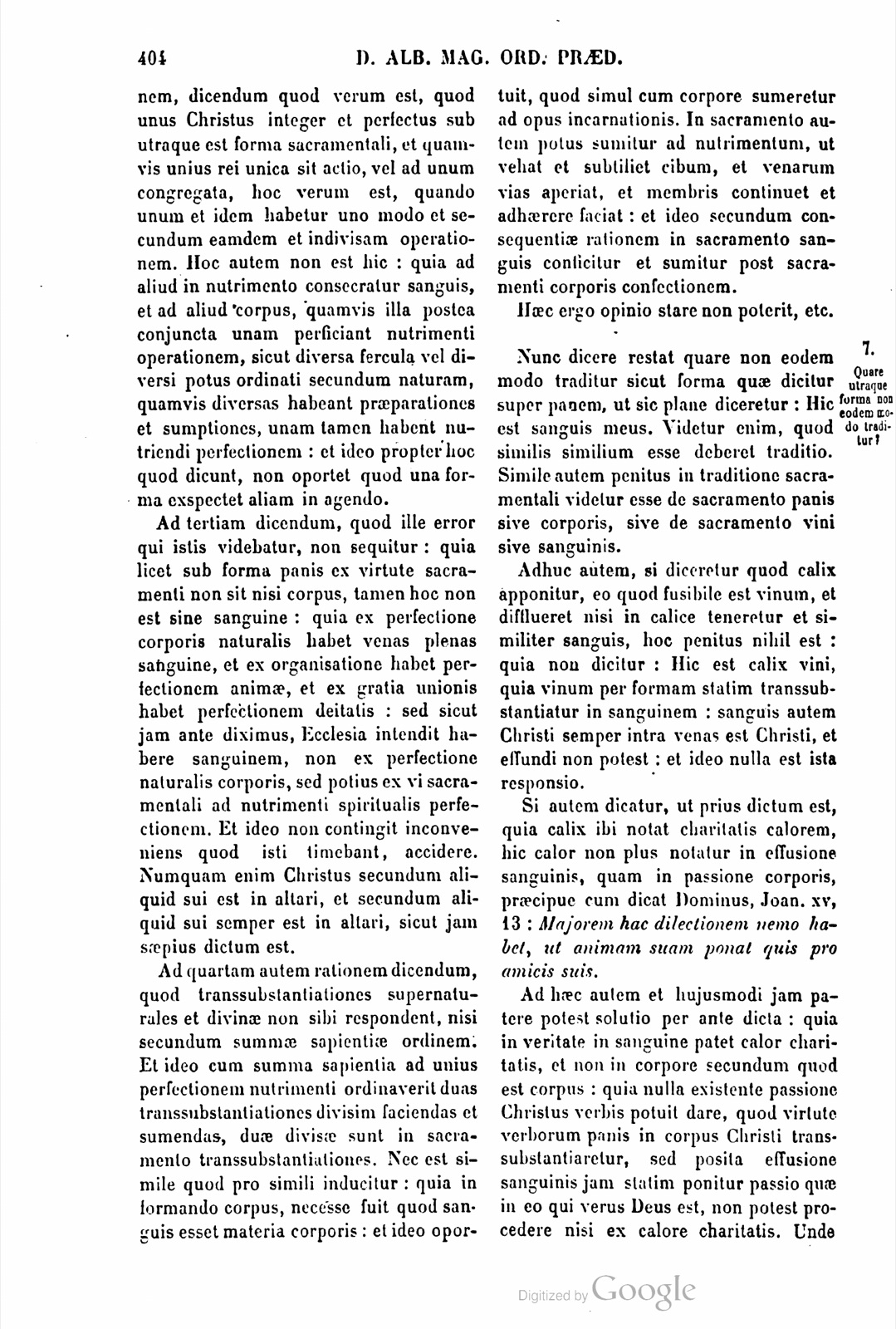
Adhuc autem, si diceretur quod calix apponitur, eo quod fusibile est vinum, et difflueret nisi in calice teneretur et similiter sanguis, hoc penitus nihil est: quia non dicitur: Hic est calix vini, quia vinum per formam statim transsubstantiatur in sanguinem: sanguis autem Christi semper intra venas est Christi, et effundi non potest: et ideo nulla est ista responsio.
Si autem dicatur, ut prius dictum est, quia calix ibi notat charitatis calorem, hic calor non plus notatur in effusione sanguinis, quam in passione corporis, praecipue cum dicat Dominus, Joan. XV, 13: Majorem hac dilectionem nemo habet, ut animam suam ponat quis pro amicis suis.
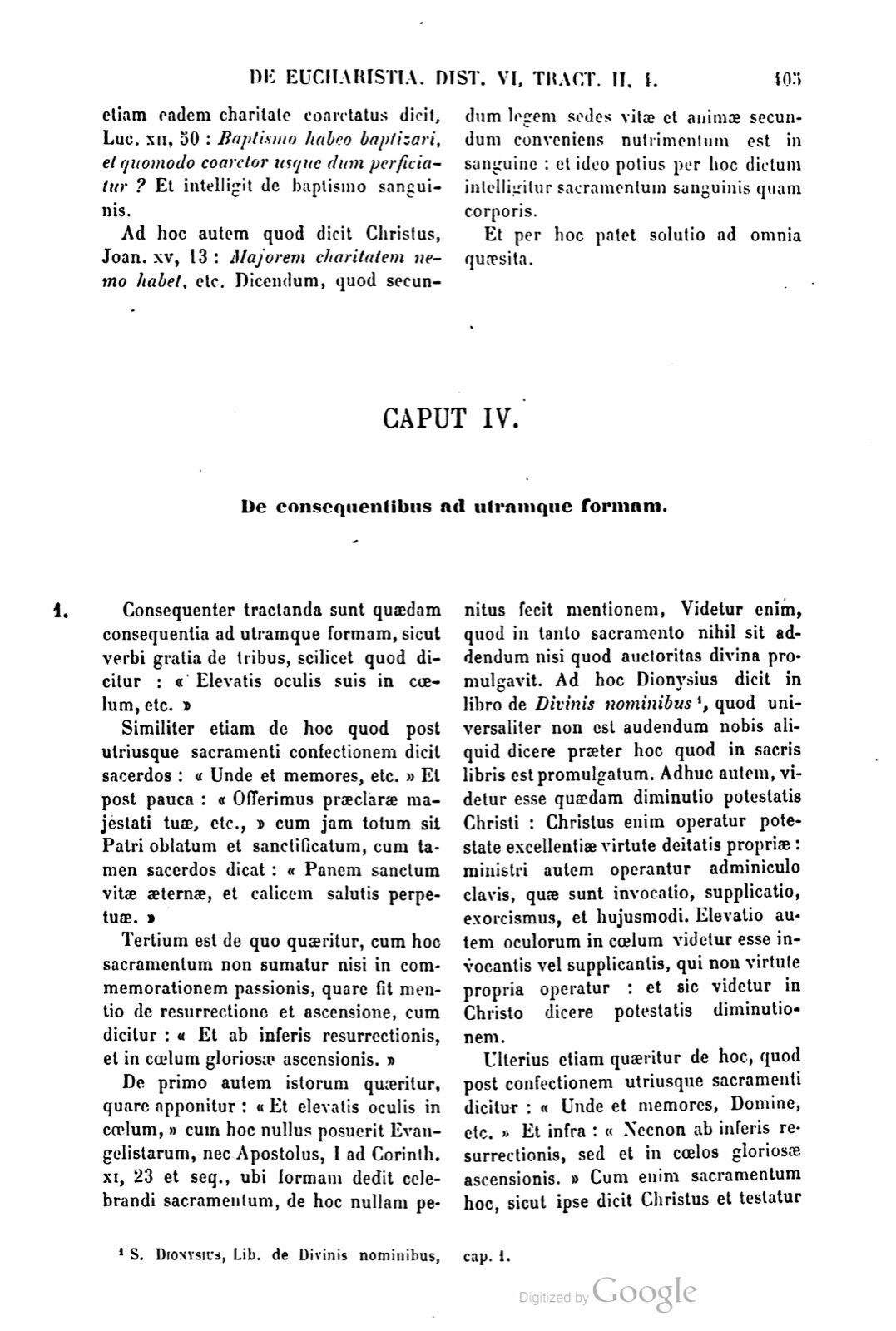
Ad haec autem et hujusmodi jam patere potest solutio per ante dicta: quia in veritate in sanguine patet calor charitatis, et non in corpore secundum quod est corpus: quia nulla existente passione Christus verbis potuit dare, quod virtute verborum panis in corpus Christi transsubstantiaretur, sed posita effusione sanguinis jam statim ponitur passio quae in eo qui verus Deus est, non potest procedere nisi ex calore charitatis. Unde etiam eadem charitate coarctatus dicit, Luc. XII, 50: Baptismo habeo baptizari, et quomodo coarctor usque dum perficiatur? Et intelligit de baptismo sanguinis.
Ad hoc autem quod dicit Christus, Joan. XV, 13: Majorem charitatem nemo habet, etc. Dicendum, quod secundum legem sedes vitae et animae secundum conveniens nutrimentum est in sanguine: et ideo potius per hoc dictum intelligitur sacramentum sanguinis quam corporis.
Et per hoc patet solutio ad omnia quaesita.
Moreover, if it were said that chalice is appended because wine is pourable and would flow away unless it were held in a chalice, and likewise blood, this is wholly nothing, because it is not said, This is the chalice of wine, because wine is immediately transubstantiated by the form into blood; but the blood of Christ is always within the veins of Christ and cannot be poured out; and therefore that response is nothing.
But if it is said, as was said before, that chalice there denotes the heat of charity, this heat is not noted more in the pouring out of blood than in the passion of the body, especially since the Lord says, John 15:13: No one has greater love than this, that someone lay down his life for his friends.
But to these and things of this kind the solution can now be clear through the things said before, because in truth the heat of charity is manifest in the blood, and not in the body according as it is body; because, even with no passion existing, Christ could have given by words that by the power of the words bread would be transubstantiated into the body of Christ, but once the pouring out of blood is posited, immediately the passion is already posited, which in him who is true God cannot proceed except from the heat of charity. Hence also, constrained by the same charity, he says in Luke 12:50: I have a baptism with which I must be baptized, and how am I constrained until it be accomplished? And he understands this of the baptism of blood.
But to this which Christ says, John 15:13, No one has greater charity, etc., it must be said that according to the law the seat of life and of the soul according to fitting nourishment is in the blood; and therefore through this saying the sacrament of the blood is understood rather than that of the body.
And through this the solution to all the things asked is clear.
If a page does not appear, its photograph has not been uploaded yet.