Works › The Book on the Sacrament of the Eucharist
Volume 38 · pp. 401–402
Chapter III, 4
A marker with ≈ is an approximate page boundary, placed by measure of the text; the page photographs remain the authority. In the paired views, clicking a page marker brings that page into view.
Ad hoc quod quaeritur, quid sit in sanguine testificatum? Dicendum, quod totum Novum Testamentum, sicut dicitur, I Joannis, V, 8: Tres sunt qui testimonium dant in terra: spiritus, et aqua, et sanguis. Sanguis enim testatur remissionem, sicut dicitur, ad Hebr. XII, 22 et seq.: Accessistis... ad sanguinis aspersionem, scilicet Jesu Christi, melius loquentem quam Abel: quia Abel sanguinis aspersio vindictam expostulat, sed sanguis Christi remissionem. Spiritus autem vaporans in sanguine, testatur sanctificationem, et aqua expiationem. Hinc est, quod, Zachar. IX, 11, dicitur: Tu quoque in sanguine testamenti tui emisisti vinctos tuos de lacu in quo non est aqua. Hoc igitur testificatur sanguis: quia, sicut dicitur, ad Hebr. IX, 22: Sine sanguinis effusione non fit remissio. Et hoc testificabatur sanguis cum flueret multis miraculis. Propter quod etiam Centurio convictus dixit, Matth. XXVII, 54: Vere Filius Dei erat iste 1. Convicti etiam erant illi qui percutientes pectora sua reversi sunt in civitatem 2. Nihil autem horum adjungitur corpori: quia corpus secundum se non est mortis signum vel passionis. Est etiam ultimae voluntatis confirmatio: quia ultima voluntas Christi fuit remissio per redemptionem, et hanc sanguine testificatus est et confirmavit multis sigillis miraculorum.
Ad id autem quod objicitur, quod in aeternitate nihil erit sacramentalium signorum, solutio patet per dicta paulo ante: quia ideo dicitur aeternum, quia non habebit succedens, et in beatitudine manebit in suo proprio significato, sicut et Christus dicitur, ad Hebr. VII, 24, sempiternum habere sacerdotium secundum ordinem Melchisedech 3.
Ad id autem quod quaeritur, unde addatur: Mysterium fidei? Dicendum, quod auctoritate Apostolica additur et Ecclesiae, ad determinationem sacramenti sanguinis: tota enim fides in sacramento sanguinis fundatur, secundum quod redemptio facta est per sanguinem: quia Christus propter hoc incarnatus fuit, sicut dicit Petrus, beati Gregorii diaconus, in paschalis cerei benedictione: « Nihil enim nasci profuit, nisi redimi profuisset. »
Ad hoc autem quod dicitur, nihil simile in Evangelio contineri. Dici potest, quod multa fecit et dixit Christus, sicut dicitur, Joan. XXI, 25: Quae si scribantur per singula, nec ipsum arbitror mundum capere posse eos, qui scribendi sunt, libros. Vel, si non dixerit Christus, tamen Ecclesiae auctoritas addidit, ut diximus, ad expressionem fidei, quae tota, sicut jam diximus, morte et sanguine Christi est completa. Et hoc quidem mysterium est: quia tota fides est de non apparentibus rationi. Unde, ad Hebr. XI, 1, dicitur, quod fides est sperandarum substantia rerum, argumentum non apparentium.
Ad hoc quod quaeritur, quare hoc non est additum formae corporis? jam patet solutio per ante dicta: quia scilicet corpus secundum quod corpus mortem omnia confirmantem forma sua non ostendit, quam perfecte ostendit fluxus de latere sanguinis.
Ad id quod quaeritur, quare non dicatur mysterium spei et charitatis? Dicendum, quod hoc non esset proprie loqui: quia secretum quod significat mysterium, non congruit nisi pertinentibus ad cognitionem, et ad cognitionem non pertinent spes et charitas.
Ad id autem quod ulterius quaeritur de hoc quod additur: « Qui pro vobis, etc. » Dicendum, quod non est de forma.
To this which is asked, what is testified in the blood, it must be said: the whole New Testament, as is said in 1 John 5:8: There are three who give testimony on earth: the spirit, and the water, and the blood. For blood testifies remission, as is said in Hebrews 12:22 and following: You have come... to the sprinkling of blood, namely of Jesus Christ, speaking better than Abel; because the sprinkling of Abel's blood demands vengeance, but the blood of Christ demands remission. But the spirit steaming in the blood testifies sanctification, and water testifies expiation. Hence it is that in Zechariah 9:11 it is said: You also, in the blood of your testament, have sent forth your bound ones from the pit in which there is no water. Therefore the blood testifies this, because, as is said in Hebrews 9:22, Without the shedding of blood remission does not occur. And the blood testified this when it flowed with many miracles. For this reason also the convicted Centurion said, Matthew 27:54: Truly this was the Son of God 1. Those also were convicted who, striking their breasts, returned into the city 2. But none of these things is added to the body, because the body according to itself is not the sign of death or of passion. It is also confirmation of the last will, because the last will of Christ was remission through redemption, and he testified and confirmed this by blood with many seals of miracles.
To that which is objected, that in eternity there will be nothing of sacramental signs, the solution is clear through what was said a little before, because it is called eternal for this reason, that it will have no successor, and in beatitude it will remain in its proper signified, just as Christ also is said in Hebrews 7:24 to have an everlasting priesthood according to the order of Melchizedek 3.
To this which is asked, whence there is added, Mystery of faith, it must be said that it is added by Apostolic authority and that of the Church for the determination of the sacrament of blood; for the whole faith is founded in the sacrament of blood, according as redemption was made through blood, because Christ was incarnate on account of this, as Peter, deacon of blessed Gregory, says in the blessing of the paschal candle: "For to be born would have profited nothing unless to be redeemed had profited."
To this, however, which is said, that nothing similar is contained in the Gospel, it can be said that Christ did and said many things, as is said in John 21:25: If they were written one by one, I do not think the world itself could contain the books that would have to be written. Or, if Christ did not say it, nevertheless the authority of the Church added it, as we have said, for the expression of faith, which wholly, as we have already said, is completed by the death and blood of Christ. And this indeed is mystery, because the whole faith concerns things not apparent to reason. Hence in Hebrews 11:1 it is said that faith is the substance of things to be hoped for, the proof of things not apparent.
To this which is asked, why this is not added to the form of the body, the solution is already clear through the things said before, namely because the body, according as it is body, by its form does not show death confirming all things, which the flow of blood from the side shows perfectly.
To that which is asked, why it is not called the mystery of hope and charity, it must be said that this would not be to speak properly, because the secret which mystery signifies is fitting only for things pertaining to cognition, and hope and charity do not pertain to cognition.
But to this which is further asked concerning this which is added, "Which for you, etc.," it must be said that it is not of the form.
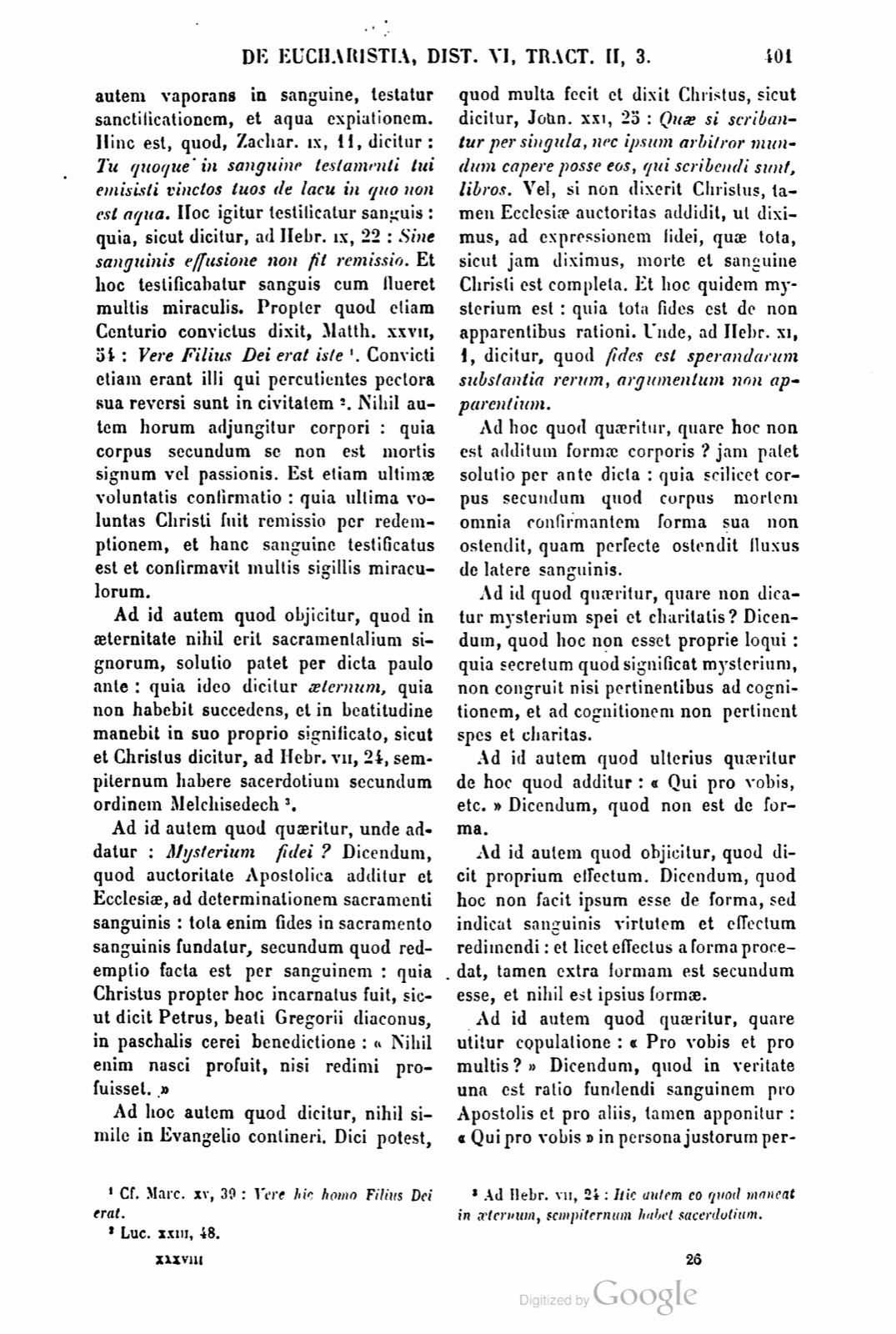
Ad id autem quod objicitur, quod dicit proprium effectum. Dicendum, quod hoc non facit ipsum esse de forma, sed indicat sanguinis virtutem et effectum redimendi: et licet effectus a forma procedat, tamen extra formam est secundum esse, et nihil est ipsius formae.
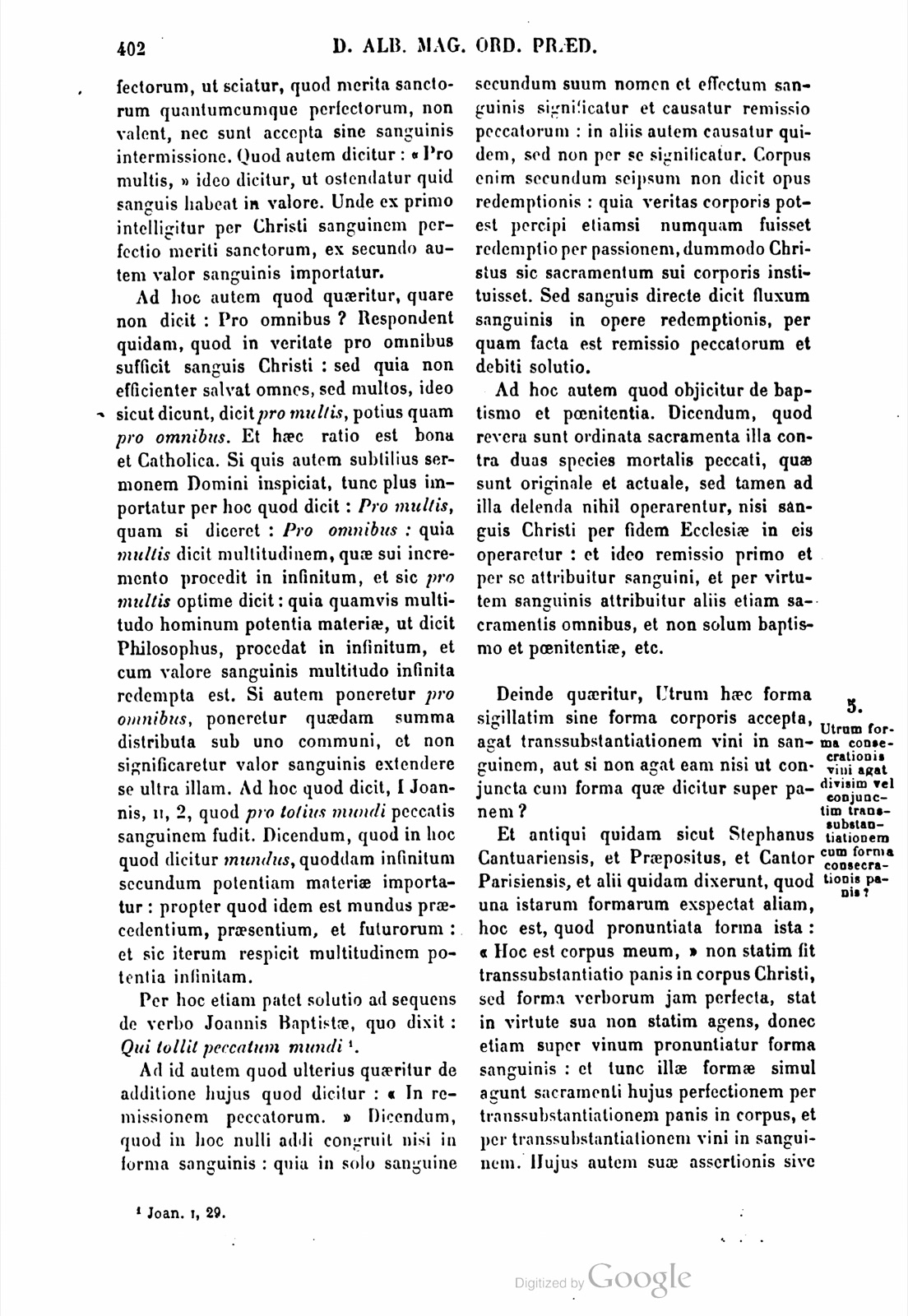
Ad id autem quod quaeritur, quare utitur copulatione: « Pro vobis et pro multis? » Dicendum, quod in veritate una est ratio fundendi sanguinem pro Apostolis et pro aliis, tamen apponitur: « Qui pro vobis » in persona justorum perfectorum, ut sciatur, quod merita sanctorum quantumcumque perfectorum, non valent, nec sunt accepta sine sanguinis intermissione. Quod autem dicitur: « Pro multis, » ideo dicitur, ut ostendatur quid sanguis habeat in valore. Unde ex primo intelligitur per Christi sanguinem perfectio meriti sanctorum, ex secundo autem valor sanguinis importatur.
Ad hoc autem quod quaeritur, quare non dicit: Pro omnibus? Respondent quidam, quod in veritate pro omnibus sufficit sanguis Christi: sed quia non efficienter salvat omnes, sed multos, ideo sicut dicunt, dicit pro multis, potius quam pro omnibus. Et haec ratio est bona et Catholica. Si quis autem subtilius sermonem Domini inspiciat, tunc plus importatur per hoc quod dicit: Pro multis, quam si diceret: Pro omnibus: quia multis dicit multitudinem, quae sui incremento procedit in infinitum, et sic pro multis optime dicit: quia quamvis multitudo hominum potentia materiae, ut dicit Philosophus, procedat in infinitum, et cum valore sanguinis multitudo infinita redempta est. Si autem poneretur pro omnibus, poneretur quaedam summa distributa sub uno communi, et non significaretur valor sanguinis extendere se ultra illam. Ad hoc quod dicit, I Joannis, II, 2, quod pro totius mundi peccatis sanguinem fudit. Dicendum, quod in hoc quod dicitur mundus, quoddam infinitum secundum potentiam materiae importatur: propter quod idem est mundus praecedentium, praesentium, et futurorum: et sic iterum respicit multitudinem potentia infinitam.
Per hoc etiam patet solutio ad sequens de verbo Joannis Baptistae, quo dixit: Qui tollit peccatum mundi 4.
Ad id autem quod ulterius quaeritur de additione hujus quod dicitur: « In remissionem peccatorum. » Dicendum, quod in hoc nulli addi congruit nisi in forma sanguinis: quia in solo sanguine secundum suum nomen et effectum sanguinis significatur et causatur remissio peccatorum: in aliis autem causatur quidem, sed non per se significatur. Corpus enim secundum seipsum non dicit opus redemptionis: quia veritas corporis potest percipi etiamsi numquam fuisset redemptio per passionem, dummodo Christus sic sacramentum sui corporis instituisset. Sed sanguis directe dicit fluxum sanguinis in opere redemptionis, per quam facta est remissio peccatorum et debiti solutio.
Ad hoc autem quod objicitur de baptismo et paenitentia. Dicendum, quod revera sunt ordinata sacramenta illa contra duas species mortalis peccati, quae sunt originale et actuale, sed tamen ad illa delenda nihil operarentur, nisi sanguis Christi per fidem Ecclesiae in eis operaretur: et ideo remissio primo et per se attribuitur sanguini, et per virtutem sanguinis attribuitur aliis etiam sacramentis omnibus, et non solum baptismo et paenitentiae, etc.
To that which is objected, that it states the proper effect, it must be said that this does not make it be of the form, but indicates the power of the blood and the effect of redeeming; and although the effect proceeds from the form, nevertheless it is outside the form according to being, and is nothing of the form itself.
To that which is asked why it uses a coupling, "For you and for many," it must be said that in truth there is one account of pouring the blood for the Apostles and for others; nevertheless "which for you" is appended in the person of perfect just men, so that it may be known that the merits of saints, however perfect, do not have force and are not accepted without the interposition of blood. But what is said, "For many," is said for this reason, that it may show what the blood has in value. Hence from the first is understood through the blood of Christ the perfection of the merit of the saints, but from the second the value of the blood is imported.
To this which is asked, why he does not say, For all, some respond that in truth the blood of Christ suffices for all, but because it does not save all efficiently, but many, therefore, as they say, he says for many rather than for all. And this reason is good and Catholic. But if someone should inspect the Lord's speech more subtly, then more is imported through this, that he says For many, than if he said For all, because many states a multitude which proceeds into infinity by its own increase, and thus he says for many most excellently, because although the multitude of men proceeds into infinity by the potency of matter, as the Philosopher says, yet with the value of the blood an infinite multitude has been redeemed. But if for all were placed, a certain sum distributed under one common whole would be placed, and it would not be signified that the value of the blood extends itself beyond that. To this which 1 John 2:2 says, that he poured out blood for the sins of the whole world, it must be said that in that which is called world, something infinite according to the potency of matter is imported; because of this the world of those preceding, present, and future is the same; and thus again it looks to a multitude infinite in potency.
Through this also the solution is clear to the following point concerning the word of John the Baptist, by which he said: Who takes away the sin of the world 4.
To that which is further asked concerning the addition of this which is said, "unto the remission of sins," it must be said that in this it is fitting to be added to none except in the form of the blood, because in blood alone according to its name and the effect of blood is remission of sins signified and caused; but in the others it is indeed caused, but not signified through itself. For body according to itself does not state the work of redemption, because the truth of the body can be perceived even if there had never been redemption through passion, provided that Christ had thus instituted the sacrament of his body. But blood directly states the flow of blood in the work of redemption, through which remission of sins and payment of the debt were made.
But to that which is objected about baptism and penance, it must be said that those sacraments truly are ordered against the two species of mortal sin, which are original and actual; nevertheless they would operate nothing for destroying those unless the blood of Christ operated in them through the faith of the Church; and therefore remission is attributed first and through itself to the blood, and through the power of the blood it is attributed also to all the other sacraments, and not only to baptism and penance, etc.
Notes
- Cf. Mark 15:39: Truly this man was the Son of God. (Cf. Marc. XV, 39: Vere hic homo Filius Dei erat.) ↩
- Luke 23:48. (Luc. XXIII, 48.) ↩
- Hebrews 7:24: But this one, because he remains forever, has an everlasting priesthood. (Ad Hebr. VII, 24: Hic autem eo quod maneat in aeternum, sempiternum habet sacerdotium.) ↩
- John 1:29. (Joan. I, 29.) ↩
If a page does not appear, its photograph has not been uploaded yet.