Works › The Book on the Sacrament of the Eucharist
Volume 38 · pp. 399–400
Chapter III, 4
A marker with ≈ is an approximate page boundary, placed by measure of the text; the page photographs remain the authority. In the paired views, clicking a page marker brings that page into view.
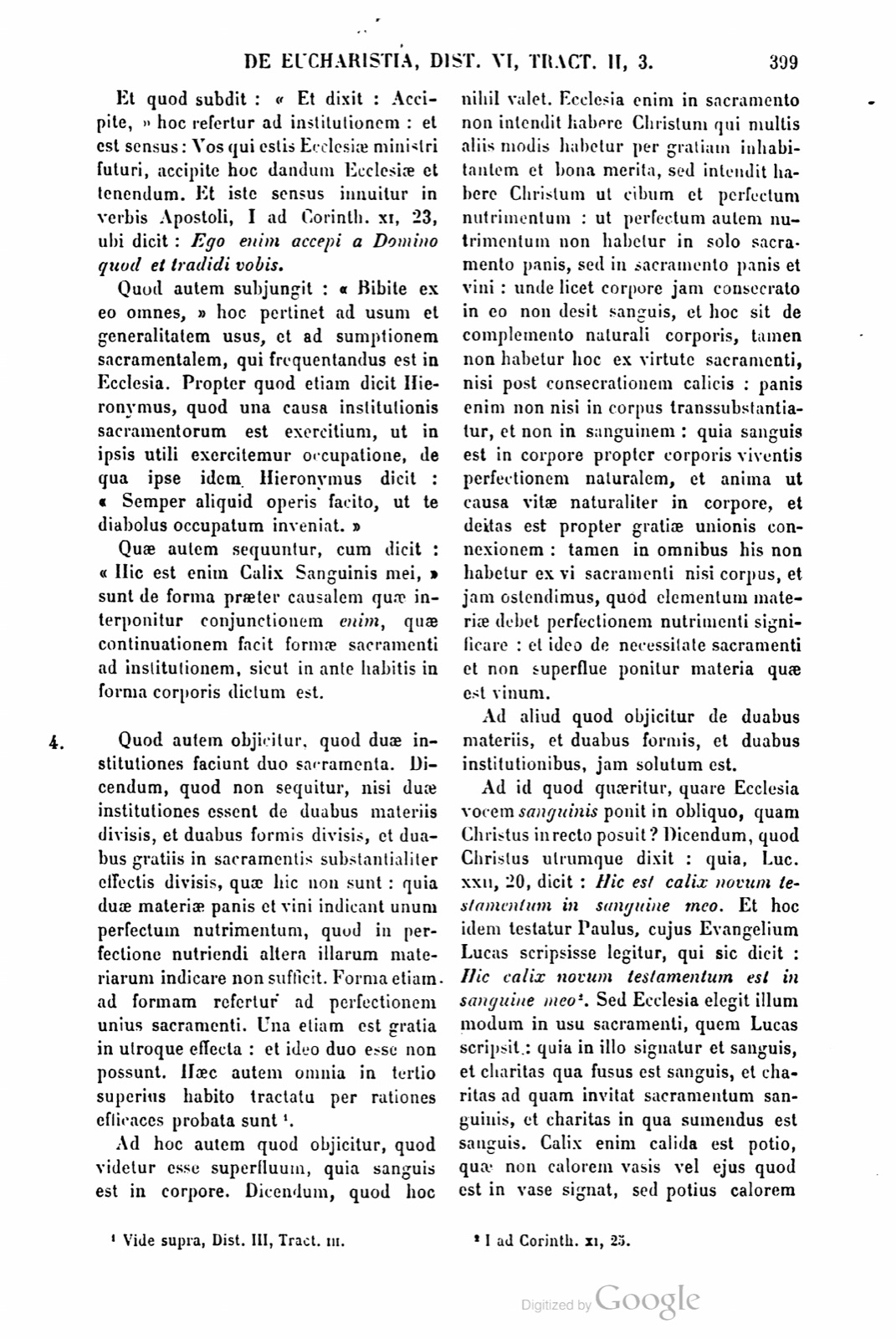
4. Quod autem objicitur, quod duae institutiones faciunt duo sacramenta. Dicendum, quod non sequitur, nisi duae institutiones essent de duabus materiis divisis, et duabus formis divisis, et duabus gratiis in sacramentis substantialiter effectis divisis, quae hic non sunt: quia duae materiae panis et vini indicant unum perfectum nutrimentum, quod in perfectione nutriendi altera illarum materiarum indicare non sufficit. Forma etiam ad formam refertur ad perfectionem unius sacramenti. Una etiam est gratia in utroque effecta: et ideo duo esse non possunt. Haec autem omnia in tertio superius habito tractatu per rationes efficaces probata sunt 1.
Ad hoc autem quod objicitur, quod videtur esse superfluum, quia sanguis est in corpore. Dicendum, quod hoc nihil valet. Ecclesia enim in sacramento non intendit habere Christum qui multis aliis modis habetur per gratiam inhabitantem et bona merita, sed intendit habere Christum ut cibum et perfectum nutrimentum: ut perfectum autem nutrimentum non habetur in solo sacramento panis, sed in sacramento panis et vini: unde licet corpore jam consecrato in eo non desit sanguis, et hoc sit de complemento naturali corporis, tamen non habetur hoc ex virtute sacramenti, nisi post consecrationem calicis: panis enim non nisi in corpus transsubstantiatur, et non in sanguinem: quia sanguis est in corpore propter corporis viventis perfectionem naturalem, et anima ut causa vitae naturaliter in corpore, et deitas est propter gratiae unionis connexionem: tamen in omnibus his non habetur ex vi sacramenti nisi corpus, et jam ostendimus, quod elementum materiae debet perfectionem nutrimenti significare: et ideo de necessitate sacramenti et non superflue ponitur materia quae est vinum.
Ad aliud quod objicitur de duabus materiis, et duabus formis, et duabus institutionibus, jam solutum est.
Ad id quod quaeritur, quare Ecclesia vocem sanguinis ponit in obliquo, quam Christus in recto posuit? Dicendum, quod Christus utrumque dixit: quia, Luc. XXII, 20, dicit: Hic est calix novum testamentum in sanguine meo. Et hoc idem testatur Paulus, cujus Evangelium Lucas scripsisse legitur, qui sic dicit: Hic calix novum testamentum est in sanguine meo 2. Sed Ecclesia elegit illum modum in usu sacramenti, quem Lucas scripsit: quia in illo signatur et sanguis, et charitas qua fusus est sanguis, et charitas ad quam invitat sacramentum sanguinis, et charitas in qua sumendus est sanguis. Calix enim calida est potio, quae non calorem vasis vel ejus quod est in vase signat, sed potius calorem qui sanguinem fervere fecit, et qui vaporat in sanguine, et qui incendit bibentem. Psal. CXV, 13: Calicem salutaris accipiam, et nomen Domini invocabo. Quia igitur hoc importatur in sanguine, ideo Ecclesia elegit potius verba Lucae quam Matthaei vel Marci.
4. But as to what is objected, that two institutions make two sacraments, it must be said that it does not follow unless the two institutions were of two divided matters, and two divided forms, and two divided graces substantially effected in the sacraments, which are not here, because the two matters of bread and wine indicate one perfect nourishment, which the other of those matters does not suffice to indicate in the perfection of nourishing. The form also is referred to the form for the perfection of one sacrament. There is also one grace effected in both; and therefore they cannot be two. But all these things were proved in the third tractate held above by effective reasons 1.
But to this which is objected, that it seems to be superfluous because blood is in the body, it must be said that this is worth nothing. For the Church in the sacrament does not intend to have Christ who is had in many other ways through inhabiting grace and good merits, but it intends to have Christ as food and perfect nourishment. But as perfect nourishment he is not had in the sacrament of bread alone, but in the sacrament of bread and wine. Hence, although with the body already consecrated blood is not lacking in it, and this is from the natural completion of the body, nevertheless this is not had from the power of the sacrament except after the consecration of the chalice. For bread is transubstantiated only into the body and not into blood, because blood is in the body because of the natural perfection of a living body, and the soul is naturally in the body as the cause of life, and deity is there because of the connection of the union of grace; nevertheless in all these things nothing is had from the force of the sacrament except the body, and we have already shown that the element of matter ought to signify the perfection of nourishment; and therefore from the necessity of the sacrament, and not superfluously, the matter which is wine is placed.
To the other thing objected about two matters and two forms and two institutions, it has already been solved.
To that which is asked, why the Church places the word blood in the oblique case, whereas Christ placed it in the direct case, it must be said that Christ said both, because in Luke 22:20 he says: This chalice is the new testament in my blood. And Paul testifies this same thing, whose Gospel Luke is read to have written, who says thus: This chalice is the new testament in my blood 2. But the Church chose that mode in the use of the sacrament which Luke wrote, because in it are signified both the blood, and the charity by which the blood was poured out, and the charity to which the sacrament of the blood invites, and the charity in which the blood is to be received. For a chalice is a warm drink, which does not signify the heat of the vessel or of that which is in the vessel, but rather the heat which made the blood boil, and which steams in the blood, and which sets the drinker on fire. Psalm 115:13: I will take the chalice of salvation, and I will call upon the name of the Lord. Therefore, because this is imported in the blood, the Church chose rather the words of Luke than those of Matthew or Mark.
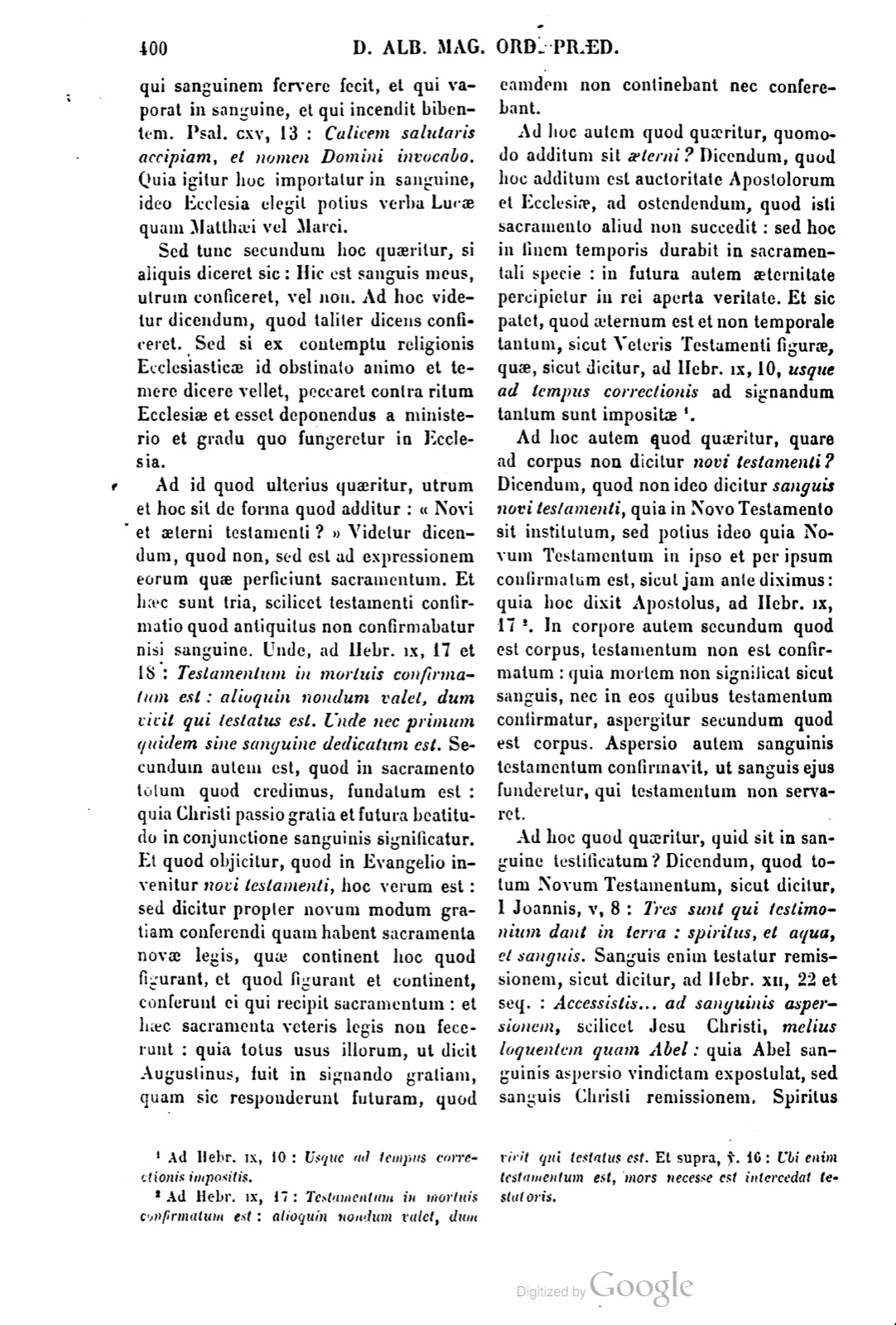
Sed tunc secundum hoc quaeritur, si aliquis diceret sic: Hic est sanguis meus, utrum conficeret, vel non. Ad hoc videtur dicendum, quod taliter dicens conficeret. Sed si ex contemptu religionis Ecclesiasticae id obstinato animo et temere dicere vellet, peccaret contra ritum Ecclesiae et esset deponendus a ministerio et gradu quo fungeretur in Ecclesia.
Ad id quod ulterius quaeritur, utrum et hoc sit de forma quod additur: « Novi et aeterni testamenti? » Videtur dicendum, quod non, sed est ad expressionem eorum quae perficiunt sacramentum. Et haec sunt tria, scilicet testamenti confirmatio quod antiquitus non confirmabatur nisi sanguine. Unde, ad Hebr. IX, 17 et 18: Testamentum in mortuis confirmatum est: alioquin nondum valet, dum vivit qui testatus est. Unde nec primum quidem sine sanguine dedicatum est. Secundum autem est, quod in sacramento totum quod credimus, fundatum est: quia Christi passio gratia et futura beatitudo in conjunctione sanguinis significatur. Et quod objicitur, quod in Evangelio invenitur novi testamenti, hoc verum est: sed dicitur propter novum modum gratiam conferendi quam habent sacramenta novae legis, quae continent hoc quod figurant, et quod figurant et continent, conferunt ei qui recipit sacramentum: et haec sacramenta veteris legis non fecerunt: quia totus usus illorum, ut dicit Augustinus, fuit in signando gratiam, quam sic responderunt futuram, quod eamdem non continebant nec conferebant.
Ad hoc autem quod quaeritur, quomodo additum sit aeterni? Dicendum, quod hoc additum est auctoritate Apostolorum et Ecclesiae, ad ostendendum, quod isti sacramento aliud non succedit: sed hoc in finem temporis durabit in sacramentali specie: in futura autem aeternitate percipietur in rei aperta veritate. Et sic patet, quod aeternum est et non temporale tantum, sicut Veteris Testamenti figurae, quae, sicut dicitur, ad Hebr. IX, 10, usque ad tempus correctionis ad signandum tantum sunt impositae 3.
Ad hoc autem quod quaeritur, quare ad corpus non dicitur novi testamenti? Dicendum, quod non ideo dicitur sanguis novi testamenti, quia in Novo Testamento sit institutum, sed potius ideo quia Novum Testamentum in ipso et per ipsum confirmatum est, sicut jam ante diximus: quia hoc dixit Apostolus, ad Hebr. IX, 17 4. In corpore autem secundum quod est corpus, testamentum non est confirmatum: quia mortem non significat sicut sanguis, nec in eos quibus testamentum confirmatur, aspergitur secundum quod est corpus. Aspersio autem sanguinis testamentum confirmavit, ut sanguis ejus funderetur, qui testamentum non servaret.
But then according to this it is asked whether, if someone said thus, This is my blood, he would confect or not. To this it seems that it must be said that one speaking in such a way would confect. But if out of contempt for ecclesiastical religion he wished to say it with obstinate mind and rashly, he would sin against the rite of the Church and would have to be deposed from the ministry and rank in which he functioned in the Church.
To that which is further asked, whether this also is of the form which is added, "of the new and eternal testament," it seems that it must be said that it is not, but is for the expression of those things which perfect the sacrament. And these are three, namely the confirmation of the testament, which anciently was not confirmed except by blood. Hence Hebrews 9:17 and 18: A testament is confirmed among the dead; otherwise it does not yet have force while he who testifies lives. Hence not even the first was dedicated without blood. But the second is that in the sacrament the whole thing that we believe is founded, because Christ's passion, grace, and future beatitude are signified in the conjunction of blood. And as to what is objected, that in the Gospel of the new testament is found, this is true; but it is said because of the new mode of conferring grace which the sacraments of the new law have, which contain what they figure, and what they figure and contain they confer on him who receives the sacrament; and the sacraments of the old law did not do this, because their whole use, as Augustine says, was in signifying grace, which they thus answered as future, that they neither contained nor conferred the same grace.
To this which is asked, how eternal was added, it must be said that this was added by the authority of the Apostles and of the Church, to show that no other thing succeeds this sacrament, but this will endure in sacramental appearance to the end of time; but in the future eternity it will be perceived in the open truth of the thing. And thus it is clear that it is eternal and not merely temporal, like the figures of the Old Testament, which, as is said in Hebrews 9:10, were imposed only for signifying until the time of correction 3.
To this which is asked, why of the new testament is not said with respect to the body, it must be said that blood of the new testament is not said for this reason, that it was instituted in the New Testament, but rather because the New Testament was confirmed in it and through it, as we have already said before, because the Apostle said this at Hebrews 9:17 4. But in the body, insofar as it is body, the testament is not confirmed, because it does not signify death as blood does, nor is it sprinkled upon those for whom the testament is confirmed insofar as it is body. But the sprinkling of blood confirmed the testament, so that his blood would be poured out who would not keep the testament.
Notes
- See above, Dist. III, Tract. III. (Vide supra, Dist. III, Tract. III.) ↩
- 1 Corinthians 11:25. (I ad Corinth. XI, 25.) ↩
- Hebrews 9:10: Imposed until the time of correction. (Ad Hebr. IX, 10: Usque ad tempus correctionis impositis.) ↩
- Hebrews 9:17: A testament is confirmed among the dead; otherwise it does not yet have force while he who has testified lives. And above, v. 16: For where there is a testament, the death of the testator must intervene. (Ad Hebr. IX, 17: Testamentum in mortuis confirmatum est: alioquin nondum valet, dum vivit qui testatus est. Et supra, v. 16: Ubi enim testamentum est, mors necesse est intercedat testatoris.) ↩
If a page does not appear, its photograph has not been uploaded yet.