Works › The Book on the Sacrament of the Eucharist
Volume 38 · pp. 398–399
Chapter III, 2-3
A marker with ≈ is an approximate page boundary, placed by measure of the text; the page photographs remain the authority. In the paired views, clicking a page marker brings that page into view.
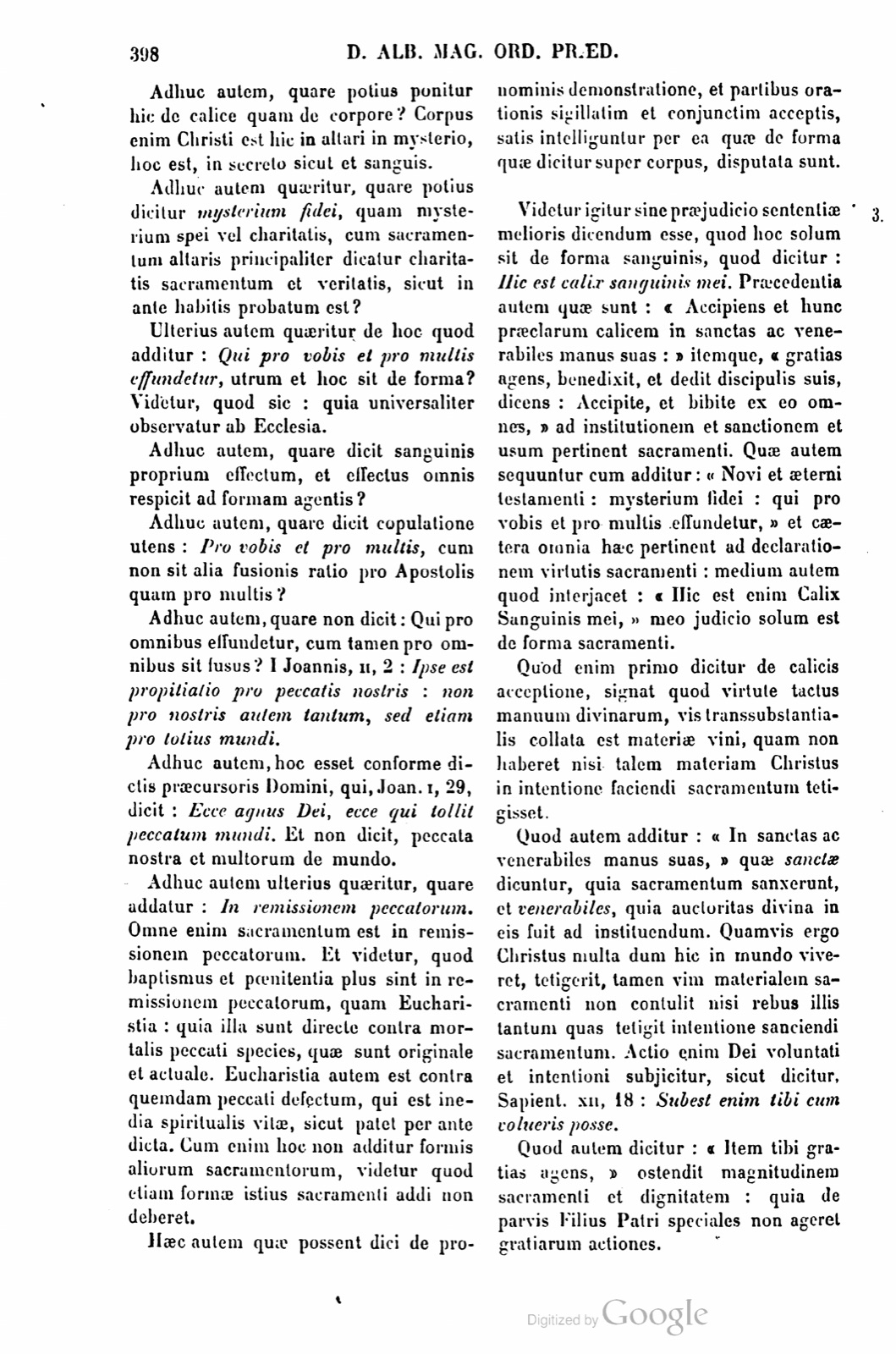
Adhuc autem, quare potius ponitur hic de calice quam de corpore? Corpus enim Christi est hic in altari in mysterio, hoc est, in secreto sicut et sanguis.
Adhuc autem quaeritur, quare potius dicitur mysterium fidei, quam mysterium spei vel charitatis, cum sacramentum altaris principaliter dicatur charitatis sacramentum et veritatis, sicut in ante habitis probatum est?
Ulterius autem quaeritur de hoc quod additur: Qui pro vobis et pro multis effundetur, utrum et hoc sit de forma? Videtur, quod sic: quia universaliter observatur ab Ecclesia.
Adhuc autem, quare dicit sanguinis proprium effectum, et effectus omnis respicit ad formam agentis?
Adhuc autem, quare dicit copulatione utens: Pro vobis et pro multis, cum non sit alia fusionis ratio pro Apostolis quam pro multis?
Adhuc autem, quare non dicit: Qui pro omnibus effundetur, cum tamen pro omnibus sit fusus? I Joannis, II, 2: Ipse est propitiatio pro peccatis nostris: non pro nostris autem tantum, sed etiam pro totius mundi.
Adhuc autem, hoc esset conforme dictis praecursoris Domini, qui, Joan. I, 29, dicit: Ecce agnus Dei, ecce qui tollit peccatum mundi. Et non dicit, peccata nostra et multorum de mundo.
Adhuc autem ulterius quaeritur, quare addatur: In remissionem peccatorum. Omne enim sacramentum est in remissionem peccatorum. Et videtur, quod baptismus et paenitentia plus sint in remissionem peccatorum, quam Eucharistia: quia illa sunt directe contra mortalis peccati species, quae sunt originale et actuale. Eucharistia autem est contra quemdam peccati defectum, qui est inedia spiritualis vitae, sicut patet per ante dicta. Cum enim hoc non additur formis aliorum sacramentorum, videtur quod etiam formae istius sacramenti addi non deberet.
Haec autem quae possent dici de pronominis demonstratione, et partibus orationis sigillatim et conjunctim acceptis, satis intelliguntur per ea quae de forma quae dicitur super corpus, disputata sunt.
3. Videtur igitur sine praejudicio sententiae melioris dicendum esse, quod hoc solum sit de forma sanguinis, quod dicitur: Hic est calix sanguinis mei. Praecedentia autem quae sunt: « Accipiens et hunc praeclarum calicem in sanctas ac venerabiles manus suas: » itemque, « gratias agens, benedixit, et dedit discipulis suis, dicens: Accipite, et bibite ex eo omnes, » ad institutionem et sanctionem et usum pertinent sacramenti. Quae autem sequuntur cum additur: « Novi et aeterni testamenti: mysterium fidei: qui pro vobis et pro multis effundetur, » et caetera omnia haec pertinent ad declarationem virtutis sacramenti: medium autem quod interjacet: « Hic est enim Calix Sanguinis mei, » meo judicio solum est de forma sacramenti.
Moreover, why is it placed here concerning the chalice rather than concerning the body? For the body of Christ is here on the altar in mystery, that is, in secret, just as the blood is.
Moreover, it is asked why it is called the mystery of faith rather than the mystery of hope or charity, since the sacrament of the altar is principally called the sacrament of charity and of truth, as was proved in the preceding matters.
Further, it is asked concerning this which is added, Which shall be poured out for you and for many, whether this also is of the form. It seems that it is, because it is universally observed by the Church.
Moreover, why does it state the proper effect of blood, and every effect looks to the form of the agent?
Moreover, why does it speak using a coupling, For you and for many, when there is not one account of pouring for the Apostles and another for the many?
Moreover, why does it not say, Which shall be poured out for all, since nevertheless it was poured out for all? 1 John 2:2: He is the propitiation for our sins, and not for ours only, but also for those of the whole world.
Moreover, this would be conformed to the words of the Lord's forerunner, who says in John 1:29: Behold the Lamb of God, behold him who takes away the sin of the world. And he does not say, our sins and the sins of many from the world.
Moreover, it is further asked why there is added, Unto the remission of sins. For every sacrament is unto the remission of sins. And it seems that baptism and penance are more unto the remission of sins than the Eucharist, because those are directly against the species of mortal sin, which are original and actual. But the Eucharist is against a certain defect of sin, which is hunger of spiritual life, as is clear through the things said before. Since this is not added to the forms of the other sacraments, it seems that it ought not to be added to the form of this sacrament either.
But these things that could be said concerning the demonstration of the pronoun and concerning the parts of the utterance taken separately and jointly are sufficiently understood through those things which were disputed about the form which is said over the body.
3. Therefore it seems that, without prejudice to a better opinion, it must be said that this alone is of the form of the blood, which is said: This is the chalice of my blood. But the preceding things, which are, "Taking also this excellent chalice into his holy and venerable hands," and likewise, "giving thanks, he blessed and gave it to his disciples, saying: Take and drink from it, all of you," pertain to the institution and sanction and use of the sacrament. But the things which follow when there is added, "of the new and eternal testament: the mystery of faith: which shall be poured out for you and for many," and all the other things, pertain to the declaration of the power of the sacrament. But the middle which lies between, "For this is the Chalice of my Blood," in my judgment alone is of the form of the sacrament.
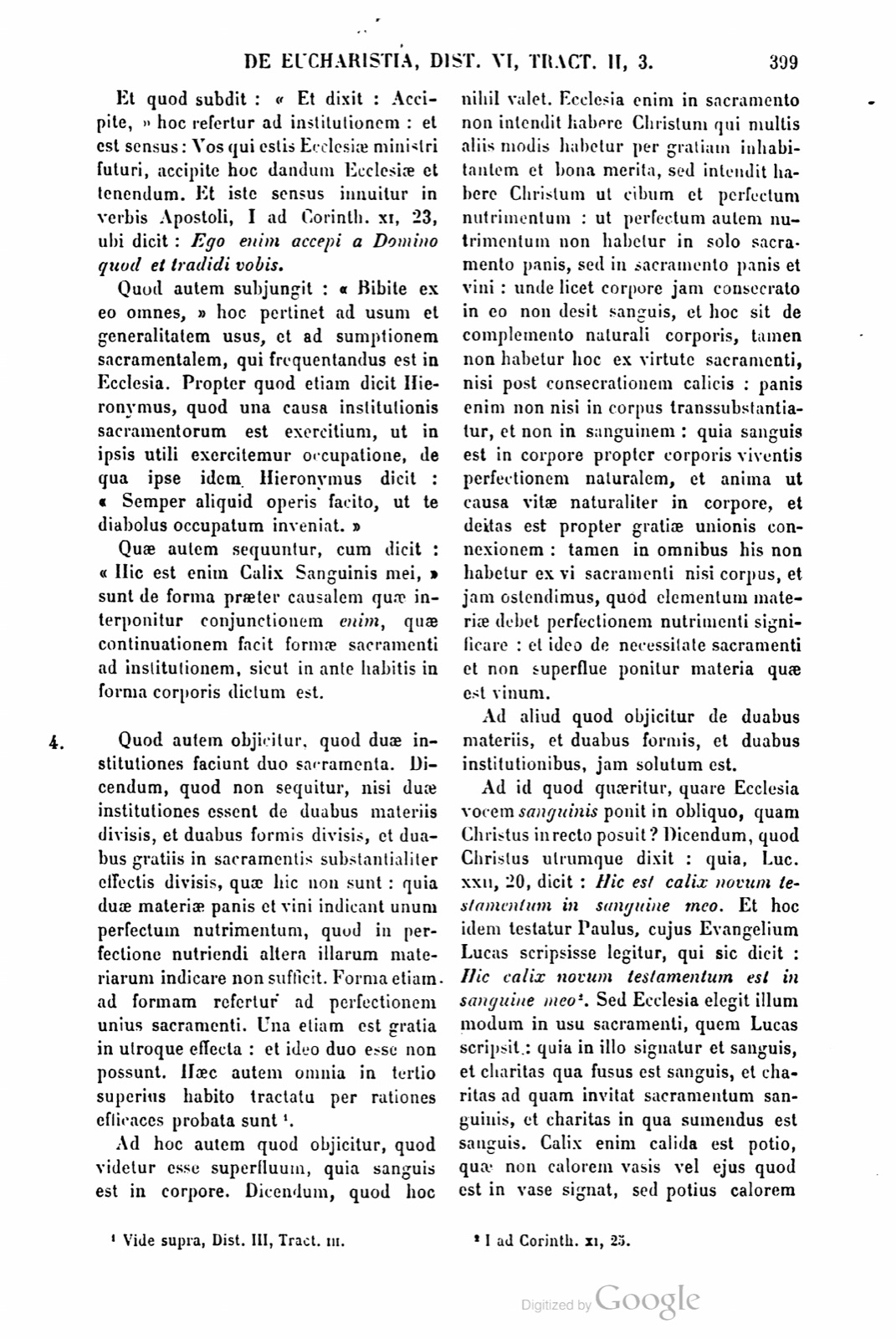
Quod enim primo dicitur de calicis acceptione, signat quod virtute tactus manuum divinarum, vis transsubstantiabilis collata est materiae vini, quam non haberet nisi talem materiam Christus in intentione faciendi sacramentum tetigisset.
Quod autem additur: « In sanctas ac venerabiles manus suas, » quae sanctae dicuntur, quia sacramentum sanxerunt, et venerabiles, quia auctoritas divina in eis fuit ad instituendum. Quamvis ergo Christus multa dum hic in mundo viveret, tetigerit, tamen vim materialem sacramenti non contulit nisi rebus illis tantum quas tetigit intentione sanciendi sacramentum. Actio enim Dei voluntati et intentioni subjicitur, sicut dicitur, Sapient. XI, 18: Subest enim tibi cum volueris posse.
Quod autem dicitur: « Item tibi gratias agens, » ostendit magnitudinem sacramenti et dignitatem: quia de parvis Filius Patri speciales non ageret gratiarum actiones.
Et quod subdit: « Et dixit: Accipite, » hoc refertur ad institutionem: et est sensus: Vos qui estis Ecclesiae ministri futuri, accipite hoc dandum Ecclesiae et tenendum. Et iste sensus innuitur in verbis Apostoli, I ad Corinth. XI, 23, ubi dicit: Ego enim accepi a Domino quod et tradidi vobis.
Quod autem subjungit: « Bibite ex eo omnes, » hoc pertinet ad usum et generalitatem usus, et ad sumptionem sacramentalem, qui frequentandus est in Ecclesia. Propter quod etiam dicit Hieronymus, quod una causa institutionis sacramentorum est exercitium, ut in ipsis utili exercitemur occupatione, de qua ipse idem Hieronymus dicit: « Semper aliquid operis facito, ut te diabolus occupatum inveniat. »
Quae autem sequuntur, cum dicit: « Hic est enim Calix Sanguinis mei, » sunt de forma praeter causalem quae interponitur conjunctionem enim, quae continuationem facit formae sacramenti ad institutionem, sicut in ante habitis in forma corporis dictum est.
For what is first said about the taking of the chalice signifies that by the power of the touch of the divine hands the transubstantiable force was conferred upon the matter of wine, which it would not have unless Christ had touched such matter with the intention of making the sacrament.
But what is added, "into his holy and venerable hands," which are called holy because they sanctioned the sacrament, and venerable because divine authority was in them for instituting. Therefore, although Christ touched many things while he lived here in the world, nevertheless he conferred the material force of the sacrament only on those things which he touched with the intention of sanctioning the sacrament. For the action of God is subject to will and intention, as is said in Wisdom 11:18: For power is present to you when you will.
But what is said, "Likewise giving thanks to you," shows the greatness and dignity of the sacrament, because concerning little things the Son would not make special thanksgivings to the Father.
And what he adds, "And he said: Take," is referred to institution; and the sense is: You who are going to be ministers of the Church, take this to be given to the Church and to be held. And this sense is intimated in the words of the Apostle, 1 Corinthians 11:23, where he says: For I received from the Lord that which I also handed on to you.
But what he adds, "Drink from it, all of you," pertains to use and to the generality of use, and to sacramental reception, which is to be repeated in the Church. For this reason Jerome also says that one cause of the institution of the sacraments is exercise, so that in them we may be exercised in useful occupation, concerning which the same Jerome himself says: "Always do some work, so that the devil may find you occupied."
But the things which follow, when he says, "For this is the Chalice of my Blood," are of the form except for the causal conjunction for, which is interposed and which makes a continuation of the form of the sacrament to the institution, as was said in the preceding matters concerning the form of the body.
If a page does not appear, its photograph has not been uploaded yet.