Works › The Book on the Sacrament of the Eucharist
Volume 38 · pp. 396–397
Chapter III. On the Form Which Is Said over the Wine, 1-2
A marker with ≈ is an approximate page boundary, placed by measure of the text; the page photographs remain the authority. In the paired views, clicking a page marker brings that page into view.
Marginal label (printed p. 396): Quae sit forma consecrationis vini?
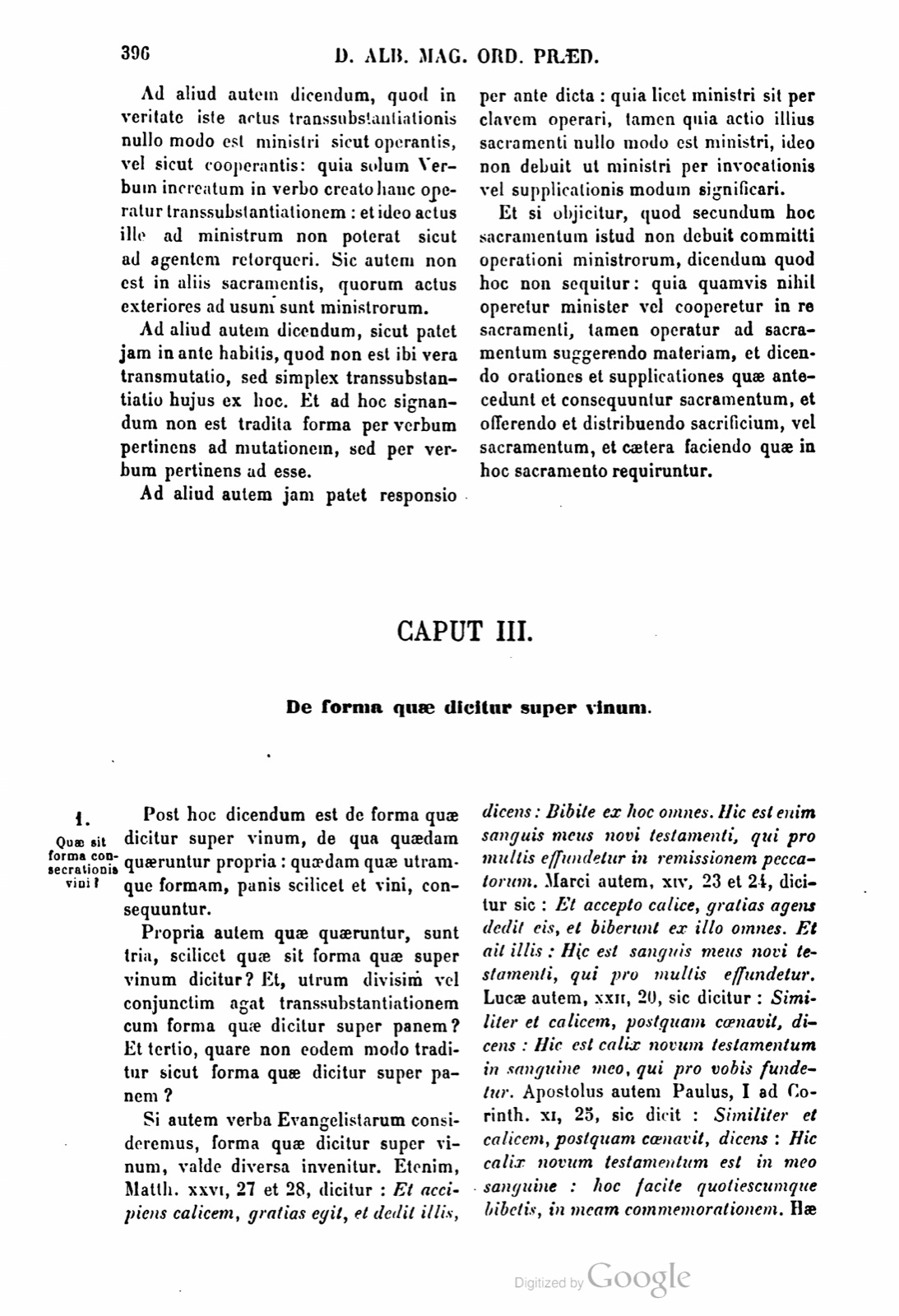
CAPUT III.
De forma quae dicitur super vinum.
1. Post hoc dicendum est de forma quae dicitur super vinum, de qua quaedam quaeruntur propria: quaedam quae utramque formam, panis scilicet et vini, consequuntur.
Propria autem quae quaeruntur, sunt tria, scilicet quae sit forma quae super vinum dicitur? Et, utrum divisim vel conjunctim agat transsubstantiationem cum forma quae dicitur super panem? Et tertio, quare non eodem modo traditur sicut forma quae dicitur super panem?
Si autem verba Evangelistarum consideremus, forma quae dicitur super vinum, valde diversa invenitur. Etenim, Matth. XXVI, 27 et 28, dicitur: Et accipiens calicem, gratias egit, et dedit illis, dicens: Bibite ex hoc omnes. Hic est enim sanguis meus novi testamenti, qui pro multis effundetur in remissionem peccatorum. Marci autem, XIV, 23 et 24, dicitur sic: Et accepto calice, gratias agens dedit eis, et biberunt ex illo omnes. Et ait illis: Hic est sanguis meus novi testamenti, qui pro multis effundetur. Lucae autem, XXII, 20, sic dicitur: Similiter et calicem, postquam coenavit, dicens: Hic est calix novum testamentum in sanguine meo, qui pro vobis fundetur. Apostolus autem Paulus, I ad Corinth. XI, 25, sic dicit: Similiter et calicem, postquam coenavit, dicens: Hic calix novum testamentum est in meo sanguine: hoc facite quotiescumque bibetis, in meam commemorationem. Hae autem omnes formae differunt ab ea quae usitatur et tenetur a tota Ecclesia in Missae Canone, ubi sic dicitur: « Simili modo, postquam coenatum est, accipiens et hunc praeclarum calicem in sanctas ac venerabiles manus suas: item tibi gratias agens, benedixit, deditque discipulis suis, dicens: Accipite, et bibite ex eo omnes. Hic est enim Calix Sanguinis mei, novi et aeterni testamenti: mysterium fidei: qui pro vobis et pro multis effundetur in remissionem peccatorum. Haec quotiescumque feceritis, in mei memoriam facietis. » Hae omnes formae valde a se invicem differre videntur: et, sicut dicit Hieronymus, non potest esse verum quod est diversum, etc.
2. Quaeritur autem de prima istarum 1: si enim secundum ea quae de forma corporis determinata sunt, quaedam horum verborum pertinent ad sacramenti institutionem, sicut id quod dicitur: Accipiens calicem, gratias egit, et dedit illis: quaedam autem pertinent ad formam, sicut id quod dicitur: Hic est sanguis meus novi testamenti, qui pro multis effundetur in remissionem peccatorum: quaedam autem pertinent ad usum, sicut id quod dicitur: Bibite ex hoc omnes: tunc videtur, quod istud sacramentum sanguinis aliam habet institutionem quam corporis sacramentum: et sic videntur esse duo sacramenta, et non unum sacramentum.
Marginal label (printed p. 396): What is the form of the consecration of wine?
CHAPTER III.
On the form which is said over the wine.
1. After this one must speak about the form which is said over the wine, about which certain proper things are asked, and certain things which follow both forms, namely that of bread and that of wine.
But the proper things that are asked are three: namely, what is the form which is said over the wine? And whether it acts the transubstantiation separately or jointly with the form which is said over the bread? And third, why is it not handed down in the same mode as the form which is said over the bread?
But if we consider the words of the Evangelists, the form which is said over the wine is found very diverse. For in Matthew 26:27 and 28 it is said: And taking the chalice, he gave thanks and gave it to them, saying: Drink all of this. For this is my blood of the new testament, which shall be poured out for many unto the remission of sins. But in Mark 14:23 and 24 it is said thus: And having taken the chalice, giving thanks, he gave it to them, and they all drank from it. And he said to them: This is my blood of the new testament, which shall be poured out for many. But in Luke 22:20 it is said thus: Similarly also the chalice, after he had supped, saying: This chalice is the new testament in my blood, which shall be poured out for you. But the Apostle Paul, in 1 Corinthians 11:25, says thus: Similarly also the chalice, after he had supped, saying: This chalice is the new testament in my blood; do this as often as you shall drink, in commemoration of me. But all these forms differ from that which is used and held by the whole Church in the Canon of the Mass, where it is said thus: "In like manner, after supper had been taken, taking also this excellent chalice into his holy and venerable hands; likewise giving thanks to you, he blessed and gave it to his disciples, saying: Take and drink from it, all of you. For this is the Chalice of my Blood, of the new and eternal testament: the mystery of faith: which shall be poured out for you and for many unto the remission of sins. As often as you shall do these things, you shall do them in memory of me." All these forms seem very much to differ from one another; and, as Jerome says, what is diverse cannot be true, etc.
2. But inquiry is made concerning the first of these 1: for if, according to those things which have been determined about the form of the body, some of these words pertain to the institution of the sacrament, as that which is said, Taking the chalice, he gave thanks and gave it to them; but some pertain to the form, as that which is said, This is my blood of the new testament, which shall be poured out for many unto the remission of sins; but some pertain to the use, as that which is said, Drink all of this, then it seems that this sacrament of the blood has an institution other than the sacrament of the body, and thus they seem to be two sacraments and not one sacrament.
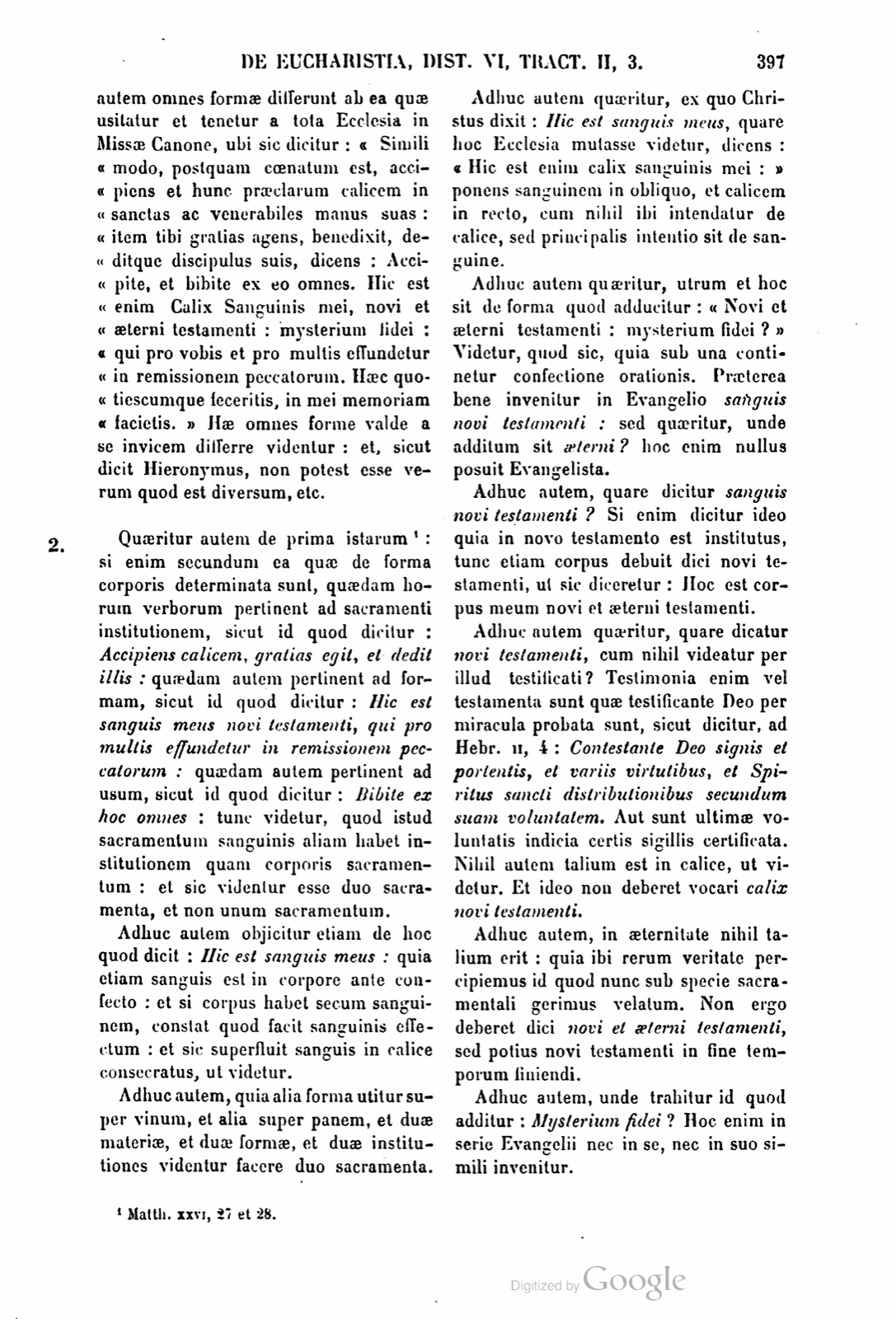
Adhuc autem objicitur etiam de hoc quod dicit: Hic est sanguis meus: quia etiam sanguis est in corpore ante confecto: et si corpus habet secum sanguinem, constat quod facit sanguinis effectum: et sic superfluit sanguis in calice consecratus, ut videtur.
Adhuc autem, quia alia forma utitur super vinum, et alia super panem, et duae materiae, et duae formae, et duae institutiones videntur facere duo sacramenta.
Adhuc autem quaeritur, ex quo Christus dixit: Hic est sanguis meus, quare hoc Ecclesia mutasse videtur, dicens: « Hic est enim calix sanguinis mei: » ponens sanguinem in obliquo, et calicem in recto, cum nihil ibi intendatur de calice, sed principalis intentio sit de sanguine.
Adhuc autem quaeritur, utrum et hoc sit de forma quod adducitur: « Novi et aeterni testamenti: mysterium fidei? » Videtur, quod sic, quia sub una continetur confectione orationis. Praeterea bene invenitur in Evangelio sanguis novi testamenti: sed quaeritur, unde additum sit aeterni? hoc enim nullus posuit Evangelista.
Adhuc autem, quare dicitur sanguis novi testamenti? Si enim dicitur ideo quia in novo testamento est institutus, tunc etiam corpus debuit dici novi testamenti, ut sic diceretur: Hoc est corpus meum novi et aeterni testamenti.
Adhuc autem quaeritur, quare dicatur novi testamenti, cum nihil videatur per illud testificati? Testimonia enim vel testamenta sunt quae testificante Deo per miracula probata sunt, sicut dicitur, ad Hebr. II, 4: Contestante Deo signis et portentis, et variis virtutibus, et Spiritus sancti distributionibus secundum suam voluntatem. Aut sunt ultimae voluntatis indicia certis sigillis certificata. Nihil autem talium est in calice, ut videtur. Et ideo non deberet vocari calix novi testamenti.
Adhuc autem, in aeternitate nihil talium erit: quia ibi rerum veritate percipiemus id quod nunc sub specie sacramentali gerimus velatum. Non ergo deberet dici novi et aeterni testamenti, sed potius novi testamenti in fine temporum finiendi.
Adhuc autem, unde trahitur id quod additur: Mysterium fidei? Hoc enim in serie Evangelii nec in se, nec in suo simili invenitur.
Moreover, objection is also made concerning what he says, This is my blood, because blood also is in the body already confected; and if the body has blood with itself, it is agreed that it makes the effect of blood; and thus, as it seems, the blood consecrated in the chalice is superfluous.
Moreover, because he uses one form over the wine and another over the bread, and two matters, and two forms, and two institutions seem to make two sacraments.
Moreover, it is asked, since Christ said, This is my blood, why the Church seems to have changed this, saying, "For this is the chalice of my blood," putting blood in the oblique case and chalice in the direct case, when nothing is intended there concerning the chalice, but the principal intention is concerning the blood.
Moreover, it is asked whether this also is of the form which is brought in: "of the new and eternal testament: the mystery of faith." It seems that it is, because it is contained under one confecting of the utterance. Besides, blood of the new testament is well found in the Gospel; but it is asked whence eternal was added, for no Evangelist placed this.
Moreover, why is it called blood of the new testament? For if it is said for this reason, because it was instituted in the new testament, then the body also ought to have been called of the new testament, so that it would be said thus: This is my body of the new and eternal testament.
Moreover, it is asked why it is called of the new testament, since nothing seems to be testified by it. For testimonies or testaments are those things which, with God testifying, have been proved by miracles, as is said in Hebrews 2:4: God bearing witness by signs and wonders, and by various powers, and by distributions of the Holy Spirit according to his will. Or they are indications of a last will certified by certain seals. But nothing of such things is in the chalice, as it seems. And therefore it ought not to be called the chalice of the new testament.
Moreover, in eternity there will be nothing of such things, because there we shall perceive in the truth of things what we now bear veiled under sacramental appearance. Therefore it ought not to be called of the new and eternal testament, but rather of the new testament to be ended at the end of times.
Moreover, whence is that drawn which is added, Mystery of faith? For this is found in the sequence of the Gospel neither in itself nor in something similar to it.
Notes
- Matthew 26:27 and 28. (Matth. XXVI, 27 et 28.) ↩
If a page does not appear, its photograph has not been uploaded yet.