Works › The Book on the Sacrament of the Eucharist
Volume 38 · pp. 393–394
Chapter II, 19
A marker with ≈ is an approximate page boundary, placed by measure of the text; the page photographs remain the authority. In the paired views, clicking a page marker brings that page into view.
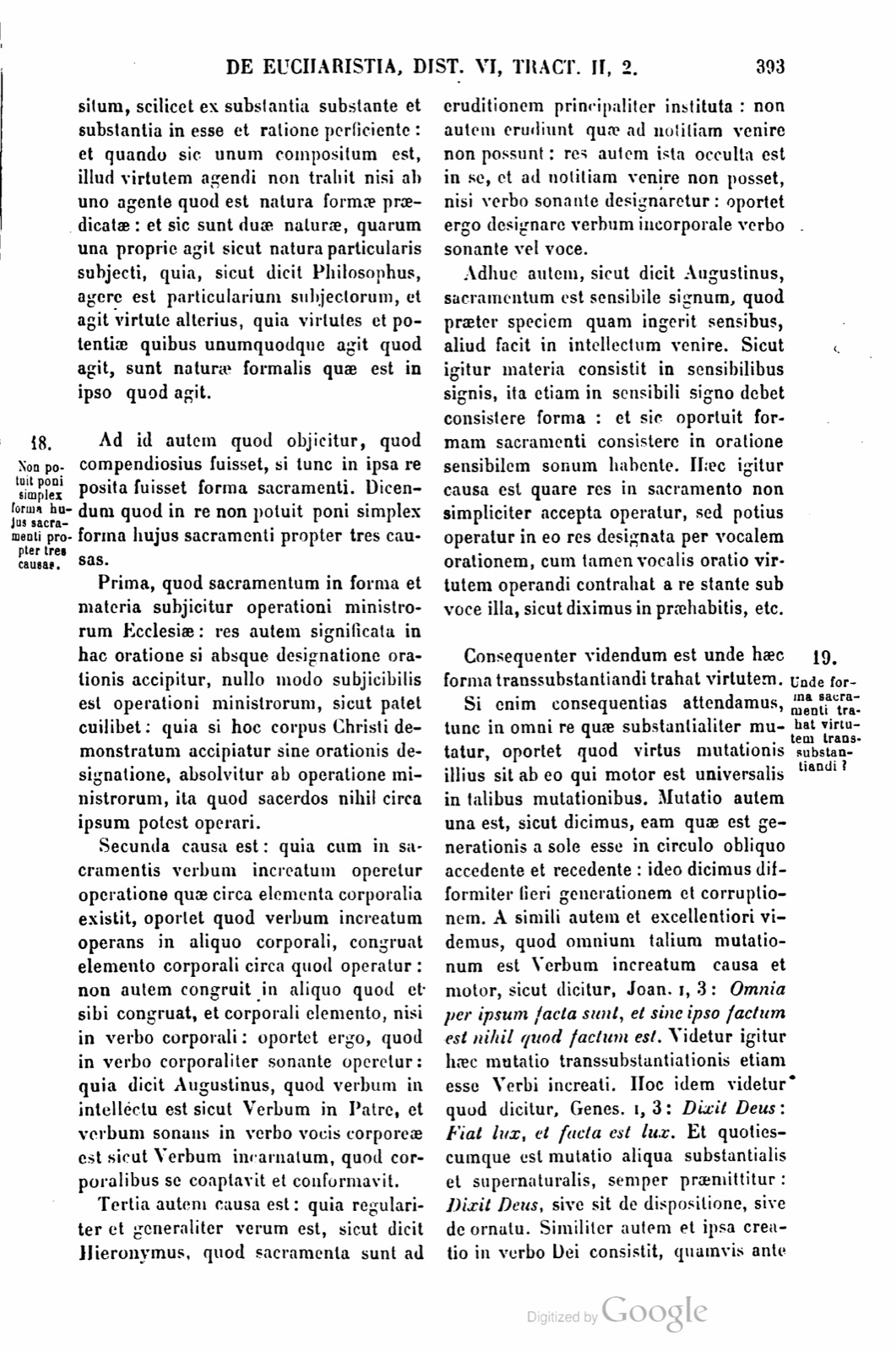
19. Consequenter videndum est unde haec forma transsubstantiandi trahat virtutem.
Si enim consequentias attendamus, tunc in omni re quae substantialiter mutatur, oportet quod virtus mutationis illius sit ab eo qui motor est universalis in talibus mutationibus. Mutatio autem una est, sicut dicimus, eam quae est generationis a sole esse in circulo obliquo accedente et recedente: ideo dicimus difformiter fieri generationem et corruptionem. A simili autem et excellentiori videmus, quod omnium talium mutationum est Verbum increatum causa et motor, sicut dicitur, Joan. I, 3: Omnia per ipsum facta sunt, et sine ipso factum est nihil quod factum est. Videtur igitur haec mutatio transsubstantiationis etiam esse Verbi increati. Hoc idem videtur quod dicitur, Genes. I, 3: Dixit Deus: Fiat lux, et facta est lux. Et quotiescumque est mutatio aliqua substantialis et supernaturalis, semper praemittitur: Dixit Deus, sive sit de dispositione, sive de ornatu. Similiter autem et ipsa creatio in verbo Dei consistit, quamvis ante opus creationis non praemittatur de verbi dictione. Si ergo in Verbo increato omnis talis mutatio consistit, tunc videtur quod etiam ista consistit in virtute Verbi increati, etc.
Adhuc autem, hoc videtur ex dicto Augustini super Genesim ad litteram, qui hoc quod dicitur: Dixit Deus: Fiat, sic exponit, hoc est, Verbum genuit in quo erat ut fieret. Si autem Verbum genuit in quo erat ut fieret, cum non fuerit in eo ut fiat quoddam, sed ut fiant omnia, sicut dicitur, quod omnia per ipsum facta sunt, et sine ipso factum est nihil quod factum est, oportet quod omnes tales rerum supernaturales mutationes sint in Verbo et a Verbo.
Adhuc autem, illius proprie agentis est facere aliquid, in cujus ratione est actu secundum formam et rationem. Ratio autem et forma talium supernaturalium transmutationum non est nisi in Verbo quod agit omnia talia, et est ars omnia talia faciendi. Igitur virtus illius transsubstantiationis tota consistit in Verbo increato. Unde, Psal. XXXI, 6, dicit: Verbo Domini caeli firmati sunt. Et super hoc dicit Ambrosius loquens de panis transsubstantiatione in corpus Domini in sacramento: « Quid miraris si Verbum Dei creaturas mutat, in quo creaturae ut essent, primum substiterunt? » Videtur igitur, quod tota virtus istius transsubstantiationis in Verbo increato consistat.
Quod si concedatur, videbitur esse contrarium his quae ante dicta sunt: quia omnis effectus sacramenti causatur a forma ipsius sacramenti. Forma autem non est Verbum increatum, sed verbum creatum prolatum ab ore sacerdotis. Adhuc autem, in aliis sacramentis verbum creatum est forma: videtur ergo, quod verbum creatum sit etiam forma in isto. Dicit enim Beda: « Accedit enim verbum ad elementum, et fit sacramentum. » Et intelligit de verbo creato prolato ab ore ejus qui minister est in sacramento.
19. Consequently it must be seen whence this form draws the power of transubstantiating.
For if we attend to consequences, then in every thing which is changed substantially, the power of that change must be from him who is the universal mover in such changes. But change is one, as we say that the change which belongs to generation is from the sun as it approaches and withdraws in the oblique circle; therefore we say that generation and corruption occur in differing fashion. But from a similar and more excellent case we see that the uncreated Word is the cause and mover of all such changes, as is said in John 1:3: All things were made through him, and without him was made nothing that was made. Therefore it seems that this change of transubstantiation is also of the uncreated Word. This same thing seems from what is said in Genesis 1:3: God said: Let light be made, and light was made. And whenever there is some substantial and supernatural change, there is always premised: God said, whether it concerns disposition or adornment. Similarly, creation itself consists in the word of God, although before the work of creation there is not premised anything about the utterance of the word. Therefore, if every such change consists in the uncreated Word, then it seems that this one also consists in the power of the uncreated Word, etc.
Moreover, this seems from the saying of Augustine on Genesis according to the letter, who expounds this which is said, God said: Let it be made, thus: that is, he generated the Word in whom it was that it should be made. But if he generated the Word in whom it was that it should be made, since it was not in him that some one thing should be made, but that all things should be made, as it is said that all things were made through him, and without him was made nothing that was made, it is necessary that all such supernatural changes of things be in the Word and from the Word.
Moreover, it belongs to him who properly acts to make something in whose account he is in act according to form and account. But the account and form of such supernatural transmutations are only in the Word who acts all such things and is the art of making all such things. Therefore the whole power of that transubstantiation consists in the uncreated Word. Hence, Psalm 31:6 says: By the word of the Lord the heavens were established. And on this Ambrose says, speaking of the transubstantiation of bread into the body of the Lord in the sacrament: "Why do you wonder if the Word of God changes creatures, in whom creatures first stood forth so that they might be?" Therefore it seems that the whole power of this transubstantiation consists in the uncreated Word.
But if this is conceded, it will seem to be contrary to the things that were said before, because every effect of the sacrament is caused by the form of that sacrament. But the form is not the uncreated Word, but the created word uttered from the mouth of the priest. Moreover, in the other sacraments the created word is the form; therefore it seems that the created word is also the form in this one. For Bede says: "For the word approaches the element, and the sacrament comes to be." And he understands this of the created word uttered from the mouth of him who is minister in the sacrament.
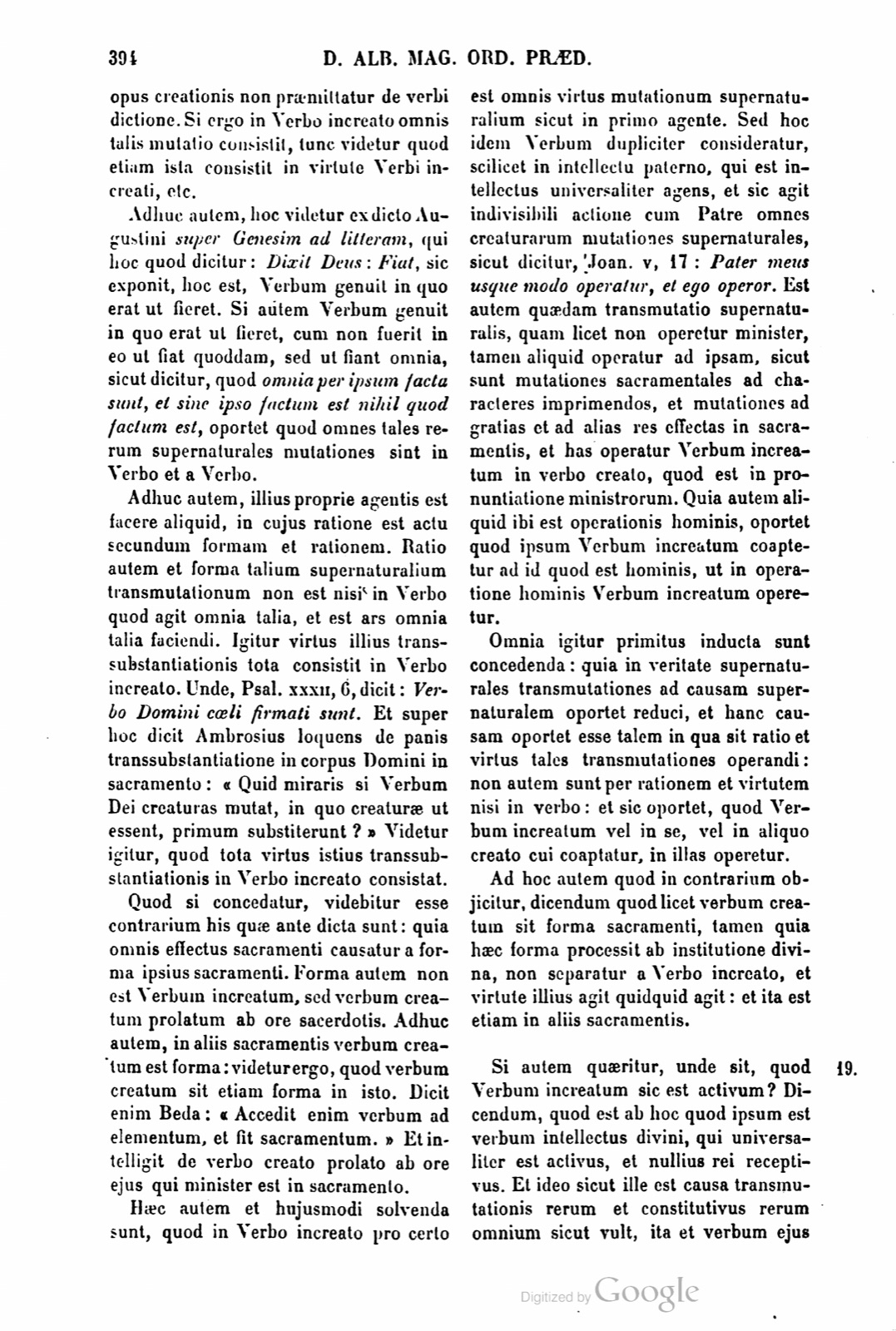
Haec autem et hujusmodi solvenda sunt, quod in Verbo increato pro certo est omnis virtus mutationum supernaturalium sicut in primo agente. Sed hoc idem Verbum dupliciter consideratur, scilicet in intellectu paterno, qui est intellectus universaliter agens, et sic agit indivisibili actione cum Patre omnes creaturarum mutationes supernaturales, sicut dicitur, Joan. V, 17: Pater meus usque modo operatur, et ego operor. Est autem quaedam transmutatio supernaturalis, quam licet non operetur minister, tamen aliquid operatur ad ipsam, sicut sunt mutationes sacramentales ad characteres imprimendos, et mutationes ad gratias et ad alias res effectas in sacramentis, et has operatur Verbum increatum in verbo creato, quod est in pronuntiatione ministrorum. Quia autem aliquid ibi est operationis hominis, oportet quod ipsum Verbum increatum coaptetur ad id quod est hominis, ut in operatione hominis Verbum increatum operetur.
Omnia igitur primitus inducta sunt concedenda: quia in veritate supernaturales transmutationes ad causam supernaturalem oportet reduci, et hanc causam oportet esse talem in qua sit ratio et virtus tales transmutationes operandi: non autem sunt per rationem et virtutem nisi in verbo: et sic oportet, quod Verbum increatum vel in se, vel in aliquo creato cui coaptatur, in illas operetur.
Ad hoc autem quod in contrarium objicitur, dicendum quod licet verbum creatum sit forma sacramenti, tamen quia haec forma processit ab institutione divina, non separatur a Verbo increato, et virtute illius agit quidquid agit: et ita est etiam in aliis sacramentis.
19. Si autem quaeritur, unde sit, quod Verbum increatum sic est activum? Dicendum, quod est ab hoc quod ipsum est verbum intellectus divini, qui universaliter est activus, et nullius rei receptivus. Et ideo sicut ille est causa transmutationis rerum et constitutivus rerum omnium sicut vult, ita et verbum ejus
But these and things of this kind must be resolved in this way: that in the uncreated Word certainly is all the power of supernatural changes as in the first agent. But this same Word is considered in two ways, namely in the paternal intellect, which is the universally acting intellect, and thus by an indivisible action with the Father he effects all supernatural changes of creatures, as is said in John 5:17: My Father works even until now, and I work. But there is a certain supernatural transmutation which, although the minister does not operate it, nevertheless he does operate something toward it, as are sacramental changes for imprinting characters, and changes toward graces and toward other things effected in the sacraments; and these the uncreated Word operates in the created word which is in the pronouncing of ministers. But because something of man's operation is there, the uncreated Word itself must be adapted to that which belongs to man, so that in the operation of man the uncreated Word may operate.
Therefore all the things first introduced must be conceded, because in truth supernatural transmutations must be reduced to a supernatural cause, and this cause must be such that in it there is the account and power of operating such transmutations; but they are not by account and power except in the word; and thus it is necessary that the uncreated Word, either in himself or in some created thing to which he is adapted, operate in them.
But to this which is objected to the contrary, it must be said that although the created word is the form of the sacrament, nevertheless, because this form proceeded from divine institution, it is not separated from the uncreated Word, and by the power of that Word it acts whatever it acts; and so it is also in the other sacraments.
19. But if it is asked whence it is that the uncreated Word is thus active, it must be said that it is from this, that it is itself the word of the divine intellect, which is universally active and receptive of no thing. And therefore, just as that intellect is the cause of the transmutation of things and constitutive of all things as it wills, so also its word
If a page does not appear, its photograph has not been uploaded yet.