Works › The Book on the Sacrament of the Eucharist
Volume 38 · pp. 392–393
Chapter II, 18-18
A marker with ≈ is an approximate page boundary, placed by measure of the text; the page photographs remain the authority. In the paired views, clicking a page marker brings that page into view.
Marginal label (printed p. 393): Non potuit poni simplex forma hujus sacramenti propter tres causas.
Marginal label (printed p. 393): Unde forma sacramenti trahat virtutem transsubstantiandi?
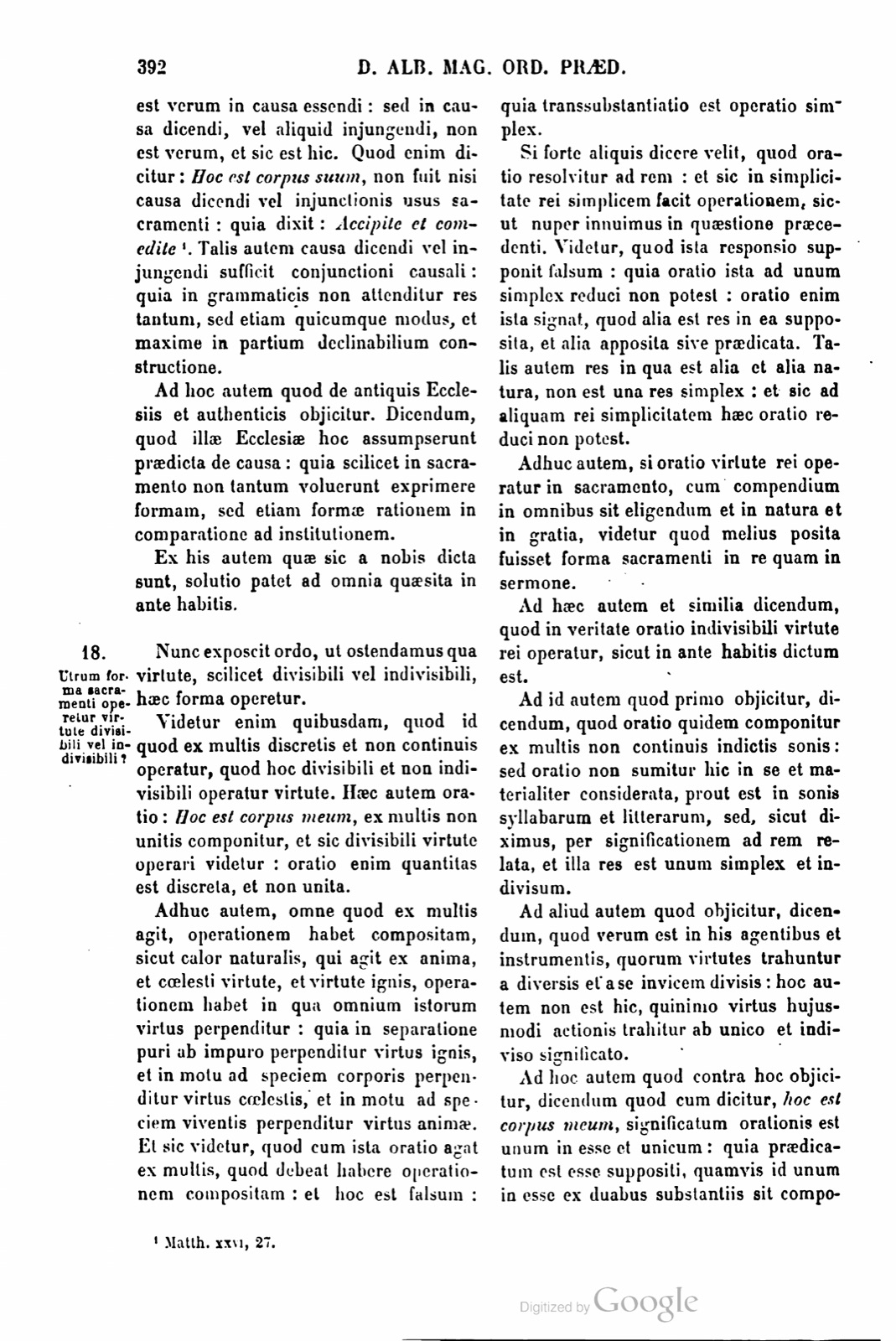
18. Nunc exposcit ordo, ut ostendamus qua virtute, scilicet divisibili vel indivisibili, haec forma operetur.
Videtur enim quibusdam, quod id quod ex multis discretis et non continuis operatur, quod hoc divisibili et non indivisibili operatur virtute. Haec autem oratio: Hoc est corpus meum, ex multis non unitis componitur, et sic divisibili virtute operari videtur: oratio enim quantitas est discreta, et non unita.
Adhuc autem, omne quod ex multis agit, operationem habet compositam, sicut calor naturalis, qui agit ex anima, et caelesti virtute, et virtute ignis, operationem habet in qua omnium istorum virtus perpenditur: quia in separatione puri ab impuro perpenditur virtus ignis, et in motu ad speciem corporis perpenditur virtus caelestis, et in motu ad speciem viventis perpenditur virtus animae. Et sic videtur, quod cum ista oratio agat ex multis, quod debeat habere operationem compositam: et hoc est falsum: quia transsubstantiatio est operatio simplex.
Si forte aliquis dicere velit, quod oratio resolvitur ad rem: et sic in simplicitate rei simplicem facit operationem, sicut nuper innuimus in quaestione praecedenti. Videtur, quod ista responsio supponit falsum: quia oratio ista ad unum simplex reduci non potest: oratio enim ista signat, quod alia est res in ea supposita, et alia apposita sive praedicata. Talis autem res in qua est alia et alia natura, non est una res simplex: et sic ad aliquam rei simplicitatem haec oratio reduci non potest.
Adhuc autem, si oratio virtute rei operatur in sacramento, cum compendium in omnibus sit eligendum et in natura et in gratia, videtur quod melius posita fuisset forma sacramenti in re quam in sermone.
Ad haec autem et similia dicendum, quod in veritate oratio indivisibili virtute rei operatur, sicut in ante habitis dictum est.
Ad id autem quod primo objicitur, dicendum, quod oratio quidem componitur ex multis non continuis indictis sonis: sed oratio non sumitur hic in se et materialiter considerata, prout est in sonis syllabarum et litterarum, sed, sicut diximus, per significationem ad rem relata, et illa res est unum simplex et indivisum.
Ad aliud autem quod objicitur, dicendum, quod verum est in his agentibus et instrumentis, quorum virtutes trahuntur a diversis et a se invicem divisis: hoc autem non est hic, quinimo virtus hujusmodi actionis trahitur ab unico et indiviso significato.
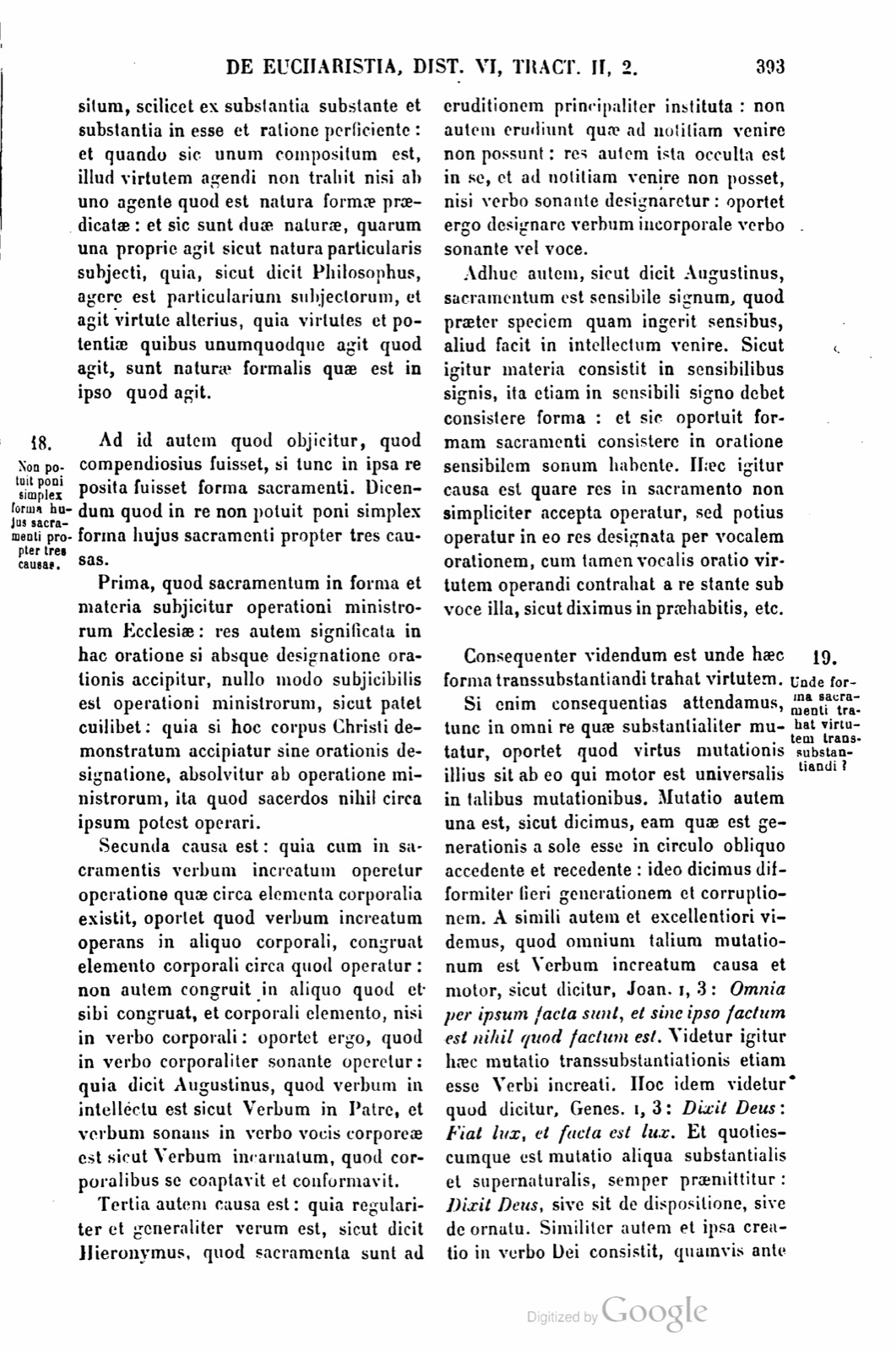
Ad hoc autem quod contra hoc objicitur, dicendum quod cum dicitur, hoc est corpus meum, significatum orationis est unum in esse et unicum: quia praedicatum est esse suppositi, quamvis id unum in esse ex duabus substantiis sit compositum, scilicet ex substantia substante et substantia in esse et ratione perficiente: et quando sic, unum compositum est, illud virtutem agendi non trahit nisi ab uno agente quod est natura formae praedicatae: et sic sunt duae naturae, quarum una proprie agit sicut natura particularis subjecti, quia, sicut dicit Philosophus, agere est particularium subjectorum, et agit virtute alterius, quia virtutes et potentiae quibus unumquodque agit quod agit, sunt naturae formalis quae est in ipso quod agit.
Marginal label (printed p. 393): A simple form of this sacrament could not be posited for three causes.
Marginal label (printed p. 393): Whence does the form of the sacrament draw the virtue of transubstantiating?
18. Now the order demands that we show by what power, namely divisible or indivisible, this form operates.
For it seems to some that what operates from many discrete and non-continuous things operates by a divisible and not an indivisible power. But this utterance, This is my body, is composed of many things not united, and so it seems to operate by a divisible power; for an utterance is a discrete and not united quantity.
Moreover, everything that acts from many things has a composite operation, just as natural heat, which acts from the soul, and from heavenly power, and from the power of fire, has an operation in which the power of all those things is perceived: because in the separation of the pure from the impure the power of fire is perceived, and in the motion to the species of the body the heavenly power is perceived, and in the motion to the species of a living thing the power of the soul is perceived. And thus it seems that, since this utterance acts from many things, it ought to have a composite operation; and this is false, because transubstantiation is a simple operation.
If perhaps someone wished to say that the utterance is resolved to the thing, and thus in the simplicity of the thing it makes a simple operation, as we recently intimated in the preceding question, it seems that that response supposes what is false, because that utterance cannot be reduced to one simple thing. For that utterance signifies that one thing is supposed in it and another is appended or predicated. But such a thing in which there is one nature and another nature is not one simple thing; and so this utterance cannot be reduced to any simplicity of the thing.
Moreover, if the utterance operates in the sacrament by the power of the thing, since brevity is to be chosen in all things, both in nature and in grace, it seems that the form of the sacrament would have been better placed in the thing than in speech.
But to these and similar things it must be said that in truth the utterance operates by the indivisible power of the thing, as was said in the preceding matters.
To that which is first objected, it must be said that the utterance indeed is composed of many non-continuous spoken sounds; but the utterance is not taken here in itself and considered materially, insofar as it is in the sounds of syllables and letters, but, as we have said, referred through signification to the thing, and that thing is one, simple, and undivided.
But to the other thing which is objected, it must be said that this is true in those agents and instruments whose powers are drawn from diverse things and things divided from one another; but this is not so here; indeed, the power of this kind of action is drawn from a single and undivided signified thing.
But to that which is objected against this, it must be said that when it is said, this is my body, the signified of the utterance is one and single in being, because the predicate is the being of the supposit, although that one thing in being is composed of two substances, namely of the subsisting substance and the substance perfecting in being and account; and when it is thus one composite, it draws the power of acting only from one agent, which is the nature of the predicated form; and thus there are two natures, one of which acts properly as the nature of a particular subject, because, as the Philosopher says, to act belongs to particular subjects, and it acts by the power of another, because the powers and potencies by which each thing acts what it acts are of the formal nature which is in the very thing that acts.
18. Ad id autem quod objicitur, quod compendiosius fuisset, si tunc in ipsa re posita fuisset forma sacramenti. Dicendum quod in re non potuit poni simplex forma hujus sacramenti propter tres causas.
Prima, quod sacramentum in forma et materia subjicitur operationi ministrorum Ecclesiae: res autem significata in hac oratione si absque designatione orationis accipitur, nullo modo subjicibilis est operationi ministrorum, sicut patet cuilibet: quia si hoc corpus Christi demonstratum accipiatur sine orationis designatione, absolvitur ab operatione ministrorum, ita quod sacerdos nihil circa ipsum potest operari.
Secunda causa est: quia cum in sacramentis verbum increatum operetur operatione quae circa elementa corporalia existit, oportet quod verbum increatum operans in aliquo corporali, congruat elemento corporali circa quod operatur: non autem congruit in aliquo quod et sibi congruat, et corporali elemento, nisi in verbo corporali: oportet ergo, quod in verbo corporaliter sonante operetur: quia dicit Augustinus, quod verbum in intellectu est sicut Verbum in Patre, et verbum sonans in verbo vocis corporeae est sicut Verbum incarnatum, quod corporalibus se coaptavit et conformavit.
Tertia autem causa est: quia regulariter et generaliter verum est, sicut dicit Hieronymus, quod sacramenta sunt ad eruditionem principaliter instituta: non autem erudiunt quae ad notitiam venire non possunt: res autem ista occulta est in se, et ad notitiam venire non posset, nisi verbo sonante designaretur: oportet ergo designare verbum incorporale verbo sonante vel voce.
Adhuc autem, sicut dicit Augustinus, sacramentum est sensibile signum, quod praeter speciem quam ingerit sensibus, aliud facit in intellectum venire. Sicut igitur materia consistit in sensibilibus signis, ita etiam in sensibili signo debet consistere forma: et sic oportuit formam sacramenti consistere in oratione sensibilem sonum habente. Haec igitur causa est quare res in sacramento non simpliciter accepta operatur, sed potius operatur in eo res designata per vocalem orationem, cum tamen vocalis oratio virtutem operandi contrahat a re stante sub voce illa, sicut diximus in praehabitis, etc.
18. To that which is objected, that it would have been briefer if then the form of the sacrament had been placed in the thing itself, it must be said that a simple form of this sacrament could not be placed in the thing for three causes.
First, because the sacrament in form and matter is subjected to the operation of the ministers of the Church; but the thing signified in this utterance, if it is taken without the designation of the utterance, is in no way subjectable to the operation of ministers, as is clear to anyone, because if this demonstrated body of Christ is taken without the designation of the utterance, it is released from the operation of ministers, so that the priest can operate nothing concerning it.
The second cause is because, since in the sacraments the uncreated Word operates with an operation that exists concerning corporeal elements, it is necessary that the uncreated Word operating in something corporeal agree with the corporeal element concerning which he operates; but he does not agree in anything that agrees both with himself and with a corporeal element except in a corporeal word; therefore he must operate in a word sounding corporeally, because Augustine says that the word in the intellect is like the Word in the Father, and the word sounding in the word of bodily voice is like the incarnate Word, who adapted and conformed himself to corporeal things.
But the third cause is because it is regularly and generally true, as Jerome says, that sacraments are instituted principally for instruction; but things which cannot come into knowledge do not instruct. But this thing is hidden in itself and could not come into knowledge unless it were designated by a sounding word; therefore it is necessary to designate the incorporeal word by a sounding word or voice.
Moreover, as Augustine says, a sacrament is a sensible sign which, besides the appearance which it brings to the senses, makes something else come into the understanding. Therefore, just as the matter consists in sensible signs, so also the form ought to consist in a sensible sign; and thus it was necessary that the form of the sacrament consist in an utterance having sensible sound. This, therefore, is the cause why the thing in the sacrament, not taken simply, operates, but rather the thing designated by vocal utterance operates in it, although the vocal utterance draws the power of operating from the thing standing under that voice, as we have said in the preceding matters, etc.
If a page does not appear, its photograph has not been uploaded yet.