Works › The Book on the Sacrament of the Eucharist
Volume 38 · pp. 391–392
Chapter II, 14-17
A marker with ≈ is an approximate page boundary, placed by measure of the text; the page photographs remain the authority. In the paired views, clicking a page marker brings that page into view.
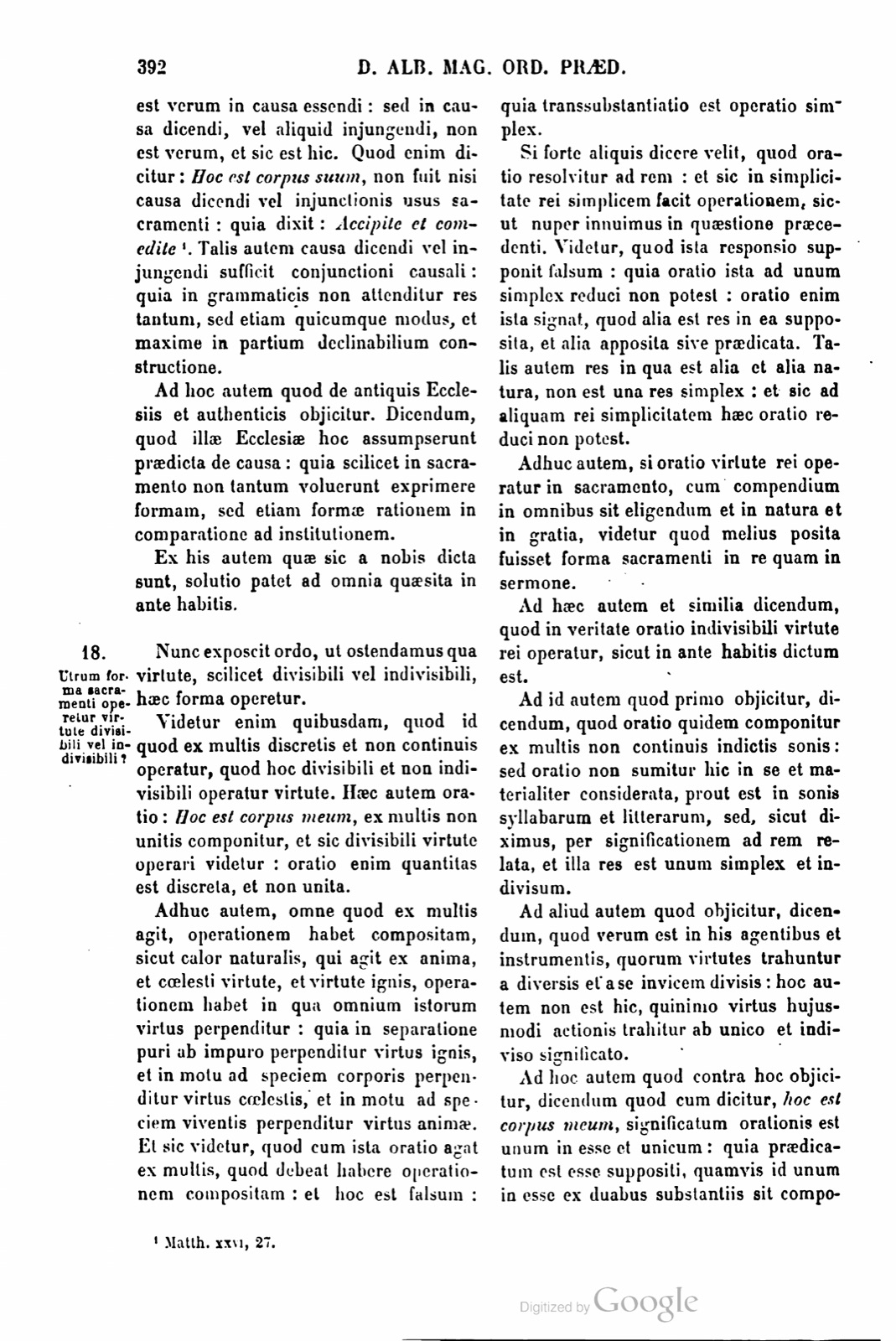
Marginal label (printed p. 392): Utrum forma sacramenti operetur virtute divisibili vel indivisibili?
14. Ad hoc autem quod quaeritur ulterius de hoc pronomine, meum, bene concedendum est, quod tunc tale exhibuit quale habuit: sed cum post resurrectionem etiam significet corpus a Christo possessum, etiam tunc supponit quale nunc habet, hoc est, immortale et gloriosum.
Ad hoc autem quod in contrarium objicitur, dicendum quod Ecclesia verba haec accipit sicut ea Christus protulit, scilicet quod verum corpus suum sit ab eo possessum: et hujusmodi veritatem non variant diversae dispositiones passibilitatis et impassibilitatis, mortalitatis et immortalitatis: quia haec non sunt de veritate humani corporis: sed remanet idem verum humanum vivum et divinum corpus sub contrariis istis dispositionibus, quod esse non posset, si illae dispositiones essent de veritate corporis Christi.
Ad hoc autem quod objicitur, quod sacramentum celebratur in commemorationem passionis. Dicendum, quod nihil prohibet in immortali corpore fieri commemorationem passionis in modo sacrificii et modo immolationis: et hoc intelligitur institutum esse sacramentum in commemorationem passionis Christi.
15. Ad hoc autem quod ulterius quaeritur, utrum hoc quod dicitur, quod pro vobis tradetur, sit de forma, vel non? Dicendum, quod non est de forma, nec Christus hoc dixit tamquam esset de forma, sed quod ostenderetur identitas unitatis inter corpus traditum sive tradendum, et corpus sub speciebus sacramenti contentum: et sic veritatis sacramentum esse probaretur.
Ad hoc autem quod objicitur per rationem, dicendum, quod non ideo dicitur, quod pro vobis tradetur, ut ostendatur vel charitas, vel effectus redemptionis, quamvis traditio pro nobis facta magnum indicium sit charitatis, sed tantum ideo additum est, ut ostendatur veritas, sicut jam dictum est: hoc enim necessarium fuit propter carnalem discipulorum adhuc intellectum, ut scirent, quod corpus esset divinum quod in cruce posset pati, et integrum remanere in sacramento sumptum quidem spiritualiter et sacramentaliter, et cum dentibus non discerptum et dilaceratum.
Marginal label (printed p. 392): Whether the form of the sacrament works by a divisible or indivisible virtue?
14. But to this which is further asked concerning this pronoun, my, it must well be conceded that then he offered such as he had; but since after the resurrection also it signifies the body possessed by Christ, then also it supposes such as he now has, that is, immortal and glorious.
But to that which is objected to the contrary, it must be said that the Church takes these words as Christ uttered them, namely that his true body is possessed by him; and diverse dispositions of passibility and impassibility, mortality and immortality, do not vary truth of this kind, because these are not of the truth of the human body, but the same true human, living, and divine body remains under these contrary dispositions, which could not be if those dispositions were of the truth of Christ's body.
But to that which is objected, that the sacrament is celebrated in commemoration of the passion, it must be said that nothing prevents commemoration of the passion from occurring in an immortal body in the mode of sacrifice and in the mode of immolation; and this is understood, that the sacrament was instituted in commemoration of the passion of Christ.
15. But to this which is further asked, whether this which is said, which shall be handed over for you, is of the form or not, it must be said that it is not of the form, nor did Christ say this as if it were of the form, but so that the identity of unity between the body handed over or to be handed over and the body contained under the species of the sacrament would be shown; and thus it would be proved to be the sacrament of truth.
But to this which is objected by reason, it must be said that it is not therefore said, which shall be handed over for you, so that either charity or the effect of redemption may be shown, although the handing over made for us is a great indication of charity; but it was added only so that truth might be shown, as has already been said. For this was necessary because of the still carnal understanding of the disciples, so that they might know that the body was divine, which could suffer on the cross and remain whole in the sacrament, received indeed spiritually and sacramentally, and not torn apart and lacerated with teeth.
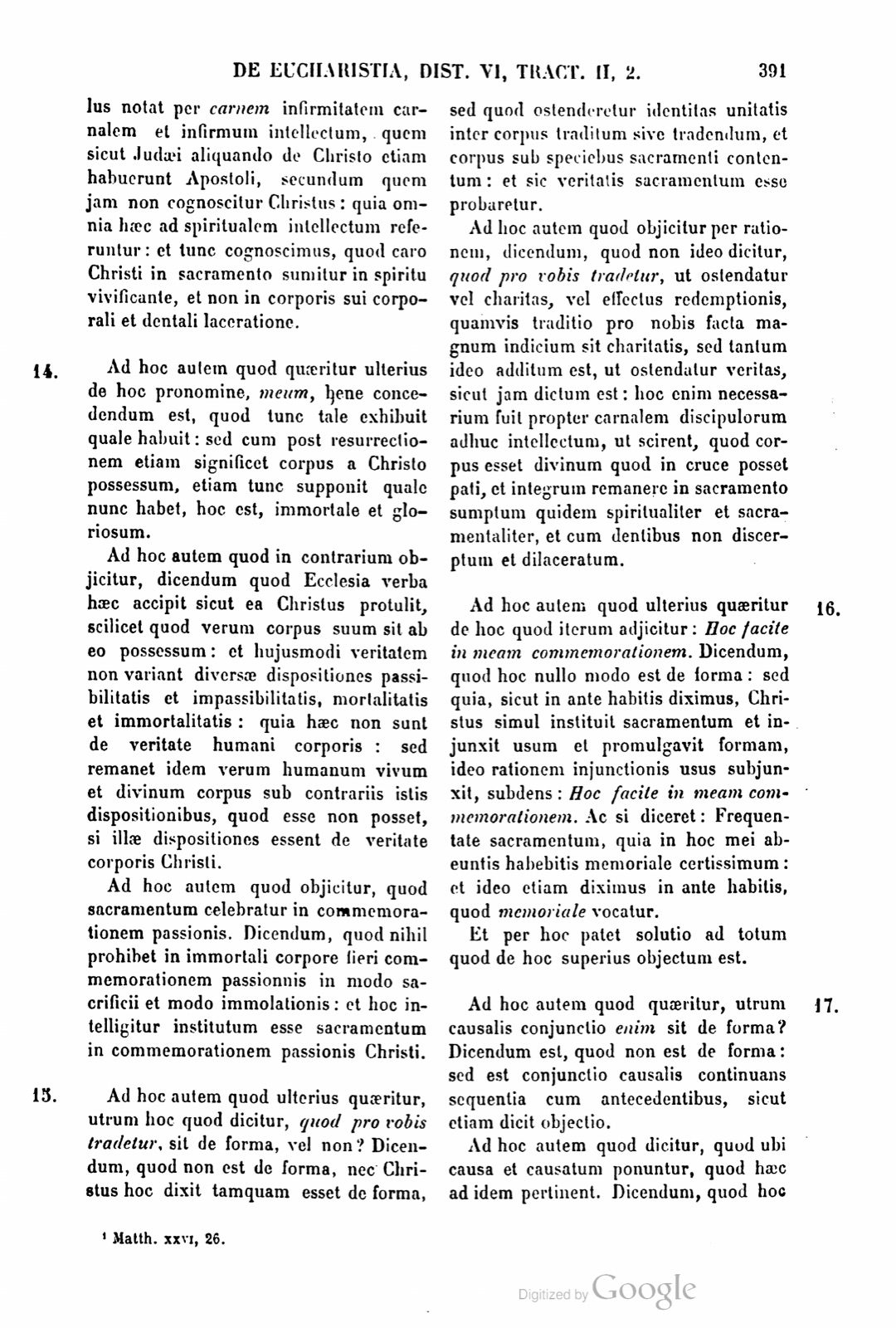
16. Ad hoc autem quod ulterius quaeritur de hoc quod iterum adjicitur: Hoc facite in meam commemorationem. Dicendum, quod hoc nullo modo est de forma: sed quia, sicut in ante habitis diximus, Christus simul instituit sacramentum et injunxit usum et promulgavit formam, ideo rationem injunctionis usus subjunxit, subdens: Hoc facite in meam commemorationem. Ac si diceret: Frequentate sacramentum, quia in hoc mei abeuntis habebitis memoriale certissimum: et ideo etiam diximus in ante habitis, quod memoriale vocatur.
Et per hoc patet solutio ad totum quod de hoc superius objectum est.
17. Ad hoc autem quod quaeritur, utrum causalis conjunctio enim sit de forma? Dicendum est, quod non est de forma: sed est conjunctio causalis continuans sequentia cum antecedentibus, sicut etiam dicit objectio.
Ad hoc autem quod dicitur, quod ubi causa et causatum ponuntur, quod haec ad idem pertinent. Dicendum, quod hoc est verum in causa essendi: sed in causa dicendi, vel aliquid injungendi, non est verum, et sic est hic. Quod enim dicitur: Hoc est corpus suum, non fuit nisi causa dicendi vel injunctionis usus sacramenti: quia dixit: Accipite et comedite 1. Talis autem causa dicendi vel injungendi sufficit conjunctioni causali: quia in grammaticis non attenditur res tantum, sed etiam quicumque modus, et maxime in partium declinabilium constructione.
Ad hoc autem quod de antiquis Ecclesiis et authenticis objicitur. Dicendum, quod illae Ecclesiae hoc assumpserunt praedicta de causa: quia scilicet in sacramento non tantum voluerunt exprimere formam, sed etiam formae rationem in comparatione ad institutionem.
Ex his autem quae sic a nobis dicta sunt, solutio patet ad omnia quaesita in ante habitis.
16. But to this which is further asked concerning this which again is added, Do this in commemoration of me, it must be said that this is in no way of the form; but because, as we have said in the preceding matters, Christ simultaneously instituted the sacrament, enjoined the use, and promulgated the form, therefore he added the reason of the injunction of the use, adding: Do this in commemoration of me. As if he said: Repeat the sacrament, because in this you will have the most certain memorial of me as I go away; and therefore also in the preceding matters we said that it is called a memorial.
And through this the solution is clear to all that was objected above concerning this.
17. But to this which is asked, whether the causal conjunction for is of the form, it must be said that it is not of the form; but it is a causal conjunction continuing the following things with the preceding, as the objection also says.
But to this which is said, that where cause and caused are posited these pertain to the same thing, it must be said that this is true in a cause of being, but it is not true in a cause of saying or of enjoining something, and so it is here. For what is said, This is his body, was only the cause of saying or of the injunction of the use of the sacrament, because he said: Take and eat 1. But such a cause of saying or enjoining suffices for a causal conjunction, because in grammar the thing alone is not considered, but also whatever mode, and especially in the construction of declinable parts.
But to this which is objected concerning ancient and authentic Churches, it must be said that those Churches took this up for the aforesaid reason, namely because in the sacrament they wished not only to express the form, but also the account of the form in comparison to the institution.
From these things, then, which have thus been said by us, the solution is clear to all the things asked in the preceding matters.
Notes
- Matthew 26:27. (Matth. XXVI, 27.) ↩
If a page does not appear, its photograph has not been uploaded yet.