Works › The Book on the Sacrament of the Eucharist
Volume 38 · pp. 390–391
Chapter II, 12-13
A marker with ≈ is an approximate page boundary, placed by measure of the text; the page photographs remain the authority. In the paired views, clicking a page marker brings that page into view.
12. Ad hoc quod quaeritur de verbo substantivo quam notet compositionem? Dicendum quod essentialem.
Ad hoc quod objicitur, est concedendum, quod corpus Christi est de essentia et ratione hujus sacramenti demonstrati, sicut lignum est de essentia et ratione hujus ligni demonstrati.
Ad hoc autem quod ulterius objicitur, dicendum quod hoc non sequitur: quia hoc facit transsubstantiatio. Unde quod corpus Christi praedicatur essentialiter de corpore quod est in dextera Dei Patris, hoc fecit natura universalis et particularis in Christo. Sed quod corpus Christi praedicatur de hoc demonstrato sub forma panis, hoc fecit transsubstantiatio, quae fit per formae sacramenti sanctificationem.
Et si objicitur, quod id quod sub sacramenti speciebus est, idem est omnino secundum rem cum eo quod est in dextera Dei patris, et quod traxit de Virgine: et sic si transsubstantiatio facit unum, tunc facit et alterum: quia unius et ejusdem una est causa. Dicendum, quod hoc non sequitur: quia quamvis idem sint penitus, non tamen eadem habent attributa secundum quod istud demonstratur sub forma panis, et illud in lineamentis et figura propria: quia isti convenit, quod sit vere cibus: hoc autem in lineamentis et figura hominis demonstratum, ut dicit Augustinus, horridum esset accipere cibum: et ideo aliam habet causam secundum quod est sub forma panis praedicatio ista, et aliam habet causam secundum quod est in lineamentis et figura hominis demonstratum.
13. Ad aliud quod de corpore objicitur, dicendum, quod quamvis ex vi sacramenti sub forma panis non sit nisi corpus Dominicum, tamen propter uniones naturales corporis Dominici cum his quae secundum naturam et gratiam sunt in corpore, multa sunt ibi alia: propter unionem enim corporis et animae est ibi anima: et quia movet anima corpus per spiritum, est in corpore illo spiritus et animalis, et vitalis, et naturalis: et propter impletionem valorum nutrimentalium est ibi sanguis: et propter unionis gratiam est ibi deitas: et sic est corpus vivificatum et divinum, vivificans vita divina et vita gratiae. Nec de hoc Christus reprehendit Judaeos carnaliter intelligentes, quod corpus spiritu vivifico plenum et divinum intelligerent, sed potius reprehendit eos, quia tale suum corpus esse intelligere nolebant, sed tantum intelligebant, quod caro sua esset dentibus laceranda, et non esset vivifica nec divina, et dentibus non laceranda, sed sumenda, et tamen integra et sana mansura. Et hoc est quod dixit: Verba quae ego locutus sum vobis, spiritus et vita sunt 1, hoc est, spiritualiter de spirituali manducatione intellecta sunt spiritus ad vitam vivificantia aeternam. Quod etiam Petrus ibidem consideravit, dicens: Domine, ad quem ibimus? verba vitae aeternae habes 2.
12. To this which is asked about the substantive verb, what composition it marks, it must be said that it marks an essential one.
To this which is objected, it must be conceded that the body of Christ is of the essence and account of this demonstrated sacrament, just as wood is of the essence and account of this demonstrated wood.
But to this which is further objected, it must be said that this does not follow, because transubstantiation does this. Hence, that the body of Christ is predicated essentially of the body which is at the right hand of God the Father, universal and particular nature in Christ did this. But that the body of Christ is predicated of this thing demonstrated under the form of bread, transubstantiation did this, which occurs through the sanctification of the form of the sacrament.
And if it is objected that what is under the species of the sacrament is wholly the same according to the thing as that which is at the right hand of God the Father and which he drew from the Virgin, and thus if transubstantiation makes one, then it also makes the other, because there is one cause of one and the same thing, it must be said that this does not follow, because although they are entirely the same, nevertheless they do not have the same attributes insofar as this is demonstrated under the form of bread and that under the lineaments and its own figure; because it belongs to this that it is truly food, but to receive as food that demonstrated in the lineaments and figure of a man, as Augustine says, would be horrifying; and therefore this predication has one cause according as it is under the form of bread, and it has another cause according as it is demonstrated in the lineaments and figure of a man.
13. To the other thing which is objected concerning body, it must be said that although by the force of the sacrament under the form of bread there is nothing except the Lord's body, nevertheless because of the natural unions of the Lord's body with those things which according to nature and grace are in the body, many other things are there: for because of the union of body and soul, the soul is there; and because the soul moves the body through spirit, there is in that body spirit both animal and vital and natural; and because of the fulfilling of nutritive values, blood is there; and because of the union of grace, deity is there; and thus it is a vivified and divine body, vivifying with divine life and the life of grace. Nor did Christ rebuke the Jews understanding carnally because they understood a body filled with vivifying spirit and divine, but rather he rebuked them because they did not wish to understand that his body was such; but they understood only that his flesh was to be torn by teeth, and was not vivifying nor divine, and was not to be torn by teeth, but to be received, and yet to remain whole and sound. And this is what he said: The words which I have spoken to you are spirit and life 1, that is, understood spiritually concerning spiritual eating, they are spirits vivifying unto eternal life. This also Peter considered in the same place, saying: Lord, to whom shall we go? You have the words of eternal life 2.
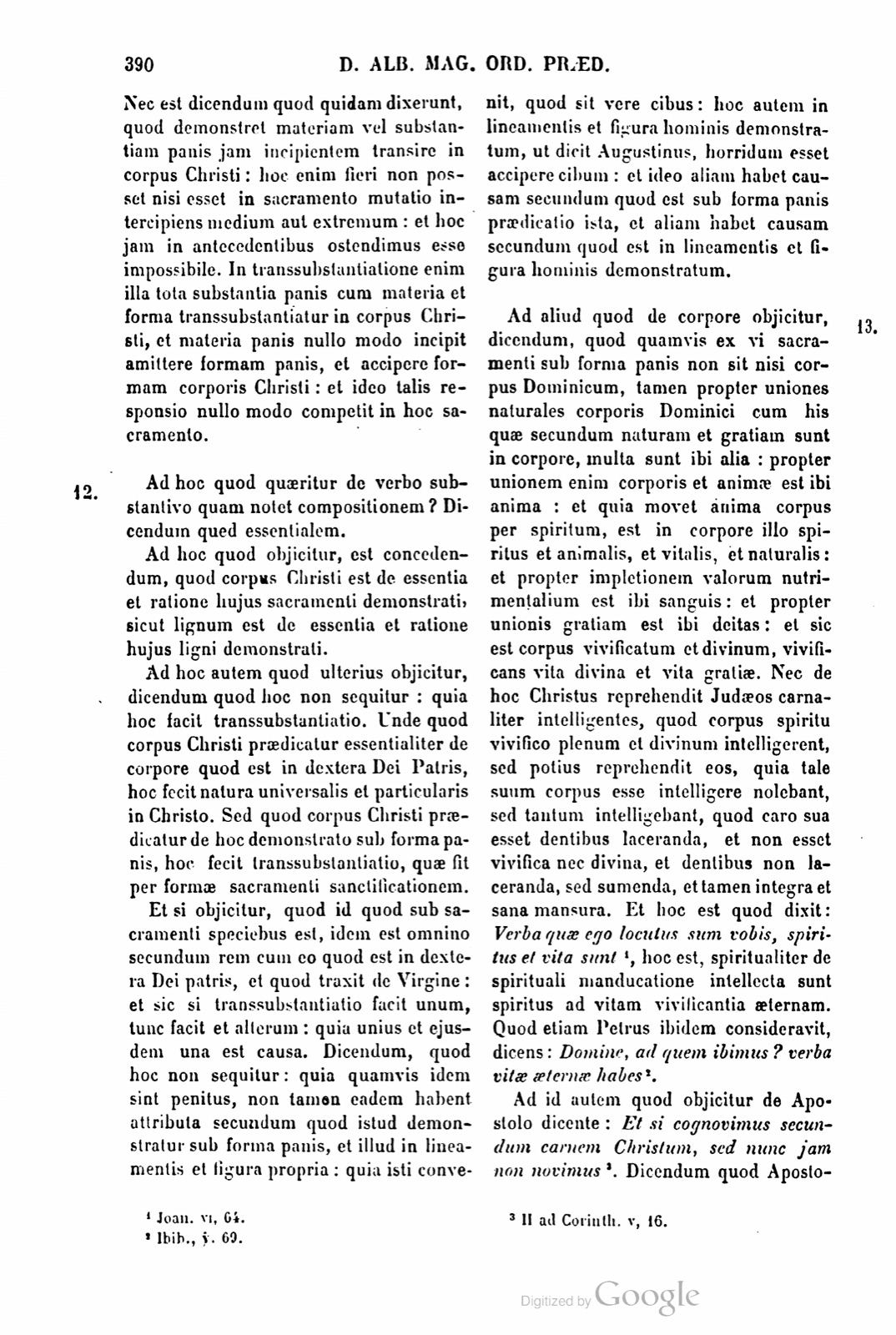
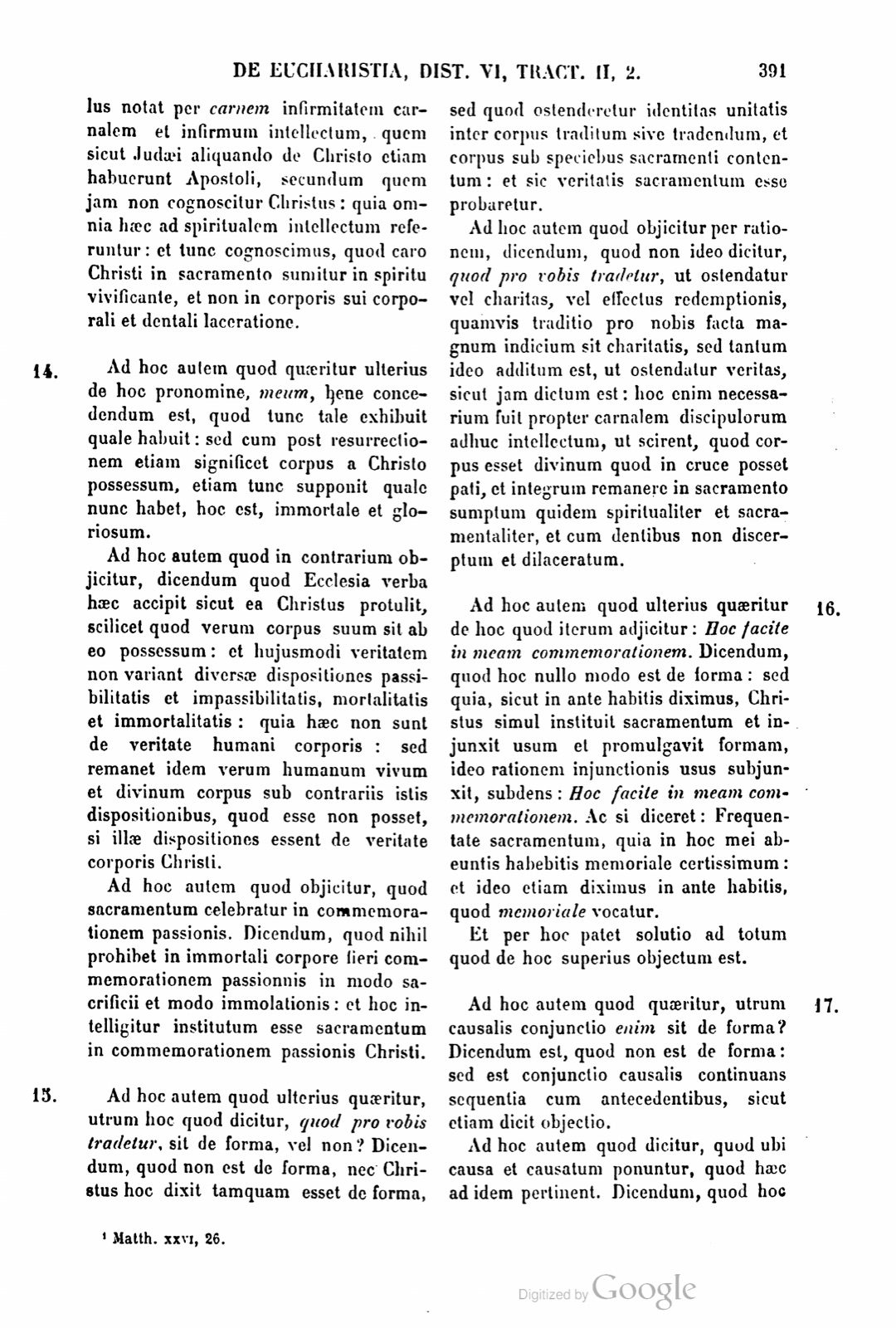
Ad id autem quod objicitur de Apostolo dicente: Et si cognovimus secundum carnem Christum, sed nunc jam non novimus 3. Dicendum quod Apostolus notat per carnem infirmitatem carnalem et infirmum intellectum, quem sicut Judaei aliquando de Christo etiam habuerunt Apostoli, secundum quem jam non cognoscitur Christus: quia omnia haec ad spiritualem intellectum referuntur: et tunc cognoscimus, quod caro Christi in sacramento sumitur in spiritu vivificante, et non in corporis sui corporali et dentali laceratione.
To that which is objected from the Apostle saying, And if we have known Christ according to the flesh, yet now we know him no longer 3, it must be said that the Apostle notes by flesh carnal weakness and weak understanding, which the Apostles also at one time had of Christ, just as the Jews did; according to this Christ is now no longer known, because all these things are referred to spiritual understanding; and then we know that the flesh of Christ is received in the sacrament in the vivifying spirit, and not in the bodily and dental tearing of his body.
If a page does not appear, its photograph has not been uploaded yet.