Works › The Book on the Sacrament of the Eucharist
Volume 38 · pp. 389–390
Chapter II, 9-11
A marker with ≈ is an approximate page boundary, placed by measure of the text; the page photographs remain the authority. In the paired views, clicking a page marker brings that page into view.
Marginal label (printed p. 389): Nihil est de forma consecrationis panis nisi quod Christus testibus quatuor probatur dixisse, scilicet, Hoc est corpus meum.
9. Ulterius autem quaeritur quare Lucas plus addit quam Marcus. Dicitur enim sic, Luc. XXII, 19: Hoc est corpus meum, quod pro vobis datur.
Quaeritur ergo, utrum etiam hoc sit de forma?
Videtur autem, quod sic: quia Christus hoc suo ore apposuit.
Adhuc autem, Apostolus tradens Ecclesiae hoc sacramentum celebrandum et observandum, hoc etiam apposuit, I ad Corinth. XI, 24, ubi sic dicitur: Hoc est corpus meum, quod pro vobis tradetur.
Adhuc autem, quia verbis illis innuitur causa passionis quam commemoramus in illo sacramento: et ideo apponendum esse videtur.
Adhuc autem, cum sacramentum istud sit charitatis, ut in ante habitis determinatum est, et potissima causa charitatis nostrae ad eum sit qui traditus est pro nobis, videtur hoc esse de principalibus in forma ponendis.
Adhuc autem, quia hujus dicit rationem quare sacramentum celebratur: ratio autem celebrationis uniuscujusque rei ad formam ejusdem rei reducitur: videtur ergo, quod et istud quod dicitur, quod pro vobis tradetur, intra formam sacramenti debeat contineri.
10. Ulterius etiam quaeritur de hoc quod, Luc. XXII, 19, ulterius additur: Hoc facite in meam commemorationem. Utrum et hoc sit de forma?
Videtur autem, quod sic: quia in una contextione in forma sacramenti totum hoc Christus pronuntiavit: et sicut ipse pronuntiavit, sic est tenendum: videtur ergo tenendum esse, quod hoc etiam sit de forma.
Praeterea, Paulus hunc ritum tradidit observandum Ecclesiae: quia, I ad Corinth. XI, 24, dixit: Hoc est corpus meum, quod pro vobis tradetur: hoc facite in meam commemorationem.
Adhuc autem, quia hoc dicit finem et intentionem Christi sacramentum instituentis: institutum enim est, ut commemoratio Christi fiat pro nobis se in cruce offerentis.
11. Ad haec autem sine praejudicio dicimus, quod nihil est de forma corporis Domini nostri, nisi quod Christus testibus quatuor probatur dixisse, scilicet, Hoc est corpus meum. Testes autem quod conficiendo sacramentum dixit sunt quatuor, Matthaeus, Marcus, Lucas, et Paulus. Nec aliud quidquam est de forma sacramenti.
Marginal label (printed p. 389): Nothing belongs to the form of consecration of the bread except what Christ is proved by four witnesses to have said, namely, "This is my body."
9. Further, it is asked why Luke adds more than Mark. For it is said thus in Luke 22:19: This is my body, which is given for you.
Therefore it is asked whether this also is of the form.
But it seems that it is, because Christ appended this by his own mouth.
Moreover, the Apostle, handing this sacrament on to the Church to be celebrated and observed, also appended this, 1 Corinthians 11:24, where it is said thus: This is my body, which shall be handed over for you.
Moreover, because in those words the cause of the passion which we commemorate in that sacrament is intimated; and therefore it seems that it ought to be appended.
Moreover, since this sacrament is of charity, as was determined in the preceding matters, and the most powerful cause of our charity toward him is that he was handed over for us, this seems to be among the principal things to be placed in the form.
Moreover, because this states the reason why the sacrament is celebrated; but the reason for the celebration of each thing is reduced to the form of the same thing; therefore it seems that even this which is said, which shall be handed over for you, ought to be contained within the form of the sacrament.
10. Further, it is also asked about this which is further added in Luke 22:19: Do this in commemoration of me. Whether this also is of the form.
But it seems that it is, because Christ pronounced this whole thing in one contexture in the form of the sacrament; and as he pronounced it, so it must be held; therefore it seems that it must be held that this also is of the form.
Besides, Paul handed on this rite to be observed by the Church, because in 1 Corinthians 11:24 he said: This is my body, which shall be handed over for you; do this in commemoration of me.
Moreover, because this states the end and intention of Christ instituting the sacrament; for it was instituted so that the commemoration of Christ offering himself on the cross for us might occur.
11. But to these things, without prejudice, we say that nothing is of the form of the body of our Lord except what Christ is proved by four witnesses to have said, namely, This is my body. But the witnesses that he said this while confecting the sacrament are four: Matthew, Mark, Luke, and Paul. Nor is anything else of the form of the sacrament.
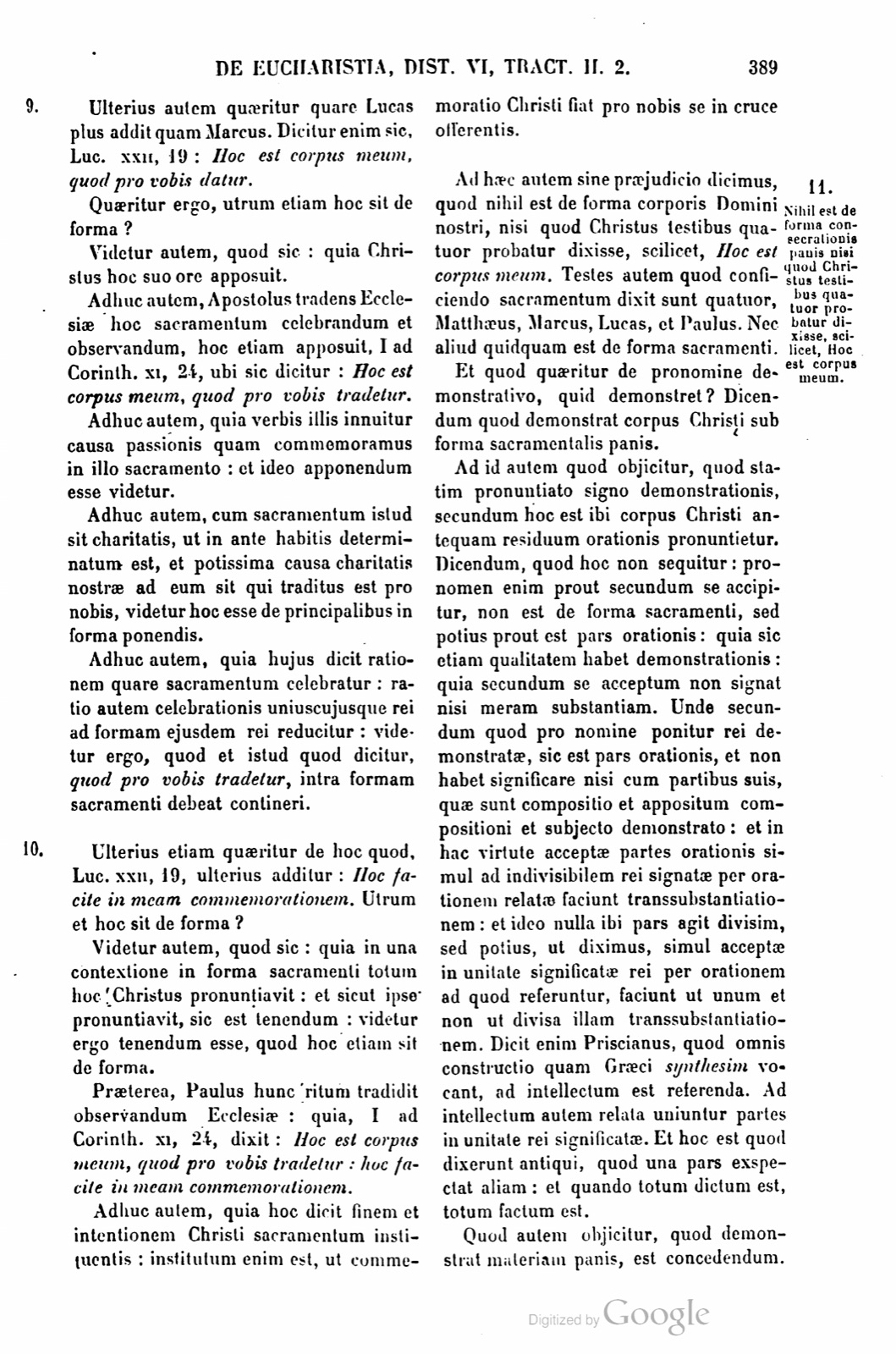
Et quod quaeritur de pronomine demonstrativo, quid demonstret? Dicendum quod demonstrat corpus Christi sub forma sacramentalis panis.
Ad id autem quod objicitur, quod statim pronuntiato signo demonstrationis, secundum hoc est ibi corpus Christi antequam residuum orationis pronuntietur. Dicendum, quod hoc non sequitur: pronomen enim prout secundum se accipitur, non est de forma sacramenti, sed potius prout est pars orationis: quia sic etiam qualitatem habet demonstrationis: quia secundum se acceptum non signat nisi meram substantiam. Unde secundum quod pro nomine ponitur rei demonstratae, sic est pars orationis, et non habet significare nisi cum partibus suis, quae sunt compositio et appositum compositioni et subjecto demonstrato: et in hac virtute acceptae partes orationis simul ad indivisibilem rei signatae per orationem relatae faciunt transsubstantiationem: et ideo nulla ibi pars agit divisim, sed potius, ut diximus, simul acceptae in unitate significatae rei per orationem ad quod referuntur, faciunt ut unum et non ut divisa illam transsubstantiationem. Dicit enim Priscianus, quod omnis constructio quam Graeci synthesim vocant, ad intellectum est referenda. Ad intellectum autem relata uniuntur partes in unitate rei significatae. Et hoc est quod dixerunt antiqui, quod una pars exspectat aliam: et quando totum dictum est, totum factum est.
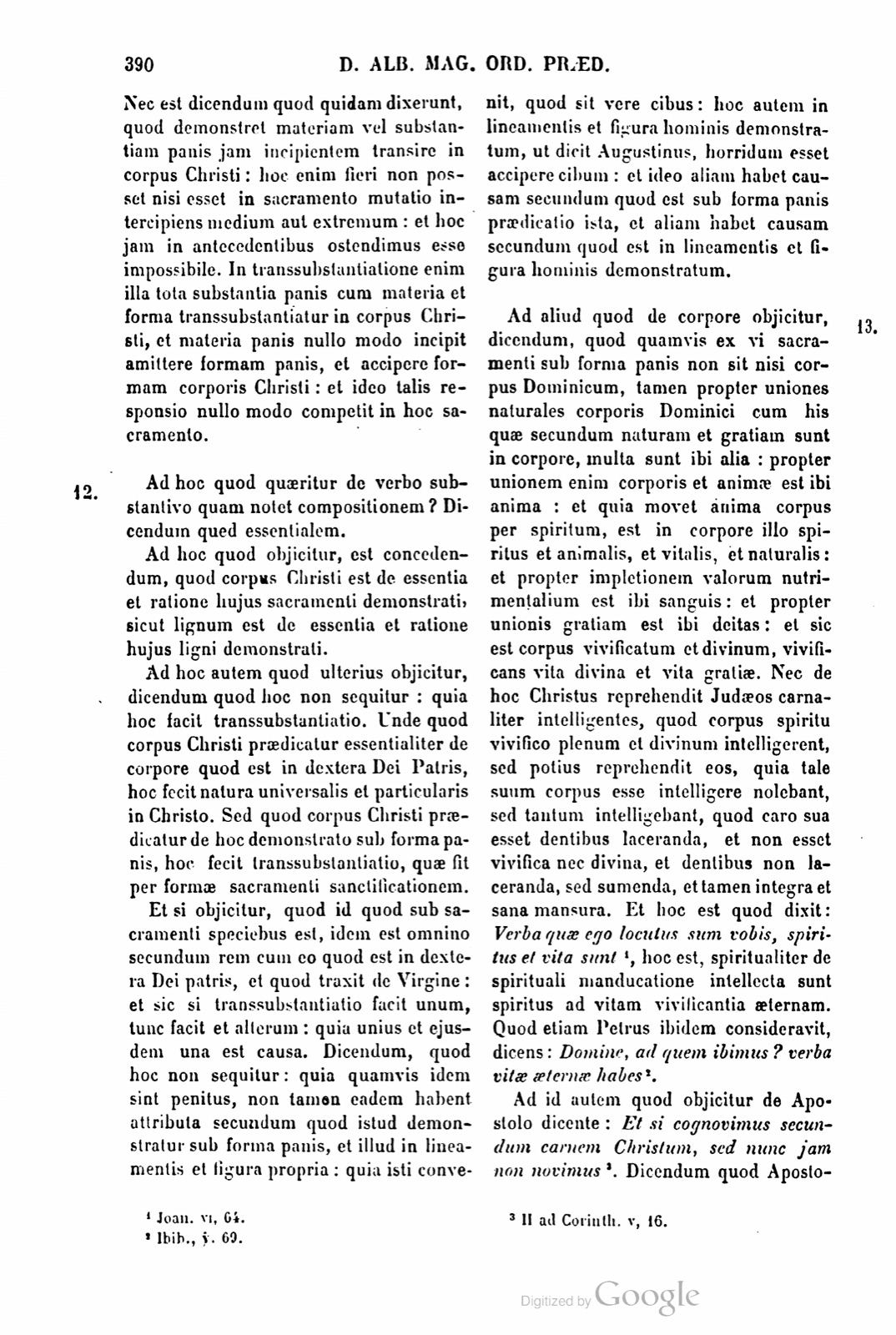
Quod autem objicitur, quod demonstrat materiam panis, est concedendum. Nec est dicendum quod quidam dixerunt, quod demonstret materiam vel substantiam panis jam incipientem transire in corpus Christi: hoc enim fieri non posset nisi esset in sacramento mutatio intercipiens medium aut extremum: et hoc jam in antecedentibus ostendimus esse impossibile. In transsubstantiatione enim illa tota substantia panis cum materia et forma transsubstantiatur in corpus Christi, et materia panis nullo modo incipit amittere formam panis, et accipere formam corporis Christi: et ideo talis responsio nullo modo competit in hoc sacramento.
And as to what is asked about the demonstrative pronoun, what it demonstrates, it must be said that it demonstrates the body of Christ under the form of sacramental bread.
To that which is objected, that as soon as the sign of demonstration has been pronounced, according to this the body of Christ is there before the remainder of the utterance is pronounced, it must be said that this does not follow. For the pronoun, insofar as it is taken according to itself, is not of the form of the sacrament, but rather insofar as it is a part of the utterance, because thus also it has the quality of demonstration; for taken according to itself it signifies only mere substance. Hence, according as it is put in place of the name of the thing demonstrated, so it is part of the utterance, and it has signification only with its own parts, which are the composition and what is appended to the composition and to the demonstrated subject; and in this power the parts of the utterance, taken together, related to the indivisible thing signified by the utterance, effect transubstantiation; and therefore no part there acts separately, but rather, as we have said, taken together in the unity of the thing signified by the utterance to which they are referred, they effect that transubstantiation as one and not as divided. For Priscian says that every construction, which the Greeks call synthesis, is to be referred to the understanding. But when referred to the understanding, the parts are united in the unity of the thing signified. And this is what the ancients said, that one part waits for another; and when the whole has been said, the whole has been done.
But as to what is objected, that it demonstrates the matter of bread, this must be conceded. Nor should it be said, as certain persons said, that it demonstrates the matter or substance of bread already beginning to pass over into the body of Christ; for this could not be done unless there were in the sacrament a change intercepting a middle or an extreme, and this we have already shown in the preceding matters to be impossible. For in that transubstantiation the whole substance of bread with matter and form is transubstantiated into the body of Christ, and the matter of bread in no way begins to lose the form of bread and to receive the form of the body of Christ; and therefore such a response in no way fits in this sacrament.
If a page does not appear, its photograph has not been uploaded yet.